




16 min 16 sec
Available in: English
Do What You Are: Discover the Perfect Career for You Through the Secrets of Personality Types
Shows how four preferences about energy, information, decisions and structure reveal your personality type. It then explains how that type, your temperament and your strongest function point you toward work that feels natural at any age.
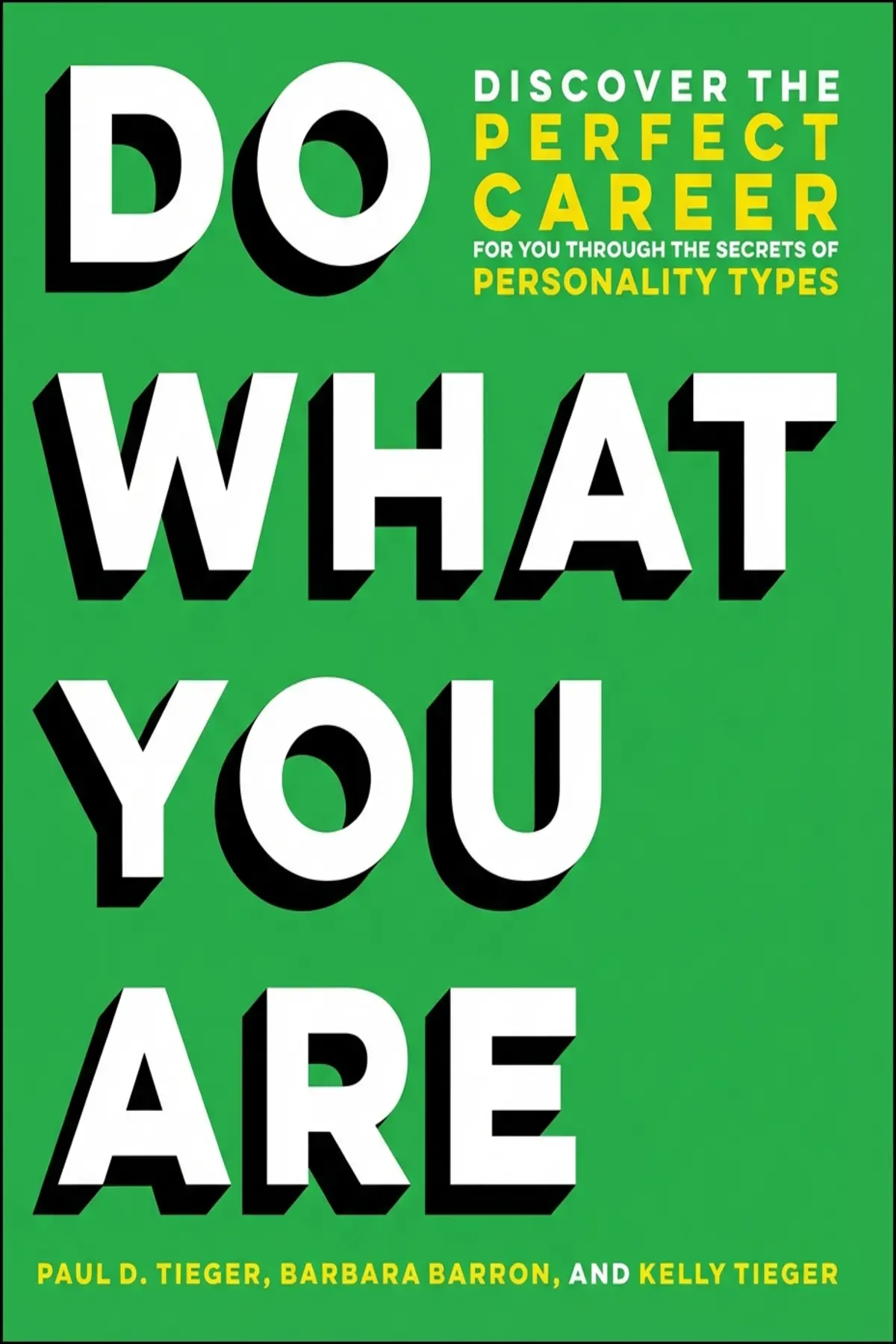
Table of Content
1. Introduction
56 sec
If your job drains you while a coworker does the same work with a smile, the gap may be less about effort than about fit. In Do What You Are, personality type experts Paul D. Tieger, Barbara Barron and Kelly Tieger argue that work matched to your natural preferences feels easy, even energizing, while a mismatch feels like writing with your other hand. Their tool is a system of 16 personality types built from four choices: how you gain energy, take in information, make decisions and organize your life.
Know your type, your temperament and your strongest mental function, they argue, and you can pick work that runs on your natural talents, then pick again as those talents shift with age. By the end you will have sorted yourself on four scales, met the four temperaments and seen how to turn four letters into a short list of jobs worth testing.
2. Stop doing your job with the wrong hand
1 min 35 sec
Two recruiters sat at the same desks, made the same calls and heard the same rejections. One thrived and one walked out. The reason had nothing to do with talent or effort.
3. Learn where your energy and information come from
1 min 49 sec
Some people find their answer by talking, others only after silence. Some reach for the instructions, others start building. These small habits reveal the first two letters of your type.
4. Pin down how you decide and plan
1 min 57 sec
A student caught breaking a strict dorm rule split two school officials down the middle. Which of them you agree with says a lot about the kind of work that will suit you.
5. Use your type's strengths and watch its traps
2 min 00 sec
Many cultures assume the outgoing person will go further. The authors flatly reject that, and their portraits of different types show why every strength arrives with its own risk.
6. Find your place among four work temperaments
2 min 14 sec
Two people can join the police for opposite reasons and both do well. Four broad temperaments explain what each kind of person needs from a workplace, and what a whole team needs from all of them.
7. Build your career around your strongest function
2 min 24 sec
One mental strength makes certain work feel almost effortless, and it shows up as early as childhood. Yet other strengths keep arriving for decades, which explains a restlessness many people feel around forty.
8. Turn four letters into your next job
2 min 15 sec
Knowing your type is only half the work. A simple ranking exercise, a conversation with the right person and one man’s leap from company president to classroom show how to act on it.
9. Conclusion
1 min 06 sec
Do What You Are turns a vague complaint, the sense that a job just isn’t you, into something you can examine. Four letters say where your energy comes from, which information you trust, how you decide and how much structure you need. Temperament places you in a family with its own strengths and traps, and your dominant function points to the work that will cost you the least strain. None of it is a ranking. A hospital needs all four temperaments, and an introvert’s odds are as good as an extravert’s.
Start by working out your type honestly, then check whether your current job uses your dominant function most days. If it doesn’t, build a five-job list, match your strengths and pitfalls to each, talk to people doing the work, and look at nearby schools and accredited online programs for any training you lack. If restlessness arrives around 38, read it the way Marty’s story suggests: as a newer part of you asking to be used, and remember that Jay found work that suited him better at 46.
Nobody has to keep writing with the wrong hand.
About this book
What is this book about?
Many people spend years in jobs that wear them down, while a colleague does the same work with ease. Paul D. Tieger, Barbara Barron and Kelly Tieger argue that the difference often comes down to personality. Work that suits your natural preferences feels easy and even energizing. Work that does not feels like writing with your other hand. The authors build on a tradition running from ancient Greece through Carl Jung to Katherine Briggs and Isabel Briggs Myers. Four scales place you among 16 types: Extraversion or Introversion, Sensing or Intuition, Thinking or Feeling, Judging or Perceiving. The types then group into four temperaments, Traditionalists, Experiencers, Idealists and Conceptualizers, and each type has a Dominant Function, the mental strength that makes work feel effortless. Readers learn how to find their own type, why no type is better than another, how interests shift between childhood and later life, and how to turn all of it into a focused job search. The book also covers late career changes, with the example of a company president who became a high-school history teacher at 46.
Book Information
Who it's for
Choosing a first career
Graduates and students choosing a first career who know what they dislike but not what they want.
Drained by their work
Mid-career professionals who feel drained by work that colleagues seem to enjoy.
Weighing change in midlife
People in their forties or fifties weighing a late career change or an encore career.
About the Author
Paul D. Tieger
Paul D. Tieger has written five books on personality type, and with Barbara Barron-Tieger, a nationally recognized expert in the field, he has trained thousands of people working in career counseling, outplacement and human resources. Kelly Tieger grew up as the daughter of two Personality Type experts and authors, and she has studied and applied Type all her life. She coauthored the previous edition of Do What You Are and is lead author of the newest one.
Ratings & Reviews
Ratings at a glance

What people think
Listeners consider this title a top-tier guide for career planning, with one listener emphasizing its usefulness for identifying their work style. Additionally, the book assists listeners in pinpointing personality types through a reliable test, and listeners appreciate how it clarifies their relationship with their environment. They generally find the content enjoyable, worth the cost, and impressively spot-on. However, views on readability vary, with some finding it a breeze to get through while others find the flow hard to track.
Top reviews
Marco
This career guide is easily one of the most effective resources I’ve encountered for navigating professional transitions. Unlike generic advice that tells everyone to ‘network more,’ this book helps you understand your specific work style through the lens of Myers-Briggs. The test provided is surprisingly accurate, and the way it breaks down the sixteen temperaments gave me a much clearer picture of why my current office environment feels so draining. I realized I was fighting against my natural introversion instead of leaning into it. My only real gripe is that the text can get a bit dense when discussing the hierarchy of functions, which might be a turn-off if you aren't into the 'nitty-gritty' of psychology. To be fair, it’s a small price to pay for such individualized insights. It truly helped me connect the dots between my values and my career path. Highly recommended for anyone feeling stuck.
Show moreAndrew
Picked this up during a total mid-life career crisis and I’m so glad I did. I had previously taken the MBTI and came out as an ENFJ, but I never knew how to apply that to my job search until now. The book helped me see the common thread between my interests in teaching and event planning. It’s eerie how accurate the descriptions are! Not gonna lie, I teared up a little reading about my 'ideal' work environment because it described exactly what I’d been missing for a decade. The authors do a great job of explaining how our needs change as we age, specifically how our third and fourth functions start to emerge after forty. It made me feel less crazy for wanting a radical change at this stage of my life. It’s an empowering read that makes you feel seen and understood in a way most career books don't.
Show moreTakeshi
Tieger and Barron have created something truly detailed here that stands the test of time. I first read this years ago and recently revisited it during a transition, and I'm struck by how relevant the advice remains. It helps you find your personality type through a series of exercises that feel much more accurate than the quickie tests you find on the internet. I love that it addresses the nuances of how an introvert might extravert certain functions. It’s a sophisticated look at human nature that actually applies to the real world of work. The specific advice for job seekers of each type—like how to prep for an interview or write a cover letter—is incredibly practical. It gave me the confidence to pursue a path in nutrition that I had previously dismissed as a mere hobby. This is essential reading for anyone who wants their work to have meaning.
Show moreEleanor
As someone who has always been obsessed with personality tests—from the Enneagram to the Big Five—I found this deep dive into MBTI quite refreshing. It goes far beyond the four-letter alphabet soup and explores how your dominant and auxiliary functions actually manifest in a workspace. Personally, the most valuable part was the 'Fourmula' for career satisfaction. It isn't just about what you’re good at; it’s about how you process information and make decisions. I do think the authors are a bit too rigid in suggesting that personality is set in stone, which can feel limiting if you believe in the power of self-improvement. However, the sheer volume of detail regarding specific professions is impressive. It’s a great tool for understanding why certain 'dream jobs' might actually be nightmares for your specific temperament. Definitely worth the price of admission for the self-awareness alone.
Show moreJavier
Ever wonder why you and your coworkers can look at the exact same project and see two completely different problems? This book explains that beautifully by breaking down the sensing versus intuition divide. I finally understand that my 'sloppy' tendencies are actually just a 'perceiving' trait that allows me to stay flexible, which has saved me a lot of self-loathing. The career lists for each type are expansive, though some of the job descriptions feel a bit dated in the digital age. Frankly, it’s one of the few self-help books that I keep on my shelf for reference rather than reading once and donating. While the readability is a bit hit-or-miss in the middle chapters, the practical exercises at the end are gold. It helped me find a work environment that actually respects my need for autonomy. If you’re willing to trudge through some technical jargon, you’ll find some real gems here.
Show moreCaleb
The chapter on the hierarchy of functions was a total lightbulb moment for me. I’ve always tested as an ISTJ, and seeing the breakdown of how I use sensing and thinking to process the world explained so much about my past professional frictions. This book is a fantastic resource for career decision making because it forces you to look at the 'why' behind your preferences. I especially liked the 'Ten Steps to Creating a Personal Career Plan' at the end. It takes the abstract personality stuff and turns it into something you can actually use. My only criticism is that the book assumes you can easily identify what a job is like before you're in it. We all know that 'marketing' at one company is totally different from another. Still, for a deep dive into the 16 types and how they fit into the economy, this is a top-tier choice.
Show moreJiraporn
The truth is, while the insights are solid, I struggled with the layout of this book. It’s a bit of a dense slog. I found myself flipping back and forth between the type descriptions and the career charts constantly, which made it difficult to follow a cohesive narrative. I think the four axes of the MBTI are interesting frames for the world, but this book treats them as gospel. To be fair, it’s much better than the generic advice you find online. I appreciated the section on how different types handle the job hunting process, especially as an introvert who finds networking to be a special kind of hell. It’s a helpful resource for identifying your strengths, but I wouldn't treat the career recommendations as a definitive list. Use it as a starting point for brainstorming rather than a final destination. It's okay, just a bit dry.
Show moreRiley
Look, the MBTI isn't a magic wand, but this guide is worth the price for the case studies alone. I found it quite entertaining to read about the different types, even if I don't fully buy into the idea that we’re all hard-wired from birth. It helped me understand my current environment much better, particularly why I clash with my 'Judging' boss. The readability is a bit of a mixed bag; some parts are breezy and fun, while other sections on 'typograms' felt like a college textbook. I’m still not 100% sure I found my perfect match in the career lists, as I seem to fluctuate between INTJ and INFJ depending on my mood. It’s a bit frustrating when the book tells you that you are one or the other with no middle ground. That said, it’s a fun exercise in self-awareness if you have the patience for it.
Show moreFinn
Finally got around to reading this after a friend recommended it. It’s a bit like a more advanced version of 'What Color is Your Parachute?' but focused entirely on personality. While I enjoyed the self-assessment portion, I found the didacticism a bit much at times. It felt like the authors were saying, 'This is who you are, so this is what you must do.' I prefer to think of myself as more complex than a four-letter code. However, the section on work-related strengths was legitimately useful for updating my resume. It helped me articulate skills I had taken for granted. If you can get past the somewhat dated feel and the rigid categories, there’s a lot of value here. It’s a solid 3-star read—useful for a specific purpose, but don't expect it to solve all your life's problems in one go.
Show moreJom
Wow, talk about putting people in boxes. While I love a good self-help book, this felt more like a ‘zodiac guide’ for the workplace than a piece of scientific literature. The authors argue that your personality is set in stone from childhood, which personally feels incredibly limiting and frankly, a bit depressing. If we can’t change our core traits, what is the point of growth? I found the Thinking/Feeling binary to be a massive oversimplification that doesn't account for maturity or emotional intelligence. Plus, the job suggestions are bizarrely specific—apparently, as an INFP, I should just quit my stable job to be a freelance poet? It’s fun for a laugh or some casual self-reflection if you don't take it too seriously, but as a serious career planning tool, it misses the mark for me. The detail is astounding, but it feels like it’s built on a foundation of imaginary facts.
Show moreQuestions about this book
What is Do What You Are about?
Paul D. Tieger, Barbara Barron and Kelly Tieger argue that work feels easy and satisfying when it fits your personality type. Four scales, Extraversion or Introversion, Sensing or Intuition, Thinking or Feeling and Judging or Perceiving, place you among 16 types. Your type, its temperament and its Dominant Function then point to careers that suit you, while a mismatch feels like writing with your non-dominant hand.
What are the four temperaments in Do What You Are?
Traditionalists (S and J) want order and clear procedures; about half of police officers belong here. Experiencers (S and P) are adventurous improvisers who like variety and unpredictability. Idealists (N and F) seek meaning and do well in teaching, counseling and human resources. Conceptualizers (N and T) love challenge and autonomy, in fields such as science, law or upper management. A hospital, the authors note, needs all four.
How do I use my personality type to find a job?
Start with your four-letter type and the jobs suggested for it, then decide what matters most to you and cross that with your interests. Rank the options and focus on your top five, asking which you would do for free. Write down how your strengths fit each role, with examples and known pitfalls, and talk to someone already doing the job before you commit.
Is it too late to change careers, according to Do What You Are?
No. The authors say interests keep developing for decades, with a third function often emerging after 40 and a fourth after 50. They expect many Baby Boomers to start encore careers. Their example is Jay, an ISTJ who left the presidency of his family’s manufacturing firm at 46 to teach high-school history and social studies, and wishes he had done it sooner.
Readers also enjoyed

60 Seconds & You’re Hired!
Robin Ryan




Be A Free Range Human: Escape the 9 to 5, Create a Life You Love,
Marianne Cantwell
Be the Unicorn: 12 Data-Driven Habits That Separate the Best Leaders from the
William Vanderbloemen
AUDIO SUMMARY AVAILABLE
Listen to Do What You Are in 15 minutes
Get the key ideas from Do What You Are by Paul D. Tieger, plus 5,000+ more nonfiction titles.
- 5,000+ titles
- Listen as much as you want
- 7-day free trial
- Cancel anytime









