


60 Seconds & You’re Hired!
Robin Ryan
 English
Shows how to grow a career the way disruptive companies grow: aim your distinctive strengths at a need nobody serves, use tight budgets and failures as fuel, and know when to step back or change direction.
1 min 01 sec
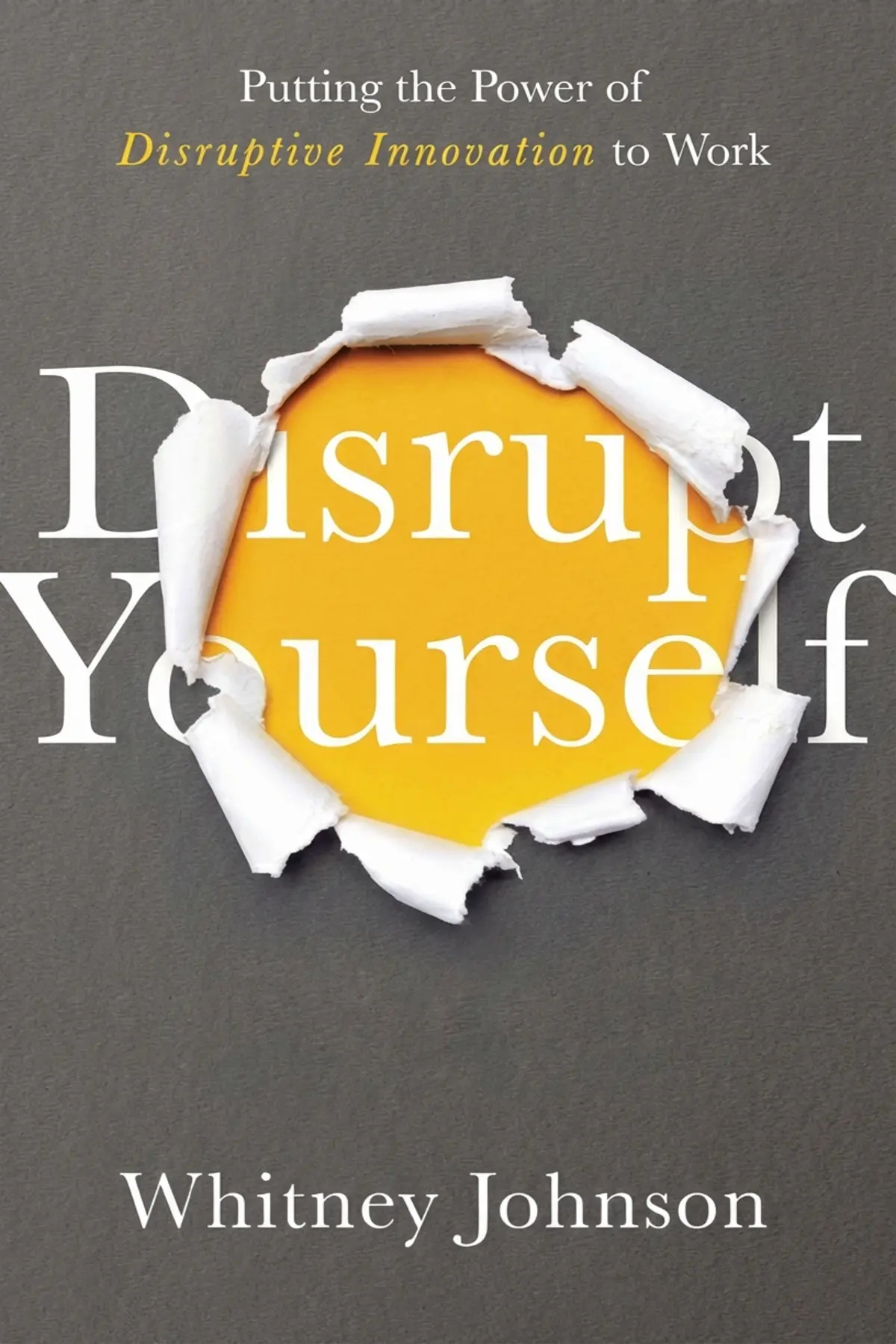
If your career feels stuck on a crowded path, the usual advice is to compete harder in the same game. In Disrupt Yourself, Whitney Johnson, who co-founded an investment fund with Harvard’s Clayton Christensen, argues for the opposite move. Her starting evidence is a study of disc drive makers: firms that bet on untested markets passed $100 million in revenue about six times as often as firms fighting rivals for proven demand.
Johnson applies that pattern to people. You disrupt yourself by aiming your distinctive strengths at a need nobody is serving, by treating limits and failures as fuel, and by being willing to step back or change course when the moment comes.
The people who prove it include a young lawyer who made partner at 32, a fashion founder who skipped her industry’s usual middlemen, and a software executive who kept starting over. Each one offers a move you can test on your own work this month.
1 min 42 sec
Two bets look almost identical from a distance, and most people pick the one that feels safer. A Harvard study of an entire industry suggests that instinct may be keeping careers and companies small.
1 min 44 sec
A young lawyer in a conservative firm had no seniority and no network to lean on. What she noticed around her office turned out to be worth more than both.
1 min 43 sec
One real estate company did its best work when money was scarce and stumbled once it was plentiful. A fashion founder who knew nothing about fashion found a similar advantage hiding in her ignorance.
1 min 50 sec
The most cited scientists of a decade shared one small habit in how they chose their sources. Before the 2008 crash, ignoring a single dissenting regulator showed what happens without it.
1 min 45 sec
Fifth graders solved easy problems, then a round of very hard ones nobody got right, then easy problems again. One sentence of praise beforehand decided whether their scores rose or fell, and the gap was striking.
1 min 43 sec
A software executive walked away from a senior role right after her biggest win. Years later, illness forced her out again. Both exits ended somewhere few would have predicted.
1 min 46 sec
A geology student ended up as a bank’s lifestyle blogger, and a company founded to treat genetic diseases ended up fighting blood cancer. Neither planned the route, and that may be the lesson.
1 min 12 sec
Johnson’s book comes down to one move, made again and again: leave the place where you compete with everyone, and go where your particular mix of strengths meets a need nobody is serving. The koala’s unusual stomach, Hassan’s spiced French cooking and Juvan’s early tweets are versions of the same idea. Tight budgets, outside voices and failed launches keep you honest along the way, and stepping back or swerving is part of the route, as Carine Clark and Millennium both found.
Her closing advice is to listen to your inner hunch about what interests you, even when it seems impossible to earn a living from it. Susan Cain’s passion was the worth of introverts in society, which hardly sounded like a promising business model. She went on to write a best-selling book and to lead The Quiet Revolution, a social media network, as its CEO.
So write down the hunch you have been dismissing. Before your next career decision, ask whether it is a competitive risk or a market risk, and what strength of yours it actually uses. Then remember the disc drive numbers: the crowded road felt safer, and only six in a hundred who took it got far.
Many careers stall on a crowded path where everyone competes for the same prize. Whitney Johnson, who co-founded an investment fund with Harvard's Clayton Christensen, argues that the theory explaining how small companies topple market leaders applies just as well to individuals. Her term for it is disrupting yourself. The book starts from a distinction between two kinds of risk. A competitive risk fights rivals for demand that already exists. A market risk bets on an unusual idea whose demand is still unknown. Christensen's study of disc drive makers suggests the second bet pays off far more often. Johnson then shows what personal disruption looks like in practice: pairing a distinctive strength with an unmet need, treating limited money and experience as advantages, seeking out voices beyond your usual circle, learning from failure, stepping down at the right moment and following curiosity wherever it leads. Her cases include a young lawyer who made partner at 32, a fashion founder who skipped the usual middlemen, a software executive who started over twice, and a classic experiment on how praise shapes children's resilience. Readers get a set of plain tests for their next career move.
Professionals stuck competing for the same promotion as everyone around them.
Career switchers wondering whether a lack of money or experience disqualifies them.
Managers and founders deciding when to step down, change direction or listen to dissent.
Whitney Johnson leads Disruption Advisors, a tech-enabled talent development company, and advises executives on developing their people so the business can grow. She co-founded the Disruptive Innovation Fund with Harvard Business School's Clayton Christensen, and earlier she was a Wall Street equity research analyst, ranked by Institutional Investor eight years in a row. She writes often for the Harvard Business Review, hosts the Disrupt Yourself Podcast and was named among leading management thinkers by Thinkers50 in 2017 and 2021.
Listeners find this work both thought-provoking and encouraging, with one listener describing it as an excellent tool for growth in both life and career. They enjoy how easy it is to digest, with one listener calling it essential for anyone looking to innovate, and they find the moving content connects strongly with the audience. The writing is backed by solid research and includes numerous memorable quotes; one listener mentions its relevance across all age groups. They particularly like the series of stories about risk-takers and the author’s straightforward prose.
Whitney Johnson has hit a home run with this guide to intentional career growth. I’ve always been an "oddball" in my professional circles, but this book helped me realize that being different is actually a distinctive strength that can be leveraged. The section on "embracing constraints" blew my mind because it reframes lack of resources as a catalyst for creativity rather than a roadblock. I love how she discusses the "dopamine" of the learning curve—it explains why the struggle at the beginning of a new project can actually be the most rewarding part. The writing is incredibly clear, and the stories she shares are both relatable and deeply motivational. Truly, this is a must-read for anyone who feels like they’ve hit a plateau and needs a roadmap for their next big leap.
Show moreAfter hearing the author speak, I knew I needed to dive into the full text, and it did not disappoint. This isn't just a "business" book; it's a deeply human look at how we deal with transition and the "grief" that often comes with failure. Johnson’s vulnerability about her own career pivots makes the advice feel authentic rather than preachy. The S-curve model provides a sense of comfort during those times when you feel like you’re working hard but seeing no results. "Momentum creates momentum," as she says, and this book definitely gave me the push I needed to start my next chapter. It’s short enough to finish in a weekend but contains enough wisdom to keep you thinking for months. It has definitely earned a permanent spot on my shelf.
Show moreEver wonder why you feel so restless once you’ve finally mastered a job? According to Whitney Johnson, it’s because you’ve reached the top of your S-curve and it’s time to jump. This book provides a brilliant framework for identifying when to make that move and how to do it without losing your mind. I loved the "six dynamite questions" for finding your distinctive strengths; they actually forced me to look at my hobbies and "oddities" in a new light. The emphasis on "imposing constraints" to spark innovation is something I’ve already started applying to my daily workflow with great success. It’s an empowering, well-researched, and highly relatable book that I would recommend to anyone at any stage of their career. Truly inspirational content.
Show moreFinally got around to reading "Disrupt Yourself" and I'm pleasantly surprised by how well Whitney Johnson translates high-level corporate theory into actionable personal advice. The S-curve concept is the real star here; it gives a visual language to that uncomfortable feeling when you’re starting something new and progress feels invisible. I found the chapter on distinctive strengths particularly helpful, especially the idea that things that come easily to us are often our greatest assets. To be fair, some of the anecdotes felt a bit rushed, jumping from one high-achiever to the next without much breathing room. However, the core framework is solid. It’s a fast, punchy read that makes a compelling case for stepping sideways to eventually move up. If you're feeling stuck in your current role, this might be the nudge you need.
Show moreAs a middle-manager looking to pivot, I found the "discovery-driven planning" section in this book to be a total game-changer for my mindset. Instead of the standard A-to-B linear planning we are all taught, Johnson suggests a more fluid approach that accounts for the unknown. Her "reverse income statement" for personal happiness is a brilliant way to calculate the actual cost of a career change. The truth is, most of us are terrified of failure, but this book teaches you how to give failure its due and use it as "validated learning." I did find the layout a bit dense in certain chapters, making it hard to skim for specific advice later on. You really have to sit down with a highlighter and engage with the text to get the full value out of it.
Show morePicked this up on a whim after seeing it mentioned in a leadership webinar, and I’m glad I did. The book is packed with great quotes and "those-who-dared" stories that make the abstract theories of disruption feel much more tangible. I particularly resonated with the idea that our "hard-won skills" are what truly set us apart in a crowded market. It’s written in a very accessible style—nothing too academic or dry, which I appreciated. My only real complaint is that it ignores the systemic barriers that make "disrupting yourself" much harder for some people than others. Still, as a motivational tool and a way to reframe your career trajectory, it’s a very solid resource. It’s the kind of book you’ll want to share with friends.
Show moreWhile I appreciate the sentiment behind this work, I'm stuck somewhere in the middle on its actual utility. The author definitely provides a fresh perspective by applying business disruption to personal branding, and I liked the seven-point framework. The idea of "competitive risk" versus "market risk" was a standout moment for me. However, the book is incredibly short and lacks the depth I was hoping for in a professional development guide. It reads more like an introductory primer than a masterclass. Frankly, the constant hopping between examples—from J.K. Rowling to financial tech—felt a bit dizzying and left me wanting more detail on the how rather than just the who. It’s a good bedside read for inspiration, but don't expect a step-by-step manual.
Show moreTo be fair, the concept of "stepping back to move ahead" is something we don't hear often enough in our hyper-competitive culture. Johnson does a decent job of explaining why a lateral move or even a demotion can lead to long-term growth on a new S-curve. I found the advice on "battling entitlement" to be a necessary, if slightly uncomfortable, reality check for anyone who thinks they've already "paid their dues." That said, the book often feels like it's trying to cover too much ground in too few pages. It mentions dozens of other books, which is great for a reading list, but it makes the author’s own contributions feel a bit lost in the shuffle. It's a nice, quick read, but I wouldn't call it groundbreaking or original.
Show moreNot what I expected from a book with such a bold title. I was looking for a more rigorous, analytical deep dive into the mechanics of personal change, but what I got was mostly a collection of anecdotes and high-level observations. The "red ocean vs blue ocean" analogy is helpful, but if you've read any business strategy in the last decade, you’ve heard it all before. I think the book serves as a good introduction for someone who has never thought about their career in strategic terms. For more seasoned professionals, however, it might feel a bit repetitive. The chapter on "dissenting voices" as allies was probably the most unique part of the book for me. Overall, it’s a fine read, just not the revolutionary text I was hoping for.
Show moreThis book feels like a collection of blog posts that never quite coalesced into a meaningful, deep dive. While Johnson is clearly knowledgeable, the adaptation of Clayton Christensen’s disruption theory to individual careers felt forced and, at times, incredibly thin. My biggest gripe is the heavy survivorship bias throughout the text. We hear about the "legends" who took massive risks and won, but there’s almost zero mention of those who "disrupted" themselves right into unemployment or financial ruin. It’s a "take a chance" mantra masquerading as a strategic framework. Look, the S-curve is a fine metaphor, but there isn't much original thought here that you won't find in a dozen other business books. It's derivative, lacking the conceptual clarity needed to provide a real formula for success.
Show moreJohnson argues that disruption theory, which explains how small companies overturn market leaders, also applies to individuals. You disrupt yourself by taking a market risk instead of a competitive one, pairing your distinctive strengths with an unmet need, using limits and failures as fuel, listening beyond your usual circle, and being willing to step down or change direction when the time is right.
A competitive risk means entering a market where demand is proven but rivals are already building similar products. A market risk means pursuing an unusual idea whose demand is unknown but where you would have a head start. In Clayton Christensen’s study of disc drive makers from 1976 to 1993, 37 percent of market risk companies passed $100 million in revenue, compared with six percent of competitive risk companies.
Start by naming the strength colleagues cannot easily copy, then look for a need your team or field is missing, as Jayne Juvan did by bringing her law firm onto social media and making partner at 32. Question the usual steps in your field, as Athelia Woolley LeSueur did. And ask whether you have finished what you set out to do in your current role.
Johnson argues that bright people often fear failure most, which hurts them. She cites Carol Dweck and Claudia Mueller’s experiment: after an impossible round, fifth graders praised for being smart scored 25 percent worse on easy problems, while those praised for effort scored 25 percent better. Nate Quigley’s team failed twice before asking users what they wanted and building Chatbooks.
It suits professionals who feel stuck on a crowded career path, career switchers worried that they lack money or experience, and leaders deciding when to step down or how to handle dissent. Its cases range from a Cleveland law firm and an online fashion shop to software start-ups and a pharmaceutical company that changed its focus to cancer drugs.
Robin Ryan




Marianne Cantwell
William Vanderbloemen
AUDIO SUMMARY AVAILABLE
Get the key ideas from Disrupt Yourself by Whitney Johnson, plus 5,000+ more nonfiction titles.









