



14 min 43 sec
Available in: English
Digital Body Language: How to Build Trust and Connection, No Matter the Distance
By Erica Dhawan
Shows how punctuation, reply timing and choice of channel replace the body language that screens remove, and how four habits of visible respect, clarity, consistency and trust stop messages being misread across teams and cultures.
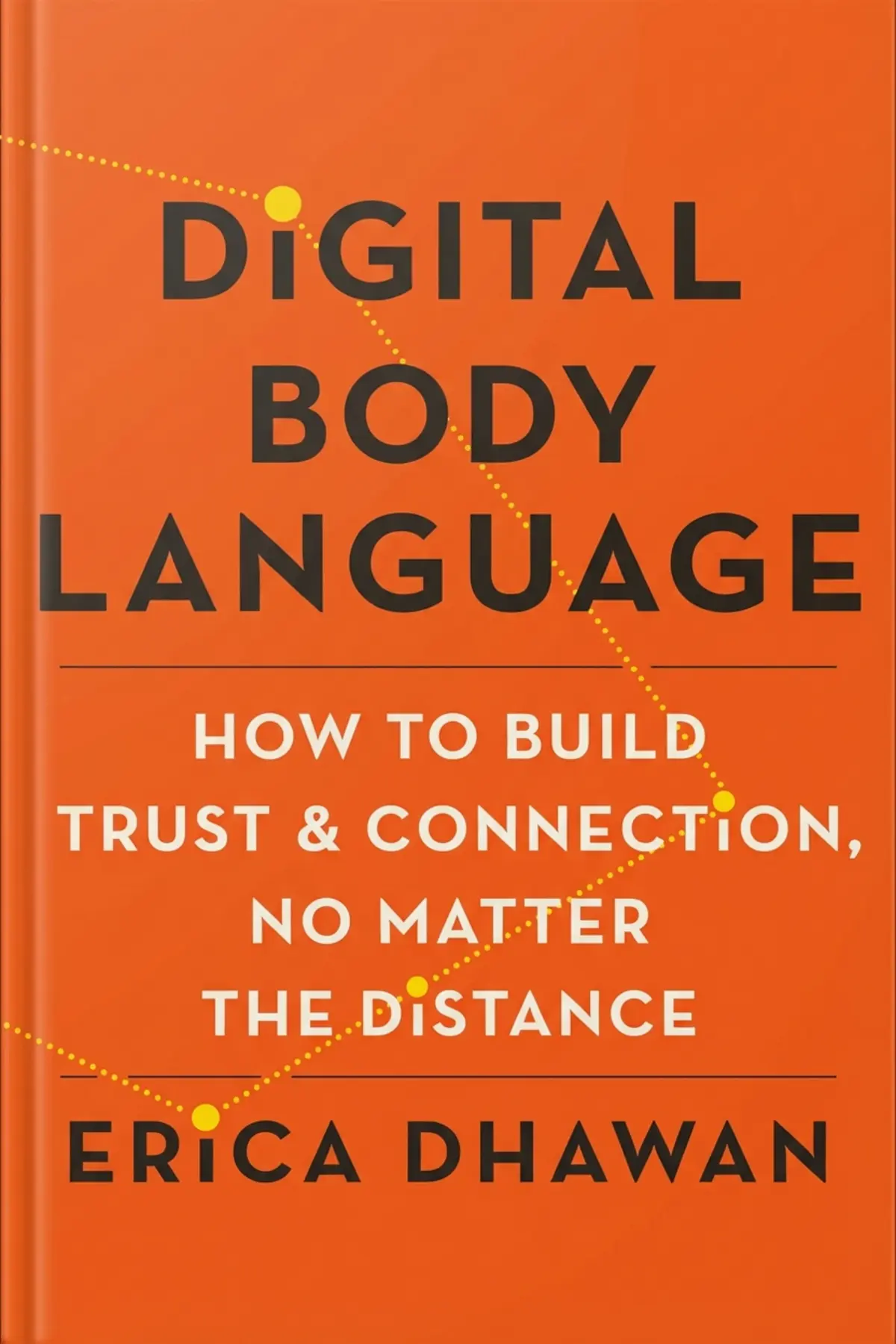
Table of Content
1. Introduction
1 min 04 sec
If your messages keep landing wrong, the problem is rarely what you said. It is the missing face, voice and posture that used to carry how you meant it. In Digital Body Language, Erica Dhawan, who founded a company that trains teams to collaborate, argues that those lost signals now live in punctuation, response times and the channel you choose. She cites research suggesting the tone of an email is misread about half the time, and she treats that as a skill gap anyone can close.
Her case is that when the body is out of the room, trust depends on making respect, clarity and intent explicit in every message. From that she derives four laws, which are to value visibly, to communicate carefully, to collaborate confidently and to trust totally, and then she checks how they hold up across gender, culture and age. By the end, a lone period from your boss should stop keeping you up at night, and your own messages should say what you actually mean.
2. See why so many messages land the wrong way
1 min 43 sec
A couple ended a long fight by text with two short lines, and one of them spent the next day mourning a relationship that was never over. Their mix-up shows what every screen takes away from us.
3. Treat punctuation, timing and channel as your face
1 min 37 sec
A manager was left anxious and second-guessing over a single dot at the end of his boss’s email. Was he overreacting? Dhawan’s answer reveals three signals you send every time you write, whether you mean to or not.
4. Respect that colleagues can actually see onscreen
1 min 42 sec
Half of employees say their leaders do not respect them enough, yet many of those leaders would be shocked to hear it. One small study shows how a single line of text can more than double someone’s willingness to help.
5. Write so clearly that tone cannot misfire
1 min 52 sec
Unclear communication costs US projects about $75 million for every $1 billion spent, and misunderstandings often start with something tiny, like a dropped word or a stray punctuation mark. Dhawan explains how to choose words and medium so your meaning survives the trip.
6. Keep a scattered team moving in one direction
1 min 44 sec
Most employees now depend on a crowd of colleagues they rarely see, spread over departments and time zones. Dhawan offers a closing question for every call and a rule for angry replies that keep that crowd aligned.
7. Trust that makes people willing to take risks
1 min 40 sec
When a public experiment collapsed within a day, one chief executive had every reason to punish his team. What he wrote instead shows how leaders can make honest mistakes safe without lowering the bar.
8. Adapt your messages across gender, culture and age
2 min 06 sec
Two founders fixed a stream of condescending emails by hiring a cofounder who never existed. Their trick exposes how gender, culture and generation shape the way identical words get read, and what you can do about it.
9. Conclusion
1 min 15 sec
Dhawan’s book comes down to one change of habit: stop assuming people can feel what you mean. In a room, a nod or a warm voice carried respect and intent for free. Online, each of those signals has to be chosen and written, from the closing period to the hour you reply and the channel you pick. Her four laws are ways of putting the missing body back into the message, and her pages on gender, culture and age are a reminder that every reader decodes those signals through their own history.
The practice can start small. Thank people in writing and mention something specific they did. End calls by asking who does what by when. Leave angry replies in drafts until morning, and when someone else’s message stings, ask a question before assuming the worst. For anyone leading a remote team, Dhawan recommends restoring what people miss most about the office, the casual water cooler chat, by reserving the first five to ten minutes of a meeting purely for conversation.
Laura spent a day grieving a relationship that had never ended, all because two words meant something else to Dave. Most misreadings are that small, and just as avoidable.
About this book
What is this book about?
Most work now happens through screens, and screens strip out the faces, voices and posture that once told us what people meant. The result is a steady stream of misread emails, anxious waits for replies and texts that start fights nobody intended. Erica Dhawan argues that body language has not disappeared online. It has moved into punctuation, timing and the channel we pick, and we can learn to read and send it on purpose. Drawing on studies of email tone, gratitude and project failure, and on stories ranging from a text that seemed to end a relationship to Microsoft's failed chatbot, Dhawan sets out four laws: value people visibly, communicate carefully, collaborate confidently and trust totally. She then shows how gender, cultural context and generation change the way the same message is read. Readers get habits they can use right away, from closing calls with a clear question about who does what and by when to saving angry replies as drafts. They also get a calmer way to interpret the messages arriving in their own inbox.
Book Information
Who it's for
Agonizing over curt replies
Remote and hybrid workers who agonize over a curt reply or a lone period from the boss.
Leads of distributed teams
Team leads running distributed teams across time zones, cultures and generations.
Often misread in writing
Anyone whose texts and emails keep getting read in the wrong tone.
About the Author
Erica Dhawan
Erica Dhawan is the founder of Cotential, which trains leaders and teams in the collaboration skills modern work demands. She has given more than 200 keynotes worldwide, for audiences including the World Economic Forum and Fortune 500 companies, and hosts the podcast Masters of Leadership. Her writing has appeared in Fast Company and Harvard Business Review. She holds degrees from Harvard Kennedy School, MIT Sloan and the Wharton School, and she coauthored Get Big Things Done: The Power of Connectional Intelligence.
Ratings & Reviews
Ratings at a glance
What people think
Listeners find this work to be an educational manual offering essential advice for communicating online, with one listener highlighting its usefulness in avoiding common traps. Furthermore, the title earns praise for its digital body language strategy, its engaging nature, and its relevance today. Listeners also value the high caliber of information, which one listener characterizes as being well-researched. On the other hand, opinions on clarity are divided; while some consider it easy to read, one listener points out several pages that are basically unreadable.
Top reviews
Leah
As someone who manages a fully remote team, this book feels like a mandatory survival manual for the modern workplace. We spend so much time communicating through text, yet we rarely think about the "body language" behind our digital signals. Dhawan’s insights on "Trust-Traditional" vs. "Digital Body Language" changed how I approach my morning emails entirely. Frankly, the advice on mirroring your recipient’s level of formality has already saved me from two potential misunderstandings this week alone. It’s an entertaining and practical look at how to build connection when you can't see someone's face or hear their voice.
Show moreYindee
Ever wonder why a single period at the end of a Slack message feels like a death threat from your boss? Erica Dhawan dives deep into these nuances, explaining how punctuation has become the new measure of our workplace emotions. I loved the "Emoji Primer" and the specific sections on how to convey excitement versus urgency through digital channels. The book is refreshing because it doesn't just mock the way younger people communicate; it validates it as a legitimate evolution of language. It’s a timely piece of work that helps bridge the gap between different generations of workers. I found the tone to be engaging and the research to be quite compelling.
Show moreTun
This book is a total game-changer for anyone struggling to build trust across screens and time zones! Erica Dhawan has managed to capture the invisible rules of the 21st-century workplace in a way that is both relatable and revolutionary. I found the section on "Digital Anxiety" to be particularly resonant, as it gave words to a feeling I've had for years. The advice is actionable, the tone is encouraging, and the content is more relevant now than ever before. If you want to collaborate competently and ensure your messages are never misinterpreted again, this is the book you need. I've already recommended it to my entire department.
Show moreJirapat
Finally got around to reading Dhawan’s take on remote communication, and it’s surprisingly solid for navigating the current hybrid work landscape. The author does a great job illustrating how things like "Reply All" or a missing emoji can unintentionally derail team trust. I personally appreciated the breakdown of how different generations interpret punctuation differently; it explained so many awkward Slack interactions I've had. While some of the anecdotes felt a bit like padding, the core framework is well-researched and incredibly timely for managers. It’s an instructive guidebook that provides critical guidance on avoiding the digital pitfalls that drain productivity. Definitely worth keeping on the shelf for reference when a professional relationship feels "off."
Show moreCholada
Truth is, we’ve all been winging it with Zoom and email for years, so having a research-backed framework is refreshing. This book is essentially an instructive guidebook that highlights how much of our intent gets lost in the digital void. I particularly liked the concept of "Digital Body Language" being the subtext behind our typing speed and channel choice. The author’s own background as a "geriatric millennial" allows her to speak both languages effectively, which makes the advice feel more balanced. It’s not a perfect book, as it can be a bit repetitive, but the entertainment value and practical tips are high. It’s a solid 4-star read for any office environment today.
Show moreSupatra
Picked this up because my inbox has become a literal minefield of misunderstandings lately and I needed a fix. The book provides a lot of "aha!" moments, especially regarding how to signal engagement during video calls without being distracting. I never realized how much my use of "Reply All" was impacting my perceived authority until I read Dhawan's analysis. Gotta say, the specific examples of channel switching from email to text to signal urgency were very practical. My only real gripe is that the book feels a bit too focused on white-collar American office norms. It could have used more diverse perspectives on how these digital cues vary across different global cultures.
Show moreDing
The information quality here is actually quite high, yet the structure feels like a series of disjointed blog posts rather than a cohesive work. Look, there is no denying that Dhawan is an expert on this subject, but the book repeats its main points constantly. I felt like I was reading the same three pieces of advice—mirror others, be clear, and use emojis—over and over again in every chapter. Some of the pages are dense with corporate jargon that makes them feel almost unreadable at times. It’s a decent primer for a "digital alien" who needs to understand modern etiquette, but the lack of depth was disappointing for me.
Show moreLogan
Dhawan makes some valid points about clarity, but I found her take on gendered communication styles a bit frustrating to digest. The book suggests that women should basically overcompensate with exclamation marks and emojis to avoid being perceived as cold or rude. Why are we still encouraging women to perform this emotional labor while men are allowed to be "professional" with a simple, dry response? In my experience, this binary standard just reinforces the very biases the author claims to be helping us navigate. Aside from that critique, the sections on navigating power plays and digital anxiety were quite insightful. It’s a bit of a mixed bag that offers good tips if you can look past the questionable gender tropes.
Show moreHugo
Maybe I’m just too young for this book, but most of the advice felt painfully obvious to anyone who grew up with a smartphone. To be fair, if you don't know that using all caps comes across as shouting, then this guide might be a revelation for you. For the rest of us digital natives, it's mostly common sense wrapped in corporate buzzwords. I found the sections on "channel switching" to be the only parts that offered any real value or new perspective. The rest of the content felt repetitive and could have easily been condensed into a single, ten-minute long-form article. It’s not a bad book, just perhaps targeted at a different generation.
Show moreSom
Not gonna lie, I expected a lot more depth than what was actually delivered in these pages. I had to read this for a work seminar and found it to be a bit of a snooze fest from start to finish. The book largely consists of surface-level advice like "don't be rude in emails" and "use a smiley face if you want to seem friendly." It lacks the sophisticated psychological analysis I was hoping for in a book about communication behavior. Many of the examples felt dated or specific to a very narrow type of American corporate culture. If you are already comfortable with Slack and Zoom, you probably won't find anything revolutionary here.
Show moreQuestions about this book
What is Digital Body Language by Erica Dhawan about?
Dhawan argues that screens remove the facial expressions, tone and posture that carry most of our meaning in person, so messages are often misread. Those cues now live in punctuation, response timing and the channel we choose. She presents four laws for using them well, which are to value visibly, communicate carefully, collaborate confidently and trust totally, and she shows how gender, culture and generation alter the way messages are read.
What are the four laws of digital body language?
Valuing visibly means showing attention and appreciation explicitly, for example by referencing details and saying thank you. Communicating carefully means choosing clear words, the right tone and the right channel. Collaborating confidently means regular check-ins, explicit goals and patient replies. Trusting totally means leaders showing vulnerability and giving people ownership, so they feel safe to take risks, as Satya Nadella did after Microsoft’s Tay chatbot failed.
Does ending a message with a period seem rude?
According to Dhawan, it often does today. The period used to simply end a sentence, but many readers now take it as a sign of aggression, much like a hard stare. Exclamation points have come to signal general friendliness, so leaving them out can seem cold. Her broader point is to treat punctuation as part of your tone and, as a reader, to give senders the benefit of the doubt.
How can leaders apply Digital Body Language with remote teams?
Dhawan advises closing each call by asking who will do what and by when, setting explicit goals early on, and checking in regularly. Send questions before meetings so introverts can prepare, and ban the mute button on team calls. Open work emails with WINFY, short for What I Need From You. She also recommends five to ten minutes of casual talk at the start of meetings to replace lost water cooler moments.
Readers also enjoyed








AUDIO SUMMARY AVAILABLE
Listen to Digital Body Language in 15 minutes
Get the key ideas from Digital Body Language by Erica Dhawan, plus 5,000+ more nonfiction titles.
- 5,000+ titles
- Listen as much as you want
- 7-day free trial
- Cancel anytime









