


14 min 18 sec
Available in: English
Defy: The Power of No in a World That Demands Yes
By Sunita Sah
Explains why saying yes under pressure is trained into us from childhood. It shows how to tell real consent from compliance, check your values in a hard moment and practice saying no until it holds.
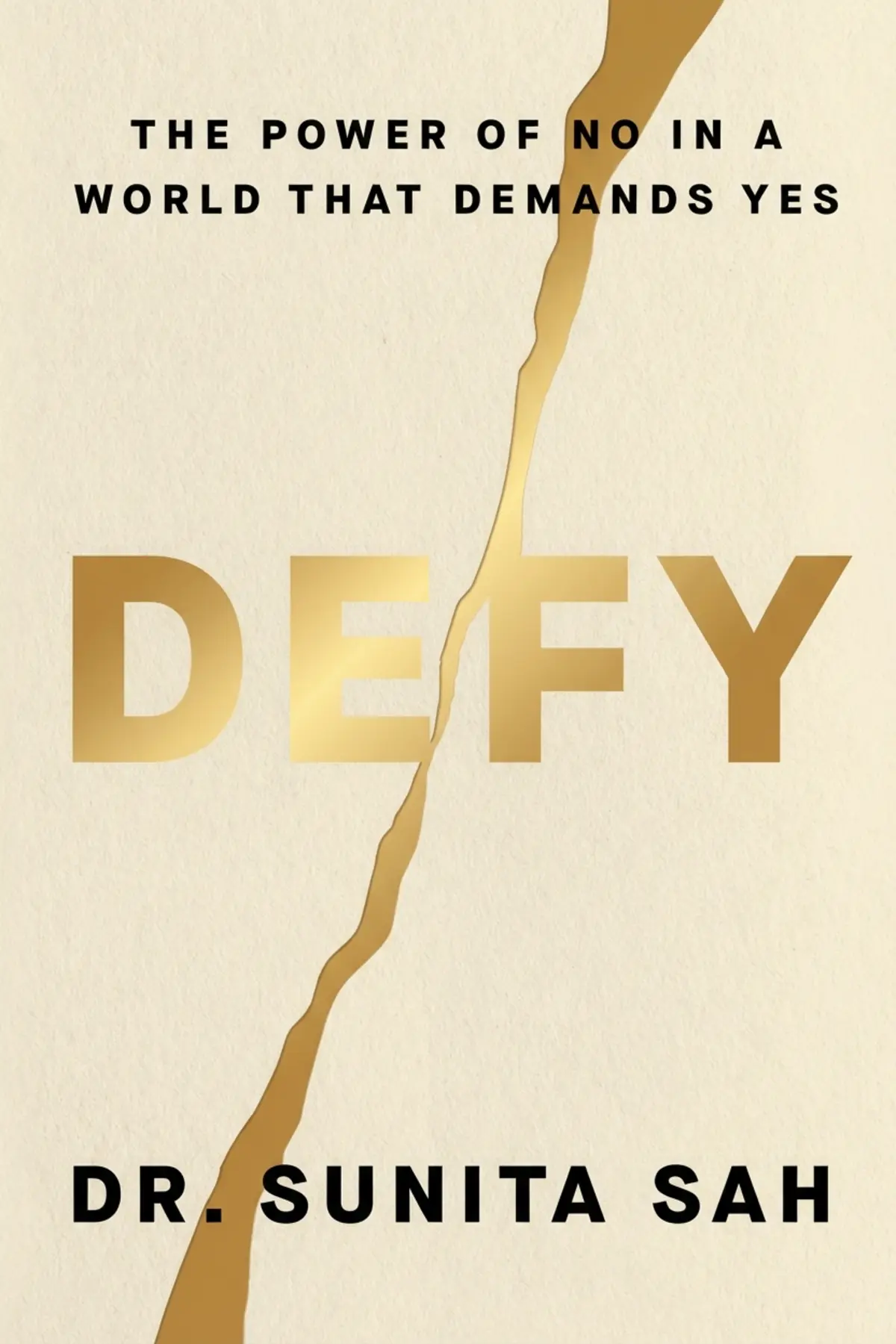
Table of Content
1. Introduction
1 min 06 sec
Most people believe they would speak up if they saw something wrong, yet under pressure they usually go along. In Defy, Cornell management professor and former physician Sunita Sah argues that this gap has little to do with weak character. The habit of complying is trained into us from early childhood, and it can be retrained. She also gives defiance a new meaning: acting in line with your own values when outside pressure pushes the other way, which can happen in a calm decision as easily as in a loud confrontation.
Her case comes down to one claim. Saying yes under pressure is learned, and saying no when it matters can be learned too, by telling a pressured yes from real consent, checking who you are in the moment and rehearsing small refusals before the big one arrives. Along the way come a rookie officer on his third day, a financial advisor’s late confession and a policeman whose voice shook as he refused an order. What you get is a test for any agreement, three questions for hard moments and a way to practice.
2. See the gap between your values and actions
1 min 57 sec
A rookie officer joined the police hoping to change it from within. By his third day on active duty, he took part in a notorious killing. His story raises an uncomfortable question about how well we know ourselves.
3. Understand the roots of obedience and make saying no easier
2 min 00 sec
Refusing a manager can make your stomach tighten even when you know you are right. Sah traces that feeling back to the earliest rewards of childhood, and to a system most of us never notice running.
4. Tell a pressured yes from a real one
1 min 48 sec
A friendly advisor gave a tired young doctor an hour of free help, then revealed one detail at the end. Her reaction was the opposite of what you might expect, and it shows how kindness can become pressure.
5. Test any agreement against five conditions
2 min 07 sec
A signed contract, a gym membership and a software update can all look like free choices. Medicine offers a sharper test, and most everyday agreements fail at least one part of it.
6. Three questions that keep you true to yourself
2 min 03 sec
Doctors joking in a break room and a tobacco scientist’s growing unease both point to the same slow danger. Sah offers a short set of questions to ask before small compromises start rewriting who you are.
7. Rehearse your no before you need it
2 min 15 sec
An officer ordered to do an illegal search felt his childhood stutter return as he answered. What carried him through was something he had done long before that day, and anyone can do it.
8. Conclusion
1 min 02 sec
Sah’s argument leaves a thought that is uncomfortable and useful at once. The rookies beside Derek Chauvin carried the same training most of us carry, from a parent’s praise to the rules of the school day. What failed them in that moment was readiness, and readiness is something anyone can build.
The building starts small. When you feel a yes forming under pressure, step away if you can, the way a pager pulled a tired young doctor out of a sales pitch, and check whether you have the capacity, the facts, the understanding and the freedom to refuse before you agree. When something does not sit right, ask yourself who you are, what kind of situation this is and what someone like you does here. And rehearse, in your head and in small daily questions, the no you hope you will never need, the way Officer Kevin had imagined his long before his superiors asked for that search.
His voice shook when the moment came. He had practiced, and he said no.
About this book
What is this book about?
Most people are sure they would speak up if they saw something wrong. Under real pressure from a boss, an expert or a friendly salesperson, they often freeze or go along. Sunita Sah, a physician turned management professor at Cornell, argues that this gap is not a flaw in character. The habit of complying is built in from childhood, through parents, school and peers, and it can be rebuilt. Sah redefines defiance as acting in line with your own values when outside pressure pushes the other way. A defiant act can be quiet. She draws on cases ranging from the rookie officers present at George Floyd's killing to a tobacco whistleblower and a police officer who refused an illegal search, along with her own experience as a doctor, fresh off a thirty-hour shift, facing a persuasive financial advisor. Readers get three tools. The five conditions of informed consent help them spot when a yes is being pulled out of them. The Defiance Compass, three short questions, keeps their choices tied to who they are. A five-stage path, practiced in small moments, makes saying no possible when the stakes are high.
Book Information
Who it's for
Professionals regretting silence
Professionals who go along with pressure at work and later wish they had spoken up.
Leaders wanting early warnings
Managers and team leads who want people to raise concerns before harm is done.
Quick to agree
Anyone who signs, clicks or agrees too quickly and wants a test for real consent.
About the Author
Sunita Sah
Sunita Sah teaches management and organizations at Cornell University's SC Johnson Graduate School of Management and directs Cornell's Academic Leadership Institute. She trained as a physician and practiced medicine in the United Kingdom, then worked as a management consultant in the pharmaceutical industry. Her research covers influence, authority, compliance and defiance. She served as a Commissioner on the National Commission on Forensic Science and has advised government agencies. Earlier she held a KPMG-named professorship at Cambridge Judge Business School, where she remains an Honorary Fellow.
Ratings & Reviews
Ratings at a glance
What people think
Listeners find this self-help guide both deeply researched and enlightening, featuring captivating personal narratives that draw them in immediately. The text also receives praise for being easy to read and mentally stimulating, using practical scenarios that make it essential reading. Furthermore, listeners value the work's genuine nature; one listener mentions how it aids in identifying one's authentic self, while another emphasizes its attention to effective self-advocacy.
Top reviews
Somsak
This book provides an incredibly refreshing framework for anyone who feels trapped by the 'people-pleaser' label. Sah’s concept of 'insinuation anxiety' perfectly captures that itchy, uncomfortable feeling when you agree to something just to avoid a social ripple. I appreciated how she blends her background in organizational psychology with real-world scenarios that feel deeply relatable. To be fair, some of the personal stories are long-winded, but they serve to humanize the heavy research. It isn’t just about being a rebel for the sake of it; it’s about authentic alignment. I’m already trying to exercise my 'defiance muscle' in small ways at the office. The writing is sharp and the message is vital.
Show moreJavier
Picked this up after seeing a recommendation from Adam Grant, and it did not disappoint. Dr. Sah explores the 'True No' with such nuance that it changed how I think about my own daily boundaries. The book is especially poignant when discussing how marginalized groups face higher stakes when they choose to defy. She handles the intersection of privilege and self-advocacy with grace. It’s rare to find a self-help book that is this well-researched yet still feels like a conversation with a mentor. If you’ve ever felt like your 'yes' was actually a 'conditional compliance,' you need to read this immediately. It’s empowering and deeply practical.
Show moreDavid
Wow, this was exactly the wake-up call I needed to stop compromising my principles just to avoid a minor social headache. Dr. Sah writes with a mix of academic authority and heartfelt vulnerability that is rare in this genre. I was particularly moved by the stories of her parents and how their resilience shaped her understanding of what it means to stand firm. The book argues that we have a moral obligation to be intentional with our consent. It’s a call to action. Frankly, the timing of this release couldn't be better. It’s a manual for anyone who wants to hold onto their humanity in systems that feel increasingly dehumanizing. Highly recommended.
Show moreOwen
Ever wonder why you find yourself nodding along to a terrible idea just because a superior suggested it? Sah breaks down the evolutionary roots of our compliance, explaining that our ancestors literally needed to 'get along' to survive. While the science is dense, the writing remains accessible and quite fast-paced. Frankly, I think the distinction between 'true' and 'false' defiance is the most valuable part of the book. It forces you to look inward. My only gripe is that some of the author’s personal medical anecdotes felt a little self-indulgent compared to the historic figures she cites. Still, it's a thought-provoking read that I've recommended to several friends who struggle with setting boundaries.
Show moreWin
Not what I expected from a Cornell professor, as the tone is surprisingly intimate and filled with stories from her own upbringing. I found the analysis of 'passive compliance'—the way we sign terms of service or agree to procedures without thinking—to be a major eye-opener. The book moves quickly. Sah makes a compelling case that defiance is a skill we can actually build over time. Look, it’s not perfect; some of the categorizations feel a bit like a 'No True Scotsman' fallacy where only 'good' defiance counts. However, the practical tools for recognizing your internal 'alarm' are worth the price of admission alone. A solid 4-star read for anyone interested in social psychology.
Show moreErn
The chapter on 'conditional compliance' really hit home for me as a corporate middle manager. We spend so much time pretending to agree just to keep the peace. Sah’s research into organizational psychology provides a sturdy backbone for her arguments about why we stay silent. I loved the term 'moral maverick'—it’s a great way to rebrand what many people just call being difficult. Some parts of the book felt a bit repetitive, and the political tilt might turn some readers off. But if you can look past that, there is a lot of wisdom here regarding how to live more authentically. It’s about more than just saying no; it's about knowing why you say yes.
Show moreYuwadee
Sah does a commendable job of stripping away the negative connotations usually attached to the word 'defiance.' Instead of seeing it as aggression, she presents it as a form of integrity. I found the section on 'insinuation anxiety'—the fear that speaking up will make you look suspicious or rude—to be incredibly relatable. It explains so much of our daily social friction. The book is well-structured, though I found the jump from small-scale personal choices to global movements a bit jarring at times. Not every act of saying 'no' is a revolutionary act. Regardless, the core message about reclaiming agency in a world that demands conformity is vital and timely. Definitely worth your time.
Show morePat
Finally got around to finishing this, and while I didn't agree with every comparison—putting trivial medical refusals next to historic civil rights acts is a stretch—the core message is solid. Dr. Sah is a gifted storyteller who makes complex psychological concepts feel easy to grasp. I liked the focus on 'active consent' versus the mindless 'yes' we give every day. The book encourages you to pause and check in with your internal compass before folding under pressure. It's a quick read, but the lessons stick with you long after you close the cover. My only minor complaint is that the author’s voice can sometimes come across as a bit superior. Still, the advice is practical and grounded.
Show moreDao
As someone who values rigorous medical training, I struggled with the way the author leveraged her MD background to justify ignoring clinical advice. Sah is clearly brilliant, but equating a refusal of a standard X-ray to the heroic defiance of Rosa Parks felt logically inconsistent to me. The book often reads more like a memoir than a psychological study. Truth is, the 'moral maverick' concept is interesting, but the execution feels a bit one-sided. I enjoyed the sections on the Challenger explosion and the tobacco industry much more than the personal chapters. It’s an okay read if you want a left-leaning take on social resistance, but it lacks the balanced perspective I was hoping for.
Show moreOn
Defy offers some brilliant psychological insights, but it frequently gets bogged down in what feels like an autobiography. I wanted more data and fewer stories about the author’s specific interactions with her doctors or her child’s school. While the concept of 'true values' is noble, the book doesn’t quite solve the problem of how we define those values in a pluralistic society. What happens when two people's 'true values' lead them to defy each other? Sah glosses over the messier parts of conflict. To be fair, her writing style is engaging and the pages fly by. It just felt a bit too 'self-help light' for my taste given her credentials.
Show moreQuestions about this book
What is the main idea of Defy by Sunita Sah?
Sah argues that our tendency to comply under pressure is trained into us from childhood by parents, school and peers, and that it can be retrained. She redefines defiance as acting in line with your own values when outside pressure pushes against them. The book offers tools for this: the five conditions of informed consent, three questions she calls the Defiance Compass, and five stages of practice that make saying no easier over time.
What is the difference between compliance and consent?
Compliance, in Sah’s account, is a yes given in response to outside pressure, such as authority, social expectations or the way a system is set up. Consent is a free choice. Borrowing from medicine, she says true consent needs five things: capacity to decide, knowledge of the facts, understanding of what they mean, freedom to refuse and an explicit yes. Clicking accept on unread terms of service is compliance, even if you agreed.
What is the Defiance Compass?
The Defiance Compass is a trio of questions Sah suggests asking in hard moments, starting with the one about identity, then a check on the kind of situation at hand. The last asks how a person like me would act in these circumstances. She recommends asking them repeatedly and letting each answer inform the others. The trigger is the feeling that something does not sit right, which she treats as a warning that your actions are drifting away from your values.
How can I practice saying no, according to Defy?
Sah treats defiance as a skill built through practice. She describes five stages: feeling tension, recognizing it, voicing your concern, stating your intention to resist and acting. Mental rehearsal helps. Officer Kevin had imagined facing an unlawful order, and that preparation let him refuse an illegal garage search even as his voice shook. Small acts, like questioning a doubtful procedure, train you for bigger ones.
Who should read Defy?
It suits people who have stayed silent at work and regretted it, team leads who want people to raise concerns, and anyone who feels pushed into agreements they do not fully understand, from contracts to medical procedures. Its cases range from the officers present at George Floyd’s killing to a tobacco whistleblower, and its tools are short enough to use in the moment.
Featured in
Readers also enjoyed

A Liberated Mind: How to Pivot Toward What Matters
Steven C. Hayes



Acting with Power: Why We Are More Powerful Than We Believe
Deborah Gruenfeld




Age of Propaganda: The Everyday Use and Abuse of Persuasion
Anthony Pratkanis

AUDIO SUMMARY AVAILABLE
Listen to Defy in 15 minutes
Get the key ideas from Defy by Sunita Sah, plus 5,000+ more nonfiction titles.
- 5,000+ titles
- Listen as much as you want
- 7-day free trial
- Cancel anytime









