

14 min 39 sec
Available in: English
Deep Future: Creating Technology That Matters
Shows why energy, shipping, food, construction and medicine need new physical technology instead of more apps, and tours the inventions, from waste-burning reactors to self-healing concrete, that Holman believes could change them.
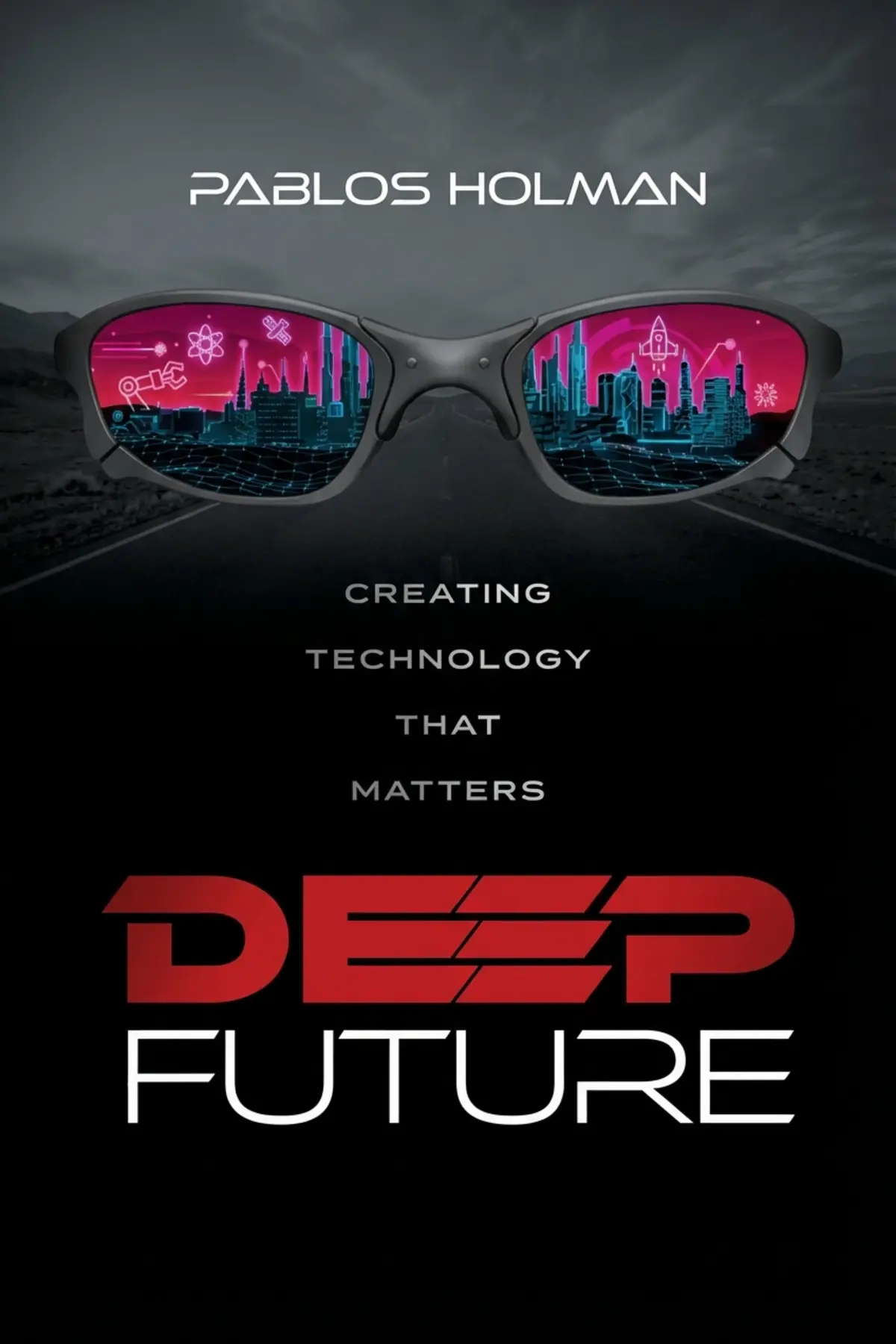
Table of Content
1. Introduction
1 min 04 sec
If your picture of cutting-edge technology is a new app on your phone, Pablos Holman thinks you are looking at the smallest part of the story. In Deep Future, the hacker, inventor and futurist notes that computing power has doubled every two years, while energy, water, food and manufacturing, the systems civilization stands on, have barely improved this century. The science exists. The industry, he argues, simply chased easy wins.
His case is that the problems deciding whether the future is livable need deep tech: new physical tools that change atoms instead of rearranging software. From cargo ships run on wind and sun to reactors that burn nuclear waste and concrete that heals itself the way Roman concrete did, Holman shows what that looks like. The reward for listening is a sharper eye, able to tell which inventions reshape the world and which only reshape a screen, and a map of where builders and investors could find the real openings.
2. Tell shallow tech from deep tech at a glance
2 min 04 sec
Ride apps and photo apps made the world feel advanced, yet the machinery under daily life has barely moved. Holman draws a line between two kinds of innovation, and many famous startups land on the wrong side of it.
3. Risky hardware creates the biggest new markets
2 min 14 sec
Two flashy gadgets became punchlines and taught investors to fear anything physical. Holman argues that fear hides the largest opportunities, and points to one industry that pollutes about as much as all of aviation.
4. Rethink the energy source the world learned to fear
1 min 59 sec
The same physics produced a weapon and a power source, and the world grew afraid of the wrong one. A reactor design that feeds on waste might settle the old objections, if anyone were allowed to build it.
5. Stop paying to ship water across oceans
2 min 07 sec
A plate of homemade pasta hides centuries of technology. Look closer at a tomato crossing a continent and you find a cost almost nobody notices, plus an idea that could shrink it dramatically.
6. Build to last centuries with Roman concrete chemistry
2 min 01 sec
Modern concrete starts failing after about fifty years, while a Roman arena still stands after two thousand. An MIT researcher finally worked out why, and his answer is now being mixed into new construction.
7. Code is learning to reprogram the body
2 min 01 sec
Reading human DNA like software has changed how cancer is understood and how inflammation might be switched off. One of the newest treatments looks, from the outside, like a pair of earphones.
8. Conclusion
1 min 09 sec
Holman’s book adds up to a new test for progress. Years of clever apps made the world feel advanced while the machinery underneath, the power plants, cargo ships, farms and building sites, barely moved. His examples share a shape. Each is physical, difficult and often feared, from a reactor that burns waste to a powder that turns back into a tomato, and each could open a market far larger than the risk it carries.
That gives you some habits worth keeping. When a new product makes headlines, ask whether it hands humanity a new tool or just moves an old one onto a new screen. When a technology scares you, check whether the version you fear is the one being designed today. And when a problem looks impossible, look backward as well as forward, the way Admir Masic unraveled how ancient Roman cement manages to mend its own cracks.
Modern concrete starts failing in about fifty years. The Colosseum has stood for two thousand. Holman’s wager is that the next great leap will look less like an app than like that wall.
About this book
What is this book about?
Smartphones, ride apps and photo feeds make the present feel advanced. Yet the systems civilization depends on, energy, water, food and manufacturing, have changed only a little this century. Pablos Holman argues that the technology industry chose easy software wins over hard physical problems, and that a crowded, warming planet can no longer afford that choice. His alternative is deep tech: new tools drawn from artificial intelligence, biotechnology, quantum computing, nanotechnology and advanced materials. Holman admits that hardware is far riskier than software, then shows why the risk is worth taking. He walks through self-sailing cargo ships, traveling-wave reactors that run on nuclear waste, 3D-printed food that travels without its water, self-healing concrete based on Roman chemistry, and medical devices that work through the immune system and the vagus nerve. Readers get a clear way to separate inventions that change the physical world from those that only repackage software, along with a tour of the fields where Holman thinks the next real breakthroughs are being built.
Book Information
Who it's for
Weighing hardware risk
Founders and investors deciding whether a hardware idea is worth its risk.
Industry professionals looking ahead
Professionals in energy, shipping, food, construction or health who want to see where their industry could be heading.
Tired of app news
Curious readers tired of app news who want to know which inventions could change the physical world.
About the Author
Pablos Holman
Pablos Holman is a hacker, inventor and technology futurist. He worked on early cryptocurrency in the 1990s, on AI for trading stocks and on building spaceships at Blue Origin. He helped launch the Intellectual Ventures Lab for Nathan Myhrvold, where his team received 6,000 patents for inventions including a machine to suppress hurricanes and a mosquito-zapping laser tied to an effort with Bill Gates to wipe out malaria. He has given TED Talks, once picking locks live on stage, and leads Deep Future, a firm that backs inventors and entrepreneurs.
Ratings & Reviews
Ratings at a glance
What people think
Listeners find the book both educational and stimulating, with one listener emphasizing its skill at simplifying intricate subjects. They value the mission-oriented perspective on innovation, where one listener points out the emphasis on advancements outside of standard software and the blend of creative concepts with practical illustrations. Listeners characterize the work as accessible, humorous, and captivating, calling it a superb essential read.
Top reviews
Wyatt
Picked this up because I was tired of hearing about the next social media app, and Holman didn’t disappoint. He draws a sharp line between the 'shallow tech' of the last twenty years and the 'deep tech' we actually need to survive. Personally, I found the section on materials science fascinating, especially the idea that we can engineer substances nature never intended. It’s a fast-paced, funny, and incredibly informative read that makes complex quantum computing feel like a dinner table conversation. My only minor gripe is that it occasionally glosses over the massive political resistance these technologies face. Still, the optimism is infectious. We’ve spent too long optimizing ad clicks; it's time to start optimizing atoms.
Show moreGin
Wow, this is the first time in years I've felt genuine hope for our planetary trajectory. Holman presents a blueprint for using biotechnology to program cells just like software, which blew my mind. Truth is, we are often told that the future is bleak, but this book argues that we simply haven't been applying our best minds to the right problems. The discussion on self-healing concrete and 3D food printing showed me that the 'Deep Future' isn't just a fantasy; it's already being built in labs around the world. Every entrepreneur should read this to understand where the real value lies. It is a refreshing and uplifting look at innovation that actually matters.
Show moreThongchai
Deep Future is a masterclass in making the impossible seem inevitable if we just shift our capital and attention. Holman, a hacker-turned-inventor, brings a unique 'what if' energy to topics like quantum computing and material science. I loved how he framed the human genome as a codebase that we are finally learning to debug. The book is incredibly easy to understand, even when he’s diving into the strange physics of nanotechnology. It is a purpose-driven manifesto that challenges us to build things that actually matter for the next century. This is easily one of the most thought-provoking books on my shelf this year. Truly a fantastic must-read.
Show moreJan
After hearing Pablos speak on a podcast, I expected a series of wild ideas, but this book is surprisingly grounded in physics and engineering. He takes massive existential threats like climate change and breaks them down into engineering problems we can actually solve. The idea of using bacteria to consume plastics or growing animal-free meat in labs isn't just sci-fi anymore; it's the inevitable result of the 'Deep Tech' revolution. Holman’s writing is punchy and accessible. He manages to explain the vagus nerve and quantum states without losing the reader. It’s an essential read for anyone who wants to see technology do more than just increase advertising income.
Show moreScarlett
The chapter on self-healing concrete alone changed how I look at my city's infrastructure. Holman has this incredible ability to take a 'boring' material and turn it into a symbol of a sustainable future. Deep Future isn't just about cool gadgets; it's about the ethos of intentional innovation and long-term vision. The book asks a fundamental question: what kind of world do we want to build? From vaccine discovery through protein folding to carbon-negative construction, the answers are all here. It's a fantastic, must-read for anyone tired of the status quo. The future isn't just happening to us; we have the tools to engineer it if we dare.
Show morePhu
As someone who works in software development, this book was a bit of a reality check. Frankly, Holman is right: we’ve been playing in a sandbox of bits while the real world—energy, food, and climate—is starving for innovation. To be fair, his vision for traveling-wave reactors using nuclear waste is brilliant, but he makes the transition sound a little easier than it will likely be in practice. The writing is engaging and lacks the dry, academic tone you might expect from a book about nanotechnology and molecular modeling. I appreciated the mix of historical context and futuristic forecasting. It’s a necessary wake-up call for the Silicon Valley elite.
Show morePrae
Ever wonder why we haven't solved the energy crisis despite having the physics for it for decades? Holman tackles this head-on, particularly through his advocacy for advanced nuclear power and the irony of our rejection of energy-dense fuels. In my experience, most books on tech are either too dense or too fluffy, but this one hits the sweet spot. It's funny, daring, and packed with examples of innovations that could revolutionize global trade and health. I did find the pacing a bit uneven toward the end, and some of the AI predictions felt slightly optimistic given current hardware constraints. Regardless, the call to action for 'Deep Tech' is one that every innovator needs to hear.
Show moreArm
Finally got around to finishing Holman’s manifesto and I’m mostly impressed, though I wish there was more detail on the regulatory hurdles for these solutions. The way he explains the shift from repurposing existing tools to creating entirely new capabilities is the best I've seen. He makes a compelling case for why hardware is the true frontier of innovation. The chapters on carbon-neutral shipping and revitalized infrastructure were highlights for me. Gotta say, it’s refreshing to read a tech book that doesn't mention 'disruption' every five seconds. A solid 4 stars for providing a visionary and practical guide to our possible future through science.
Show moreOscar
Not what I expected from a 'hacker,' but that’s exactly why it works. Instead of talking about breaking into systems, Holman talks about building them at the atomic level. It’s a very comprehensive look at how materials science serves as the canvas for every other breakthrough mentioned. Personally, I found his critique of our current 'app economy' to be the most satisfying part. We've wasted so much talent on trivial conveniences while our core infrastructure rots. While some of the solutions, like 3D printed food, felt a bit far-fetched for immediate global adoption, the underlying philosophy is sound. A very informative and dynamic read for the tech-curious.
Show moreMuk
The core premise that we need to stop building 'frivolous' apps and focus on atoms is powerful, but Holman's delivery can feel a bit dismissive of the software foundations that make deep tech possible. Look, I get the frustration with another delivery app. However, the hardware-first approach he champions carries astronomical risks that he sometimes brushes aside with a 'just build it' attitude. I found the sections on global shipping and hurricane suppression fascinating, if a bit speculative. It's an important perspective, but the techno-optimism felt a bit blind to the socio-economic barriers that often stall these massive projects. Good, but proceed with a healthy dose of skepticism regarding the timelines.
Show moreQuestions about this book
What is deep tech according to Pablos Holman?
Holman contrasts deep tech with shallow tech. Shallow tech applies existing computing tools to new tasks, the way Uber changed booking a ride without changing the car. Deep tech creates tools humanity never had, in five areas: artificial intelligence that models molecules, biotechnology that programs cells, quantum computing, nanotechnology and advanced materials. His shorthand is that deep tech improves atoms, which is what energy, food, building and health problems need.
Why does Deep Future argue for nuclear energy?
Holman stresses energy density: one uranium pellet the size of a fingertip contains the same energy as a ton of coal, and the United States already gets roughly half its clean energy from 92 reactors. He accepts the problems of conventional reactors, enrichment, cooling failures like Chernobyl and long-lived waste. His answer is the traveling-wave reactor, which would run on depleted uranium, spent fuel or thorium, though regulation has so far blocked any prototype.
How does Roman concrete heal itself?
Concrete fails when water seeps into cracks and damages it from inside. MIT researcher Admir Masic found that Roman cement contained scattered lime deposits. When water entered a crack, it activated the lime, which expanded and filled the gap on its own. Masic’s company, DMAT, now makes additives based on that chemistry, which seal cracks in modern concrete and reduce the need for carbon-heavy Portland cement.
Who should read Deep Future?
It suits founders and investors weighing hardware against software, professionals in energy, shipping, food, construction or medicine who want a view of where their field could go, and curious readers who sense that apps are not the whole story of progress. The examples are concrete, from self-sailing boats built by Ladon Robotics to an earphone from Aurnear Labs that calms inflammation through the vagus nerve.
How can I apply the ideas in Deep Future?
Use Holman’s test on any new product: does it add a new tool, or move an old one to a new screen? Judge hardware ideas by the market they could create as well as their risk, as NVIDIA’s chips did for AI. Look at hidden costs in supply chains, such as paying to ship food that is mostly water. And study old solutions that have lasted, the way Roman concrete inspired a modern additive.
Readers also enjoyed









AUDIO SUMMARY AVAILABLE
Listen to Deep Future in 15 minutes
Get the key ideas from Deep Future by Pablos Holman, plus 5,000+ more nonfiction titles.
- 5,000+ titles
- Listen as much as you want
- 7-day free trial
- Cancel anytime









