

1491: New Revelations of the Americas Before Columbus
Charles C. Mann
 English
A short history of the office that explains how clerks' rooms became stopwatch-timed rows, skyscrapers full of perks, German open plans and finally the cubicle. It also shows what each layout was really meant to do.
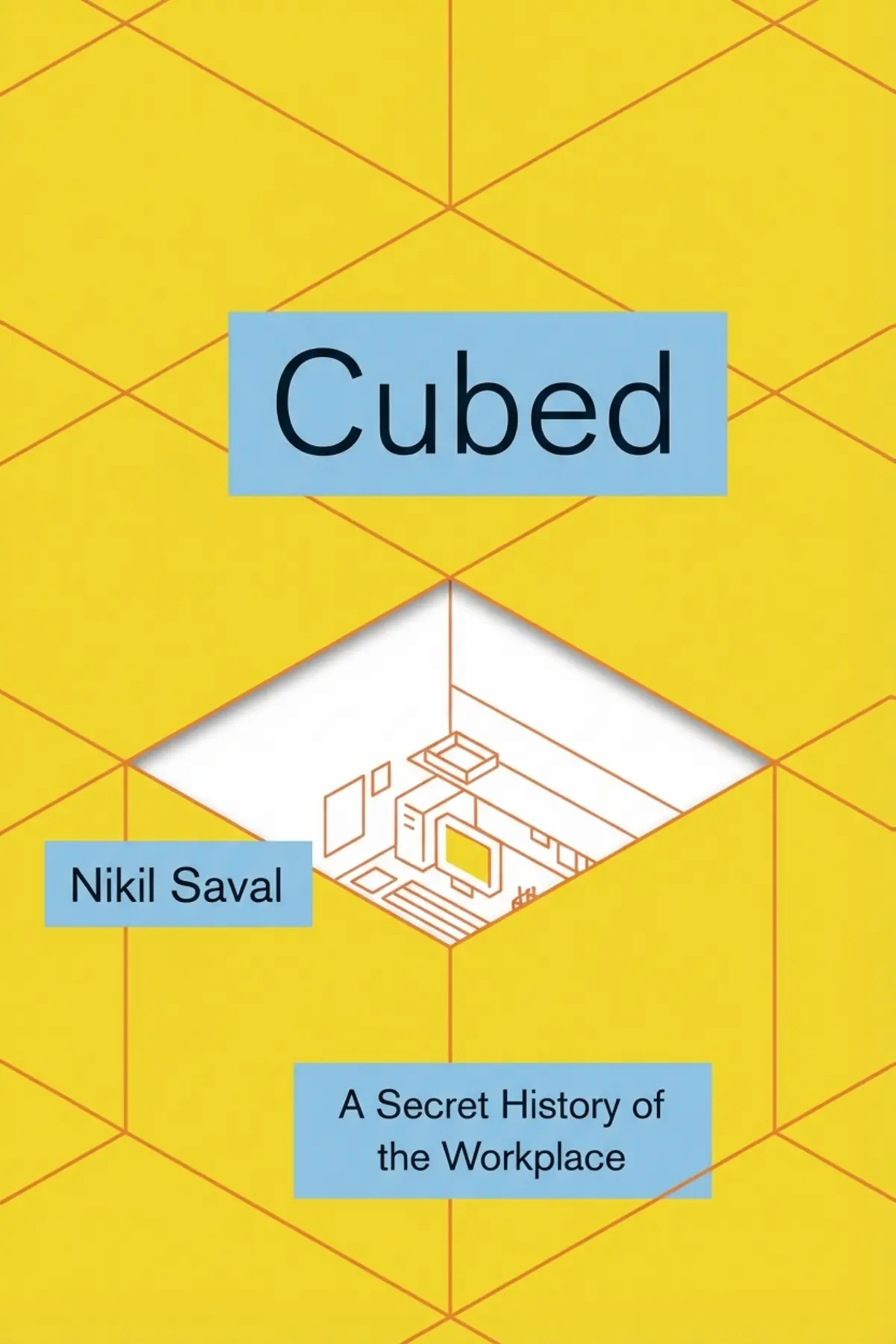
1 min 06 sec
If you spend eight or more hours a day at a desk, you probably treat the office as a fixed fact, like the weather. In Cubed, writer and editor Nikil Saval shows it is nothing of the kind. The cubicle-filled floor is a recent invention, shaped by trains and telegraphs, by fear of labor unrest and, in the end, by cost.
Saval follows the clerk’s cramped counting house as it turns into rows of typists timed with stopwatches. Then come skyscrapers with their own barbershops, open plans from postwar Germany and finally the cheap partitioned box. One thread runs through all of it. Every office layout carries someone’s idea of what workers are for, and those ideas came from money, machines and class politics far more than from the people doing the work.
Once you can see that thread, your own workplace looks different. The way the desks are arranged, the perks, who gets a door and who gets a partition all start to tell a story, and so does the question of what a better space would cost.
1 min 59 sec
Before typists and open plans, office work happened in dark rooms where a window was a stroke of luck. Even then, the building was already sorting people into two kinds of worker before anyone did a day’s work.
2 min 08 sec
A clerk who traveled sixty years into the future would barely recognize his own job. A single American engineer’s answer to the chaos he found there still decides how a lot of office work is measured.
2 min 03 sec
Early office towers offered libraries, dentists and barbershops to people whose desks were often drab. The reason has little to do with kindness, and a violent event in Chicago sits at the heart of it.
1 min 51 sec
Two German brothers looked at ruined cities and saw a chance to throw out the rigid rows of desks. Their method began with a question most companies still never ask about the people they seat.
1 min 56 sec
A furniture company hired an art professor to rethink office work, and he came up with an office built for health and movement. What happened to his idea explains the box many people sit in today.
1 min 19 sec
Cubed changes how you see the most ordinary room in many people’s lives. The cubicle looks like a neutral fact, but Saval shows it is the top layer of a long buildup. Beneath it lie the clerk’s separate entrance, Taylor’s stopwatch and the skyscraper barbershop meant to keep office staff apart from factory hands. Beneath it, too, lie the Schnelle brothers’ generous experiment and Propst’s Action Office, cut down to whatever companies were willing to pay. Technology, economic pressure and beliefs about how workers should be arranged built it together, one decision at a time.
That history gives you a sharper eye at work. Look at who has a door, a screen or a better seat, and ask whether the reason is the job or the rank, since the sound screens of the 1960s were mostly about rank. Treat perks as messages, the way the amenities in Chicago’s towers were. And if you ever get to shape a space, start where the Schnelles did, with how people and papers actually move. Come ready to make the case on cost, because that is where better designs have lost before.
The box around your desk was never inevitable. It was a choice, made cheaply, and choices can be made again.
Millions of people spend most of their waking hours in an office without ever asking why it looks the way it does. Nikil Saval argues that the cubicle-filled floor is a recent invention. It grew out of a long chain of changes in technology, business and ideas about how workers should be arranged. Saval starts with the nineteenth-century clerk working beside his boss in a cramped counting house. He follows the office through Frederick Taylor's efficiency methods, the skyscrapers of Chicago and New York, the open plans that German designers developed after the war, and Robert Propst's Action Office for Herman Miller. Along the way he shows how labor unrest, rising rents and above all cost decided what office workers got. Readers come away with a clear story of where the modern workplace came from. They also get a sharper eye for what their own desks, perks and partitions say about status, control and money.
Office workers who have spent years in open plans or cubicles and want to know how they got there.
Team leads and founders deciding how to seat people and what a workspace should signal.
Readers curious about how class, labor and money shaped everyday working life.
Nikil Saval, born in 1982, is a writer, editor, journalist and organizer. He worked as an editor at n+1, a literary magazine based in New York. Since 2021 he has served as a Democratic member of the Pennsylvania State Senate for the 1st district, which covers much of South Philadelphia and all of Center City. He is the first Asian American elected to that chamber.

Listeners find the book to be an engaging listen featuring an excellent narrative that explores the philosophy of management. In addition, the text offers a quality historical perspective, with one listener highlighting its fascinating chronicle of the office's development. However, reactions to the writing style are varied, as one listener describes the prose as verbose.
Ever wonder why your office feels like a maze of beige walls and fluorescent lights? Nikil Saval delivers a brilliant breakdown of how architecture and corporate culture merged to create the cubicle. The way he traces the evolution from 19th-century clerks to the tech campuses of Silicon Valley is nothing short of masterful. I particularly enjoyed the exploration of management philosophy and how it shifted from overt control to 'collaborative' spaces that are just new ways to monitor workers. It’s an enlightening, well-written journey through the spaces that define our adult lives. Highly recommended for anyone who feels like a gear in the machine. A truly fascinating accounting of history.
Show moreWow, what a deep dive into the soul-crushing reality of the white-collar world. Saval is an intellectual omnivore who manages to weave together pop culture references like Office Space and Dilbert with serious architectural history. I loved the way he explained how the cubicle was originally designed to be a flexible, human-centric space before corporations turned it into a tool for densification. It’s a fascinating accounting of how we ended up in these 'cubicles in new clothes' even in the most progressive tech companies. The narrative is engaging and provided a lot of 'aha!' moments for me. It’s a necessary read for anyone trying to survive the 9-to-5 grind.
Show moreFinally got around to reading this look at where we spend our lives. Saval maps out how the clerical world shifted into the modern corporate landscape we know today. It’s fascinating to see how the 'Action Office' was actually meant to be liberating before it became a series of felt-lined prisons. Some parts are definitely a bit wordy, but the narrative flow kept me turning pages despite the heavy research. It really makes you question the management philosophies that dictate our daily routines. If you’ve ever stared at a gray partition and wondered 'why?', this provides some much-needed context. It is a wonderful narrative for anyone curious about their environment.
Show moreThe chapter on the history of women entering the workforce was easily the highlight of this book for me. Saval does a great job illustrating how the physical office space was used to reinforce gender hierarchies and pay gaps. It’s sobering to realize that many of the issues faced by 'working girls' in the 50s are still echoing in our current corporate climate. While the book leans heavily into the academic side, the sections on the 9to5 movement and the 'Man in the Gray Flannel Suit' felt very personal. I wish there had been more focus on how technology is changing things right now, but the historical tack works well enough. A solid read.
Show moreAfter hearing several interviews with Saval, I was worried the book would be redundant, but I found it quite enlightening. He digs deep into the nitty-gritty of how skyscrapers and office parks changed the human psyche. The transition from the 'clerk' to the 'knowledge worker' is handled with a lot of nuance and careful research. I did find some of the earlier chapters a bit subdued and slow, but the payoff in the later sections is worth the wait. It’s a great reminder that our work environments are not accidents, but the result of specific political and economic choices. Look, it's not a light beach read, but it's very rewarding if you're a history geek.
Show moreFrankly, I didn't think a book about office furniture could be this interesting, but Cubed proved me wrong. It offers a wonderful narrative examining how management philosophies have physically shaped our workdays over the last century. I was particularly struck by the discussion on security and how modern co-working spaces often ignore the need for privacy and data protection. The book does a great job of showing that the 'future of work' is often just a recycled version of the past. My only gripe is that it can feel a bit verbose in the middle sections. Overall, it’s a smart and insightful look at the boxes we live in.
Show moreAs someone who spends forty hours a week in a permanent build cube, I had high hopes for this cultural history. There are plenty of interesting 'infobytes' here, especially concerning the sexism faced by early female workers and the rise of labor unions. However, the structure felt a bit weak and scattered across different disciplines like film analysis and architecture. I couldn't always tell if I was reading a history book or a critique of capitalism. The writing is easy enough to follow, but it lacks a certain heft or a unique angle. It’s a decent overview, but it doesn't quite stick the landing for me. A mixed bag, to be sure.
Show morePicked this up because I absolutely loathe the open office layout and wanted to understand its origins. While Saval covers a lot of ground—from Bartleby the Scrivener to the GooglePlex—the book feels a bit like a collection of essays rather than a cohesive whole. He shows that the modern 'hip' campus is often just window dressing for the same old bureaucracy we've had for decades. It’s informative, sure, but it lacks a definitive argument to tie all the research together. I appreciated the points about Propst and the unintended consequences of the Action Office 2. It's a solid 3-star read for those who like niche histories but don't expect a fast-paced thriller.
Show moreThis book was a massive disappointment given the interesting premise. It frankly felt like reading an undergraduate senior thesis where the author was desperate to show off every single source he found. Instead of a tight narrative, you get a dry list of facts about the history of the clerk that never quite coalesces into a strong argument. I was hoping for more insights into the psychological toll of the open office, but it stayed too academic and detached. To be fair, the research is exhaustive, but the execution is just too tedious for a casual reader. I ended up skimming the last third just to be done with it.
Show moreNot what I expected at all, and truth is, it's a bit of a chore to get through. The author seems more interested in being verbose and sounding intellectual than actually telling a compelling story about office design. It reads like a very long academic paper that desperately needed an editor to prune the redundant history of 19th-century filing systems. I wanted to learn about the modern workplace, but the focus was so heavy on the distant past that I lost interest. If you want the gist, just listen to an interview with the author and save yourself the headache. It’s dry, slow, and lacks any real wit or charm.
Show moreCubed is a history of the office. Saval traces it from nineteenth-century counting houses, where a few clerks sat beside their boss, through Taylor’s efficiency methods, office skyscrapers, the German Bürolandschaft and Robert Propst’s Action Office, to the cubicle. His argument is that each layout grew out of the technology, economic pressures and ideas about organizing workers that shaped its time.
Saval links the cubicle to Robert Propst’s Action Office, which he designed for Herman Miller after the company hired him in the late 1950s. The Action Office supported standing and sitting and had movable surfaces and modular walls, but it was too expensive. Companies cared more about price than about movement or employee health, so they bought small, cheap, enclosed cubicles instead.
Saval explains that the amenities in early skyscrapers were meant to make office workers feel well-off and separate from factory workers. Labor movements were criticizing big business, rising office rents in Chicago were pushing up living costs, and in 1886 a bomb went off in a Chicago skyscraper in connection with a labor union gathering. Perks helped turn office staff into a distinct class.
Taylorism was the method of the American engineer Frederick Taylor, who lived from 1856 to 1915. It split work into specialized tasks and pushed each worker to finish theirs as fast as possible. In crowded offices full of typists and messengers, it replaced confusion with order and stopwatch timing. It also brought factory-style efficiency into office work and helped administrative departments grow.
The book offers a lens more than a manual. Notice which divisions in your building reflect rank rather than the work, as the 1960s sound screens did. Ask what a perk expects in return. If you plan a team’s space, follow the Schnelle brothers and map who talks to whom and where files move before choosing a layout. Be ready to argue on cost, which decided the cubicle’s victory.
Charles C. Mann

James Shapiro
Andrew Ross Sorkin

Pankaj Mishra

Fay Bound Alberti

Ben Macintyre

Ron Chernow

Philip Freeman
AUDIO SUMMARY AVAILABLE
Get the key ideas from Cubed by Nikil Saval, plus 5,000+ more nonfiction titles.









