

15 min 12 sec
Available in: English
 ไทย
EnglishไทยCreative Confidence: Unleashing the Creative Potential Within Us All
Shows why creativity belongs to engineers, lawyers and managers as much as artists, and how to rebuild it by failing early, seeing familiar problems freshly, working in teams and acting on ideas quickly.
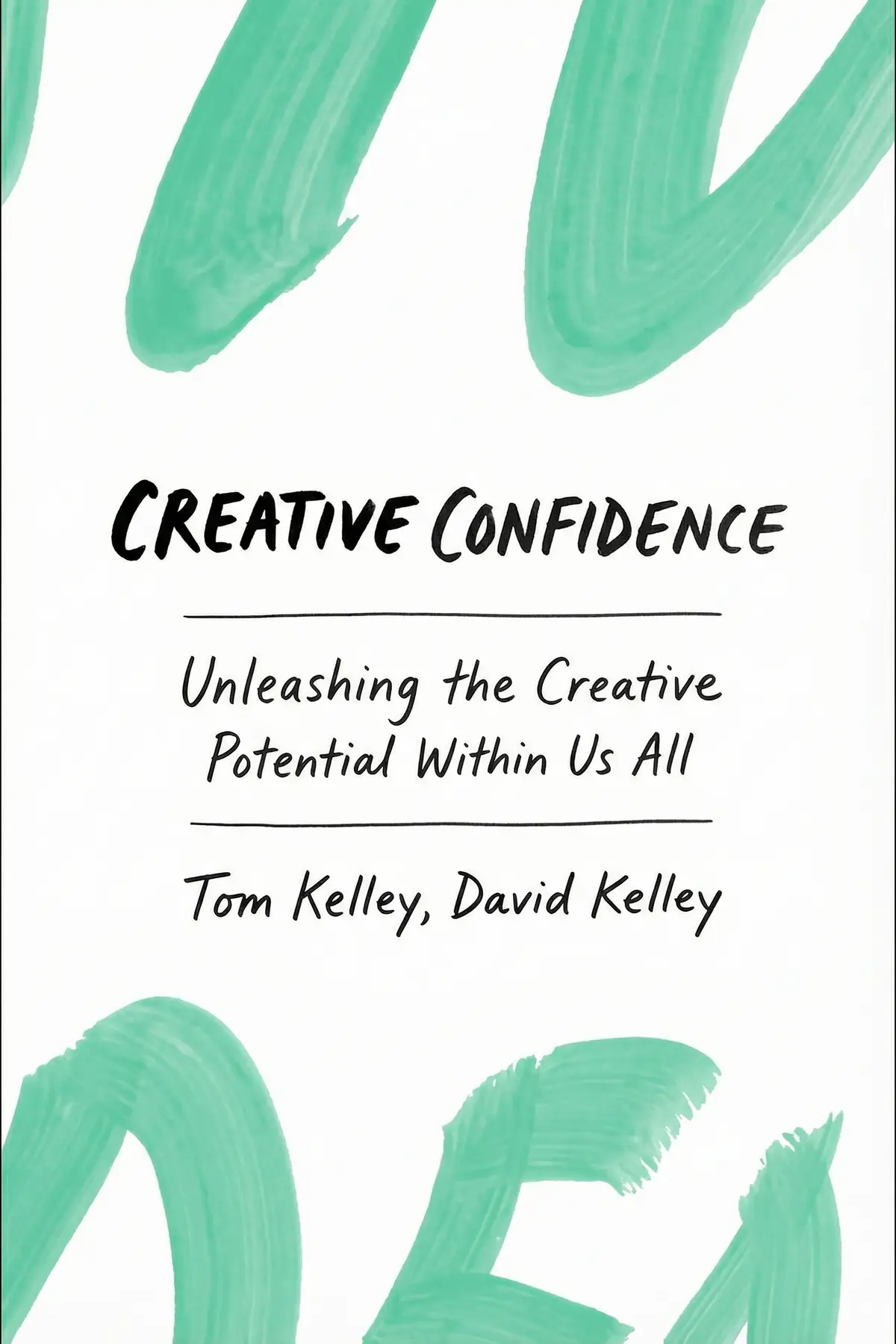
Table of Content
1. Introduction
1 min 05 sec
Plenty of capable professionals have filed themselves under not creative, often ever since a teacher told them to stop drawing and get back to real work. In Creative Confidence, brothers Tom and David Kelley of the design firm IDEO argue that this label is simply wrong. Creativity, as they define it, means using your imagination to make something new, so it covers a programmer’s fresh interface as much as a painting.
Everyone has this ability. Like a muscle, it weakens when it goes unused, but it never disappears. The Kelleys, drawing on IDEO and on the d.school at Stanford, make one case throughout: you win your creativity back by facing the fear of failing and acting anyway. Their evidence runs from a hospital scanner dressed up as a pirate ship to a radio editor who solved a cold wait at a bus stop in under a day. What the book offers is a way to approach problems at work and at home, and the nerve to try ideas before they feel finished.
2. Spot the creativity hiding in analytical work
1 min 49 sec
An MRI technician, very much the analytic type, struggled to help children feel safe inside the scanners. The fix he found came from a skill most adults believe they lost in primary school, and the authors insist it was never gone.
3. Treat creative skill as a career asset
1 min 43 sec
A schoolboy in Liverpool was advised to give up music for a sensible job in industry. The same message still reaches doctors and lawyers today, just as the people running large companies are starting to say the opposite.
4. Fail early so the final version flies
1 min 51 sec
The most celebrated creative minds in history did not fail less often than everyone else. One researcher found the opposite, and two brothers in North Carolina show why a quick first success can be a trap.
5. Find fresh ideas by seeing like a visitor
1 min 57 sec
Two students could have solved their assignment from a laptop. They chose to travel instead, and what they saw saved children’s lives. The cheaper version of their method works on an ordinary commute.
6. Share the problem and ideas multiply
1 min 46 sec
The image of the lone genius working in silence is appealing and, the authors argue, misleading. A blackboard covering a whole office wall hints at what actually keeps ideas flowing when your mind goes blank.
7. Turn I should into I will
1 min 45 sec
A camera giant saw the digital future coming and still froze. A radio editor in Manhattan heard about one cold bus stop and built a fix before the next day. The gap between them is a single sentence.
8. Build work that pays and feels like yours
1 min 57 sec
Tom Kelley got a desperate call offering serious money to return to his old consulting life. His answer, and the reasoning behind it, reframes the old choice between a safe salary and work you care about.
9. Conclusion
1 min 19 sec
What the Kelleys finally describe is a recovery. The creativity people had as children, building tree houses and solving small problems their own way, was trained out of many of them by classrooms and careers that called it unserious. It never left. It waits, like an unused muscle, for exercise, and the exercise is mostly courage: accepting early failure, going out to see problems firsthand, sharing half-formed ideas and acting today on what you already know.
None of this asks you to become an artist. Doug Mietz, an MRI technician, let himself redesign the machine that scared his young patients. John Keefe, a radio editor, simply stopped waiting for someone else to fix a cold bus stop.
The book also suggests passing the habit on. If you have children, push back against the school message to stay inside the lines: give them room to want unrealistic things, to paint wherever they like and to fail, so they learn to build their own answers. For yourself, choose one problem you have only been complaining about and make a rough attempt at fixing it before the week ends. The muscle grows back only when you use it.
About this book
What is this book about?
Many capable adults decided long ago that they are not creative, often because a teacher or a career told them imagination was a distraction from real work. Tom and David Kelley, the brothers behind the design firm IDEO, argue that the label is wrong. In their view, creativity simply means using imagination to make something new, so it includes a programmer's new interface or a CEO's fresh strategy. Everyone has it, and like a muscle it weakens without use but can be trained back. Drawing on their work at IDEO and at Stanford's d.school, the authors show what that training looks like. They tell of an MRI technician who turned frightening scanners into pirate ships for children, a pair of students whose travels produced a heated sleeping pouch for children in harsh climates, the Wright brothers' hundreds of failed trials and a radio editor who fixed a freezing bus stop wait in under a day. Readers get a practical way to approach problems at work and at home: treat early failure as information, look at routine things with fresh eyes, share half-formed ideas, close the gap between knowing and doing, and use the same creativity to balance money and passion in a career.
Book Information
Who it's for
Told they're not creative
Engineers, lawyers, analysts and managers who were told long ago that they are not the creative type.
Leads wanting braver teams
Team leads who want more ideas from their people and less fear of getting things wrong.
Weighing salary against passion
Parents and professionals weighing a safe salary against work they care about.
About the Author
Tom Kelley
David Kelley is an engineer, designer and educator who co-founded the design firm that became IDEO and has served as its chair. He has taught at Stanford University for more than 25 years and led the creation of its d.school, the Hasso Plattner Institute of Design. He is a member of the National Academy of Engineers. His brother Tom Kelley is IDEO's general manager and helped manage the firm as it grew from twenty designers to more than three hundred staff, while still joining hands-on prototyping and brainstorming sessions.
Ratings & Reviews
Ratings at a glance

What people think
Listeners find this book exceptionally accessible and functional, praising its lucid prose and effectively articulated ideas. Furthermore, it outlines a methodical approach to creative thinking and features detailed real-world examples that educators find especially useful. Listeners also value the inspiring nature of the material; one listener mentions it encourages a reassessment of life’s various facets, while another describes it as an excellent primer on the principles of design thinking.
Top reviews
Valentina
This book completely shifted my perspective on how I approach problem-solving in my daily life. Instead of viewing innovation as some mysterious lightning strike, Tom and David Kelley break it down into a repeatable, practical process. Personally, I found the chapter on 'failing forward' to be incredibly liberating because it reframes mistakes as necessary data points rather than personal failures. The writing style is approachable and energetic, making it a very quick read despite the depth of the concepts. It doesn’t just focus on business; it’s about regaining that childhood sense of play and curiosity that most of us lose by adulthood. If you’re looking for a roadmap to unlock your latent potential, this is definitely it. It's highly motivational without being overly cheesy.
Show moreKevin
As someone who works in the classroom, I found the case studies in this book to be an absolute goldmine for student engagement. The authors provide a clear, step-by-step framework that is perfect for teaching young minds how to tackle complex challenges without fear. It’s not just for CEOs; the principles of empathy and rapid prototyping are just as relevant for a middle school science project as they are for a tech startup. Gotta say, the emphasis on 'human-centered' design really resonated with my educational philosophy. The book is highly readable and manages to stay optimistic without feeling overly naive or unreachable. I’ve already started implementing some of the brainstorming exercises with my staff, and the results have been fantastic. It really helps you reevaluate your approach to teaching.
Show moreHassan
Picked this up during a career rut and it was exactly the spark I needed to start looking at my work differently. The authors successfully argue that creativity is a choice, not a trait, which is a very empowering realization for anyone stuck in a routine. Truth is, I found myself reevaluating several aspects of my personal life as well as my professional goals after finishing it. The emphasis on empathy and understanding the 'end user' is a game-changer for anyone in a service-oriented role. It’s a beautifully written, motivational guide that manages to be both inspiring and actionable. The case studies are rich and well-explained, making the concepts easy to grasp. Definitely worth the read if you feel like your innovative spark has dimmed lately.
Show moreThitima
Wow, what a refreshing perspective on innovation in a world that usually prioritizes logic and spreadsheets above all else. This book provides a much-needed bridge between the world of 'serious' business and the playful, messy world of creative exploration. The step-by-step process for design thinking is explained in such a simple, non-intimidating way that it makes you wonder why we don't work like this all the time. I particularly liked the focus on 'empathy maps' and how they can be used to solve real problems for real people. It’s a high-energy read that makes you want to go out and make something immediately. Every leader who thinks they 'aren't the creative type' should have a copy of this on their desk. It is both practical and deeply transformative.
Show moreSirichai
Finally got around to reading this after seeing it on every 'must-read' list for years. The Kelley brothers present a really compelling case that creativity isn't a rare gift but a muscle we can all strengthen. Truth is, the step-by-step methodologies for design thinking are laid out so clearly that even the most 'un-creative' person in accounting could find a way to apply them. I particularly appreciated the 'Creative Confidence To Go' section at the end for its actionable exercises. My only minor gripe is that it can feel a bit like a highlight reel for IDEO and the Stanford d.school at times. However, the core message about overcoming the fear of judgment is powerful enough to make those marketing moments easy to overlook. It’s a solid, practical introduction for anyone feeling stuck in a rigid corporate mindset.
Show moreFatou
The way the Kelley brothers weave together storytelling and practical advice makes for a very engaging experience. It’s rare to find a business-adjacent book that actually feels human and empathetic rather than cold and analytical. While some critics argue it’s too corporate, I think the real-world examples help ground the more abstract concepts in reality. Not gonna lie, I was skeptical about the whole 'everyone is creative' mantra at first, but the evidence presented here is hard to ignore. The book functions as a great introduction to the IDEO mindset, providing a clear path for those who feel blocked by a fear of failure. It’s an easy read that leaves you feeling energized and ready to tackle your next big project with a fresh set of tools.
Show moreSudarat
Ever wonder why we stop being 'creative' as we get older? This book dives deep into that question and offers a practical way to reclaim our lost confidence. The authors focus heavily on the 'do' part of creativity, encouraging readers to stop overthinking and start building low-fidelity prototypes immediately. In my experience, this bias toward action is exactly what most teams are missing when they get bogged down in endless meetings. The writing is clear and the layout is visually inviting, which matches the creative spirit of the content perfectly. It might be a little light on the academic side, but for a motivational boost and a step-by-step guide to design thinking, it hits all the right notes. It's definitely changed how I view my own potential.
Show moreAisha
To be fair, I expected a bit more substance and a few less anecdotes about how amazing their own projects are. While the central premise is inspiring, a lot of the advice feels like a collection of common-sense design principles: talk to users, use sticky notes, and prototype quickly. For someone already working in a creative field, many of these 'revelations' will feel like old news or even slightly redundant. It often reads like a long recruitment brochure for the d.school, which gets a bit tiresome after the third or fourth chapter. That said, the specific activities in the final section are quite useful for breaking out of a rut. It’s a decent motivational tool for beginners, but veterans of the design world might find it a bit fluffy and corporate.
Show moreChatchai
After hearing so much hype about this title, the reality was a bit of a mixed bag for me. On one hand, the core message is incredibly positive and the authors are clearly experts in their field. On the other hand, the constant name-dropping of d.school and big-name corporate clients makes it feel a bit like a long sales pitch. To be fair, the 'Move' chapter at the end provides some concrete activities that saved the book for me. It’s a great 'Design Thinking 101' for someone who has never heard of it, but it doesn't offer much new for anyone with a design background. It's essentially a well-written cheerleader for a very specific methodology. Useful, but ultimately a bit repetitive and relentlessly focused on business success.
Show moreRapee
Look, if you’ve ever worked in a modern office, you’ve heard every single one of these corporate buzzwords before. I was hoping for deep insights into the psychology of creativity, but what I got was mostly 'business blah-blah' and success stories about billions of monies made. The authors seem more interested in promoting their consulting firm than providing actual, rigorous techniques for generating new ideas. It follows that classic bad self-help formula where one simple idea is stretched across hundreds of pages using confirmation bias and long-winded examples. Frankly, you could probably get the same value from a ten-minute summary online. Unless you are brand new to the concept of design thinking, skip this and find something with more meat on the bones. It's essentially a high-priced brochure.
Show moreQuestions about this book
What is the main idea of Creative Confidence?
Tom and David Kelley argue that creativity is not a gift reserved for artists. They define it as using imagination to make something new, which includes a programmer’s interface or a CEO’s strategy. Everyone has this ability, and like a muscle it weakens without use but can be trained back. The way to rebuild it is to face the fear of failure and act: test early, seek new experiences, work with others and follow through.
Who should read Creative Confidence?
It suits people in analytical jobs, such as medicine, law, engineering or management, who have been told creativity has no place in their work. It also helps team leads trying to get more ideas from their people, and anyone stuck between a well-paid job and work they care about. The authors draw on their experience at the design firm IDEO and at Stanford’s d.school.
Why do the Kelleys say failure is good for creativity?
They cite Professor Simonton of the University of California, who found that famous creative geniuses failed more often than others, then learned from it and adjusted. Early failures expose weaknesses while they are still easy to fix. The Wright brothers went through hundreds of failed unmanned trials before their 1903 flight at Kitty Hawk, and the authors suggest that without them the brothers might have crashed.
How can I apply Creative Confidence at work?
Start by dropping the belief that you are not creative. Look at routine tasks as a visitor would and keep asking why things work as they do. Talk directly to the people who struggle with a problem, as IDEO did with elderly users of kitchen tools. Share rough ideas with colleagues, and replace I should with I will, the way John Keefe built a bus tracking phone line in under a day.
What is the knowing-doing gap in Creative Confidence?
It is the space between knowing what you should do and actually doing it. The authors point to Kodak, whose innovation team saw in the 1990s that photography would go digital but was too afraid to change course, and which has kept losing market share since. Their fix is a change of mind-set, in which “I know I should probably do this” gives way to “I will do this.”
Featured in
Readers also enjoyed





AUDIO SUMMARY AVAILABLE
Listen to Creative Confidence in 15 minutes
Get the key ideas from Creative Confidence by Tom Kelley, plus 5,000+ more nonfiction titles.
- 5,000+ titles
- Listen as much as you want
- 7-day free trial
- Cancel anytime









