
15 min 42 sec
Available in: English
Crashed: How a Decade of Financial Crises Changed the World
By Adam Tooze
Adam Tooze shows how the 2008 financial crisis, and the slow, divided rescue that followed, spread from American mortgages to European banks and then into Greek austerity, war in Ukraine, Brexit and Trump's election.
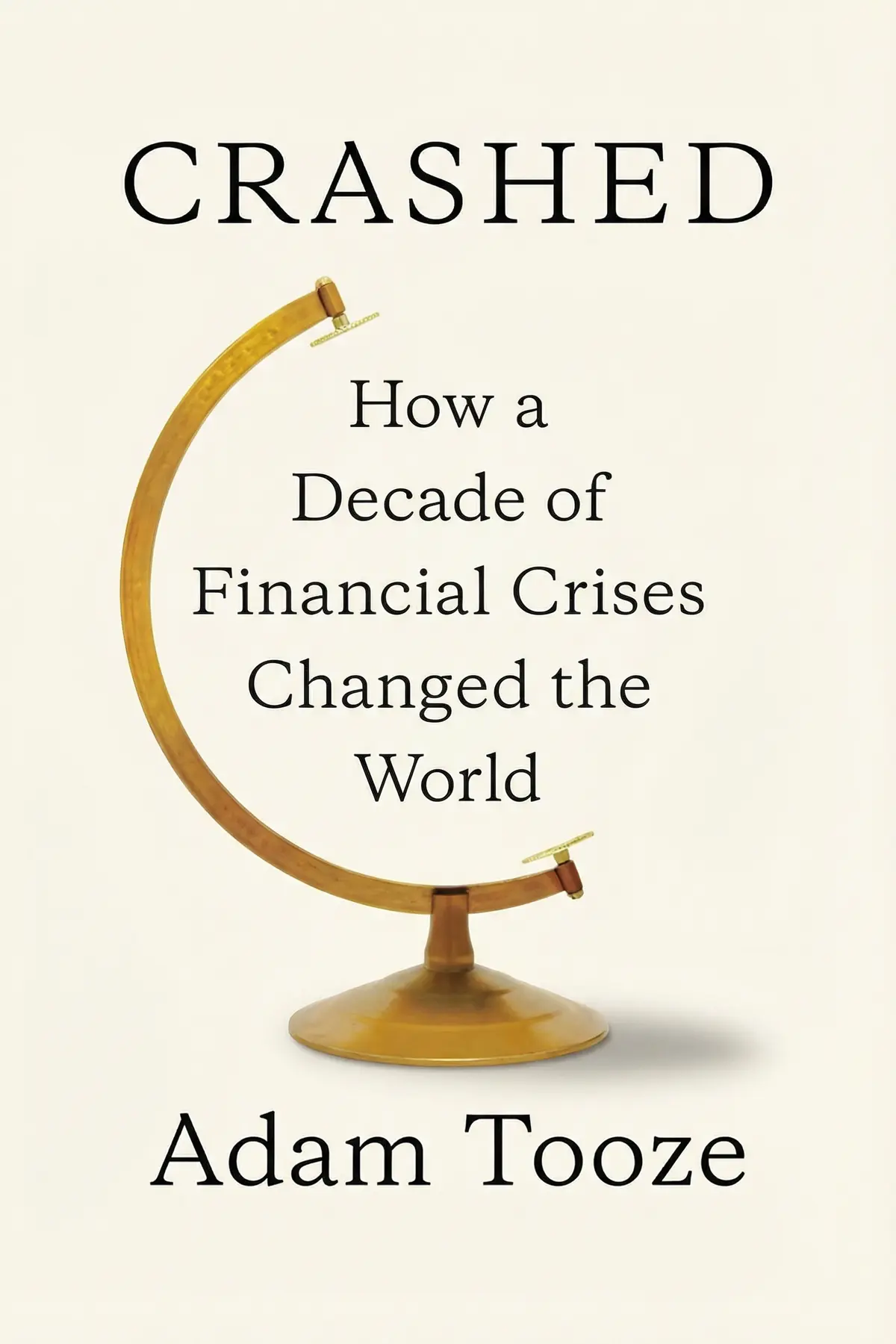
Table of Content
1. Introduction
58 sec
If a decade of headlines feels like a string of unrelated shocks, from Greek austerity and war in Ukraine to Brexit and Donald Trump, Adam Tooze reads them as one story. In Crashed, the Columbia University historian traces each upheaval back to the financial crisis of 2008 and to the way governments handled it. Before the crash, Western politics had settled into a broad agreement that markets should run themselves. The crash broke that agreement, and the repair made things worse.
Banks were saved while ordinary people paid, and rich countries refused to share the burden with weaker neighbors. Follow the money from American mortgages to European banks, then to Athens, Kiev, London and the American ballot box, and a confusing decade becomes a chain of causes you can explain. Tooze insists that any way back to stability starts with getting this history right.
2. Read the slow fuse behind a sudden crash
1 min 49 sec
Lehman Brothers collapsed on one September day, yet the charge that blew it apart had been laid decades earlier. A warning given in Wyoming three years before shows how visible the danger was to anyone willing to look.
3. Spot the hidden weakness in Europe's banks
1 min 46 sec
Europe liked to see 2008 as an American illness that crossed the ocean. The figures on what European banks borrowed and bought tell a far more uncomfortable story, and a French bank sounded the alarm first.
4. A shared currency needs a shared rescue plan
1 min 40 sec
America answered the crash by creating money on a vast scale. Europe had a central bank too, yet one government’s memory of the 1990s kept the continent from reaching for the same medicine.
5. See who really pays for a bailout
1 min 53 sec
Ireland promised to stand behind its banks and went broke keeping the promise. Greece’s rescue came with conditions that wealthy democracies had only ever imposed on others, and the bill landed on one particular group of people.
6. Follow the money that led to war in Ukraine
2 min 03 sec
A shrinking steel industry and two rival aid offers put Ukraine at the center of a contest between Russia and the West. The bigger offer won at first, and that is where the real trouble began.
7. Trace Brexit back to London's trading floors
2 min 13 sec
For decades London grew rich because banking rules were strict somewhere else. The crash undid much of that advantage, and a referendum meant to calm a restless party ended up carrying Britain out of Europe.
8. Understand how unpunished bankers emptied the political center
2 min 14 sec
While millions of families lost their homes, one failing insurer announced hundreds of millions in staff bonuses. The fury that followed found no outlet in 2012, and four years later it swung three states that decided a presidency.
9. Conclusion
1 min 06 sec
Crashed adds up to a warning about what happens after the emergency. The panic of 2008 was contained: the Federal Reserve printed money, the troika lent, the banking system survived. What failed was everything around the rescue. Governments acted late or alone, and those who wrecked the economy kept their bonuses while Greek workers, Florida homeowners and users of Britain’s health service paid the bill. That imbalance, in Tooze’s reading, is how an economic crisis became a political one, still felt more than a decade after the worst crash since 1929.
The habits of mind it leaves are worth keeping. When a crisis seems to come from nowhere, look for the slow fuse of cheap credit, rising prices and risk everyone believes has been spread away. When a group shares a currency, a budget or a fate, ask whether it also has a plan for sharing hard times. And when the next rescue is announced, watch who carries the losses.
The AIG bonuses lasted a news cycle. The anger they fed is still deciding elections.
About this book
What is this book about?
After the Cold War, Western politics settled into a comfortable consensus: let markets run, and the old fights between left and right would fade. The financial crisis of 2008 ended that. Historian Adam Tooze argues that the political shocks of the following decade, from Greek austerity and the war in Ukraine to Brexit and the election of Donald Trump, all trace back to the crash and to how governments chose to manage it. Tooze follows the chain step by step. Deregulated American lenders issued subprime mortgages that were bundled and sold to investors. European banks bought heavily, often with borrowed money, and turned out to be even more exposed than Wall Street. The US Federal Reserve moved fast, while Germany blocked a joint European response and left smaller countries to the IMF and harsh austerity. Russia exploited the weakness of its neighbors, London lost ground as a financial center, and bonuses paid to the bankers behind the disaster turned public anger against the political center. Readers get a clear account of how one crisis became many, and a simple way to judge the next rescue: ask who carries the losses.
Book Information
Who it's for
Professionals following world news
Professionals who followed Brexit, Ukraine and Trump in the news and want to see how they connect.
Finance workers and investors
Investors and finance workers who want the story of 2008 told well beyond Wall Street.
Economics, history, politics students
Students of economics, history or politics looking for one clear account of the decade after the crash.
About the Author
Adam Tooze
Adam Tooze is a professor at Columbia University, where he directs the European Institute. He studied economics at King's College, Cambridge, then studied in Berlin, and earned a doctorate in economic history at the London School of Economics. He taught at Cambridge and then spent six years at Yale. He received a Philip Leverhulme Prize for Modern History in 2002, and his book The Wages of Destruction was among the Wolfson History Prize winners in 2006. He also writes the newsletter Chartbook.
Ratings & Reviews
Ratings at a glance

What people think
Listeners find the work offers a deep analysis that is easy to follow, with one listener noting it functions as an encyclopedic foundation for economic activity. Furthermore, the writing quality is well-regarded, and listeners value the narrative approach, with one calling it the best story of the financial crash. The book also earns praise for its financial insights, as one listener points out its crucial role in averting a global financial meltdown. Conversely, the political themes and authorial perspectives draw varied responses; while some listeners commend the author’s proficiency, others voice concerns regarding the political environment and a liberal bias.
Top reviews
Sureerat
This book is an absolute unit of historical analysis. Adam Tooze manages to weave together the disparate threads of the 2008 Lehman collapse, the subsequent Eurozone nightmare, and the rise of contemporary populism into one coherent, albeit terrifying, tapestry. It is staggering. In my experience, most authors either get lost in the weeds of technical finance or hover too high in the clouds of abstract political theory, but Tooze occupies the perfect middle ground. He demystifies the granular mechanics of dollar swap lines and bank balance sheets while never losing sight of the human cost. The way he frames the crisis as a political choice rather than a mere market failure is essential. It completely shifted my perspective on why the recovery felt so lopsided. Personally, I think this should be mandatory reading for anyone trying to understand why the world feels so broken today. It’s dense, yes, but the prose has a literary punch that keeps you moving through the data.
Show morePloy
As someone who lived through the 2008 crisis while working in the financial sector, I found Tooze’s account to be startlingly accurate and deeply uncomfortable. He hits the nail on the head regarding the sheer fragility of the system. The book serves as a crucial narrative of how central banks basically became the world's firefighters without a clear map of the building. I was captivated by his description of the 'G2 world' and the surprising solidification of the US dollar despite the chaos originating in New York. The writing quality is top-tier; it doesn't feel like a dry textbook at all. Instead, it’s a sprawling story about the people—Geithner, Merkel, Bernanke—and the impossible choices they faced. He doesn't just explain the 'what' but explores the 'why' of the political fallout that followed. It’s the best story of the financial crash currently available on the market. Truly a masterpiece of contemporary history.
Show moreFinn
Wow, I finally understand why the Eurozone crisis was such a protracted disaster compared to the US recovery. Tooze explains the 'troika' and the sadistic austerity forced on Greece with such clarity that it makes your blood boil. The truth is, most books on this topic are either too partisan or too technical, but this one finds the sweet spot. He shows how the lack of a unified political institution in Europe turned a banking problem into a total social collapse. I loved the way he tracked the flow of dollars across the Atlantic. It made me realize how interconnected we really are. The narrative is fast-paced despite the length. It’s easily the most comprehensive look at the GFC available. If you want to understand the mechanics of how the global elite averted—and sometimes invited—disaster, buy this book. It is a demanding but very worthwhile read that I will likely revisit.
Show moreDream
Picked this up after hearing the author on a podcast and it lived up to the hype. This is a first-rate history of how the 2008 financial crisis reverberated across the entire globe. Tooze is particularly strong in unpicking the role of historical contingency—how specific actions by a handful of people changed everything. It’s a globetrotting journey from the subprime mess in Detroit to the streets of Athens and the halls of the Kremlin. I found the analysis of the Fed’s currency swap lines to be the most enlightening part of the whole book. It’s a demanding read, but the prose is so engaging that the pages fly by. He avoids the standard macroeconomic traps and focuses on the actual flow of money. Truly, it’s a holistic view that combines geopolitics and corporate trends into a wider, necessary narrative. This is essential reading for understanding the modern world.
Show moreAnawin
After hearing so much about 'neoliberalism' and 'globalism,' it was refreshing to see someone actually map out the mechanics of how that world almost died. Tooze is that rare author who knows a lot about a lot. This book is so comprehensive and so insightful that it feels like the definitive word on the decade. He understands nuanced political thought in every country he covers, from the US to South Korea. I know the most about the aftermath of the 2008 crisis in America, and his description is exactly on point. It’s politics, stupid. Not just the economy. He shows how political choices shaped the recovery and created the inequality that led to our current turmoil. The way he ties the Ukraine crisis into the financial narrative was a stroke of genius. It’s a massive achievement in historical writing. Highly recommended for anyone who wants to see the forest and the trees.
Show moreMaja
Ever wonder how we actually got from the 2008 mortgage meltdown to the current era of Brexit and Trump? Tooze provides the most exhaustive reference point I’ve ever encountered on the subject. To be fair, it is a demanding read that requires your full attention for several hundred pages. I particularly appreciated the focus on how European banks were essentially just an extension of Wall Street’s greed, something often overlooked in US-centric accounts. My only real gripe is that the section on the 2015 Chinese market slump felt a bit rushed compared to the painstaking detail given to the Fed’s early interventions. Still, the author’s competence is undeniable. He takes a globally integrated financial system facing total collapse and makes the rescue efforts feel like a high-stakes thriller. It’s an insightful look at the 'extend and pretend' policies that defined a decade of misery for the Eurozone’s periphery. Worth the effort if you have the stamina.
Show morePrim
Tooze is a master of the 'big picture' narrative, and this book proves he knows a lot about a lot. Look, I didn't know much about the nuances of the Ukraine crisis or the specific mechanics of the ECB’s failures before picking this up. Now, I feel significantly more informed. The thesis is clear: economics is never just about numbers; it’s about power and political will. Not gonna lie, some of the chapters on Eastern Europe were a bit of a slog, but they are necessary to understand the full global scope. The author’s ability to jump from the Fed's balance sheet to Putin’s geopolitical maneuvering is impressive. I noticed some people complain about a liberal bias, and while he certainly has a point of view, his data is rock solid. It’s an encyclopedic background for anyone who wants to understand the shifting economic policies of the last ten years. A solid four stars.
Show moreNaomi
The truth is, most economics books are dry as dust, but this reads like a high-stakes political drama. Tooze handles the narrative of the 2008 crash with such skill that you almost forget you’re reading a 700-page tome on macro-financial statistics. It’s brilliant. He perfectly captures the tension between the need for fast decision-making in a crisis and the slow, grinding wheels of democracy. I did find his occasional personal opinions on certain political figures to be a bit distracting at times, but it didn't ruin the experience. To be fair, the book is at its strongest when it focuses on the Fed’s role as the global lender of last resort. The connections he draws between the financial meltdown and the rise of nationalist movements are fascinating, even if some of the links feel a bit speculative. Overall, it’s a great place to start for anyone interested in the intersection of finance and power.
Show moreMan
Gotta say, the sheer scope of this research is intimidating but rewarding. Adam Tooze provides an encyclopedic background for the economic actions that defined my adult life. He doesn't just stop at the US borders; he goes deep into the dynamics of the PIIGS and the massive Chinese stimulus package. In my experience, very few writers can synthesize this much information without becoming incoherent. My only minor criticism is that the writing style can be a bit 'at the moment' journalistic, which sometimes sacrifices depth for speed. Also, the author’s perspective does lean toward a specific brand of transatlantic liberalism that might grate on some readers. However, his competence in explaining the 'dollar-denominated debt' problem is world-class. If you've never read anything else on the 2010 Eurocrisis, this is the book to get. It’s thorough, insightful, and surprisingly easy to follow given the complexity of the subject matter.
Show moreMalee
Frankly, I found the second half of this book to be a massive disappointment. While the first few chapters provide a decent retelling of the 2008 crisis, the later sections read like a collection of run-of-the-mill journalism articles you’d find in a weekend magazine. The author spends way too much time on 'he said, she said' accounts of meetings between Merkel and Sarkozy without providing enough historical distance or actual analysis. Where is the clarity that ten years of hindsight should provide? Instead of a strong thesis, we get a smattering of quasi-related events like Trump’s election and Brexit that aren't tied together with much rigor. It felt like Tooze was rushing to meet a deadline rather than writing a definitive history. For a book that claims to show how a decade of crises changed the world, it fails to advance a truly original argument. It’s too long and lacks the deep insight I expected.
Show moreQuestions about this book
What is the main idea of Crashed by Adam Tooze?
Tooze argues that the political upheavals of the decade after 2008, including Greek austerity, the war in Ukraine, Brexit and Donald Trump’s election, all trace back to the financial crisis. The crash itself was contained, but governments responded late, without coordination, and without punishing those responsible. That turned an economic crisis into a political one, and ended the post-Cold War consensus that markets should simply be left to run.
What caused the 2008 financial crisis according to Tooze?
He traces it to the deregulation of US lending in the 1970s and a housing boom in which prices almost doubled between 1996 and 2006. Lenders issued risky subprime mortgages, then bundled and sold them through securitization. When the bubble burst, borrowers defaulted and home values fell together, leaving banks like Lehman Brothers, with two-thirds of its $133 billion in securities in subprime loans, unable to survive.
Why did the Eurozone crisis hit Greece and Ireland so hard?
Eurozone members could not print their own money, so only a joint rescue could help weaker states. Merkel’s Germany refused, fearing voter anger and recalling resentment over paying East Germany’s debts after reunification. Ireland went bankrupt guaranteeing its banks’ debts, and Greece became insolvent. The IMF, together with the European Commission and the European Central Bank, then made loans in return for severe austerity.
How did the 2008 crash lead to Brexit and Trump?
In Britain, austerity after 2010 strained public services and fed resentment toward EU migrants and distant elites, pushing David Cameron into a referendum he expected to win. In America, bankers kept huge bonuses, including at the failing insurer AIG, while millions lost their homes. Anger at a system seen as serving an elite drove voters toward outsiders, and about seven million Obama voters switched to Trump.
How can I apply the ideas in Crashed?
The book suggests three habits. Look for the slow build-up behind sudden crises: easy credit, rising prices and confidence that risk has disappeared. Check whether any group that shares a budget or currency also has a plan for sharing losses. And judge every rescue by who absorbs the losses and who keeps the gains, because Tooze shows that voters eventually judge it that way too.
Readers also enjoyed


A River in Darkness: One Man’s Escape from North Korea
Masaji Ishikawa

A Splendid Exchange: How Trade Shaped the World
William J. Bernstein

A Theory of Justice
John Rawls






A Warning
Miles Taylor
AUDIO SUMMARY AVAILABLE
Listen to Crashed in 15 minutes
Get the key ideas from Crashed by Adam Tooze, plus 5,000+ more nonfiction titles.
- 5,000+ titles
- Listen as much as you want
- 7-day free trial
- Cancel anytime









