
14 min 13 sec
Available in: English
Common Sense on Mutual Funds: New Imperatives for the Intelligent Investor
Shows why most fund investors lose ground to fees, trading and taxes, and how a low-cost mix of index funds and quality bonds, held for decades, keeps more of the market's return.
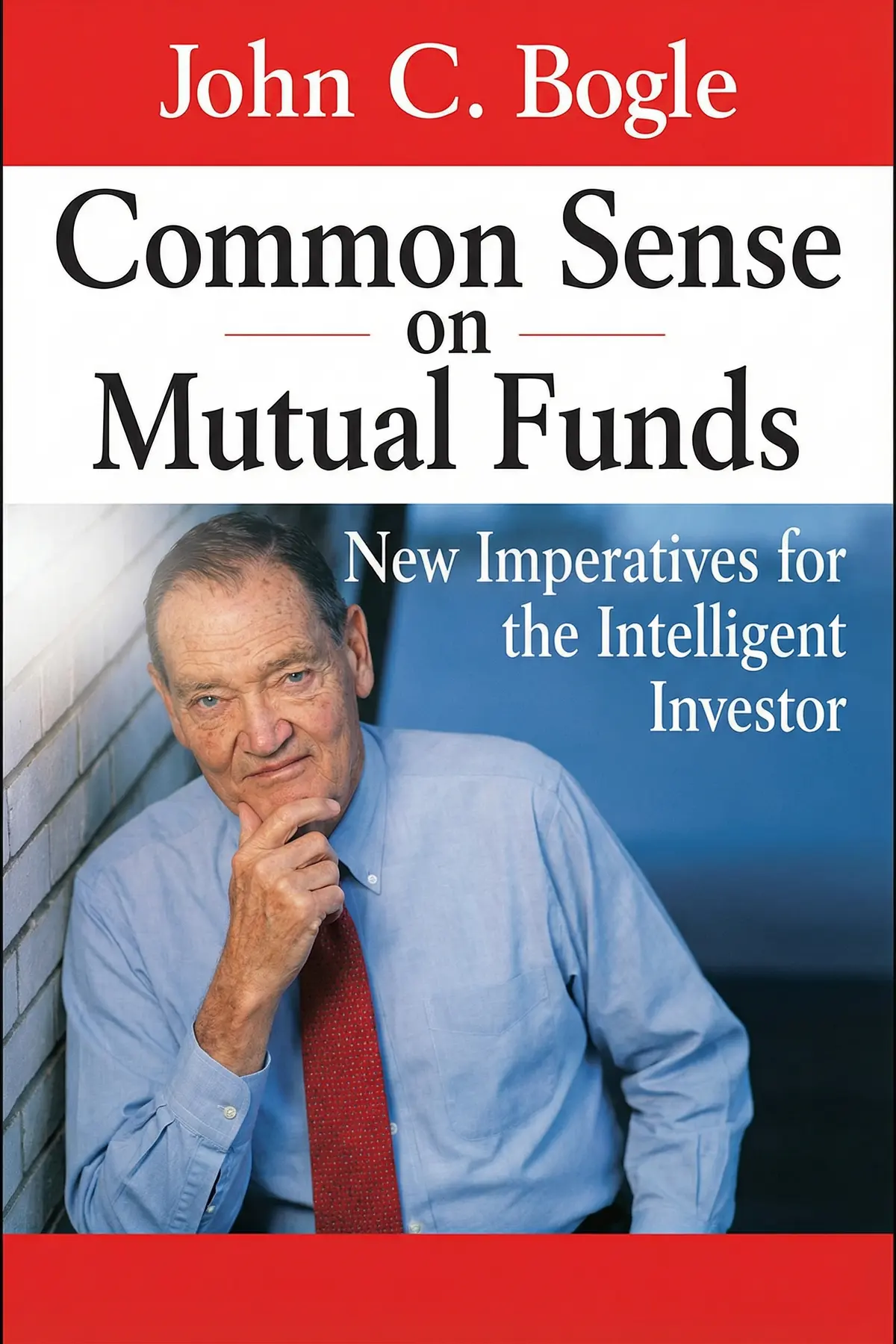
Table of Content
1. Introduction
57 sec
Most people who own mutual funds are paying for help that leaves them poorer. In Common Sense on Mutual Funds, John C. Bogle, the founder of the investment firm Vanguard, points to a blunt figure: over the long run, 85 percent of actively managed funds fall behind the market they are trying to beat. His argument is that the reliable path to wealth is the plain one. Hold low-cost index funds and good bonds in a sensible mix, leave them alone for decades, and refuse the fees, taxes and trading that an industry built for its own profit keeps pushing on you.
The book moves you from trusting a fund’s advertising to judging it on cost, turnover and who owns the manager. Along the way come the rise and slowdown of a famous fund, a tax bill most investors never notice, a simple rule for splitting money between stocks and bonds, and the signs of a firm that actually works for its investors.
2. Find out who your fund really works for
1 min 52 sec
Your fund has a board, a manager and a glossy brochure, yet none of them may answer to you. Bogle traces the ownership quirk that lets fees climb, and who ends up paying for the advertising.
3. Stop paying managers who trail the market
1 min 51 sec
Hiring a professional to pick stocks feels like the responsible choice. The long-run scorecard tells a different story, and part of it is hidden in trades you never see and funds that disappeared.
4. Read past performance without being fooled
1 min 45 sec
One fund returned 29 percent a year for over a decade, and money flooded in. What happened next explains why a glowing track record can be one of the weakest reasons to buy.
5. Keep more of your gains after taxes
1 min 36 sec
Two investors can own funds with the same reported returns and end up with very different sums. The difference comes from a bill most people never notice arriving, year after year.
6. Set your stock and bond mix by age
1 min 50 sec
Most investors agonize over which fund to buy and barely think about a decision Bogle considers far bigger. He reduces it to a starting rule you can work out from your birthday.
7. Let time compound while traders pay fees
1 min 41 sec
Selling before a slump and buying back near the bottom sounds like plain good sense. Bogle explains why the people who try it usually end up behind the ones who did nothing at all.
8. Choose a fund company that puts you first
1 min 38 sec
Where executives sit on a plane and where they eat lunch may seem irrelevant to your savings. Bogle argues these small habits reveal whether a firm will protect your money or spend it.
9. Conclusion
1 min 03 sec
Bogle’s book changes where an investor looks. Most attention goes to choosing the right manager or the right moment to buy. His evidence points toward the things you can actually control: what you pay, how often your money is traded, how much tax you hand over, how your savings are split, and how long you leave them alone. Almost anyone can earn the market’s return. The industry’s costs decide how much of it reaches you.
The first steps are modest. Look up the fees and turnover of every fund you hold, and ask who owns the company running each one. Set a mix of stocks and bonds close to your age, and rebalance it occasionally instead of reacting to the news. When an advertisement boasts of a recent winning streak, think of Magellan swelling to $75 billion, and of the 85 percent of active managers who fall behind the market over time.
Then comes the hardest part, which is doing nothing. A garden grows when the gardener stops digging it up.
About this book
What is this book about?
Most people who buy mutual funds assume they are paying for expertise that will grow their savings. John C. Bogle argues that for most investors the opposite is true. Over the long run, about 85 percent of actively managed funds fall behind the market, while their fees, heavy trading and tax bills eat steadily into what investors keep. Bogle, who founded Vanguard and started its 500 Index Fund, traces the problem to how the industry is built. Fund shareholders do not own the companies that manage their money, boards rarely push back on fees, and marketing paid for by investors pushes them to chase last year's winners. He uses the rise and slowdown of the Fidelity Magellan Fund, along with figures on taxes and turnover, to show why star performance fades. The book's answer is deliberately plain: low-cost index funds, high-quality bonds in a mix tied to your age, occasional rebalancing and the patience to let compounding work. Readers get a short list of things to check in any fund and any fund company, and a reason to ignore most of what the industry sells.
Book Information
Who it's for
Never checked fund fees
Savers who own mutual funds and have never checked what they pay in fees.
Young professionals planning retirement
Young professionals setting up a first retirement portfolio who want a plan they can keep.
Investors tempted to trade
Investors tempted to sell in every downturn or chase last year's top fund.
About the Author
John C. Bogle
John C. Bogle founded Vanguard in 1974 and ran it as chairman and chief executive until 1996, staying on as senior chairman until 2000. A Princeton economics graduate, he had worked with a predecessor firm since 1951, and in 1975 he launched the Vanguard 500 Index Fund. He spent his career urging investors to hold for the long term and keep costs low. Common Sense on Mutual Funds, published in 1999, became a bestseller and is regarded as a classic. Bogle died in 2019.
Ratings & Reviews
Ratings at a glance
What people think
Listeners describe the material as exceptionally clear and simple to grasp, though one individual remarks that it feels similar to a college textbook. They also value its utility as a manual for investing, with one listener labeling it the finest financial title available on mutual funds. Finally, the caliber of the content earns praise, with one listener emphasizing the use of historical data going back several hundred years.
Top reviews
Dylan
John Bogle’s masterpiece is less of a typical finance book and more of a historical manifesto for the common investor. He uses historical data going back several hundred years to prove that the "arithmetic of investing" is undefeated. While some chapters read like a dense college text, the core message is incredibly easy to understand: keep your costs low and stop trying to outsmart the market. The book is an essential investment guide that exposes how the financial industry prioritizes their own profits over your retirement. It’s a dense read, but if you want to understand the economics of mutual funds, there is simply no better source available.
Show moreUbolwan
Why did I wait so long to read this foundational text? Bogle is practically a saint in the investing world, and his passion for the individual shareholder shines through every page. He doesn't just give advice; he provides a meticulous breakdown of why index funds are superior to active management. The truth is, most managers are just charging you high fees to underperform. I loved the section on the "four dimensions of investing"—risk, return, cost, and time. It’s a long book, and occasionally repetitive, but the wisdom inside is worth every second of your time.
Show moreWanida
The 10th-anniversary edition is a bit of a mixed bag because of the formatting, but the content is gold. I really enjoyed Bogle’s updates where he reflects on his previous predictions—he’s remarkably humble when he’s wrong and rightfully vindicated when he’s right. But the way these updates are spliced into the original text can be confusing, especially if you’re listening to the audiobook version. That being said, the core logic remains impeccable. He rips into the "marketing machine" of Wall Street that treats investors like customers rather than owners. If you can push through the dense, academic-style prose, you’ll come away with a much clearer understanding of how to build a portfolio.
Show moreWyatt
Look, if you want a get-rich-quick scheme, go somewhere else. This is a book about discipline, patience, and the cold, hard math of compounding. Bogle explains that the "winner’s game" is simply avoiding the "loser’s game" of high costs and frequent trading. The historical data he presents is staggering and makes a very compelling case for why index funds are the only logical choice for 99% of people. Some parts feel like a college textbook, but that’s actually a plus—it means he’s backing up his claims with substance instead of just shouting vague platitudes at the reader.
Show moreAnna
To be fair, this is one of the most exhaustive looks at the mutual fund industry ever penned. Bogle focuses heavily on the cost structure of funds, illustrating how seemingly small fees can cannibalize a huge portion of your lifetime returns. I appreciated the specific rules for selecting funds, like ignoring "stars" and avoiding large asset sizes that inhibit performance. However, be prepared for some heavy jargon. If you aren't already familiar with expense ratios or turnover, you might find yourself reaching for a dictionary early on. Despite the occasionally dry tone, the information quality is top-tier. It serves as a sobering reminder that we are often our own worst enemies when we try to time the market.
Show moreWatcharaporn
Ever wonder why your portfolio isn't growing as fast as the S&P 500? This book gives you the answer in painful detail. Bogle argues that most of us should just buy the whole market and hold it forever. He suggests a simple rule of thumb: keep your bond percentage equal to your age to mitigate risk as you get older. I found this to be one of the most practical pieces of advice in the entire guide. The book is definitely long and repetitive, but that repetition helps drive home the point that simplicity wins. It’s a highly readable investment guide for anyone willing to put in the effort to study the data.
Show moreAmy
Picked this up after hearing Bogle called the "conscience" of Wall Street. It’s fascinating to read his take on leadership and the creation of Vanguard. He emphasizes that investing is an act of faith in corporate America, which was a surprisingly emotional take for such a data-heavy book. He really exposes how the mutual fund industry has shifted from a service to a profit-gathering machine. While the 10-year updates add a lot of length, they provide a great perspective on how the market evolved through the early 2000s. It’s a bit overwhelming at times, but the "rules" he provides in the later chapters are worth the price of admission alone. Truly a must-read for serious investors.
Show moreElan
As someone who appreciates data-driven arguments, Bogle’s use of centuries of market history is staggering. He doesn't just say costs matter; he proves that over time, they are the single biggest determinant of your success. I loved his breakdown of how "reversion to the mean" eventually kills most star fund managers. It’s a sobering look at an industry that thrives on hype. The book can be a bit dense and the tone is occasionally preachy, but the logic is airtight. If you're willing to ignore the "carpet-bombing" of financial advertising and follow Bogle’s lead, your bank account will thank you in twenty years. A definitive guide for any intelligent investor.
Show moreYam
Personally, I found the organization of the book a little frustrating. The author introduces complex concepts and jargon early on, only to explain them chapters later. It made for a very bumpy reading experience. To be fair, the underlying message about avoiding "hot" funds and focusing on long-term returns is essential, but the delivery is quite dry. I struggled with the sections that focused heavily on the business side of mutual fund management, which felt less relevant to a casual investor like me. It’s a valuable book, but it desperately needs a better editor to streamline the arguments and make them more accessible to beginners.
Show moreTong
It’s hard to ignore how dry the prose gets after the first few chapters. I really wanted to love this because Bogle is a legend, but the writing style felt like a slog through deep mud. He uses a lot of stretched metaphors that didn't quite land for me, and the organization felt disjointed. For a "common sense" book, it assumes you already have a high-level understanding of causal relationships in finance. I spent more time trying to figure out why A leads to B than actually learning. It’s definitely outdated in some respects, though the fundamental argument for low-cost indexing is still very solid.
Show moreQuestions about this book
What is the main idea of Common Sense on Mutual Funds?
John C. Bogle’s central argument is that most investors do best by keeping it simple: hold inexpensive index funds along with top-quality bonds, blend them sensibly, and stay invested for decades. He shows that about 85 percent of actively managed funds trail the market over the long run, and that fees, heavy trading and taxes explain much of the gap between what the market earns and what investors keep.
Why does Bogle think past performance is a poor reason to buy a fund?
Bogle says returns tend to revert to the mean, so today’s top funds rarely stay on top. His example is the Fidelity Magellan Fund, which returned 29 percent a year under Peter Lynch from 1977 to 1990. As its assets grew toward $75 billion, it had to take bigger positions in fewer stocks, trading costs rose, and its edge became hard to sustain.
What stock and bond mix does Bogle recommend?
Bogle offers a simple starting rule: hold roughly your age in bonds. Someone aged 40 would hold about 40 percent bonds and the other 60 percent stocks, which makes the portfolio more stable as the years pass. He prefers low-cost funds holding high-quality US Treasury or corporate bonds over high-yield junk bond funds, and argues that this split matters more than which individual funds you pick.
How do taxes affect mutual fund returns according to Bogle?
High-turnover funds create taxable capital gains that investors pay even without selling. Bogle found that over 15 years the average stock fund earned 13.6 percent a year before taxes but only 10.8 percent after, a loss of 2.8 points a year. Index funds beat 94 percent of active funds before taxes and 97 percent after, so he recommends low-turnover funds and tax-advantaged accounts.
How can I apply Bogle's advice to my own investments?
Start by checking the fees and turnover of each fund you own and asking who owns the company managing it. Set a stock and bond mix close to your age, rebalance now and then, and avoid jumping in and out of the market, since timers tend to miss the rallies after downturns. Bogle’s rule of thumb: if an investment sounds exciting, it is probably costly and unnecessary.
Readers also enjoyed




AUDIO SUMMARY AVAILABLE
Listen to Common Sense on Mutual Funds in 15 minutes
Get the key ideas from Common Sense on Mutual Funds by John C. Bogle, plus 5,000+ more nonfiction titles.
- 5,000+ titles
- Listen as much as you want
- 7-day free trial
- Cancel anytime









