

15 min 04 sec
Available in: English
Collaborative Intelligence: Thinking with People Who Think Differently
Shows how to work and generate ideas with people whose minds run differently, by understanding your own attention, senses, talents and thinking style, and by asking questions that turn friction into shared progress.
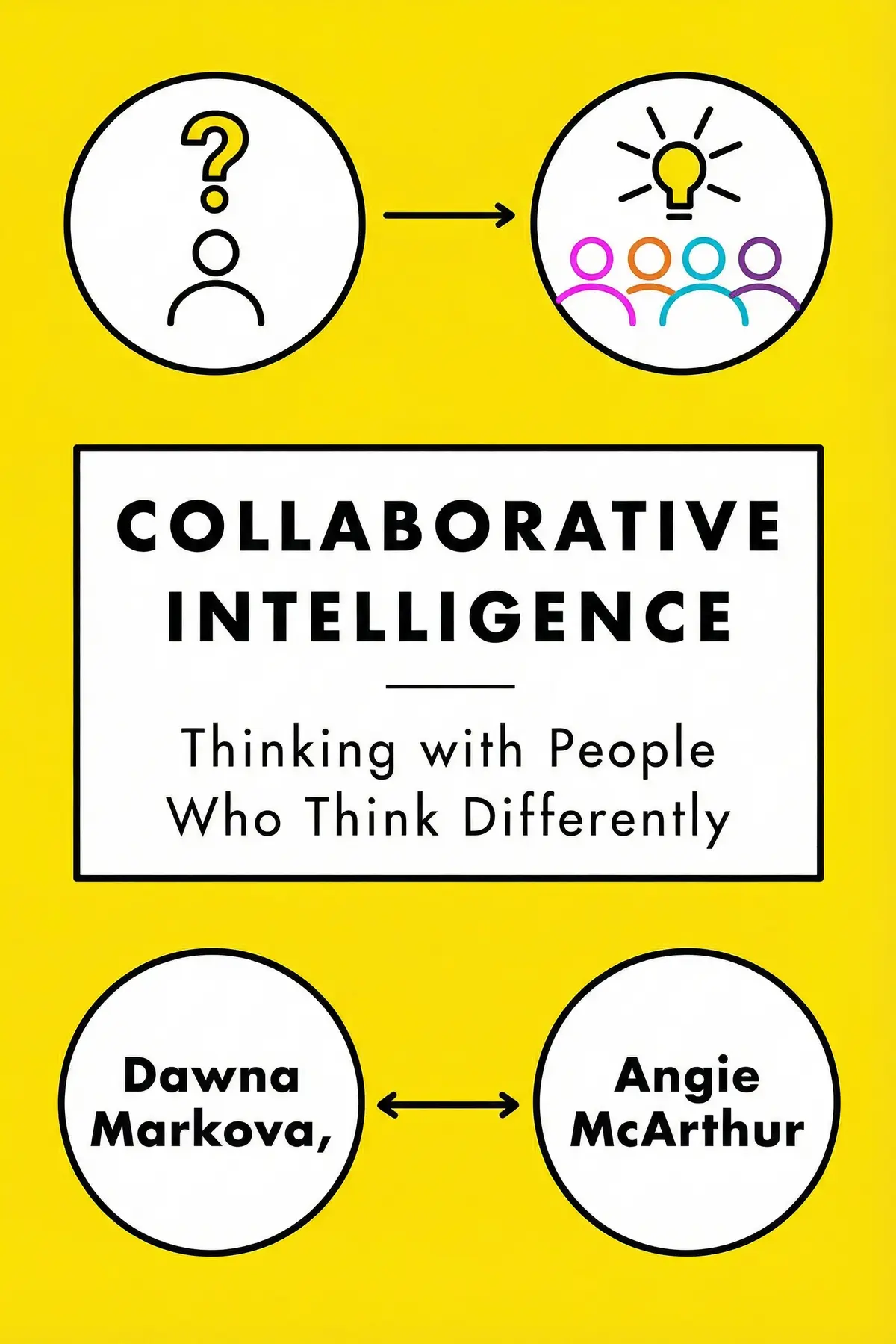
Table of Content
1. Introduction
1 min 03 sec
Most of us were trained to compete for the right answer, so when a meeting drags or a colleague’s logic feels impossible to follow, we have no tools for it. In Collaborative Intelligence, Dawna Markova and Angie McArthur argue that those tools exist and can be learned. Their starting point is simple: when two people talk an idea over, both leave with more ideas, which makes thinking with others one of the most valuable skills at work.
The authors call that ability collaborative intelligence. It rests on knowing how your own mind works, seeing how other minds differ and asking questions that turn the difference into progress.
The route runs through three kinds of attention, a lemon that reveals how you take in information, a burr stuck to a walker’s trousers and a rugby team visiting South Africa’s poorest townships. The payoff is practical: meetings that work for every kind of thinker, and a way to hear an annoying objection as help.
2. Share ideas to grow what everyone knows
1 min 28 sec
Most of us were raised to win arguments and guard our best ideas. A major hiring site found a way to compete with its rivals and still gain by sharing with them, and the logic applies far beyond business.
3. Stop treating focus as the only useful attention
1 min 36 sec
Almost every productivity tip tells you to concentrate harder. The authors say concentration is only one of three mental states you move through each day, and starving the other two comes at a cost.
4. Find the mind pattern behind how you think
1 min 36 sec
Imagine a lemon and notice what arrives first in your mind. That small test points to one of six patterns that shape what you remember easily, what you forget and when you get stuck.
5. Run meetings that fit how each person listens
1 min 32 sec
The colleague who talks too much and the one who goes silent may be struggling with the same thing. A few small changes to how a meeting runs can bring both of them back into the conversation.
6. Make your strengths visible before they look like flaws
1 min 33 sec
The habit that makes you good at your job can look like stubbornness or delay to a teammate. One short sentence, said at the right moment, changes how others read what you are doing.
7. Hear a yes-but question as support for your idea
1 min 39 sec
You present a new idea and someone immediately asks how it could ever work. It feels like an attack. A four-part map of thinking styles suggests a very different reading of that moment.
8. Ask better questions and stay calm without answers
1 min 38 sec
Admitting you don’t know can feel like a threat to your reputation. An inventor’s 700 failed bulbs and a walk through a field show why the best thinking starts exactly where answers run out.
9. Point a whole team at one shared goal
1 min 48 sec
Winning a group’s attention feels good; the real question is how to keep them from losing interest. A rugby squad that spent its time in poor townships shows what happens when a whole nation lines up behind one aim.
10. Conclusion
1 min 11 sec
Markova and McArthur end up redefining what it means to be smart at work. Intelligence, in their account, is less a possession of one person than something that happens between people whose minds differ, once each knows how they think and says so out loud. The colleague who stalls a meeting with logic, the one who keeps talking, the one who asks how long it will take: each may be offering a strength nobody has named yet.
Naming it is where to begin. The authors propose a collaboration handbook. Each team member writes one page on their mind pattern, thinking talents, blind spots and cognitive style, plus how they like to receive information and feedback. The team meets to share and explain these pages, then gathers them into a booklet everyone keeps.
Alongside that, ask before your next meeting how each person communicates best, and when a question about your idea stings, pause to consider which style it comes from.
A group that knows how each member thinks no longer needs everyone to think alike. That is when a room of different minds starts producing ideas none of them would have reached alone.
About this book
What is this book about?
Most of us were trained to compete. School rewarded the fastest right answer, and work rewarded whoever could prove a rival wrong. So when a meeting drags or a colleague's reasoning seems impossible to follow, few people have any tools for it. Dawna Markova and Angie McArthur argue that working and generating ideas with others is a skill, and that it is now one of the most valuable ones. They call it collaborative intelligence. It starts with knowing how your own mind works: which of three kinds of attention you are in, which senses you rely on, which of 35 thinking talents you carry and which of four cognitive styles you prefer. From there, the authors show how to adjust meetings for different minds, hear awkward questions as help and use questions of your own to get a stuck team moving. Readers get a practical map of how different people think, plus concrete tools, from walking meetings to a team collaboration handbook, for making those differences useful.
Book Information
Who it's for
Team leads
Team leads whose meetings drag and who want every kind of thinker to contribute.
Clashing with colleagues
Professionals who clash with colleagues whose reasoning they cannot follow.
Thinkers and doers
Idea people who struggle to get plans built, and doers who want their questions heard as support.
About the Author
Dawna Markova
Dawna Markova has worked as an author, teacher, psychotherapist, researcher and executive advisor, and was one of the creators of the bestselling Random Acts of Kindness series. Her other books include I Will Not Die an Unlived Life and Reconcilable Differences. Angie McArthur joined Professional Thinking Partners in 1998 and is now a senior partner there, designing and leading conferences, leadership retreats, training programs and one-on-one Thinking Partnerships for organizations from non-profits to Fortune 500 companies. She also co-wrote Relational Intelligence and the parenting book I Am Smart.
Ratings & Reviews
Ratings at a glance
What people think
Listeners find this work both educational and engaging, with one listener emphasizing its practical, research-grounded method. They also value how it strengthens teamwork and serves as a stellar resource for interacting with clients. Additionally, the writing is clear, with one listener highlighting the included step-by-step worksheets, and listeners consider it stimulating, with one pointing out the 'thinking talents' exercise. However, views on its level of innovation are divided; while some consider it original, others disagree.
Top reviews
Sam
Ever wonder why you click instantly with some colleagues but feel like you're speaking a foreign language with others? This book provides the Rosetta Stone for those office dynamics. By focusing on 'thinking talents' rather than just skill sets, the authors offer an amazing communication tool that helped me reframe my approach to our weekly strategy meetings. The step-by-step worksheets included are incredibly practical. They don't just tell you to collaborate; they show you the mechanics of how different minds can actually lock together. I’ve already noticed a shift in how our team handles creative friction. It is a game-changer for anyone in a high-pressure environment where cognitive diversity is often ignored.
Show moreAroon
This book acts as a detailed, prescriptive handbook for anyone trying to manage a diverse team without losing their mind. I especially appreciated the 'thinking talents' exercise, which helped our group identify where we were doubling up on strengths and where we had massive gaps. It serves as an amazing communication tool, particularly when dealing with difficult clientele who have very specific ways of processing information. The writing is clear and the tone is encouraging, making it easy to read despite the depth of the material. I’ve started using the guiding questions in my one-on-ones, and the response from my direct reports has been overwhelmingly positive. It is a must-read for modern leaders.
Show moreElla
Wow, the way Markova and McArthur break down the mechanics of focus is nothing short of eye-opening. By identifying our natural strengths and even the darker 'shadow' attributes—like how a drive for excellence can morph into never-ending dissatisfaction—we finally get a map for navigating office friction. I listened to the audiobook first but had to buy the physical copy just to have the exercises and worksheets on hand for reference. It’s an amazing communication tool that helped me realize I wasn't 'wrong' in my approach, I was just dominant in a different pattern than my boss. Instead of being frustrated, we now know how to bridge that gap. This is a fascinating book with endless applications for both work and life.
Show moreNaomi
Picked this up on a whim, but the VKA framework—Visual, Kinesthetic, and Auditory—actually explained a lot about my own internal processing that I hadn't quite put into words before. Markova and McArthur have a way of describing these mind patterns that feels freakishly accurate, almost like they’ve been sitting in on my brainstorming sessions. While some parts of the book felt a bit repetitive, the insights into how we focus are genuinely helpful for reducing workplace conflict. It is less about changing who you are and more about understanding the 'how' behind your thoughts. I found the online resources at their website to be a nice supplement to the text, making the concepts easier to apply in real-time.
Show moreBrahim
The step-by-step worksheets in this book are what really set it apart from the sea of other leadership manuals cluttering my desk. As a manager, I often find it difficult to facilitate conversations where every voice feels heard, but the prescriptive nature of this handbook provides a clear path forward. It’s a dense read, for sure. You can't just skim it and expect to gain the full benefit of their 'collaborative intelligence' model. However, if you are willing to put in the work and actually run the exercises with your team, the payoff in clarity is worth the effort. The focus on 'thinking with people who think differently' is exactly what my department needed this quarter.
Show moreIff
After hearing a colleague rave about the 'mind patterns' theory, I finally dove into the text and found the embodied exercises quite fascinating. I particularly loved the Aikido stories sprinkled throughout; they provided a much-needed physical metaphor for the mental shifts the authors are proposing. It’s a fairly dense book that requires you to go back and review the models multiple times to truly grasp the distinctions. Some might find the level of detail overwhelming, but for those of us who like a manual we can study, it’s perfect. It helps you get out of your own way so you can stop butting heads and start actually producing results with your peers. Truly insightful stuff.
Show moreUbolrat
To be fair, I went into this expecting a dry business text, but I ended up learning more about my own cognitive blind spots than I did about management. The descriptions of how we use our attention are remarkably precise. It’s one of those books where the answer seems so apparent once it’s explained that you wonder why you never noticed it before. My only critique is that some of the methodologies seem a bit time-consuming for a fast-paced corporate environment. It takes a dedicated team to actually sit down and work through these frameworks together. Still, the core idea that everyone thinks differently and that’s a strength is a message more people need to hear.
Show moreZoe
Look, the overarching principles in this text range from actually solid to completely banal. While I appreciate the intent to foster a more inclusive workplace, the authors seem so enamored with their own obtuse theory of 'mind patterns' that the practical advice often takes a back seat. You will likely spend more time trying to parse their specific initialisms and pseudoscientific taxonomies than actually improving your team's workflow. To be fair, there are moments of brilliance where the strategies for flexible thinking really shine through the jargon. If you are a fan of personality assessments and enjoy deep-diving into definitions, you will find value here. If you want a quick fix, look elsewhere.
Show moreHom
Not what I expected from a book on collaboration, as it felt more like a rebranding of old-school personality tests than a fresh look at collective intelligence. I have a lot of skepticism toward these types of 'trade-secret' taxonomies that companies use to categorize employees. While there are some interesting takeaways buried in the text, I wonder to what extent teams would actually take the time to follow these complex methodologies at the expense of project deadlines. Most of the 'innovative' ideas here can be found elsewhere in more accessible formats. I trudged through it to the end, but I left feeling like it was more of a marketing tool for their consulting business than a practical guide.
Show moreTim
Frankly, I struggled to get through even a third of this book because it feels entirely unmoored from actual science. The authors present a sprawling list of personality characteristics and preferred thinking styles, yet they never once cite a peer-reviewed study or explain how this list was empirically derived. It reads like a collection of personal anecdotes masquerading as a professional methodology. If you are looking for a research-based approach to organizational culture, you will likely be disappointed by the total lack of transparency regarding their data sources. It is frustrating to read a book that treats commercially-owned proprietary 'intellectual property' as if it were established biological fact. Save your time and find something with actual citations.
Show moreQuestions about this book
What is the main idea of Collaborative Intelligence?
Dawna Markova and Angie McArthur argue that being able to team up with others and produce ideas together has become one of the most valuable skills, because shared ideas multiply. They call it collaborative intelligence. It depends on understanding your own mind, including your attention, senses, talents and cognitive style, then adapting to how others think and using questions to turn differences into progress.
What are the three kinds of attention in Collaborative Intelligence?
The authors describe focused attention, which locks onto one thing and gets goals done; sorting attention, which moves between inside and outside to weigh options and see the big picture; and open attention, a diffuse state where memories and new insights surface. Everyone moves between them daily, and the authors warn that favoring focus above the others has real costs.
What are the four cognitive styles the book describes?
Drawing on Ned Hermann, author of The Creative Brain, the book names analytical thinking, which prefers data and facts; procedural thinking, which prefers processes and step-by-step tactics; relational thinking, which centers on feelings, morale and teamwork; and innovative thinking, which looks to the future and the big picture. Studies the authors cite suggest only 3 percent of people are naturally talented in all four.
How can I apply Collaborative Intelligence to my team?
Ask each person how they communicate best and build that into meetings, then check afterward what worked. Let restless talkers move, perhaps with a 15-minute morning walk to discuss the agenda. The authors also suggest a collaboration handbook: each member writes a one-page description of their mind pattern, talents, blind spots, cognitive style and feedback preferences, and the team shares and collects them.
Who should read Collaborative Intelligence?
It suits managers and team members who find meetings unproductive or colleagues hard to follow, and anyone whose good ideas keep getting stuck or questioned. Its tools are concrete, from success-based questions that recall past wins to hanging photos of each person’s intentions on one wall, so they can be tried in the next meeting.
Readers also enjoyed


A Year with Peter Drucker: 52 Weeks of Coaching for Leadership Effectiveness
Joseph A. Maciariello





Acting with Power: Why We Are More Powerful Than We Believe
Deborah Gruenfeld


All In: How Great Leaders Build Unstoppable Teams
Mike Michalowicz
AUDIO SUMMARY AVAILABLE
Listen to Collaborative Intelligence in 15 minutes
Get the key ideas from Collaborative Intelligence by Dawna Markova, plus 5,000+ more nonfiction titles.
- 5,000+ titles
- Listen as much as you want
- 7-day free trial
- Cancel anytime









