


14 min 55 sec
Available in: English
Cognitive Behavioral Therapy: Simple Techniques to Instantly Be Happier, Find Inner Peace, and Improve Your Life
A short, practical guide to the core tools of cognitive behavioral therapy. It shows how to test harsh thoughts, face fears step by step, release lingering guilt, loosen addictive habits and calm the mind with mindfulness.
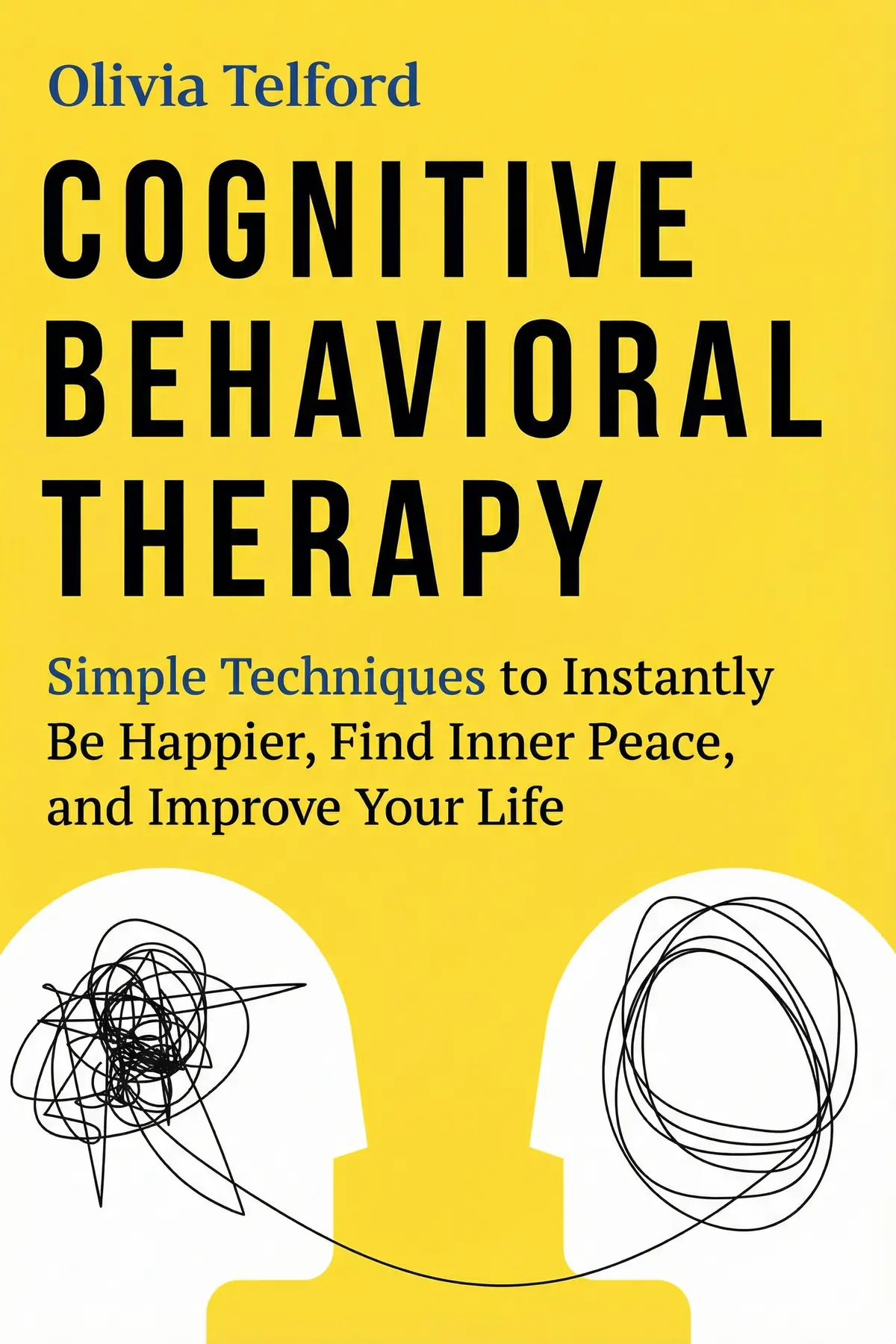
Table of Content
1. Introduction
1 min 02 sec
When low mood or anxiety settles in, the good parts of life can seem to sit beyond your reach. In Cognitive Behavioral Therapy, Danish-born author Olivia Telford argues that what keeps them there is often a story: the beliefs you hold about yourself shape how you react to events, and those beliefs can be checked and rewritten. That is the heart of CBT, a treatment applied to depression, anxiety, guilt, compulsions and addiction.
Telford’s case is that painful thoughts are claims to be tested, and that questioning them, facing fears gradually and paying attention to the present can loosen their grip. Her tools range from a three-step method for weighing a harsh thought to a fear ladder and a slow-eating exercise with a piece of dried fruit, each small enough to try this week. She also sets a clear limit: anyone who suspects clinical depression or chronic anxiety should work with a therapist, counselor or psychologist.
2. See the story between an event and your reaction
1 min 38 sec
Something happens outside you, and how you respond depends on what you believe about it. The story you tell yourself shapes what you think, feel and do next. A model from 1955 explains why, and points to the step you can change.
3. Weigh the evidence against your harshest thoughts
1 min 47 sec
After a breakup, the mind can deliver a verdict that sounds final: unlovable, alone forever. CBT treats that verdict as a claim on trial, and the evidence usually tells a different story.
4. Give your anxiety the advice you'd give a friend
1 min 54 sec
Panic, constant worry and dread of small talk feel different, yet a single trick of perspective helps with all of them. It relies on an odd fact about whose problems we judge most clearly.
5. Face your fears one planned step at a time
1 min 57 sec
Avoiding what scares you feels like protection, yet it lets the fear grow. A ladder of small exposures, and twenty uncomfortable minutes, can turn that pattern around.
6. Let guilt teach its lesson, then put it down
1 min 38 sec
Guilt can feel like the decent thing to keep carrying, even years later. Telford argues there is a point where it stops protecting anyone, and shows how to recognize that point.
7. Break an addiction with a four-stage plan
1 min 57 sec
Addiction is not limited to drinking or drugs; shopping, work and the phone in your pocket qualify too. A set of five simple questions reveals what keeps the habit running.
8. Calm a busy mind with one slow bite
1 min 53 sec
The final tools ask you to stop arguing with your thoughts altogether. A single piece of dried fruit and a short walk show what that looks like in practice.
9. Conclusion
1 min 09 sec
Telford’s book comes down to one habit of mind: treating what you think as something to examine, not something to obey. A harsh belief about yourself, a fear, a weight of guilt and a craving look very different, yet each is held in place by a story, and each story can be tested. Sometimes the test is evidence written on a page. Sometimes it is a planned step toward a fear, with a professional beside you. Sometimes it is simply letting a thought pass while you taste a piece of dried fruit.
The best starting point is small. When a strong feeling arrives, separate the event from what you told yourself about it, then weigh that story the way you would weigh a friend’s. When guilt lingers, ask whether it still has a job to do. If a habit has taken hold, spend a week answering the five Ws. And once a day, take one bite or one short walk with full attention.
None of this removes difficult thoughts; Telford is clear that no one lives without them. What changes is who holds the pen. The thought still arrives. You decide whether it gets to write the story.
About this book
What is this book about?
Low mood and anxiety can make the good parts of life feel out of reach. Olivia Telford argues that what often keeps people stuck is a story they tell about themselves and the world. Those beliefs shape how they feel and act after every event, and they are often less accurate than they seem. Telford introduces cognitive behavioral therapy through its simplest frame, the ABC model of event, belief and consequence. She then shows how one core technique, cognitive restructuring, applies to depression, anxiety, guilt and regret. Along the way she explains exposure therapy and exposure and response prevention for fears and OCD, a four-stage program for addiction, and two everyday exercises from mindfulness-based cognitive therapy. Readers get a clear map of how CBT thinks and a handful of tools they can try at once: weighing the evidence against a painful thought, asking what they would tell a friend, mapping a habit with five questions and eating one mindful bite. Telford is also clear that anyone facing clinical depression or chronic anxiety should work with a professional.
Book Information
Who it's for
Mood and anxiety self-helpers
People caught in low moods or anxious loops who want practical tools to try before or alongside therapy.
Guilt and habit wrestlers
Anyone carrying old guilt or a habit like shopping, work or phone use that has started to control them.
Curious CBT beginners
Curious readers who want a clear first map of how cognitive behavioral therapy works.
About the Author
Olivia Telford
Olivia Telford was born in Vejle, Denmark, and her writing blends Scandinavian simplicity with modern psychology. Her books have sold more than 130,000 copies worldwide, led by Cognitive Behavioral Therapy. She has also written Hygge: Discovering the Danish Art of Happiness, The Art of Minimalism and Stop Overthinking, all aimed at helping readers simplify daily life, lower stress and stay in the present moment.
Ratings & Reviews
Ratings at a glance

What people think
Listeners find the material educational and simple to grasp, offering actionable strategies for cultivating mindfulness and navigating mental health concerns. The integrated exercises are highly regarded as a valuable supplement to the core text. Listeners also characterize the work as a swift listen that brings joy.
Top reviews
Prae
Finally, a psychology book that doesn't read like a dry, dusty textbook! I’ve struggled with social anxiety for years, and while I’ve tried other CBT workbooks, they were often too technical to actually apply to my daily life. Telford’s approach is refreshing because it’s grounded in simple things and gratitude. The exercises are practical and didn't feel like a chore to complete. Not gonna lie, I was skeptical at first because of her other books on lifestyle topics like hygge, but she really knows how to present information in an encouraging way. It’s an easy, joyful read that makes you feel like you actually have some control over your internal dialogue. If you’re looking for a deep clinical analysis, look elsewhere, but if you want a friendly hand-holding through the basics of mindfulness, this is for you.
Show moreKenji
Picked this up because I needed something straightforward and didn’t want to wade through dense academic jargon. Olivia Telford does a great job of distilling complex CBT concepts into actionable lists that you can actually use in your daily life. It’s a very quick read, but that’s exactly what I wanted for my morning commute. The exercises at the end of each section provide a nice structure for those of us who need a nudge to start self-reflecting. While some might say it’s a bit oversimplified, I found it to be a gentle entry point into mindfulness. It doesn't replace a real therapist, of course, but it’s a solid tool for anyone looking to declutter their mind and manage everyday stressors like procrastination or light anxiety. It definitely brought some joy to my week.
Show moreDarius
Changing your mindset isn't easy, yet this book manages to make the process feel approachable rather than intimidating. I found the section on breaking negative thought patterns particularly insightful for my own situation. The writing style is very conversational, which makes sense given the author’s background in topics like minimalism. It feels more like a guide for a mindful life than a medical manual, which is both a strength and a weakness depending on what you’re looking for. Personally, I enjoyed the practical techniques for dealing with insomnia and general worry. Some of the generalizations about mental illness felt a bit broad, but for a layperson, it serves as a helpful roadmap for self-improvement. It's a nice little resource to keep on your nightstand for when things get overwhelming.
Show moreLars
The chapter on insomnia was actually quite helpful, providing some solid frameworks for calming a racing mind at night. I went into this knowing Telford isn't a clinical psychologist, so I adjusted my expectations accordingly. The book is structured in a way that’s very easy to digest, with plenty of bullet points and clear definitions. It feels very much like a "pick-up-and-go" type of guide. Truth is, not everyone has the time or money for intensive one-on-one therapy right away, so having a low-cost introduction like this is valuable. It covers a wide range of topics from jealousy to addiction, though some sections are admittedly a bit thin on detail. For a high-level overview of how to apply cognitive behavioral techniques to your own life, it’s a worthwhile purchase that doesn't overstay its welcome.
Show moreNannapat
As someone who struggles with overthinking and chronic procrastination, I found this book to be a handy little manual for resetting my brain. The author doesn't pretend to be a doctor, which I actually found quite honest in a way. She’s more like a curator of helpful ideas. I particularly liked the sections on social anxiety and how our self-schemas can hold us back from reaching our full potential. The lists are easy to refer back to when you're having a bad day, and the language is very inclusive. Look, it’s not going to solve all your problems overnight, but it gives you a solid 20% of the foundation you need to start making changes. It’s a great companion piece for someone who is also practicing mindfulness or looking to simplify their lifestyle.
Show moreAnthony
Let’s be real for a second: this book is exactly what it claims to be, which is an introductory guide. It’s not a medical journal, and it shouldn't be treated as one. I found the real-life examples to be relatable, even if they were a bit simplified at times. The author emphasizes that the real work—the other 80%—comes from the reader actually putting the techniques into practice. I appreciate the disclaimer about consulting a doctor if you’re on medication, as that’s an important boundary to set. For a layperson, the definitions of the cognitive triad and thought processes are easy to grasp. It’s a quick read that provides a starting point for a new way of thinking. Not every self-help book needs to be a 500-page slog to be effective.
Show moreNadia
Ever wonder why you react to stress the way you do? This book helped me realize that a lot of my reactions are just habits of the mind that can be unlearned. I’ve read Telford’s books on hygge and minimalism before, and she brings that same sense of calm and order to the world of psychology here. The practical exercises are definitely the highlight, as they force you to sit down and actually analyze your triggers. I liked that she didn't just focus on the big illnesses but also on "nonclinical" things that affect our happiness. To be fair, it is a very basic overview, and those with more serious conditions might find the advice a bit trivializing. But as a general guide for living more mindfully, it’s quite effective and easy to follow.
Show moreAey
While I appreciate the effort to make therapy concepts accessible, I can't help but feel this book is a bit watered down. As a person who has spent a lot of time in actual therapy, I found the "quick-fix" tone of some chapters slightly irresponsible. The author isn't a licensed therapist, and it shows in how she treats serious conditions like depression as something you can just "logic" your way out of with a few lists. To be fair, the information isn't inherently wrong—it just lacks the nuance and soul-searching required for real progress. It reads a bit like a well-researched undergraduate essay or a series of SEO-optimized blog posts. If you are a complete beginner looking for a basic definition of CBT, this is fine. Just don't expect a magic pill for deep-seated trauma.
Show moreYaowares
It feels like a collection of blog posts, but that’s not necessarily a bad thing if you’re looking for a fast introduction. The tone is very efficient, clean, and extremely SEO-friendly. I did find some of the generalizations about people with depression or addiction to be a bit condescending, as if it’s just a matter of "correcting" a faulty thought process. However, for minor issues like everyday stress or improving your reaction to difficult coworkers, the tools provided are quite solid. The book is a bit light on the "soul-searching" aspects of therapy, focusing instead on the mechanics of behavior change. It’s a decent enough resource if you have Kindle Unlimited, but I’m not sure it’s worth a premium price given how much of this info is available for free online.
Show moreNang
I was hoping for a deep dive into the mechanics of cognitive behavioral therapy, but what I got instead was a surface-level summary. It’s hard to ignore that the author lacks professional qualifications in this field. Most of the advice feels like common sense repackaged with therapy terminology. For instance, the way it suggests "instantly" overcoming major mental health struggles is not just unrealistic, it’s potentially harmful to those in crisis. The book is very list-heavy, which makes it feel like it was written more for an algorithm than for a human being seeking help. It’s not that the techniques aren’t legitimate—they are—but the presentation is so simplified that it loses the "why" behind the "how." I’d suggest looking for a book written by a practicing clinician if you want something with more substance.
Show moreQuestions about this book
What is the main idea of Cognitive Behavioral Therapy by Olivia Telford?
Telford argues that much of our distress is shaped by the stories we tell ourselves about events, not by the events alone. Using the ABC model of activating event, belief and consequence, she shows that the belief in the middle can be examined and changed. The book applies this idea to depression, anxiety, OCD, guilt, regret and addiction, and adds mindfulness exercises to help prevent problems from starting.
What is cognitive restructuring in CBT?
Cognitive restructuring is the core CBT technique Telford describes. It has three steps: spot an unhelpful thought, weigh the evidence for and against it, and build a more accurate and useful alternative. After a breakup, for example, the thought that you are unlovable can be checked against your many friendships and past relationships. The aim is to process the thought in a balanced way, without denying or suppressing it.
How does CBT help with anxiety and OCD?
For anxiety, Telford suggests asking what you would tell a best friend in your place, and replacing catastrophic thoughts with truer ones. Exposure therapy uses a ranked list of feared situations, faced gradually from the least frightening. For OCD, exposure and response prevention means letting obsessive thoughts arise without acting on the compulsion, often sitting with the anxiety for about 20 minutes. She stresses that both methods need a mental health professional’s guidance.
What is the difference between CBT and mindfulness-based cognitive therapy?
Telford explains that CBT is about doing: actively challenging and restructuring faulty thoughts to treat problems already present. Mindfulness-based cognitive therapy is about being: accepting thoughts and letting them pass while attending to the present moment. MBCT is mainly preventive, meant to stop people from becoming depressed or anxious in the first place. Her examples include eating a piece of dried fruit slowly and walking with full attention to every sense.
Who should read Cognitive Behavioral Therapy by Olivia Telford?
It suits readers who want a short, plain introduction to CBT and a few techniques to try right away, especially people dealing with low mood, worry, lingering guilt or habits such as gambling, shopping or phone use. Telford is clear that it does not replace care: anyone who believes they are clinically depressed or living with chronic anxiety should reach out to a therapist, counselor or psychologist.
Readers also enjoyed





Alcoholics Anonymous
Alcoholics Anonymous World Services

A Liberated Mind: How to Pivot Toward What Matters
Steven C. Hayes


AUDIO SUMMARY AVAILABLE
Listen to Cognitive Behavioral Therapy in 15 minutes
Get the key ideas from Cognitive Behavioral Therapy by Olivia Telford, plus 5,000+ more nonfiction titles.
- 5,000+ titles
- Listen as much as you want
- 7-day free trial
- Cancel anytime









