

Acting with Power: Why We Are More Powerful Than We Believe
Deborah Gruenfeld
 English
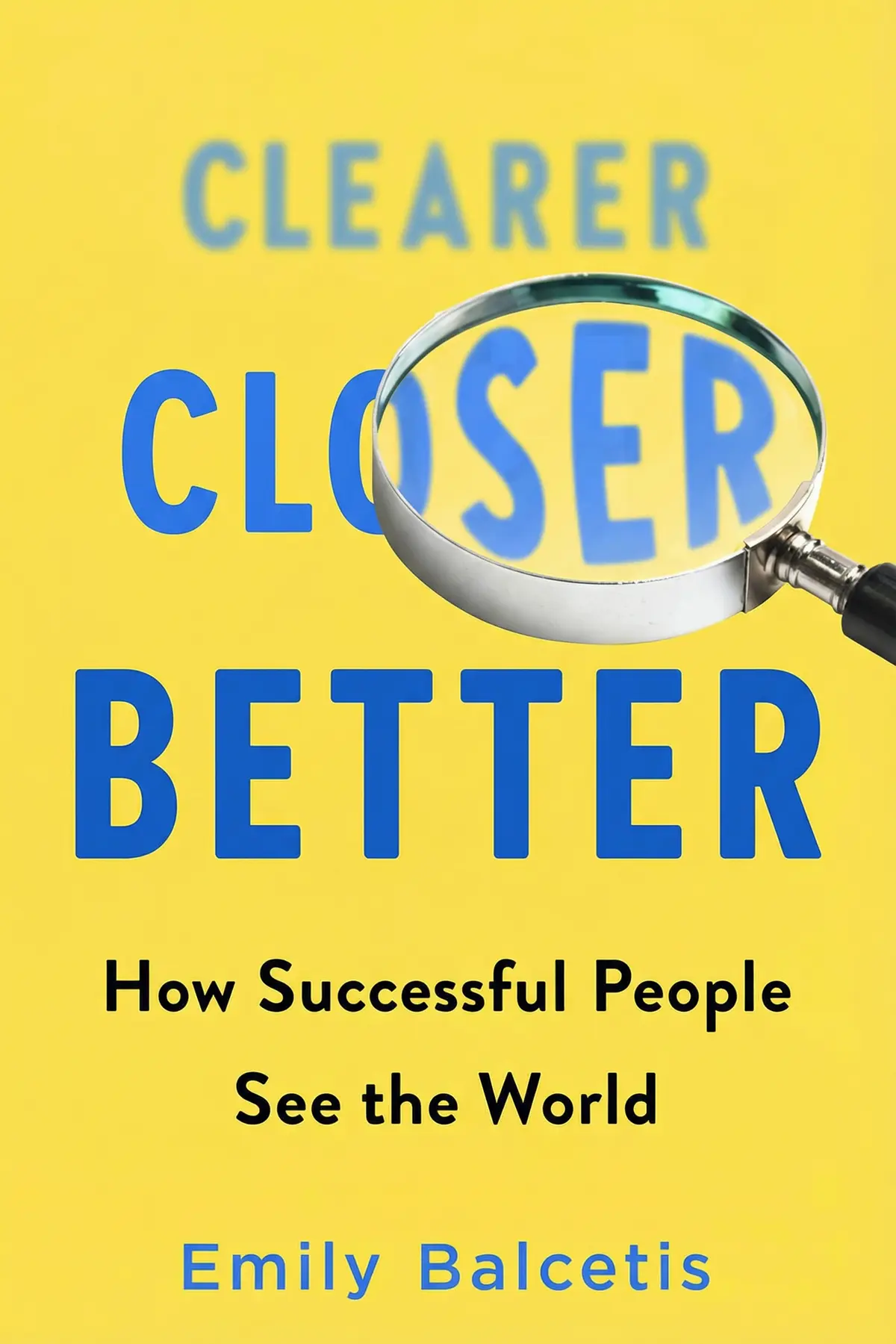
Shows how choosing what you look at changes what you achieve. It covers when to narrow or widen your focus, how to make goals and progress visible, and how to read people's faces accurately.
1 min 03 sec
If your goals feel far away, part of the problem may sit in your eyes. In Clearer, Closer, Better, New York University psychologist Emily Balcetis reports that people who kept their gaze fixed on a finish line judged it 30 percent closer than people who looked around. They also reached it 23 percent faster. Our eyes take in an incomplete picture, she explains, and the mind fills the gaps, often wrongly and without our noticing.
Balcetis treats that gap as a tool. Her case is that successful people steer what they see. They narrow or widen their focus on purpose, make goals and progress visible, arrange their surroundings and read faces honestly. Each of these moves makes a hard goal look more reachable, and then makes it more reachable in fact. What follows is a set of visual habits, from a swimmer’s kickboard to a senator’s choice of seat, that you can test on your next deadline, budget or workout.
1 min 32 sec
An Olympic champion refused to think about the race in front of her, and walkers with weights strapped to their ankles moved faster when they stopped looking around. Where you point your eyes changes how hard a goal feels.
1 min 35 sec
Two groups of students pictured their midterm exam every day, and one of them ended up below the class average. What they chose to imagine made the difference, and so did a company award for failure.
1 min 30 sec
A tedious notepad of calories turned into a company sold for hundreds of millions, and a young woman buried in debt cleared it in just over a year. Both started by looking at numbers most people avoid.
1 min 29 sec
Members of the US Senate fight over seats at the start of every year, and a retail giant learned that crowded shelves make money. Both stories reveal how much your line of sight decides for you.
1 min 39 sec
Nearly everyone in one survey believed that feeling good about yourself leads to success, and scientists say they are wrong. The better skill involves noticing what a smile, a raised eyebrow or a mouth is really saying.
1 min 37 sec
A psychologist and her students guessed what their impulse buys would cost over two weeks and missed by hundreds of dollars. Seasoned runners suggest the fix, and it involves changing your focus as an effort unfolds.
1 min 38 sec
Hundreds of thousands of job ads demand multitaskers, yet dieters who juggled tasks ate far more than they meant to. Emergency room doctors show where a little juggling helps and the exact point where it starts to hurt.
1 min 25 sec
A fired stockbroker became a nightclub doorman, and a figure skater missed the Olympics. Both lost the future they had planned, and both found something larger by changing how they looked at what they had.
1 min 00 sec
Balcetis’s book adds up to a plain claim with large consequences: you never see the whole world, so choose which part you look at. The people she describes decide when to stare at the next runner and when to step back and take in the whole race. They put the target on the kickboard and the debt on a chart. They sit where the person who grants the floor can see them, and they check a colleague’s eyes before trusting a smile.
Her closing advice is the least comfortable. Instead of burying regrettable mistakes, call them to mind on purpose. Being realistic about past choices, the shortfalls along with the wins, gives a clearer view of what your biggest goals actually demand. Then look around your desk, your screen and your kitchen, and ask what each of them is telling your eyes to do.
The finish line stays where it is. How close it looks, and how fast you reach it, depends on where you point your eyes.
We act as if our eyes show us the world as it is. Emily Balcetis, a psychologist at New York University, argues that they never do. The eyes deliver a partial picture, the mind fills in the rest, and the errors we never notice slip into our decisions about money, health, work and the people around us. Her twist is that this gap can work in our favor. If perception is partly constructed, we can construct it better. Drawing on her own lab studies and on stories from an Olympic marathoner, a triple Olympic champion swimmer, the founder of MyFitnessPal and a long-serving US senator, she describes the visual habits successful people use. They narrow their focus to make a distant goal feel near, materialize targets and progress so they can be seen, control what sits in their line of sight, and read emotions honestly. Readers get a practical set of seeing strategies and a sense of when to use each one. That includes knowing when to widen the frame, resist multitasking or let a cherished goal go.
Professionals and students whose long projects, savings plans or training goals keep feeling out of reach.
Managers who give and receive feedback and want to read colleagues' reactions more accurately.
Anyone wondering whether to keep chasing a stalled dream or redirect the skills it built.
Emily Balcetis is an associate professor of psychology at New York University, with a PhD from Cornell University earned in 2006. Her research examines how goals, motivations and emotions shape perception, especially what people literally see. She has written more than seventy scientific publications, received awards from several scientific societies and lectured at Harvard, Princeton and Yale. Her TEDx New York talk has been viewed by several million people.
Listeners find this book highly educational, highlighting its revelatory research and practical strategies for daily use. Its accessible style is frequently praised, with one listener describing it as an effortless read. The storytelling also earns positive remarks, as listeners enjoy the various narratives and find that the initial story provides a smooth transition into the core concepts.
Every once in a while, a book comes along that changes the way you literally look at your morning to-do list. Emily Balcetis has a gift for taking complex social psychology and turning it into something meaningful and quick. I’m a sucker for a good story, and this book is packed with them—from paratroopers to personal parenting fails. The stories serve a purpose beyond entertainment; they ground the research in reality. Understanding how to change my perspective to lead better and achieve my goals has been a game-changer for me. I’ve already recommended this to several colleagues who are feeling burnt out. The humor makes the medicine go down easy, and the 'narrow focus' trick is something I use every single day now. It’s brilliant, engaging, and genuinely life-changing if you actually apply the techniques she suggests.
Show moreRarely do I find a social psychology book that actually makes me laugh while teaching me something profound about human nature. The author’s personal journey of learning the drums was the highlight for me, as it illustrated the principles of framing and materializing in a way that felt authentic and messy. We often hear about 'success' in such clinical terms, so seeing the 'smelly diaper' side of goal-setting was refreshing. The science of visual perception is handled with a light touch but remains deeply informative. I loved the advice about recalling shortcomings instead of just successes to help bridge the gap to our ultimate goals. This book is a must-read for anyone who feels stuck in a rut. It’s easy to read, full of heart, and provides a clear roadmap for anyone looking to see their way to a better version of themselves.
Show moreVisual perception is a tool most of us completely take for granted until we see the data. This book really opened my eyes to how successful people use their 'lenses' differently to stay motivated. I loved the section on 'materializing'—the idea that making a plan physical or visual can bridge the gap between a goal and its realization. It’s a very easy read, and the stories kept me engaged even when the science felt a bit light. I’ve already started applying the narrow focus technique to my morning workouts, and I can honestly see a difference in my persistence. Some of the humor is a little hit-or-miss, and the focus is very much on a US-centric lifestyle, but the core principles of everyday application are solid. If you struggle with long-term goals, this offers a fresh perspective on how to literally look at your progress.
Show moreIt’s fascinating how our physical eyes can actually trick our brains into thinking a path is steeper or longer than it really is. Balcetis explains the 'wide bracket' and 'narrow focus' concepts with enough clarity that I felt I could implement them immediately. Not gonna lie, I actually liked the drumming story! It gave the book a human element that many psychology books lack. It was helpful to see her struggle with her own principles while managing a baby and a career. My only gripe is that it relies a little too heavily on anecdotes rather than providing a wide range of peer-reviewed studies. Still, the eye-opening research she does include is memorable and actionable. It’s a great pick for anyone looking to change their perspective on personal growth and goal-setting through a more visual lens.
Show morePicked this up after seeing a recommendation online and found it to be a very pleasant surprise. The author is quite funny and her journey to learn the drums serves as a perfect thread to tie the different psychological principles together. I really appreciated how she discussed these ideas in terms of common goals like saving money or weight loss, making the science feel very relevant. While I agree with other reviewers that some of the content on mindsets is a bit of a rehash, the specific focus on 'visual' strategies felt new to me. The chapter on framing was especially enlightening. It reminds us that we have more control over our environment and our focus than we think. It’s a quick, informative read that doesn't take itself too seriously while still delivering some high-quality advice for getting things done.
Show moreAfter hearing Emily Balcetis on Hidden Brain, I had really high expectations for this book. The opening story about the paratrooper jumping into a net from 25,000 feet is absolutely gripping and serves as a fantastic segue into the science of perception. There are some very good insights here, especially the balance between needing a narrow focus for immediate steps and a wide bracket for the big picture. However, the book is incredibly wordy and chatty. I personally found the constant references to diaper pails and her personal drumming journey to be a bit distracting from the actual data. It’s a bit of a yo-yo book; one moment you’re learning something profound about visual lenses, and the next you’re wading through weak humor. It’s a fast read and has its moments, but it could have been sixty pages shorter and much more impactful.
Show moreFrankly, this book feels like a rehash of better titles in the productivity genre. It covers the basics like 'growth mindset' and 'narrow focusing'—things that are already quite common if you read a lot of non-fiction. I did appreciate the four main strategies: Narrow Focus, Materializing, Framing, and Wide Bracketing. Those give a decent structure to the narrative. But the writing style is non-direct and often gets lost in the author's own life stories. One chapter title links 'forgoing forbidden fruit' with 'perceiving patterns' in a way that never quite clicked for me. It isn't a bad book, and for a beginner, it might actually be a four-star read. But for someone who has already read the classics on habit formation, it’s just okay. It’s informative enough to finish, but not something I’d likely revisit or recommend to friends.
Show moreIs this a manual for success or a diary of a new mom trying to learn the drums? The truth is, it’s a bit of both. I took some copious notes on the materializing and framing sections because the actionable principles are actually quite solid. Balcetis does a good job explaining how our visual perception can be manipulated to make goals seem more achievable. But the 'smelly poop' jokes and the constant personal anecdotes make it feel less like a science book and more like a casual conversation. I enjoyed the storytelling to an extent, but the content density just wasn't there for me. It’s a fine choice if you want something light and easy to read on a plane, but don't expect a deep dive into neurological research. It hits the middle ground of being helpful but ultimately forgettable.
Show moreThe audiobook experience was quite a struggle for me, mostly because of the narrator's tone. Emily Balcetis reads her own work, but she adopts this cutesy, almost juvenile voice that makes the scientific content hard to take seriously. Look, I appreciate when authors try to make research accessible, but this felt like half a memoir about learning the drums and half a repetitive self-help guide. The stories about her baby and her personal life are fine for a blog, but they don't provide the 'proof' of research I was hoping for. I found myself wanting to skip ahead just to get to the actual strategies like framing and materializing. Unfortunately, those sections were quite thin and didn't offer much beyond common sense or stuff you’d find on a basic vision board. I really wanted to like this after the interesting premise, but the execution was lacking.
Show moreSkip this one if you’re looking for high-density scientific insights or a serious academic study. To be fair, I expected a rigorous dive into social psychology, but what I got was an over-reliance on personal anecdotes that felt largely irrelevant to the core thesis. Why am I reading about her husband Pete leaving for a business trip or the smell of dirty diapers in the first paragraph of a chapter? The writing style is clunky and the attempts at humor often fall flat or feel forced. While the concept of 'narrow focus' is somewhat interesting, it’s buried under pages of the author’s quest to become a drummer. If you’ve read any growth mindset books before, you’ve already seen most of these 'revelations' elsewhere. It’s a quick read, but the lack of content density makes it feel like a waste of time. Save yourself the trouble and just find a summary online.
Show moreEmily Balcetis argues that our eyes give us an incomplete picture, and our minds fill in the rest, often wrongly. Instead of treating this as a flaw, she shows how successful people use it. They narrow their focus to make goals feel closer, materialize targets and progress, control what is in their line of sight, read emotions accurately and widen their view when decisions affect long-term plans.
Balcetis and her colleagues strapped on cuffs that made people’s bodies 15 percent heavier, then had them walk fast toward a finish line. Those told to look only at the line judged it 30 percent closer than those who looked around normally. They also used 17 percent less effort and arrived 23 percent faster, which suggests that a narrow visual focus makes hard tasks feel and become easier.
Balcetis cites research from the late 1990s by Shelley E Taylor, a psychologist at UCLA. College students who spent time each day imagining the concrete steps of preparing for a midterm studied more and earned better results. Students who only pictured getting a high grade studied less and did significantly worse than the class average. Picturing the process works better than picturing the prize.
Mostly bad for long-term goals. In a study by psychologists at Swarthmore College and UCLA, dieters who multitasked ate 40 percent more calories. Yet research by Diwas KC on emergency room doctors found that a small increase in load, from three patients to four, sped up discharges by about 25 percent. At five or six patients the switching cost won and patients stayed longer.
Pick the next visible marker on a long project and focus only on it near the end, while keeping the big picture in view early on. Write your targets where you will see them and track progress with a log or chart. Arrange your space so good choices are the visible ones. And recall your mistakes deliberately, since Balcetis argues that honesty about past choices clarifies what your goals require.
Deborah Gruenfeld




Anthony Pratkanis



William B. Irvine


AUDIO SUMMARY AVAILABLE
Get the key ideas from Clearer, Closer, Better by Emily Balcetis, plus 5,000+ more nonfiction titles.









