
15 min 21 sec
Available in: English
 ไทย
EnglishไทยChatter: The Voice in Our Head, Why It Matters, and How to Harness It
By Ethan Kross
Shows why the inner voice that helps you plan can spiral into draining negative chatter, and gives simple research-based ways to step back from it, from talking to yourself by name to walks, rituals and better advisors.
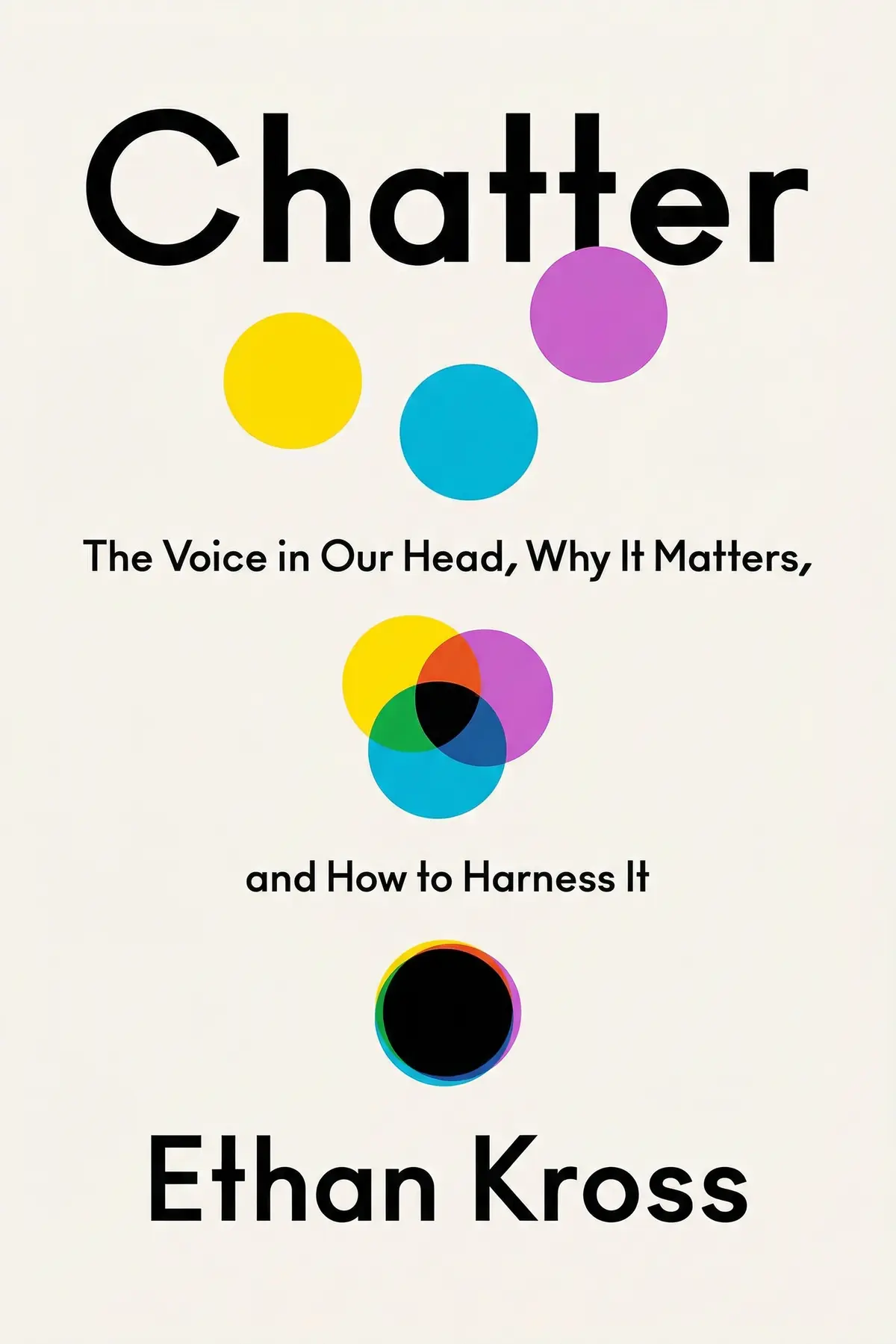
Table of Content
1. Introduction
58 sec
If your mind replays an argument at midnight, the trouble is a planning tool that has turned against you. In Chatter, experimental psychologist Ethan Kross reports that people spend more than a third of their lives in self-talk, reflecting, remembering and rehearsing what might happen. That inner voice lets us learn from mistakes and plan ahead, yet it slides easily into chatter, a loop of negative thoughts that drains focus, strains friendships and wears on the body.
Kross argues that the brain already holds the tools to turn the volume down, and nearly all of them do one thing: they put distance between you and the problem. That distance can come from how you picture an event, the words you use for yourself, the people you call, the view from your window or a small ritual before a hard task. Each is simple enough to try during the next spiral, and one of them works in about a second.
2. Your inner voice helps you learn and plan
1 min 48 sec
Your inner voice runs faster than any speaker alive and once frustrated monks at prayer. Before trying to quiet it, it helps to know what evolution built it for, and what you would lose without it.
3. Spot what rumination is costing your work and health
1 min 50 sec
A fight with a partner can leave you unable to read a page. The same mental noise reaches further than focus, into your friendships and your health, often without you noticing the link.
4. Shrink a problem by stepping outside it
1 min 52 sec
Lincoln was hopeless with his own romantic tangle and wise about his friend’s identical one a year later. A simple shift in viewpoint explains the difference, and anyone can borrow it in a few seconds.
5. Calm yourself in seconds by using your own name
1 min 49 sec
A beloved children’s television host ended a letter full of self-doubt with four words to himself. The small grammatical trick he used calms the brain faster than most people would believe possible.
6. Build a board of advisors who move you forward
1 min 57 sec
Grieving students found comfort sharing their pain online, yet their symptoms stayed. The reason exposes a trap in how friends usually comfort each other, and points to the kind of helper worth seeking out.
7. Recharge your focus with green views and tidy rooms
1 min 56 sec
Residents of Chicago housing projects focused better depending on what their windows faced. A tennis champion’s water bottles point to the same hidden resource, one most people drain all day and rarely refill.
8. A small ritual can quiet an anxious mind
1 min 58 sec
An eighteenth-century fraud with magnets, Michael Jordan’s old shorts and Steve Jobs at his mirror share something that really works. It costs nothing and can start with a sink full of dishes.
9. Conclusion
1 min 13 sec
Chatter adds up to a book about distance. The same voice that teaches a toddler self-control, lets a professional rehearse a hard message and helps an adult build a life story can zoom in so tightly that it crowds out focus, friendship and health. Kross’s answer is to change how far you stand from it, and he shows that distance can be made almost anywhere: a memory replayed from the corner of the room, your own name spoken back to you, a friend who listens and then points forward, a window full of trees, a ritual as plain as washing dishes.
He adds one more tool for the next time thoughts start to spin. Research he cites finds that writing about painful experiences brings relief, partly because narrating your life like an outside storyteller creates distance. Sit down and write about what is bothering you for 20 minutes. When you read it back, ask how much it will matter in ten years.
In 1841, Lincoln could not see his own way out. A year later, standing a little further back, he could see it clearly for a friend, and that view is open to anyone who takes one step back.
About this book
What is this book about?
Everyone talks to themselves, and most of the time that inner voice is useful. It helps us learn from mistakes, rehearse what to say and build a sense of who we are. Ethan Kross, an experimental psychologist who studies emotion regulation, explains what happens when the voice turns into chatter: a loop of negative thoughts that eats up attention, pushes friends away and keeps the body's stress response switched on. His answer is distance. Drawing on his own lab's experiments and on wider research, Kross shows how to step back from a problem by viewing it as a fly on the wall, imagining it ten years from now or addressing yourself by name. He explains why venting to sympathetic friends can make things worse, and what kind of support helps instead. He also covers less obvious tools: green views and short walks that recharge attention, tidying that restores a sense of control, and rituals and placebos that calm the mind through belief. Readers get a clear model of why their thoughts spiral and a set of quick, practical moves to try the next time they do.
Book Information
Who it's for
Knowledge workers replaying mistakes
Knowledge workers who replay mistakes at night and lose focus the next day.
Feeling worse after venting
People who vent to friends about a problem and come away feeling worse.
Hoping to calm self-criticism
Students and professionals under deadline or performance pressure who want fast, research-based ways to calm self-criticism.
About the Author
Ethan Kross
Ethan Kross is an experimental psychologist and writer who specializes in emotion regulation. He is a professor of psychology and management at the University of Michigan, where he directs the Emotion and Self Control Laboratory. He studied at the University of Pennsylvania as an undergraduate and did his doctoral work at Columbia University. He has taken part in policy discussions at the White House and has spoken at TED and South by Southwest. His books include Chatter and Shift.
Ratings & Reviews
Ratings at a glance

What people think
Listeners find this work captivating and skillfully composed, offering straightforward insights into psychological science along with actionable advice for building healthy coping mechanisms. Furthermore, the book assists in controlling internal dialogue and offers effective strategies for modifying emotional reactions, all while remaining simple to navigate. Listeners also value the caliber of the study, with one review highlighting that it is backed by evidence-based research.
Top reviews
Ubolrat
Finally got around to reading this, and the timing couldn't have been better. I've always been an overthinker, but Kross provides a scientific framework for why that happens and how to stop the spiral. The technique of using your own name to gain distance—distanced self-talk—sounded silly at first, yet it actually works. I found myself talking to myself in the third person during a stressful work meeting and felt an immediate shift. The writing is incredibly accessible for a book written by a researcher, never getting bogged down in too much academic jargon. It’s rare to find a self-help book that is both evidence-based and genuinely practical. I especially loved the summary of tools at the back, which makes it easy to revisit the main points without re-reading the whole thing. If your brain feels like a noisy carnival ride, this is the manual you need to slow it down.
Show moreWipada
Ever wonder why a walk in the woods actually calms you down? Kross dives deep into the 'green experience' and how our environment dictates the volume of our internal chatter. This book is a fascinating blend of neuroscience and behavioral psychology that feels remarkably relevant in our current high-anxiety world. I loved the section on how we can use ritual and order in our physical space to quiet the chaos in our minds. The writing is crisp, engaging, and flows logically from theory to evidence to practical application. Truth is, I started implementing the 'fly on the wall' perspective immediately, and it has already helped me navigate a few heated arguments. It’s one of the few science-based books that I’ve finished feeling like I actually have a new set of skills. Highly recommended for anyone who feels paralyzed by their own thoughts.
Show moreIsabella
This book should be mandatory reading for anyone who gets trapped in their own head during stressful times. I listened to the audiobook, which Kross narrates himself, and his passion for the subject really shines through the performance. He explains how our default state is often disconnected from the 'now,' making the 'be present' advice from mindfulness gurus feel almost impossible. Instead of shaming the reader for not being mindful, he provides tools that work with the way our brains naturally function. The concepts of 'mental time travel' and 'distanced self-talk' have become daily habits for me since I finished the book. It’s rare to find a science book that feels this personal and supportive while maintaining its academic integrity. Truly a life-changing perspective on the voices we all carry around.
Show moreAroon
The chapter on 'distanced self-talk' really changed my perspective on anxiety and how we process stress. Kross explains the psychology behind our inner monologue with clarity, making complex neurological concepts feel intuitive for the average reader. While some of the experiments with college students felt a bit repetitive after a while, the real-world examples kept me engaged. I was particularly struck by the connection between emotional distress and physical pain; it explains so much about how we feel when we're spiraling. To be fair, I wish there were even more examples of daily application throughout the chapters instead of just at the end. However, the 'Tools' section is a goldmine for anyone looking to build a better relationship with their inner critic. It’s a solid, research-backed guide that avoids the usual fluff found in this genre.
Show moreManika
As someone who struggles with a loud inner critic, this was a breath of fresh air compared to typical 'just be positive' advice. Kross doesn't tell you to silence the voice, but rather how to coach it into something productive and helpful. The distinction between venting and 'co-ruminating' was a huge lightbulb moment for me because I realized I was often making my friends' anxiety worse. The book is well-paced and the scientific evidence feels robust without being overwhelming or too 'academic.' I did feel that some of the celebrity anecdotes were a bit overused, but they helped illustrate the points effectively. The 'Tools' summary at the end is probably the most useful part of the entire book, serving as a quick reference guide for high-stress moments. It’s a practical, no-nonsense look at the mechanics of our thoughts and how to steer them.
Show moreArthit
Ethan Kross does a fantastic job of blending hard science with relatable human experiences in this deep dive into the mind. He acknowledges that our inner voice isn't just a nuisance; it's a fundamental tool for human evolution that occasionally malfunctions. The book offers a variety of ways to 'zoom out' when we are stuck in a negative thought loop, which I found incredibly helpful. Some of the psychological theories were a bit dense, and I had to re-read a few paragraphs to fully grasp the mechanics. Nevertheless, the payoff is worth it because the advice is grounded in actual research rather than just 'vibes.' I appreciated that he didn't over-promise quick fixes, acknowledging that managing chatter is a lifelong practice. It’s a thoughtful and well-organized book that provides a great roadmap for mental health.
Show moreMaria
What I appreciated most was the lack of fluff or pseudo-science that usually clutters books about mental health. Kross is a serious researcher, and he backs up every claim with peer-reviewed data and fascinating case studies. The book focuses heavily on 'psychological distance,' teaching you how to step back from your own drama to see the bigger picture. I did find the transition from the heavy data sections to the practical tips a little jarring at times. It felt like two different books—a science textbook and a coaching manual—fighting for space. Regardless, the content is top-tier and the 'Toolkit' at the end is worth the price of admission alone. It’s a great resource for anyone who wants to understand the 'hidden mechanics' of their own consciousness.
Show moreWanida
After hearing about Kross’s work on a podcast, I had high expectations for this deep dive into the mind. The book definitely delivers on the science, offering a clear explanation of why our thoughts can become so toxic so quickly. I especially liked the section on 'invisible support' and how the wrong kind of help from friends can actually fuel our chatter. The pacing is mostly good, though it slows down significantly during the detailed descriptions of laboratory experiments with students. I would have liked to see more varied real-world anecdotes beyond just famous athletes or politicians to make it more relatable. Still, the overall message is empowering: we aren't victims of our thoughts, and we have the power to change our internal dialogue. It’s a solid 4-star read that I’ll likely recommend to several friends.
Show moreKenji
To be fair, if you’ve read a lot of pop psychology, many of these concepts will feel familiar. The ideas of journaling, getting into nature, and seeking perspective aren't exactly revolutionary in the self-help space. However, Kross does provide the 'why' behind these actions with very specific scientific studies that add a layer of credibility. I found the middle section a bit repetitive, as if the author was trying to hit a specific word count with endless experiment descriptions. It's a bit of a 'publish or perish' vibe, where the core message could have been delivered much more concisely. That said, the summary at the end is excellent and provides a clear list of actionable steps for different situations. It’s a decent read if you want the scientific backing for common advice, but don't expect a totally new paradigm.
Show morePun
Look, I wanted to love this, but it felt like a chore to get through the middle sections. The book starts strong with a personal story from the author, but then it quickly devolves into a dry recitation of academic studies. It felt like I was reading a collection of lab reports rather than a cohesive narrative about the human mind. While the concept of 'chatter' is interesting, I don't think there was enough fresh material here to justify a full-length book. Many of these ideas, like mindfulness and journaling, have been covered extensively in other better-written psychology books. I also found the author's tone a bit rambling at times, which made it hard to follow his main thesis. By the time I reached the actual tools at the end, I had already lost interest in the methodology. It probably would have functioned better as a long-form magazine article.
Show moreQuestions about this book
What is the main idea of Chatter by Ethan Kross?
Ethan Kross argues that the inner voice is a useful tool for learning from the past and planning ahead, but it often turns into chatter, a loop of negative self-talk. Chatter overloads attention, strains relationships and keeps stress running, which many studies tie to heart problems and cancer. Most of his remedies work by creating distance, through changes in perspective, self-talk, support, surroundings and rituals.
What is distanced self-talk in Chatter?
Distanced self-talk means addressing yourself by your name or as you, he or she, instead of I. Kross found that it reduces emotional turmoil, and brain recordings showed emotional activity falling within about one second. Fred Rogers used it when he ended a doubtful letter by urging himself, by name, to get to work. The technique helps turn a threat into a challenge you can take on.
Why can venting to friends make you feel worse?
Kross explains that people in distress have two needs: comfort and perspective. Sympathetic friends often meet only the first, asking for every detail, which makes you relive the event and feel worse, a pattern called co-rumination. After two 2008 campus shootings, students who shared grief in Facebook groups felt comforted, but their long-term symptoms did not improve. Look for people who listen and then help you move toward a solution.
How can I apply the ideas in Chatter in daily life?
Start small. When a problem consumes you, replay it as a fly on the wall or ask how much it will matter in ten years. Talk to yourself by name before a hard task. Build a board of advisors suited to different areas of life. Take short walks in green spaces, tidy your surroundings, adopt a personal ritual, and try writing about what bothers you for 20 minutes.



Readers also enjoyed



Acting with Power: Why We Are More Powerful Than We Believe
Deborah Gruenfeld




Age of Propaganda: The Everyday Use and Abuse of Persuasion
Anthony Pratkanis



Alcoholics Anonymous
Alcoholics Anonymous World Services
AUDIO SUMMARY AVAILABLE
Listen to Chatter in 15 minutes
Get the key ideas from Chatter by Ethan Kross, plus 5,000+ more nonfiction titles.
- 5,000+ titles
- Listen as much as you want
- 7-day free trial
- Cancel anytime









