

60 Seconds & You’re Hired!
Robin Ryan
 English
Shows how to pass consulting case interviews by thinking like a working consultant: lead with a hypothesis, structure problems without gaps, do quick mental math and deliver a clear recommendation with confidence.
1 min 03 sec
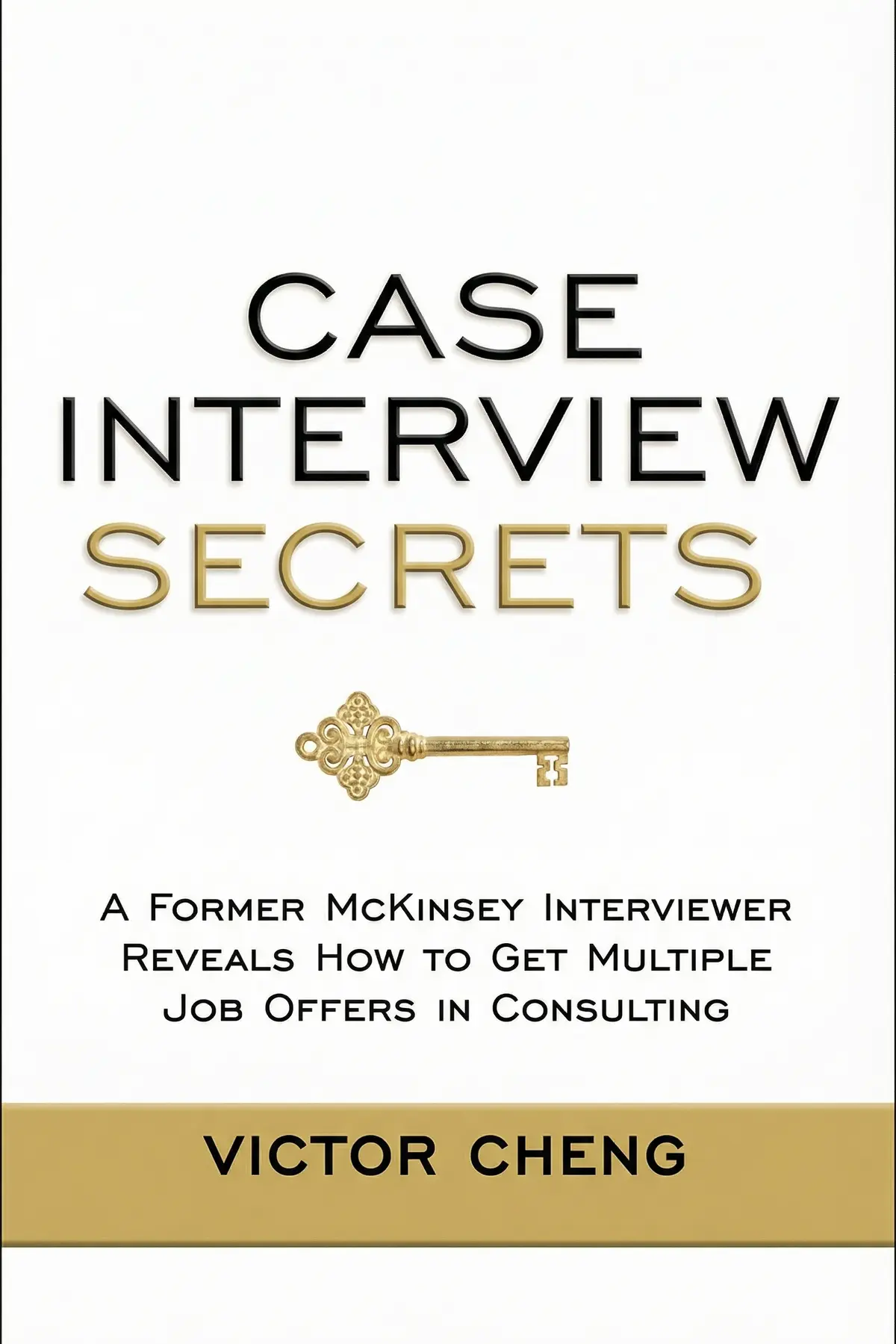
Many strong candidates arrive at a consulting interview ready to talk about their résumé. Then they stumble on a question about drive-thru hamburgers. In Case Interview Secrets, former McKinsey consultant and interviewer Victor Cheng explains what happened: the case interview is a rehearsal of the job itself, and the interviewer is quietly playing your future client.
Cheng has sat on both sides of that table. As a candidate he cracked 60 of the 61 cases he faced and won offers from McKinsey, Bain, Monitor, L.E.K., Oliver Wyman and A.T. Kearney. Later he interviewed applicants for McKinsey. His argument is that you win by thinking and acting like a working consultant from the first minute. You lead with a hypothesis, test it with clean structures and quick math, and close with a recommendation delivered calmly. Along the way come the two frameworks he says handle most cases, a test for splitting any problem without gaps, mental math for very large numbers and the habit of giving the answer first.
1 min 36 sec
Interviewers at top firms can seem pushy, demanding estimate after estimate. Cheng says the pressure has a purpose. Once you see what it is, the way you prepare for the whole interview changes.
1 min 39 sec
Most candidates gather facts and hope an answer appears. Cheng’s method runs the other way: you name the answer first. The surprising part is what you do with that answer next.
1 min 36 sec
Ask why a business is struggling and the reasons pile up, repeat each other and still miss something. One test with an awkward name catches both errors before an interviewer does.
1 min 36 sec
Some prep guides ask you to memorize a long menu of frameworks. Cheng bets on just two and claims they cover most of what you will face. The skill lies in switching between them.
2 min 00 sec
Brilliant mathematicians still fail consulting math questions. Cheng explains why, then shows a splitting trick and a rounding trick that turn ugly numbers into answers you can give in seconds.
1 min 44 sec
Nobody knows how many burgers a drive-thru sells in a day, and the interviewer doesn’t expect you to. What they watch for is one check that most candidates forget to make.
1 min 34 sec
Candidates often finish a case by replaying every calculation in order. Consultants never present to clients that way. A short closing habit shows the interviewer you could stand in front of an executive tomorrow.
1 min 12 sec
In the end, Cheng offers a way to stop treating the case interview as an exam and start treating it as your first day at work. Every tool in the book copies what a consultant does in front of a client. You commit to a view and organize the problem so nothing is missed. You put numbers on it quickly, and you tell the client what to do. The method worked for its author, who passed 60 of 61 cases. The book’s praise pages also include Northwestern student Michael Yang, who reports six consulting offers, among them McKinsey and BCG.
The preparation is modest and daily. A few minutes of mental multiplication builds speed, especially if you practice rounding in opposite directions when the figures get messy. In every mock case, say a hypothesis early, check your tree for gaps and overlaps, and end with the recommendation before the reasons. Practice staying calm as seriously as you practice the math. One reviewer notes that the book contains no practice cases and says little about the behavioral fit interview, so pair it with live mock interviews.
Firms hire the candidate who already sounds like one of their consultants.
Consulting firms don't just ask about your résumé. They hand you a business problem, such as why a company is losing money or how many hamburgers a drive-thru sells, and watch you solve it live. Many bright candidates freeze, wander through the data or slip on the arithmetic. Victor Cheng has sat on both sides of that table. As a candidate he passed 60 of the 61 cases he faced. Later he interviewed applicants for McKinsey. His core argument is that the case interview simulates the job itself, and the interviewer is playing your future client. So you should behave like a consultant. Commit to a hypothesis early. Test it with issue trees that have no gaps or overlaps. Use two flexible frameworks that he says cover most cases. Then close with the answer first. Readers get a working method for the whole case: how to open, which questions to ask, how to multiply large numbers in their head, how to estimate a market from proxies and how to deliver a recommendation calmly enough that an executive would act on it.
Students, MBAs and PhDs with a consulting case interview on the calendar.
Experienced professionals switching into consulting who freeze on live business problems.
Analysts who want a clean way to structure problems and do quick estimates at work.
Victor Cheng began his career as a management consultant at McKinsey & Company and went on to senior management roles at LivePerson and Art Technology Group. He holds a BA in Economics and an MA in Sociology from Stanford University. He founded CaseInterview.com, a site for people pursuing careers in management consulting. He also advises owners and CEOs of small businesses and Inc. 500 companies on their decisions.

Listeners find this case interview guide indispensable for beginners, as it provides a thorough look at the truly vital elements of consulting recruitment. The book teaches the core logic required and helps listeners adopt a consultant's perspective while presenting in-depth preparation techniques. Listeners value the organized framework, straightforward wording, and simple explanations, which make it a highly useful tool for anyone pursuing a career in consulting.
If you're serious about breaking into management consulting, this is essentially the bible for the interview process. It works surprisingly well for most beginners. Victor Cheng does an incredible job of shifting your mindset from a typical student to a high-level problem solver who can tackle any business challenge with poise. I found the chapter on hypothesis-driven thinking particularly illuminating. Before reading this, I was just guessing at frameworks, but now I understand the deep logic behind every issue tree I build during my mock sessions. The writing style is consistently clear and accessible. It completely demystifies the entire case selection process. Personally, the tips on 'drilling down' into the data until you find the root cause helped me navigate my mock interviews with much more confidence.
Show moreThe truth is, preparing for a case interview feels like learning a whole new language, and Victor Cheng is a patient, if slightly boastful, teacher. This book provides a comprehensive overview of the entire process, from the first contact to the final partner interview. I loved the focus on the business situation framework and how it differs from the standard profitability model most people use. It’s clear that the author knows these firms inside and out, having sat on both sides of the table. Some reviewers complain about the self-promotion, but I found his success stories quite motivating during the long hours of prep. It’s well-structured and easy to understand, even if you don't have a formal business background. Following his advice on 50-100 hours of practice is probably the most honest career advice I've ever received. It’s a must-have for any serious applicant.
Show moreAfter hearing about the legendary Victor Cheng for months, I finally dived into his methodology. This isn't just a book about interview questions; it’s a deep dive into the mindset required to survive at a top-tier firm. The way he explains issue trees makes so much more sense than the generic templates you find online. I particularly valued the emphasis on making an early hypothesis and being willing to pivot as soon as the data contradicts you. Got to say, the linear thinking approach described here is exactly what interviewers at Bain and BCG are testing for during the case. While the diagrams are a bit basic and the book feels like a gateway to his online ecosystem, the fundamental strategies are unbeatable. If you master the three frameworks he suggests, you’ll be ahead of 90% of other candidates. It gave me the confidence I needed to stop panicking.
Show moreTo be fair, the constant reminders to visit his website are annoying, but the core content on hypothesis-driven thinking is worth its weight in gold. Most candidates fail because they try to memorize frameworks instead of learning how to actually think like a consultant. This book solves that by focusing on linear logic and the synthesis of complex information into a clear recommendation. I especially liked the section on estimation questions and how to handle the qualitative business situation cases. It puts you right in the interviewer's shoes, explaining exactly what they are looking for in a successful candidate. Some might find the tone a bit boastful, but when you’ve cracked as many cases as he has, maybe you’ve earned it. In my experience, this is the most direct path to understanding how firms like McKinsey evaluate talent. It’s an essential first step for any aspiring consultant.
Show moreEver wonder why some candidates seem to breeze through the McKinsey case while others stumble over basic math? This book pulls back the curtain on the evaluation techniques that firms actually use to filter out the 'smart' from the 'prepared.' The explanation of how to use numerical models to analyze profit components was particularly helpful for my quantitative preparation. I did find it a bit irritating that he constantly references his expensive online courses, but the free value in these pages is still substantial. To be fair, the pictures and diagrams are a bit low-budget, looking more like sketches than professional consultant slides. Despite the formatting issues, the strategic advice on how to behave like a consultant from the very first minute is spot on. It’s a reliable roadmap for anyone feeling lost in the competitive world of management consulting.
Show morePicked this up on a recommendation from a mentor and found the analytical frameworks surprisingly transferable to other industries. Even if you aren't aiming for McKinsey, the way Cheng teaches you to deconstruct problems into mutually exclusive parts is a vital business skill. Personally, I think the book could have been much more concise if the author had trimmed the sections about how great his own track record is. It feels a bit like a printed advertisement for his website at times, especially with the frequent links embedded in the text. However, the core lessons on how to structure a 'drill down' analysis are top-notch. It’s a great guide for anyone who needs to learn how to communicate complex ideas in a structured, linear fashion. Just take the ego-heavy stories with a grain of salt and focus on the logic models.
Show moreFinally got around to reading this after trying to wing my first mock interview with disastrous results. I quickly realized that case interviewing is less about business knowledge and more about demonstrating a very specific, reductionist analytical process. Cheng’s breakdown of the profitability framework is straightforward, though I found his omission of Barbara Minto’s 'Pyramid Principle' a bit strange considering he clearly uses her methods. The book is written in a very accessible way, but you have to ignore the parts where the author humble-brags about his own career. Truth is, the advice on synthesis—restarting with your conclusion before diving into the 'why'—is what actually gets people hired. It’s a solid resource for first-time applicants who need to understand the 'rules of the game' before they step into the room. Just be prepared for some heavy self-promotion throughout the text.
Show moreAs someone who struggles with open-ended business problems, I found the drill-down analysis section to be a total game-changer. Victor Cheng explains how to stop at the minimal information necessary to prove a point, which saved me so much time in mock cases. The writing style is very casual and conversational, making it easy to power through the book in a weekend. My only real gripe is that it feels a bit repetitive, as he hammers home the same points about his own interview success multiple times. You definitely get the sense that he’s trying to sell you on his website's premium content. But if you can look past the marketing, the strategies for building issue trees are incredibly effective. It helped me move away from 'creative' thinking and toward the structured, linear logic that these big firms crave. It’s a solid four-star resource.
Show moreLook, the technical advice here is undeniably solid, but the author's ego is splashed across every single page. I appreciate the deep dive into issue trees and the MECE principle. However, did we really need a reminder every ten pages that Victor is a former McKinsey interviewer who cracked 60 cases? The constant links to his website felt like a cheap marketing tactic rather than a genuine resource for the reader. That being said, the way he breaks down the synthesis is a crucial skill. It is a good foundational text for beginners. You simply have to filter through a lot of fluff and self-aggrandizement to find the gold. I wish it were about 50 pages shorter and more focused on mechanics. It is a valuable tool, but definitely not a perfect one.
Show moreNot what I expected from a supposedly professional guide to high-level consulting careers. The 'profitability' and 'business situation' frameworks feel like they were pulled from other sources without much original thought. The formatting is shockingly poor for a published book, featuring cheap-looking diagrams that provide very little visual clarity for the reader. I found the constant self-promotion and reminders to buy expensive courses incredibly distracting. Frankly, the author’s bragging about his own success rate becomes exhausting very quickly. You could find 90% of this information for free on various online forums. It is a shame because the core idea of linear thinking is actually quite useful. Unfortunately, the delivery is so self-absorbed that it is hard to finish.
Show moreVictor Cheng argues that a consulting case interview simulates the job itself, with the interviewer acting as your future client. To pass, you behave like a working consultant. State a hypothesis early, test it with issue trees that have no gaps or overlaps, use two flexible frameworks, do the math quickly and close with a clear, top-down recommendation. Do all of it calmly enough that a client would trust you.
He teaches two. The profitability framework splits profit into revenue and cost, so you can find where money is being lost. The business situation framework looks at customers, product, company and competition, so you can find out why. Cheng claims these two cover about seventy percent of the case types candidates meet. He encourages switching between them during a case instead of memorizing many rigid frameworks.
MECE stands for mutually exclusive and collectively exhaustive, and it is central to how Cheng builds issue trees. Mutually exclusive means no two branches overlap, so no cause is counted twice. Collectively exhaustive means the branches together cover every possibility, so the real cause can’t slip through a gap. Profit split into revenue and cost is a simple example of a MECE split.
Cheng recommends breaking calculations into easy steps and practicing daily. To find 15 percent of $600 million, take 10 percent (60 million) and add 5 percent (30 million) to get $90 million. When the numbers are awkward, round one up and another down so the errors offset. For example, 42 million and 12.7 percent become 40 million and 15 percent, which gives $1.2 billion against an exact $1.07 billion.
The book is aimed at undergraduates, MBA students, PhD candidates and experienced hires preparing for consulting interviews. It is strongest on the analytical side of the case: hypotheses, issue trees, frameworks, estimation and synthesis. One reviewer notes that it includes no practice cases and gives little attention to the behavioral fit interview, so candidates should add mock interviews and separate fit preparation.
Robin Ryan





Marianne Cantwell
William Vanderbloemen
AUDIO SUMMARY AVAILABLE
Get the key ideas from Case Interview Secrets by Victor Cheng, plus 5,000+ more nonfiction titles.









