

A History of the World in 6 Glasses
Tom Standage
 English
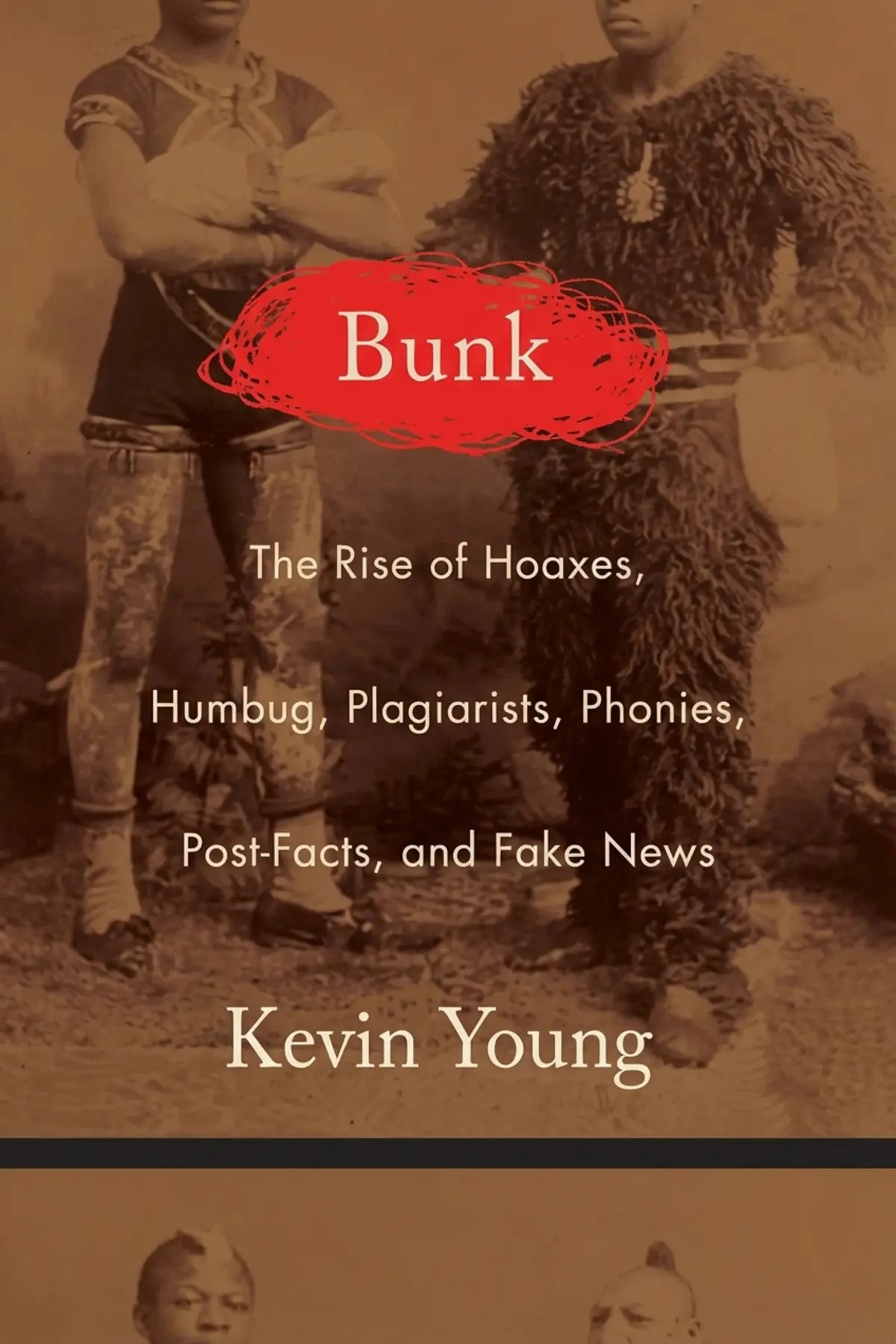
Kevin Young traces America's long love affair with hoaxes, from an 1835 newspaper story about life on the moon to fake news, and shows how deception works by feeding desire, fear and racial prejudice.
54 sec
When a headline makes you gasp, the first instinct is to share it, not to check it. In Bunk, poet and museum director Kevin Young argues that this reflex has a long American history, starting with a New York newspaper that told readers in 1835 that life had been spotted on the moon.
Young’s claim is that a hoax works by handing people what they already want to believe, and that the wants it feeds most often are about race. From P. T. Barnum’s stage shows to an invented story that won a Pulitzer Prize, he traces how deception moved from wonder to fear and then into politics.
Follow his cases and you get a working test for any story that excites you: ask whose desire it serves, and whose real history it pushes aside. That question marks the difference between being entertained by a con and being able to name it.
1 min 54 sec
An editor in 1835 picked a famous scientist to quote precisely because nobody could reach him. His trick says something about a young country, and about why a major newspaper later gave up tracking online fakes.
1 min 55 sec
A showman claimed a blind woman was 161 years old, and a photographer promised grieving families pictures of their dead. Neither needed proof. Both understood something about audiences that still holds every time you scroll.
2 min 03 sec
A man dressed in animal hide was shown as the missing link months after Darwin published. A civil rights leader turned out to be someone else entirely. Young finds the same pattern linking them across 150 years.
1 min 57 sec
A Hiroshima survivor’s poems and a Navajo writer’s prize-winning memoirs moved American readers. Both authors were invented. Young explains why the damage went far beyond embarrassing the publishers who fell for them.
1 min 53 sec
A radio play sent a country into panic, and a heartbreaking newspaper story about a child won journalism’s top prize. Neither was real. Young shows why horror became the hoaxer’s favorite material in the twentieth century.
1 min 57 sec
Many call this a post-fact era. Young picks a different name, and it points the finger less at liars than at audiences who enjoy the show too much to ask whether any of it is real.
1 min 13 sec
Bunk ends where it began, with an audience that wants the show more than the truth. Young’s line of cases, from moon creatures to an invented Navajo memoirist, builds one argument: a hoax is a mirror. It shows what a society longs for, what it fears and, again and again, what it believes about race. That is why he refuses to treat hoaxes as harmless fun. Each one can keep a stereotype alive and push a real people’s history out of the room.
His cases suggest some habits worth keeping. When a story thrills you, ask what you hoped was true before you read it, the way Mary Todd Lincoln hoped for a picture of her son. When it horrifies you in a familiar way, remember that Jimmy’s World won a Pulitzer because it matched expectations. And when someone speaks for a whole community, look for the real members of that community in the conversation.
Barnum invited his crowds to see and touch Joice Heth and judge for themselves. The invitation to check was part of the con. Looking is never enough; the harder work is asking why you wanted to believe.
Fake news and alternative facts can feel like new problems. Kevin Young argues they are old ones. In Bunk, he follows the American hoax from a New York newspaper's invented moon creatures in 1835 to viral blogs and presidential campaigns, and asks why so many people prefer a thrilling story to a true one. His answer is that a hoax is never judged on whether it holds up. It is judged on how strongly it excites its audience, and it does that by telling people what they already want to hear. Young shows that those wishes have very often been about race. P. T. Barnum's exhibits, fake memoirs written in borrowed Native American and Japanese voices, and a Pulitzer Prize story about a child heroin addict that turned out to be invented all leaned on familiar stereotypes. Readers get a sharp history of deception and a way to read the present. Young explains how the hoax moved from wonder to horror, why it can erase the real history of the people it claims to represent, and why he sees today as an age of euphemism, where spectacle wins over truth.
Readers worn out by fake news who want to understand why false stories spread so easily.
Journalists, editors and publishers who decide which voices and stories reach the public.
Anyone curious how race and entertainment have shaped American deception from Barnum to social media.
Kevin Young is a poet, editor and museum leader. His poetry collection Jelly Roll: A Blues was a National Book Award finalist, and his nonfiction book The Grey Album was a New York Times Notable Book. He has taught at Emory University, where he curated the Raymond Danowski Poetry Library, and he has directed both the Schomburg Center for Research in Black Culture and the Smithsonian's National Museum of African American History and Culture.
Listeners find this book to be an excellent read. Opinions on the depth of research are varied, though several listeners point out that it is well researched.
Wow, what a staggering achievement this book is. Kevin Young has managed to trace the DNA of the "fake" from P.T. Barnum all the way to the current era of fake news with such acrobatic skill. This isn't just a collection of fun facts; it's a profound study of how we as a culture allow ourselves to be lied to. The writing is gorgeous—it’s essentially a book of poetry masquerading as a historical study. I loved the way he dissected the "Noble Savage" tropes and the way white hoaxers often appropriate minority suffering for profit. It’s a masterpiece that should be mandatory reading for anyone trying to navigate our modern misinformation landscape. Don't let the page count scare you off.
Show morePicked this up expecting a light history of scams and ended up with a life-changing perspective on the American "post-truth" condition. Young is brilliant at revealing how the hoax changes history and the future. From the Cottingley Fairies to the heartbreaking reality of fake Holocaust memoirs, he handles each subject with a mix of poetic grace and righteous indignation. The book is long, yes, but every page feels necessary to build the case that truth is a matter of life and death. His analysis of how institutions feed off stereotypes is both enlightening and terrifying. This is easily one of the most important nonfiction books I've read in years. It is well researched and absolutely essential for understanding today's world.
Show moreEver wonder how a book about circus sideshows could feel so vital to our modern political moment? While it’s true that Young’s writing style is dense and occasionally moves in circles, the connections he draws between 19th-century "humbug" and today’s "fake news" are brilliant. The chapter on Rachel Dolezal is particularly sharp, written with a personal touch that some of the more academic chapters lack. To be fair, it is a very long read and requires some patience to navigate the nonlinear structure. However, the sheer depth of research and the unique perspective on how hoaxes reinforce social hierarchies made it worth the effort for me. It’s a challenging but ultimately rewarding look at the American psyche and our obsession with the fake.
Show moreFinally got around to finishing this behemoth, and while it's a lot to process, the insights are incredibly timely. Young argues convincingly that the hoax isn't just a harmless prank, but a tool often used to maintain social and racial hierarchies. Seeing the parallels between the 1800s "penny press" and today’s internet chaos was a total "aha" moment for me. The book is definitely not light reading—it’s thick and sometimes the academic tone can be a bit sapping—but the cultural analysis is top-notch. If you’re interested in the "post-truth" era and where it actually came from, this provides a necessary, if uncomfortable, historical context. It’s well researched and far more profound than your average history book.
Show moreAs someone who loves obscure history, I found the deep dives into characters like Nasdijj and the Hitler Diaries quite compelling. Young does an admirable job of debunking these "spectacular falsehoods" while showing the very real human cost involved. I did feel the book was a bit "trim-challenged," as it circles back to the same themes of race and identity a bit too frequently for my taste. Some might find the focus on the racial underpinnings of hoaxes to be "reaching," but I thought those arguments were some of the strongest and most original parts of the book. It’s a dense, challenging work that demands your full attention, but the payoff is a much deeper understanding of the history of American deception.
Show moreTo be fair, Young is an incredible poet, and that lyrical quality shines through in his descriptions of various historical frauds. He treats these hoaxes like confessions of our cultural desires, which is a fascinating lens. However, the book is a bit of a shaggy mess. One minute he's talking about Edgar Allan Poe, and the next he's rambling about modern plagiarism in a way that feels more personal than objective. It’s like a collection of beautiful but disjointed Christmas lights; some spots are brilliant, but there’s too much murkiness in between for a clear pattern to emerge. I learned a lot of trivia, but I wish he had honed his arguments into something more concise and less like a graduate sociology seminar.
Show moreFrankly, the early chapters on the evolution of "bunkum" and the penny press were the highlight for me, though the momentum died once we hit the deep dives into literary plagiarists. Kevin Young clearly knows his stuff, and the historical images and playbills included throughout are a delight to look at. But the book suffers from a lack of stylistic consistency; it oscillates between being a rigorous history and a ruminative collection of prose poems. Some readers will love the intellectual posing, but I found it a bit much after four hundred pages. It’s a solid 3-star read—highly informative and deeply researched, but just way too long for the points it's trying to make. A good editor could have made this a classic.
Show moreLet's be real: this book is massive, and for all its 600+ pages, it feels remarkably repetitive and unfocused. I found the early sections on P.T. Barnum and Joice Heth somewhat interesting, but the narrative flow is nonexistent as the chapters progress. Young jumps from one con man to another without providing enough historical context for the reader to keep up. It’s a very interesting subject yet somehow incredibly boring at the same time. I kept putting it down and struggling to find the motivation to pick it back up again. It feels like a giant info dump where the author is more interested in settling literary scores than providing a cohesive narrative. Not recommended if you value your time.
Show moreThe table of contents promised a thrilling journey through history's greatest deceits, but the reality was an exhausting academic slog. While the research is clearly extensive, the author spends the bulk of these 600 pages rambling through sociopolitical theories rather than actually recounting the history of the events. It felt less like a book for a general audience and more like a dense PhD thesis that desperately needed a more aggressive editor to trim the fat. Every time I thought we were getting to a juicy bit about a historical forgery, Young would pivot back to the same repetitive arguments about systemic racism. I appreciate the intellectual effort, but the delivery is just too dry and disjointed to be engaging for a casual reader. It's a waste of time for anyone looking for a readable, chronological history.
Show moreI was hoping for a fascinating exploration of American humbuggery, but "Bunk" is exactly what the title suggests—complete nonsense. The author reaches for predetermined conclusions, attempting to link every single historical lie, from the Feejee Mermaid to fake child prodigies, directly to racial animus. It is an illogical stretch that gets old by page fifty, yet the book drags on for hundreds of pages more. The prose is needlessly dense, full of poetic posturing that obscures the facts rather than illuminating them for the reader. If you want a lecture from the academic clouds that ignores the more nuanced or "fun" side of historical trickery in favor of a navel-gazing seminar style, this is for you. Otherwise, steer clear and save your money.
Show moreBunk traces the history of the American hoax, from the 1835 Great Moon Hoax in a New York newspaper to viral blogs and modern politics. Young argues that hoaxes succeed by giving audiences what they want to believe, not by being convincing, and that they very often rest on racial stereotypes. He follows the hoax as it shifted from shows of wonder to stories of horror and finally into what he calls the Age of Euphemism.
Young names the Great Moon Hoax of 1835 as the earliest example of something we would today label fake news. Richard Adams Locke, editor of the New York Sun, published articles claiming life had been found on the moon, with invented quotes credited to astronomer Sir John Herschel. Locke picked Herschel because he was hard to contact, which made the hoax unlikely to be exposed quickly.
Young notes that the hoax and the modern idea of race emerged together during the Enlightenment. He shows that many hoaxes rely on racial judgments, from Barnum displaying Joice Heth and a Black man presented as a missing link, to Janet Cooke’s invented Pulitzer story about a child heroin addict. These stories succeeded partly because they confirmed what audiences already believed about Black and minority people.
Young argues that when someone invents a voice for a community, the fake story replaces the real one. Kent Johnson’s invented Hiroshima poet Araki Yasusada recycled American clichés about Japan, and Tim Barrus wrote three fake memoirs as an imaginary Navajo named Nassijj. Such fabrications rewrite a people’s history and remove the pressure for real conversations about those communities’ needs.
Young’s cases suggest a few questions. Ask what you were hoping was true before you read a story, since hoaxes feed desire. Be especially careful when a shocking report confirms a familiar stereotype, as Jimmy’s World did. Check whether a voice speaking for a community can be verified. And notice when you are being entertained, because spectacle is what lets audiences stop caring about truth.
Tom Standage


Ishmael Beah

bell hooks




William J. Bernstein

Ben Macintyre

AUDIO SUMMARY AVAILABLE
Get the key ideas from Bunk by Kevin Young, plus 5,000+ more nonfiction titles.









