


13 min 39 sec
Available in: English
Bulletproof Problem Solving: The One Skill That Changes Everything
A seven-step method for cracking hard problems at work or alone: frame the right question, break it into parts, focus effort where it pays, analyze simply and present an answer people act on.
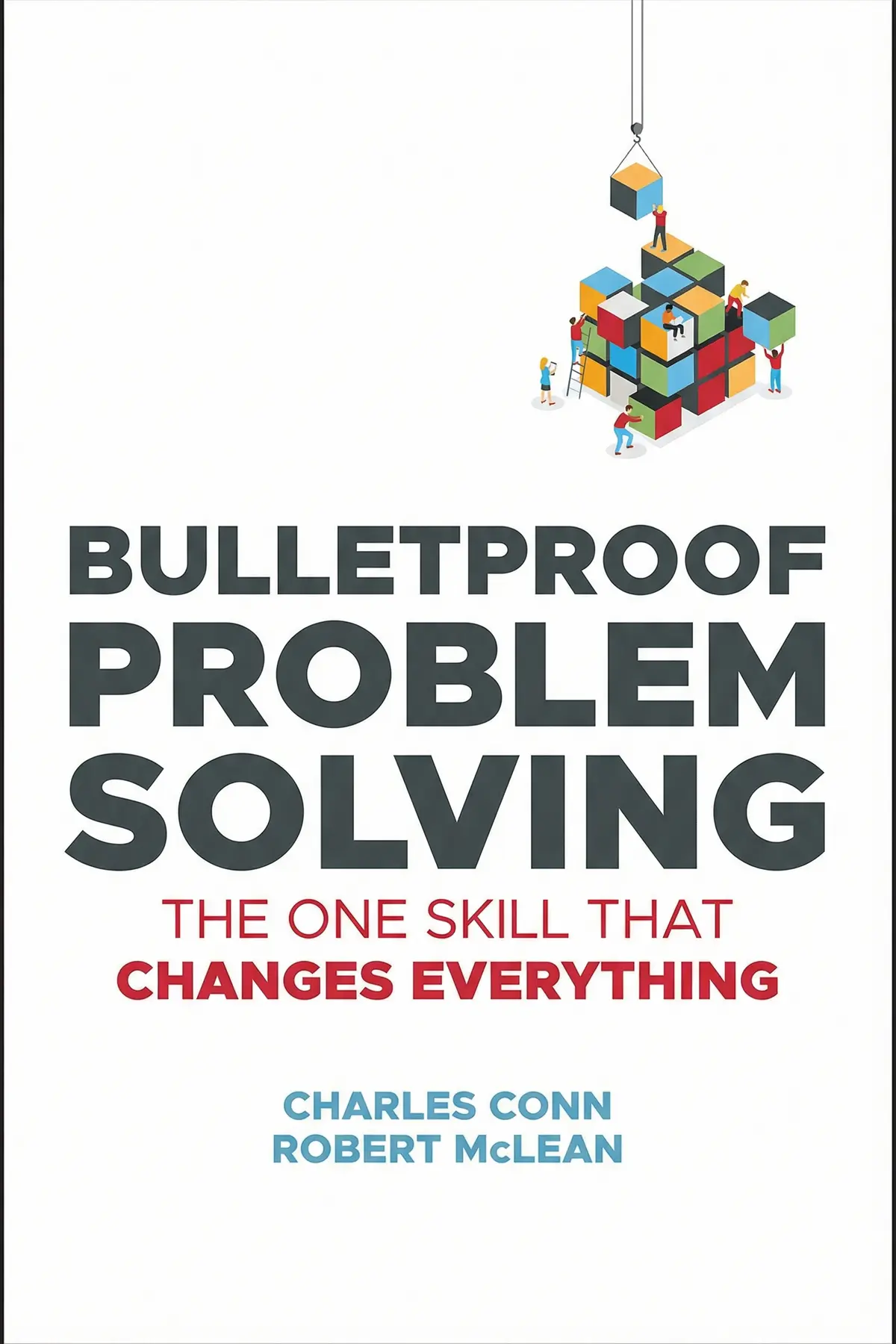
Table of Content
1. Introduction
1 min 03 sec
Most people handed a messy problem start solving it at once, and that rush is how good work ends up answering the wrong question. In Bulletproof Problem Solving, Charles Conn and Robert McLean, both former leaders at McKinsey, argue that solving problems well is a structured skill, and that it begins by slowing down at the very first step. The skill matters more every year, they say: routine work has been shrinking since the 1960s, and the World Economic Forum finds the best-paid jobs are now non-routine and cognitive.
Their method has seven steps, and their argument comes down to this. A hard problem becomes manageable when you ask the right question, split it into pieces, focus only where effort pays off, and then tell the answer as a story people act on. Along the way there are newspaper executives who misread the internet, a salmon foundation that picked its battles, and a handful of shortcuts that make any analysis faster to start.
2. Write the problem as one sharp sentence first
1 min 51 sec
An industry with huge newsrooms and decades of success looked at a new rival and decided it was safe. Their mistake had nothing to do with effort or talent, and it began before any analysis started.
3. Split any problem into branches you can work on
1 min 48 sec
A goal as simple as losing a few pounds hides a surprising number of separate decisions. Drawing them out reveals options you had not considered, and warns you about the one branch people forget.
4. Spend effort where impact and control meet
2 min 05 sec
A foundation with limited money wanted to save a fish that spans an entire ocean. Most of the obvious options were either impossible or useless, and the one that worked came from where the fish go to breed.
5. Give every task an owner and a deadline
1 min 57 sec
A health team wants to know why fewer people are training to become nurses. Before anyone opens a spreadsheet, a few plain questions decide whether their research will produce answers or just more data.
6. Size the problem with simple shortcuts first
1 min 56 sec
People who know advanced software tend to reach for it on every question. A rule of thumb about 500 years old, and a few others nearly as simple, often tell you more and much sooner.
7. Turn your findings into a story leaders act on
1 min 47 sec
Excellent analysis is often ignored, and the reason is rarely the numbers. The last two steps decide whether months of work change anything, and the right structure depends on how the listener feels about the answer.
8. Conclusion
1 min 12 sec
What Conn and McLean offer is a discipline more than a bag of clever tricks. Each step protects the next one from waste. A sharp question keeps the tree from growing in the wrong direction. The grid keeps the team from boiling the ocean, the plan keeps the analysis honest, and the simple shortcuts keep the big models waiting until they are needed. The story at the end is where all of it either becomes action or sits unread in a file.
The method is also a loop. The authors stress that answers improve as you dig into the data and refine your understanding, so the first tree and the first problem statement are drafts, meant to be redrawn.
The newspaper executives make the warning hard to forget. They had experienced people and a long record of surviving new technology, and they still lost, because they answered a question about content when the real one was about advertising money.
So start with the problem on your desk today. Write it in one sentence and name who decides. Sketch the tree, and spend this week only on the top right box of your grid. When you report back, open with the answer, and let everything else hold it up.
About this book
What is this book about?
Most people facing a difficult problem rush to gather data and build answers before they know what they are really solving. Charles Conn and Robert McLean, both former leaders at McKinsey, argue that this rush is where good work goes wrong, and that problem solving is now the skill that matters most, as routine jobs shrink and the best-paid work becomes non-routine and cognitive. Their answer is a seven-step loop. Define the problem in one crisp sentence. Break it apart with logic trees. Prune the tree to the levers that have a big impact and that you can actually change. Build a work plan with owners, deadlines and clear deliverables. Analyze with simple shortcuts such as Occam's razor and the 80:20 rule before reaching for big models. Then synthesize the findings and communicate them as a story that leads to action. The examples include newspaper executives who misread the threat from the internet, a foundation protecting wild Pacific salmon on a limited budget, and a health team investigating falling nursing enrollment. Readers get a method that works for one person at a desk or for a whole team, and the habit of asking the right question first.
Book Information
Who it's for
Consultants and analysts
Analysts and consultants whose careful work keeps getting ignored or answers the wrong question.
Stretched founders and managers
Founders and managers facing messy decisions with limited time and budget.
Leads coordinating team research
Team leads who want a shared method for splitting up research and presenting results.
About the Author
Charles Conn
Charles Conn was a Partner at McKinsey, then founding CEO of Ticketmaster-Citysearch, head of the venture firm Oxford Sciences Innovation and, for five years, chief executive of the Rhodes Trust. He also led conservation work on wild salmon ecosystems for the Gordon and Betty Moore Foundation. Robert McLean led McKinsey's practice in Australia and New Zealand for eight years, sat on the firm's global Director's Committee and served as Dean of the Australian Graduate School of Management. He now works as an investor.
Ratings & Reviews
Ratings at a glance

What people think
Listeners value the systematic framework for tackling issues and describe the content as both functional and beneficial. The work is thoroughly documented, with one listener highlighting that it is chock-full of case studies, and listeners characterize the material as lucid and simple to track. They view it as a remarkable piece of work and highly prize its instruments for making decisions.
Top reviews
Pear
This book is essentially a masterclass in structured thinking that feels like a secret weapon for anyone working in a high-pressure corporate environment. The authors break down the complex art of tackling challenges into a clear, seven-step process that actually feels actionable. I particularly enjoyed how they use logic trees to disaggregate problems into manageable, bite-sized chunks. To be fair, some of the concepts like MECE might feel familiar if you’ve spent any time in management consulting, but the depth of explanation provided here is unmatched. It’s not just abstract theory; the case studies range from personal finance to global health issues, making the framework feel truly universal. Frankly, I think this provides a real unfair advantage in a world where routine tasks are increasingly being automated. It demands a lot of mental energy to get through, but the payoff is a much sharper analytical lens.
Show moreLily
Finally got around to finishing this, and the chapter on logic trees alone is worth the price of admission for any serious professional. The authors do a fantastic job of illustrating how a dash of creativity paired with rigorous strategy can solve almost anything. I loved the practical nature of the case studies, which helped bridge the gap between abstract theory and real-world application. It’s one of those rare books that makes you realize it’s not just about what you know, but how you organize that knowledge. Not gonna lie, the level of detail is intense, and you have to be willing to do the mental work to follow along. However, the reward is a comprehensive framework that you can apply to everything from business turf wars to personal investment decisions. This is an exceptional read for anyone looking to level up their cognitive toolkit.
Show moreHazel
Wow, I wish I had read this at the very start of my career instead of discovering it years later. The way Conn and McLean explain the importance of cleaving a problem using logic trees changed my entire perspective on strategy. It is not just about being smart; it is about having a repeatable process that prevents you from getting lost in the weeds. I’ve started applying the prioritize and prune step to my weekly goals, and the results in my productivity have been immediate. The book is chock-full of case studies that prove these methods work for everything from small business hurdles to massive social crises. Got to say, this feels like the kind of book you keep on your shelf and revisit every time you hit a wall. It’s sophisticated, rigorous, and ultimately empowering for anyone who wants to be a better thinker.
Show moreBee
After hearing so much about the McKinsey way of doing things, I finally dove into this guide to see if the hype was real. What I found was a very disciplined approach to analysis that emphasizes the importance of the problem-definition cycle. The sections on inductive and deductive trees were particularly enlightening, providing a visual way to cleave a problem into its component parts. I've read several strategy books, but few provide this level of quantitative tint to the decision-making process. My only gripe is that the analysis portion felt slightly underdeveloped compared to the time spent on team dynamics. Still, the emphasis on being mutually exclusive and collectively exhaustive is a game-changer for my daily work plan. It’s a professional, well-structured manual that I’ll likely keep on my desk for reference during complex projects.
Show moreDao
Look, if you’re looking for a quick fix or a light weekend read, you should probably look elsewhere. This is a dense, high-level manual that demands your full attention to grasp the nuances of their seven-step approach. I found the sections on synthesizing findings particularly useful, as that is where most people—including myself—usually stumble. The authors include a lot of tables and illustrations that are crucial for understanding the more technical analytical frameworks they propose. Personally, I found it a bit similar to Principles by Ray Dalio in its systematic approach, though much more focused on specific problem-solving tactics. It’s a bit of a slog in the middle, but the clarity you gain on how to prioritize crucial elements is worth the effort. A solid resource for anyone entering the world of strategy consulting or high-level management.
Show moreRoydao
As someone who deals with complex project management daily, I found the 7-step model incredibly grounding and surprisingly versatile. The book moves beyond simple brainstorming and introduces a quantitative rigor that is often missing from modern leadership literature. I specifically appreciated the focus on disaggregation, which taught me how to break down massive, intimidating hurdles into small, solvable units. The truth is, the book can feel a bit repetitive if you are already familiar with standard consulting frameworks like SWOT or the BCG Matrix. However, seeing these tools applied through the lens of modern challenges like machine learning or environmental issues was very refreshing. It’s well-researched and clearly written, even if it occasionally leans too heavily into the consultant persona. I’d recommend it to anyone who feels overwhelmed by the open-ended challenges of the modern workplace.
Show moreFon
The chapter on communicating findings was a standout for me, especially the advice on the pyramid communication pattern. Most books focus on the doing of the work, but this one realizes that synthesis and communication are just as vital for a solution to actually take hold. I found the authors’ tone to be professional and authoritative, which fits the McKinsey-style content perfectly. Some of the charts and data-heavy examples required me to slow down and really focus, which might be a turn-off for some. Frankly, it’s a lot to digest in one go, but the structured approach is a breath of fresh air compared to more fluffy business books. It provides a formal way to tackle problems that usually feel chaotic, giving you a sense of control over complex variables. If you’re a fan of data-driven decision-making, you’ll find a lot of value in these pages.
Show moreLayla
Ever wonder why business books often feel like they could have been a twenty-page white paper? While the core methodology here is undeniably solid, the delivery often feels a bit dry and textbook-ish for my taste. I appreciated the initial breakdown of the define and disaggregate steps, yet the middle section became incredibly repetitive after a while. The authors use a lot of detailed examples, like the obesity crisis, which are interesting but sometimes feel like they are burying the lead. In my experience, the constant jumping between different case studies made it hard to maintain a steady flow of learning. It’s a good introduction for those unfamiliar with the McKinsey style, though I wouldn't call it a page-turner. If you can push through the dense parts, there is value here, but it is definitely a slow burn.
Show moreMats
Picking this up felt like a good career move, but I have mixed feelings about the actual reading experience. On one hand, the bulletproof methodology is clear, structured, and obviously based on decades of high-level experience. On the other hand, the prose is quite dry and can feel like you’re reading a very long slide deck at times. I think management-consultant-wannabes will absolutely love the level of detail, but for a general business reader, it might be overkill. Some parts felt very familiar, and I didn't feel like I was getting many head-exploding new ideas. To be fair, the checklists and work-planning tips are helpful, but I found myself skimming the later chapters on communication. It's a useful reference book to have, but not necessarily something I’d sit down and read from cover to cover again.
Show morePridi
Not what I expected at all, especially given the glowing recommendations I’ve seen on LinkedIn lately. While the authors are clearly brilliant experts, they seem to struggle with distilling their knowledge into something that doesn’t border on being totally confusing. I found myself reading the same chapters multiple times just to figure out what the actual takeaway was supposed to be. They’ll introduce a fascinating concept like design thinking, but then only share a tiny bit of info before pivoting to something else entirely. To be honest, it felt like the book was trying to cram too much information into one volume without a clear narrative thread. The seven steps are there, but the meat of the advice is scattered across different chapters in a way that feels disjointed. I didn't finish it because it just became too boring and academic for my current needs.
Show moreQuestions about this book
What is the main idea of Bulletproof Problem Solving?
Charles Conn and Robert McLean argue that problem solving is the key skill for modern work and can be done with a structured, repeatable process. Their seven steps are: define the problem, break it down with logic trees, prioritize the levers that matter and that you can change, build a work plan, analyze, synthesize the findings and communicate them. The process loops, so answers improve as you learn.
What are the seven steps of Bulletproof Problem Solving?
First, state the problem in one crisp sentence and understand the decision-maker’s context. Second, split it into parts with a logic tree. Third, use a two-by-two matrix to focus on high-impact levers you can influence. Fourth, write a work plan with owners, deadlines and deliverables. Fifth, analyze, starting with simple heuristics. Sixth, synthesize results into a storyline. Seventh, communicate a one-sentence answer supported by a clear structure.
What is a logic tree in problem solving?
A logic tree places the problem at the root and breaks it into its main causes or components, then into finer ones. To lose 10 pounds, for example, you can burn more calories or eat fewer, and each branch divides further. The authors say branches should not overlap and should together cover everything relevant, since a missing branch may hold the solution.
How do you prioritize which part of a problem to work on?
The authors use a prioritization matrix, a two-by-two grid comparing each lever’s impact with how easily you can change it. Focus first on the box with big impact and high influence, and ignore small levers you cannot move. In a salmon conservation project, this led a foundation away from ocean conditions and licensing politics toward key breeding rivers and commercial catch rules.
How can I apply Bulletproof Problem Solving at work?
Begin your next project by writing the problem as one sentence and naming who will decide. Sketch a logic tree, place its end branches on the impact and influence grid, and assign each priority an owner, a deadline and a specific deliverable. Try simple tools such as the 80:20 rule before complex models, and present your conclusion as a single governing thought supported by arguments and data.
Readers also enjoyed

60 Seconds & You’re Hired!
Robin Ryan




Be A Free Range Human: Escape the 9 to 5, Create a Life You Love,
Marianne Cantwell
Be the Unicorn: 12 Data-Driven Habits That Separate the Best Leaders from the
William Vanderbloemen
AUDIO SUMMARY AVAILABLE
Listen to Bulletproof Problem Solving in 15 minutes
Get the key ideas from Bulletproof Problem Solving by Charles Conn, plus 5,000+ more nonfiction titles.
- 5,000+ titles
- Listen as much as you want
- 7-day free trial
- Cancel anytime









