


12 min 05 sec
Available in: English
Build for Tomorrow: An Action Plan for Embracing Change, Adapting Fast, and Future-Proofing Your Career
By Jason Feifer
Shows how to move through any major change, from a shrinking industry to a cancelled launch, by recognizing four predictable phases and using a specific tool to get past each one faster.
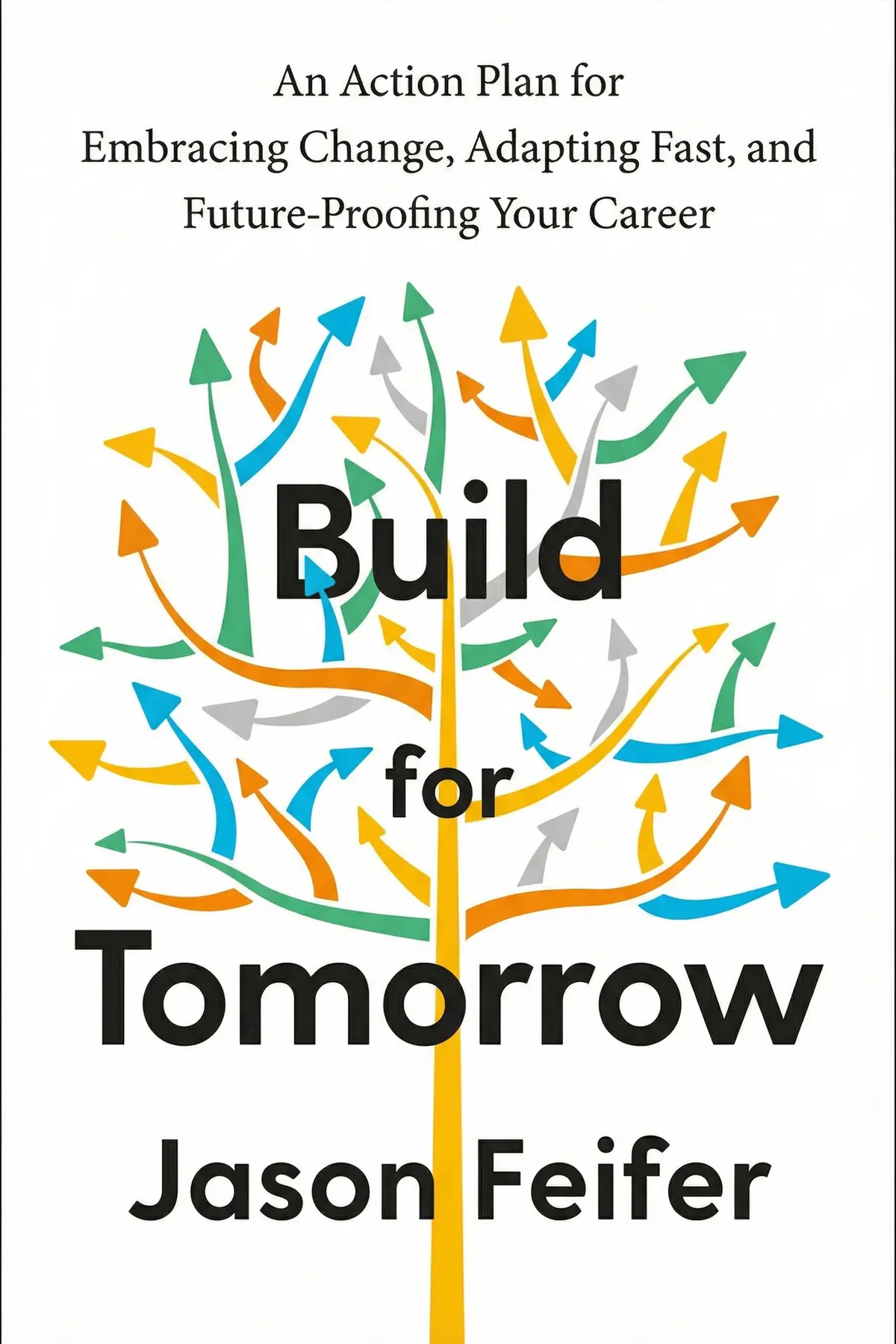
Table of Content
1. Introduction
56 sec
When a job, a business plan or a whole way of life shifts under you, the first instinct is to count what you are about to lose. In Build for Tomorrow, Jason Feifer, editor in chief of Entrepreneur, argues that this instinct is the real danger, because panic pushes people into big mistakes that hurt them along the way. His alternative is a map.
Feifer describes change as four phases that people pass through: Panic, Adaptation, the New Normal, and finally a point he calls Wouldn’t Go Back, where you would not return to the old way even if you could. Each phase has a tool that moves you to the next one sooner.
A famous composer who fought the radio, a brewer who limited sales of his own hit beer and a talking elevator show how those tools work in practice. Learn them, and the next disruption at work becomes something you can move through faster and with more courage instead of resisting it.
2. Spot the panic before it costs you
1 min 36 sec
A celebrated composer looked at two new inventions and decided they would wreck music, and humanity with it. His fear followed a pattern most of us repeat whenever a job, a city or a plan suddenly shifts.
3. Turn a fear of loss into a list of gains
1 min 37 sec
The same machines that seemed to threaten a whole profession ended up feeding it in ways few people predicted. The way out of panic starts with a belief you are allowed to hold before you have any proof.
4. Keep your purpose steady while your work changes
1 min 36 sec
A food company had a big launch ready for early 2020, and then the world shut down. What kept its founders steady is a question anyone changing careers can answer in a single sentence.
5. Change your own success before the market does
1 min 53 sec
A brewer whose beer was selling out across the country chose to sell less of it, and customers were furious. His reasoning shows why the safest time to change can be while things are going well.
6. Ease into new routines by carrying something old
1 min 45 sec
Automatic elevators fixed real problems, yet people refused to ride them. A small touch from the manufacturers changed their minds, and it suggests how to help anyone, including yourself, settle into something new.
7. Find the missing piece that makes change stick
1 min 36 sec
Square’s rivals copied its card reader almost exactly and still lost. What they overlooked points to the small gap that keeps many people from ever feeling fully at home after a big change.
8. Conclusion
1 min 06 sec
Feifer’s larger claim is that change has a shape, and the shape repeats. The same four phases met Sousa with the radio, the founders of Foodstirs with a pandemic and office workers with an elevator that had nobody inside. Knowing the sequence will not remove the discomfort, yet it can shrink the time you spend in it, because you stop defending something that was going to move anyway.
The book points to a few things worth trying the next time something shifts under you. Separate the losses you know from the ones you are imagining, and assume some gain is coming before you can see it. Hold on to your why and let your what change around it. Where something is working almost too well, consider changing it yourself, the way Calagione capped his best seller while it was still selling out. And when the new situation still feels slightly wrong, carry over one familiar piece and hunt for the missing 1 percent.
Sousa fought the machines that ended up carrying his marches to listeners he could never have reached in person. The change he feared most turned out to be working for him.
About this book
What is this book about?
Change keeps arriving, at work and at home: an industry shrinks, a business plan collapses, a pandemic shuts everything down. Most people respond by counting what they are about to lose, and that panic pushes them into big mistakes that end up hurting them. Jason Feifer, editor in chief of Entrepreneur, argues that change follows a predictable path through four phases: Panic, Adaptation, the New Normal and a final point he calls Wouldn't Go Back, when you would not return to the old way even if you could. For each phase he offers a tool. Look for gains instead of losses. Separate your lasting purpose from the work you happen to do. Start change yourself before it is forced on you. Carry something familiar into the new situation, and find the last missing piece that makes it feel right. The stories are specific and memorable: John Philip Sousa raging against the radio, a brewer capping sales of his own best seller, elevator makers adding a recorded voice to calm nervous riders, and Square's rivals copying a card reader while missing what made it work. Readers get a clear sequence to follow the next time their plans shift.
Book Information
Who it's for
Professionals in shifting fields
Professionals whose industry or role is shifting and who feel their identity shaken by it.
Founders changing course
Founders forced to cancel a plan or rethink a product after the market moved.
Team leads introducing change
Team leads introducing new tools or routines to people who would rather keep the old ones.
About the Author
Jason Feifer
Jason Feifer is editor in chief of Entrepreneur, the American business magazine. He hosts two podcasts, Build for Tomorrow and Problem Solvers, and works as a keynote speaker and an advisor to startups. He has taught his methods for adapting to change at companies including Microsoft, Chipotle and Pfizer, and this book grew from his aim of helping people meet constant change with more flexibility and resilience.
Ratings & Reviews
Ratings at a glance
What people think
Listeners find the book engaging and skillfully composed, featuring practical advice throughout the text. They value the distinctive historical insights, with one listener highlighting how the author masterfully bridges the past with the present. Listeners consider the material to be both inspiring and mentally stimulating.
Top reviews
Wanphen
Ever wonder why we're so terrified of things that eventually become mundane? Feifer masterfully uses history—like the bizarre initial fear of recorded music—to show that our current tech panics aren't unique. It's incredibly grounding to realize that humans have been reacting this way for centuries. The 'Wouldn’t Go Back' phase is a mindset I’m actively trying to adopt now. While some parts feel a bit like a collection of articles rather than a cohesive narrative, the overall message is deeply motivating. If you’re feeling stuck in the 'Panic' phase of a life change, this provides a much-needed perspective shift that reminds us we are more in charge than we think.
Show moreYanin
The chapter on the history of automatic elevators was a total lightbulb moment for me regarding how we perceive safety and 'the new.' Jason has this unique ability to take a seemingly boring piece of history and turn it into a vital lesson for the modern entrepreneur. This book isn't just about business; it’s about the psychology of how we evolve as a species. I found the 'Wouldn’t Go Back' moment to be a powerful goal to work toward during my own recent career transition. It’s rare to find a book that is both an entertaining history lesson and a motivational kick in the pants. Absolutely worth the read for the perspective shift alone.
Show moreSelin
Not what I expected from an editor of Entrepreneur magazine, as it felt much more human and less focused on just making millions. Instead of telling you to just work harder, Feifer gives you a roadmap for understanding why your brain is fighting the future. The 'Wouldn't Go Back' phase is such a perfect way to describe that feeling of finally hitting your stride after a disaster. I've already started applying the 'but really' technique to my own business hurdles to find that missing 1% that makes the difference. Look, if you’re looking for a step-by-step business plan, this isn't it. But if you want to fix your mindset around change, this is the gold standard.
Show moreAmelia
Feifer’s framework for navigating change—Panic, Adaptation, New Normal, and Wouldn’t Go Back—is surprisingly practical for a business book. I especially appreciated the 'Bridge of Familiarity' concept, which explains why we need a little bit of the old to accept the new. It's a quick, punchy read that doesn't get bogged down in too much academic jargon or boring data points. However, some of the strategies felt a bit vague when it came to real-world application. You can definitely tell he’s a storyteller first and a consultant second. Still, it’s a solid resource for anyone whose life has been upended lately and needs a roadmap to get back on their feet.
Show moreWararat
Picked this up during a major career shift, and the 'Bridge of Familiarity' concept was exactly what I needed to stop spiraling. Transitioning to a new field is terrifying, but Feifer’s breakdown of the four phases made me realize that my panic was just a standard part of the process. I loved the story about the 60 Minute IPA and why you should instigate change before you’re forced to by the market. My only gripe is that it occasionally veers into 'hustle culture' territory, which isn't always my vibe. But the historical context—like the teddy bear controversy—was so fascinating it kept me hooked until the final page.
Show moreGoy
Jason Feifer writes with a contagious kind of optimism that makes even the scariest life transitions feel like a puzzle waiting to be solved. As someone currently navigating a 'New Normal' in my personal life, seeing how people throughout history survived similar upheavals was incredibly comforting. The writing is snappy, energetic, and avoids the dry, clinical tone that usually plagues these types of self-help books. I found the section on finding your 'why'—your core purpose that doesn't change—to be the most impactful part of the whole experience. It's a fast read, but it’s packed with enough 'aha' moments to make it feel like a valuable investment of my time.
Show moreSupaporn
After hearing Jason speak on a panel, I wanted to see if his book lived up to his stage presence, and I wasn't disappointed by the structure. The four phases—Panic, Adaptation, New Normal, Wouldn’t Go Back—are easy to remember and actually helpful to visualize when things go sideways. The stories about the waltz and novels being considered 'dangerous' were hilarious and remind us that every generation thinks the world is ending. It's a great blend of history, psychology, and business advice that doesn't take itself too seriously. Some parts are a bit repetitive if you read it in one sitting, but the message is vital for anyone living through today’s chaos.
Show moreJames
I'm a big fan of Jason's podcast, so I went into this with high expectations, but I found much of the content to be recycled from his episodes. It felt like a hodgepodge of random anecdotes that didn't always tie back to the core thesis perfectly. There were moments of brilliance, particularly when discussing the '99% there' problem, but then it would pivot back to generic advice like 'don't fear change.' It’s a decent primer for someone who hasn't followed his work, but long-time listeners might find it a bit redundant. I’d say it’s a 3-star read—entertaining and well-written, but not exactly life-changing if you've already been paying attention to his brand.
Show moreCooper
To be fair, there are some great nuggets of wisdom buried in here, but you have to wade through a lot of tech-bro success stories to find them. The author’s background as the editor of Entrepreneur magazine is very evident in the way he prioritizes 'making it big' over finding simple contentment. I liked the historical anecdotes about the telegraph and the phonograph, yet they sometimes felt disconnected from the practical advice offered. It’s an easy read and certainly kept me entertained, but I’m not sure how much of it will actually stick with me a month from now. Good for a plane ride, but maybe not a permanent spot on the reference shelf.
Show moreHana
Maybe I'm just not the target audience, but the level of 'grind' and 'disrupt everything' energy here felt exhausting. The author seems to think everyone wants to 'go big' and 'make fast leaps,' but some of us just want stability without being told we're stagnating. I found the history lessons interesting, but they took up about 80% of the book, leaving very little room for actual, actionable advice for regular people. It’s heavy on Silicon Valley HypeSpeak and anecdotes about rich founders that I just couldn't relate to. Frankly, the 'unknown knowns' and constant pressure to pivot made me want to delete all my apps and move to the woods rather than 'build for tomorrow.'
Show moreQuestions about this book
What is the main idea of Build for Tomorrow?
Jason Feifer argues that change follows a predictable sequence of four phases: Panic, Adaptation, the New Normal and Wouldn’t Go Back. Most people lose time and make costly mistakes in the first phase because they focus on what they will lose. By learning a tool for each phase, from looking for gains to finding the missing 1 percent, you can move through change faster and with more control.
What are the four phases of change according to Jason Feifer?
First comes Panic, when you fixate on losses and imagine more of them. Next is Adaptation, when you hold on to your core purpose and may even start the change yourself. Then comes the New Normal, where nostalgia lingers and a Bridge of Familiarity helps. Last is Wouldn’t Go Back, the point where you would not return to the old way even if you could.
What is the Bridge of Familiarity in Build for Tomorrow?
It is Feifer’s tool for settling into the New Normal: bring something from the old experience into the new one. His example is the automatic elevator of the early 1950s. People feared riding without an operator until manufacturers added a recorded female voice announcing the direction, which made riders feel a person was still behind the controls.
How can I apply Build for Tomorrow to a career change?
Start by listing what you fear losing and separating facts from guesses. Assume the change will bring some benefit, even before you can name it. Define your why, the purpose behind your work, apart from any job title, as the Foodstirs founders did with their mission of bringing joy. Then look for your but really, the hidden factor, such as new skills, that makes the new role worth it.
Readers also enjoyed

A Guide to the Good Life: The Ancient Art of Stoic Joy
William B. Irvine


A High-Performing Mind: Strengthen Your Mind and Live Your Best Life
Andrew D. Thompson


Abundance: The Inner Path to Wealth
Deepak Chopra


60 Seconds & You’re Hired!
Robin Ryan


AUDIO SUMMARY AVAILABLE
Listen to Build for Tomorrow in 15 minutes
Get the key ideas from Build for Tomorrow by Jason Feifer, plus 5,000+ more nonfiction titles.
- 5,000+ titles
- Listen as much as you want
- 7-day free trial
- Cancel anytime









