

14 min 04 sec
Available in: English
Blockchain Revolution: How the Technology Behind Bitcoin Is Changing Money, Business and the World
Explains how blockchain, the shared ledger behind Bitcoin, could replace banks and other middlemen as the source of trust, making payments, contracts, property records and personal data cheaper, safer and open to billions more people.
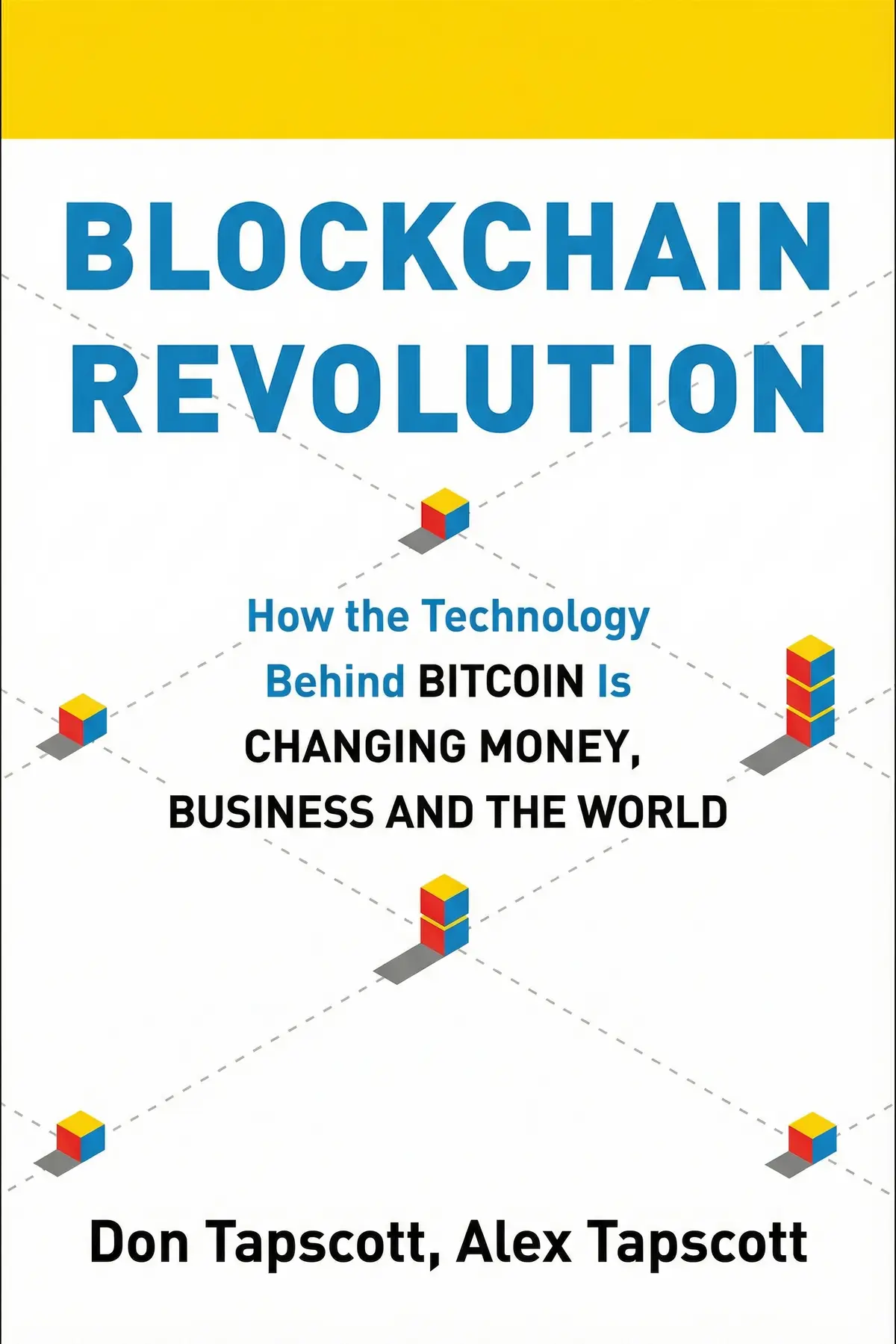
Table of Content
1. Introduction
1 min 01 sec
Every time you pay a bank fee, wait days for a transfer or wonder what an app does with your data, you are paying for trust you borrow from a middleman. In Blockchain Revolution, Don Tapscott and his son Alex Tapscott argue that much of that cost may soon be unnecessary. Their story begins in 2008, just after the world financial crisis, when someone writing as Satoshi Nakamoto proposed Bitcoin and, underneath it, a new way to record who owns what. Nobody knows who Nakamoto is, and the authors say it hardly matters.
What matters is the design: a shared record that no single party controls and nobody can quietly rewrite. The Tapscotts argue that such a ledger can take over the work of trust from banks, platforms and governments, making money, contracts, personal data and small business cheaper, fairer and open to billions more people. By the end, blockchain stops being jargon, and you can judge where its promise is strong and where its costs are real.
2. Stop paying middlemen for trust you can verify
1 min 44 sec
Banks, notaries and ride apps all sell the same product: the confidence to deal with a stranger. The authors argue that the sellers of that confidence have proven shakier than we assume, and that a replacement already exists.
3. Cheating a blockchain costs more than it pays
1 min 37 sec
A record that anyone can see sounds easy to fake. The design behind Bitcoin turns that weakness around, so that a forger would need more computing power than the whole world using the system.
4. See how a mailed anvil beats your bank
1 min 36 sec
A heavy block of iron in the post and a ten-dollar bank transfer set off for China together. The winner of that race exposes why billions of people are shut out of banking altogether.
5. Let contracts enforce themselves and protect property
1 min 51 sec
Most people on Earth cannot prove the land under their feet is theirs, and many agreements fail because no one chases the payment. A different kind of blockchain promises to fix both with a few lines of code.
6. Choose what the world sees about you
1 min 40 sec
A ledger everyone can read sounds like the end of privacy. The authors argue it can do the opposite, letting charities be followed dollar by dollar while ordinary people decide who sees their data.
7. A company with far less paperwork
1 min 39 sec
Uber and Airbnb call themselves the sharing economy, but the authors think the label hides who really profits. They sketch a version where your phone, hard drive and solar panel earn money directly.
8. Weigh the real risks before betting on blockchain
1 min 43 sec
Running Bitcoin burns enough electricity to cost a fortune every year, and whole accounting departments could be replaced by code. The authors take these objections seriously, and their answers may surprise skeptics.
9. Conclusion
1 min 13 sec
What the Tapscotts describe is a change in where trust lives. For centuries it sat inside institutions: the bank that held the title, the notary who stamped the deed, the platform that vouched for a stranger’s car. A blockchain moves it into a shared record that everyone can check and nobody can secretly rewrite, and that single move reaches into everything else. Payments speed up and get cheaper. Land titles and contracts become harder to steal or escape. A charity’s donations can be followed dollar by dollar, while an ordinary person chooses what to reveal. The biggest gains go to the billions of people the old system never found worth serving.
The authors’ own advice is hands-on. When the internet arrived, the best way to understand it was to open an email account and send a first message. In the same spirit, they suggest getting a few Bitcoins and learning how to earn and spend them. Alongside that, ask of every intermediary in your life what it really guarantees, and of every blockchain promise whether cheating truly costs more than honesty.
Today the anvil still beats the ten-dollar bill to China. The Tapscotts are betting it will not for long.
About this book
What is this book about?
Almost every deal between strangers runs through a middleman: a bank that confirms the payment, a notary who stamps the deed, a platform that vouches for the driver. That trust is slow and expensive, and the guardians themselves can fail. Banks collapse, apps sell customer data and governments overreach. Don and Alex Tapscott argue that the technology Satoshi Nakamoto introduced with Bitcoin in 2008 offers another way. A blockchain is a record shared by everyone who uses it, with each block linked to the last and protected by math that makes cheating cost more than it could ever earn. With trust built into the record itself, money can move in minutes, contracts can carry out their own terms, land titles can be proven, and people can decide for themselves which personal data to share. The authors follow that idea into finance, property, charity, privacy and new business models, and they show how it could serve the billions of people banks find unprofitable. They also face the obstacles squarely: public understanding, slow regulators, the risk of surveillance, energy use and lost jobs. Readers get a clear picture of how the technology works and where its promise is strongest.
Book Information
Who it's for
Professionals curious about blockchain
Professionals who hear about blockchain daily and want to understand how it works and why it matters.
Company builders questioning middlemen
Founders and operators who rely on banks, payment firms or platforms and wonder which could be bypassed.
Valuing fairness and privacy
Readers who care about corruption, privacy or the billions of people without bank accounts.
About the Author
Don Tapscott
Don Tapscott, born in Toronto in 1947, is a Canadian executive, writer, speaker and consultant who advises business and government leaders on innovation and technology's effect on the economy. His books include The Digital Economy and Wikinomics, the top-selling management book of 2007, and Thinkers50 named him one of the world's most influential management thinkers in 2011. His son Alex Tapscott, a former investment banking executive at Canaccord Genuity and a CFA charterholder, writes about blockchain and digital assets. Together they co-founded the Blockchain Research Institute in 2017.
Ratings & Reviews
Ratings at a glance
What people think
Listeners find this work to be a premier introduction to blockchain, offering an extensive summary and clear-cut explanations regarding the technology that powers Bitcoin. Furthermore, the book is highly accessible and remarkably well-composed, serving as an ideal foundation for grasping the future of blockchain. Additionally, listeners value the stimulating insights and the text’s focus on how these advancements could improve life for millions of people.
Top reviews
Plernpiriya
Don Tapscott has a knack for spotting paradigm shifts before they fully materialize, and this book is no exception. It provides a comprehensive overview of how this 'trust protocol' can reshape our economic systems and redistribute power to the edges. While some critics complain about the lack of technical jargon, I found the explanations of the engine behind Bitcoin to be exceptionally clear. The authors do a fantastic job of illustrating the potential for transparency and security across various industries. It is a thought-provoking read that challenges you to imagine a world without traditional intermediaries like banks or centralized platforms. Truly an essential primer for anyone wanting to be part of the next digital disruption.
Show moreRay
Ever wonder how the world will look once we move past the era of centralized intermediaries like big institutions? This book offers a brilliant roadmap for that transition, explaining the design principles that make decentralized applications so potentially transformative. Tapscott and his son have produced an encyclopedic work that covers everything from food safety to reforming democracy. Truth is, we are at the onset of a major paradigm shift, and this book captures that excitement perfectly. It’s not a technical manual for developers, but rather a strategic guide for leaders and entrepreneurs. The insights on how blockchain creates 'collective judgment' are worth the price of admission alone. Highly recommended for visionaries.
Show moreTeng
Finally got around to reading this one after seeing Tapscott's TED talk on the subject. It’s a solid introduction that paints a vivid picture of a decentralized future where value flows as freely as information does today. The chapters on the Internet of Things and new business models were particularly enlightening and well-researched. My only gripe is that it can get a bit repetitive, with the authors occasionally overstating their case. Not every problem in the world requires a blockchain solution, and some of their predictions feel a bit far-fetched in the current climate. Still, as a high-level overview for a newcomer, it’s remarkably well-written and easy to digest.
Show moreOscar
Picking this up was a great decision because it shifted my perspective from seeing Bitcoin as just a speculative asset to seeing the underlying tech as a foundational tool. The writing style is engaging and accessible, making complex economic shifts feel understandable for someone without a finance degree. I appreciated the specific references to existing services and Dapps that are already pushing these boundaries today. However, I have to admit that the 'cheerleading' tone can be a bit much at times. Not everything is going to be a revolution, and some skepticism would have added more weight to their arguments. Overall, it’s a very helpful starting point for those curious about the future of digital assets.
Show moreMikael
After hearing so much noise about crypto, I wanted a resource that looked at the underlying engine without getting lost in the day-trading frenzy. This book delivered a thorough overview of the potential shifts in our global infrastructure. It’s well-written and serves as a great bridge between the technical world and the business world. I particularly enjoyed the sections on how blockchain can improve outcomes for the unbanked and provide more transparency in governance. To be fair, it’s a bit uncritical of the hurdles involved, but the sheer breadth of use cases mentioned is impressive. It’s a thought-provoking guide that will definitely spark new ideas for your own industry.
Show moreSuphan
Not what I expected in terms of technical depth, but it turned out to be a fantastic high-level strategy book. It frames the blockchain not just as a financial tool, but as a way to fundamentally change how we record truth in a digital world. The Tapscotts write with a lot of energy, and their passion for the subject makes it a very fast read despite the page count. I found the chapter on the synergies between blockchain and the Internet of Things to be particularly visionary and practical. There are minor criticisms to be made about the uncritical praise, but the core message is vital. It’s a great way to grasp the 'big picture' before diving into more technical books.
Show moreJan
This book is a prime example of why more pages don't always equal more value. While I agree that the core concepts are interesting and inspiring, the authors repeat themselves so often that the book could have been half its length. They've definitely drunk the Kool-aid, presenting the technology as a silver bullet for every human woe imaginable. Some of the platitudes about corporate strategy and growth felt like filler from a generic business textbook. That being said, the explanation of mining and the basic principles of the ledger were quite clear for a beginner. It’s a decent primer, but you might find yourself skimming through the more 'visionary' sections toward the end.
Show moreHannah
The authors seem to have fallen into the trap of writing about a subject before they actually understood the technical implementation. They talk almost exclusively in analogies, which might work for a five-minute video but becomes exhausting over several hundred pages. I was hoping for a balanced look at the challenges, but instead, I got a 'True Believer' manifesto that ignores real-world friction. For instance, their claim that blockchain inherently removes service downtime is misleading because users still rely on centralized web interfaces to access these ledgers. It’s more of a promotional piece for their own perspective than a grounded educational resource. I would suggest 'The Age of Cryptocurrency' instead for a more nuanced history.
Show moreSumalee
I found myself skimming through the second half because the level of repetition became unbearable. The book starts with a clear perspective on the 'Internet of Value,' but it quickly devolves into superficial arguments and wishful thinking. They use terms like 'paradigm shift' constantly without addressing the massive energy consumption or the legal barriers to adoption. Look, I want to believe in this technology as much as the next person, but this feels like an inflated sales pitch. The examples given are often overly simplistic and fail to account for the incentives needed to build these businesses in the first place. It was a disappointing read given the authors' reputations.
Show morePisit
As an engineer, I was looking for a deep dive into the actual mechanics of the ledger, but what I found was mostly hype. The book is incredibly wordy and lacks the specific information required to understand how blockchains are actually constructed. Frankly, it feels like the authors are more interested in promoting the idea of the technology than explaining how it facilitates transactions. I expected a critical analysis of the protocols, not three hundred pages of regurgitated fluff and hollow arguments. Most of the 'innovative' use cases they present, like the hypothetical decentralized AirBnb, completely ignore basic business incentives. If you want to understand the code or the math, you should look elsewhere.
Show moreQuestions about this book
What is the main idea of Blockchain Revolution?
Don and Alex Tapscott argue that blockchain, the technology behind Bitcoin, lets two parties exchange money or other assets directly without trusting a bank or platform in the middle. A shared, tamper-proof record does the work of trust. They believe this can make finance faster and cheaper, protect property, enforce contracts automatically, reduce corruption and bring billions of poor people into the global economy.
How does a blockchain stay secure according to the Tapscotts?
Each block of transactions links to the previous one, forming a chain. Computers called miners add new blocks only after solving demanding math problems that depend on the chain’s full history, a method called proof of work. To fake an old record, a criminal would need to outpace the whole network’s computing power, which the authors say would cost far more than any fraud could gain.
What are smart contracts in Blockchain Revolution?
Smart contracts are small programs stored on a blockchain such as Ethereum that react automatically to certain transactions. If someone is owed money when a property sells, the sale can trigger the payment with no one approving it, and the contract cannot be changed or avoided. The authors cite The DAO, an investment fund run entirely by smart contracts that had raised $168 million from 10,000 contributors.
What problems with blockchain does the book discuss?
The Tapscotts name four. The public must understand the technology for it to work at scale. Slow governments might regulate it badly or use it for mass surveillance. The Bitcoin blockchain costs around $100 million a year in electricity, though they compare this with the costs of gold and today’s banking system. And accounting jobs could be automated, even as new businesses appear.
How can I apply the ideas in Blockchain Revolution?
The authors’ own advice is to get some Bitcoins and learn how to earn and spend them, much as people once learned the internet by sending a first email. More broadly, look at the intermediaries you pay, from payment services to platforms, and ask what each one really guarantees and whether a shared, open record could provide the same trust for less.
Readers also enjoyed







AUDIO SUMMARY AVAILABLE
Listen to Blockchain Revolution in 15 minutes
Get the key ideas from Blockchain Revolution by Don Tapscott, plus 5,000+ more nonfiction titles.
- 5,000+ titles
- Listen as much as you want
- 7-day free trial
- Cancel anytime









