

15 min 33 sec
Available in: English
Big Data: A Revolution That Will Transform How We Live, Work and Think
Shows how huge, messy datasets reveal patterns that small careful samples never could, how to find value in data collected for other reasons, and where data-driven decisions start doing harm.
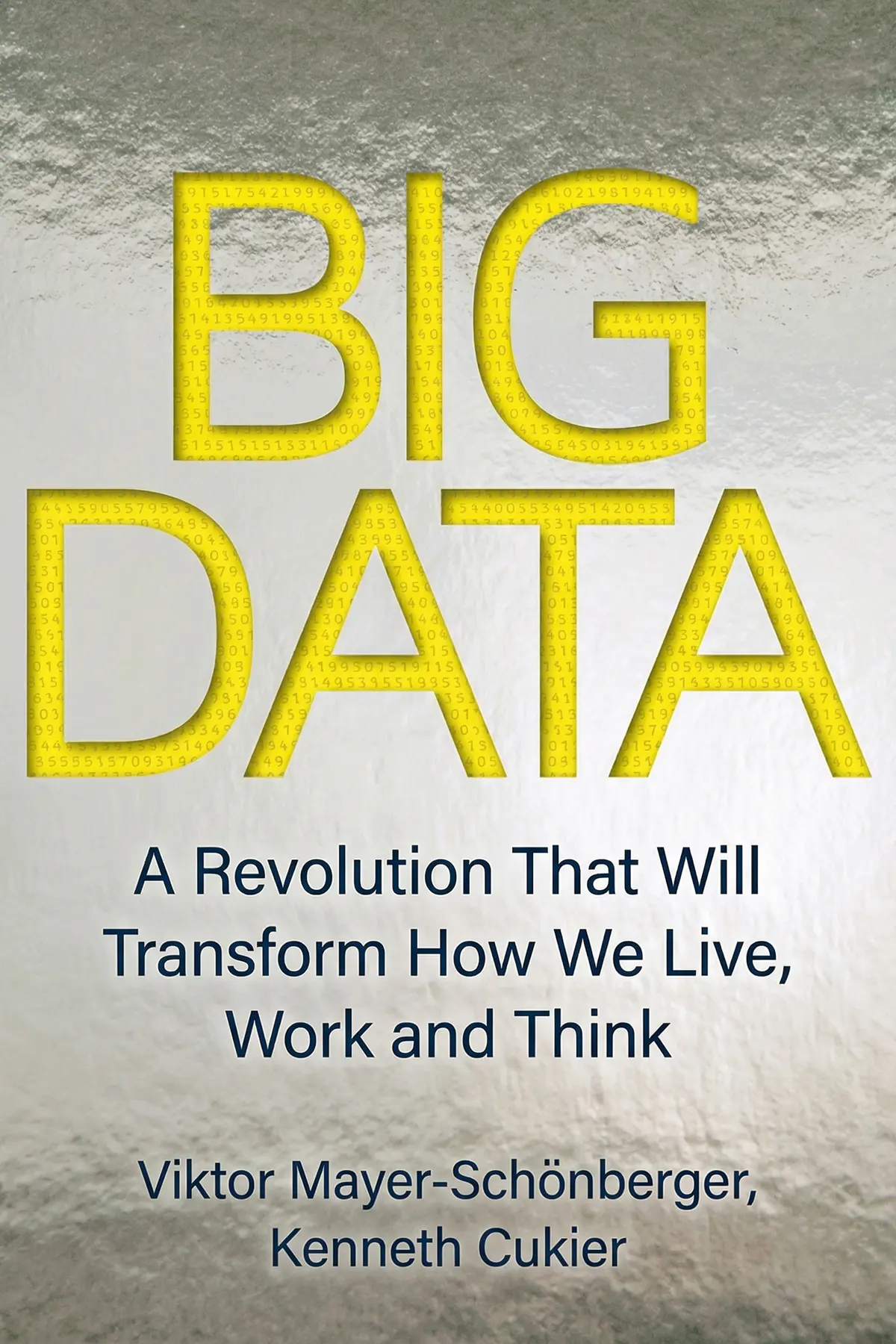
Table of Content
1. Introduction
58 sec
If you work with numbers, you were probably taught to take a careful sample, clean it and understand the cause before acting. In Big Data, Oxford professor Viktor Mayer-Schönberger and Economist journalist Kenneth Cukier argue that this habit now holds people back. In 2009, Google showed it could follow the spread of flu using 45 search terms. When the deadly H1N1 strain arrived weeks later, its signals reached health officials sooner and proved more useful than government statistics.
The authors’ case is that once you can capture nearly all the data, even messy data, you see patterns no sample reveals and can act on them without knowing their cause. The same power, they warn, breaks our privacy rules and tempts institutions to punish people for predictions. What follows shows how to spot hidden value in data you already have, and when to stop trusting it.
2. Stop guessing from small samples
1 min 47 sec
A census that took eight years to publish was useless on arrival. Today a car seat can recognize its owner. Between those two facts lies a change in what we can know about almost any group.
3. Messy data at scale beats tidy scraps
1 min 56 sec
IBM trained a translation system on carefully checked official documents and failed. A rival fed its system whatever it could find online and won. The reason changes how you should spend time cleaning data.
4. Act on patterns before you know why
1 min 48 sec
Orange used cars break down less often, and nobody can say why. Doctors caring for premature babies learned to worry when things looked fine. Both findings ask you to trust a pattern before you understand it.
5. Give old data a second, richer life
1 min 56 sec
A bank payment network now sells economic forecasts, and a Seattle company earns fees from scraps of location data nobody else wanted. The data you already store may be worth more than the job it was collected for.
6. Build a product on data others overlook
1 min 57 sec
A few friends in their twenties started predicting flight delays well enough that airline staff checked their site. They owned no special data and no secret tools. What they had is something you can practice.
7. Set smarter limits on privacy and prediction
2 min 12 sec
A search company removed every name from its data before sharing it, and reporters found one user within days. Meanwhile, forecasts already help decide who stays in prison. The authors draw a line that many systems are crossing.
8. Keep the numbers from steering you wrong
1 min 42 sec
A defense secretary ran a war by one number, and his own officers fed him figures designed to please him. The same three traps wait inside every dashboard and target a team is asked to hit.
9. Conclusion
1 min 17 sec
Mayer-Schönberger and Cukier describe a change in kind, not just in size. When a census took eight years, people learned to work from small, careful samples and to demand causes before acting. Now that car seats, earbuds and flight records all produce data, the better habit is to gather as much as you can, accept the mess, act on patterns that hold and keep asking what else a dataset could show. That is how a few friends ended up forecasting delays so well that even airline employees checked their site for their own flights.
The same abundance cuts the other way. It can unmask a widow from her searches, push parole boards and police toward judging people by forecasts, and let a defense secretary steer a war by a count his officers were inflating.
Start with the data you already touch, at work or online, and ask who else could use it, alone or joined with another source; Swift’s forecasts and FlightCaster began exactly there. Then, before any number shapes a decision about a person or a team, check what it measures, what it rewards and who supplied it. Data can show you almost anything. Deciding how to treat people remains a human job.
About this book
What is this book about?
For most of history, information was so slow and expensive to gather that people worked from small samples and tried to explain every result before acting on it. Viktor Mayer-Schönberger and Kenneth Cukier argue that computers, digitization and the internet have changed the rules. When you can collect nearly all the data about something, cheaply and often passively, three old habits stop making sense: relying on samples, insisting on clean data and demanding a cause before using a pattern. The authors back this with cases ranging from Google's flu tracking and machine translation to orange used cars, premature babies whose vital signs went calm before infection, and a payment network that now forecasts GDP. They show how data collected for one purpose often earns more in a second use, how combining datasets creates new value, and how people with no data of their own built businesses like FlightCaster. The book also looks hard at the costs: anonymized records that can be traced back to a real person, parole and policing decisions based on predictions, and leaders misled by the wrong metric. Readers get a way of seeing the data around them and a set of checks before trusting it.
Book Information
Who it's for
Weighing samples and dashboards
Analysts and managers who rely on samples, dashboards and targets and want to know when to trust them.
Founders exploring existing data
Founders looking for product ideas hidden in public or existing data.
Uneasy about privacy
Readers uneasy about privacy, profiling and predictive policing who want the argument on both sides.
About the Author
Viktor Mayer-Schönberger
Viktor Mayer-Schönberger is a professor of internet governance and regulation at the Oxford Internet Institute, University of Oxford, who studies the network economy. He taught for ten years at Harvard's Kennedy School, and his book Delete won the 2010 Marshall McLuhan Award. Kenneth Cukier is a journalist best known for his work at The Economist, where he also hosted a weekly technology podcast. He was a research fellow at Harvard's Kennedy School from 2002 to 2004.
Ratings & Reviews
Ratings at a glance
What people think
Listeners find this book offers a superb gateway to big data, utilizing numerous real-world cases that keep the narrative engaging throughout. Furthermore, the writing is skillfully executed, and listeners appreciate how it triggers deep thought regarding the massive potential of the field. However, reactions to the content are varied, with some viewing it as essential while others remark that it can become repetitive.
Top reviews
Rose
Wow. This is hands-down the most accessible entry point for anyone trying to wrap their head around how our digital world is being reshaped by massive datasets. I loved how Mayer-Schönberger and Cukier explain 'datafication'—the idea that we can turn almost any aspect of life into quantifiable information. To be fair, I went in with zero background in statistics, so the shift from 'why' to 'what' was a total revelation to me. The specific example of Matthew Maury’s ship logs really illustrates that this isn't just a modern fad but a fundamental change in human inquiry. Personally, it made me look at my Fitbit and my search history in a completely different light. It’s a visionary piece of work that actually makes you think about the future.
Show moreHom
After hearing so much buzz about this title, I’m glad it lived up to the reputation as a definitive guide. The way it explains that we don't always need to know 'why' something happens, as long as we know 'what' is happening, is brilliant. It’s a scary thought, but the authors handle the ethical implications with a lot of nuance in the final chapters. The writing is punchy and the pace is fast, making it one of the few tech books I’ve finished in a single weekend. It really opened my eyes to the 'magical' value of data that can be reused for purposes we haven't even imagined yet. A truly fascinating look at our future.
Show moreWillow
As someone who works in marketing, I found the breakdown of the Big Data value chain to be incredibly insightful for my daily strategy. The authors have a gift for taking abstract concepts and grounding them in real-world scenarios that keep the reader engaged. While some sections felt a bit padded, the core argument about embracing 'messiness' over exactitude is a game-changer for business decision-making. You don't need a math degree to follow the logic here. It does get a little repetitive toward the end, but the overall impact on my perspective was worth the time spent reading. It's a solid introduction to a complex topic.
Show moreJib
Ever wonder how Google knows about a flu outbreak before the CDC? This book explains the mechanics of those predictions with surprising clarity and poise. I was particularly struck by the notion that we are moving away from sampling toward analyzing entire populations. It’s a massive shift in how humanity processes reality. My only gripe is that the authors occasionally drift into vague, 'Lord of the Rings' style metaphors about data revealing secrets to the humble. Despite the occasional flowery language, the central thesis is robust and well-argued. It’s definitely a must-read for anyone curious about the algorithms currently running our lives behind the scenes.
Show moreKek
The chapter on the history of data collection was worth the price of admission alone. Most people think Big Data started with the internet, but the authors do a great job showing the historical lineage of these ideas. It’s a polished, well-crafted narrative that successfully demystifies a lot of the buzzwords we hear every day. Not gonna lie, I did find myself skimming through some of the later chapters because they reiterate the same points about correlation. However, the book succeeds in its primary mission: getting the reader to think about the massive potential and the inherent risks of a data-driven society. It is a thought-provoking read for the general public.
Show moreLuckana
This book provides a fantastic framework for understanding the three major shifts in our information landscape. First, the move to 'n=all.' Second, the acceptance of messiness. Third, the pivot toward correlation over causation. These are heavy concepts, but the writing style is so fluid that it never feels like a chore to get through. I did notice some repetitive phrasing, and the lack of in-text citations was a bit annoying for a non-fiction work. That said, the real-world examples are vibrant and kept me turning the pages. It’s an essential read for anyone trying to stay relevant in the modern economy. Highly recommended for beginners.
Show moreSirirat
Finally got around to reading this and I have mixed feelings. On one hand, the prose is elegant and the examples of Farecast and airline pricing are genuinely interesting to see in print. On the other hand, the constant hype about Big Data being a 'magical diamond mine' feels a bit dated and hyperbolic. The truth is that the book makes three or four very good points and then spends 200 pages repeating them in slightly different ways. It’s a decent primer if you’re new to the tech world, but industry professionals will likely find it lacking in technical depth and overly optimistic about the death of the subject-matter expert.
Show moreEye
Truth is, I expected more data and less marketing jargon from an Oxford professor. The book is well-written, but it feels like the authors are more interested in being 'messengers' of a revolution than actual critics of it. I appreciated the chapters on privacy and the potential for 'propensity' policing, yet those felt like an afterthought compared to the initial excitement. Gotta say, the lack of any mention of semantic web or information architecture makes the book feel a bit superficial for a serious study. It's a quick, breezy read for a flight, but don't expect it to serve as a textbook. It's more of a long-form essay.
Show moreCarter
Look, if you want a book that tells you Big Data is a gold mine and we’re all going to be rich off 'Algorithmists,' this is for you. If you want a critical analysis of the pitfalls of data dredging, you might be disappointed. The authors make grandiose claims about overturning centuries of established practice, which feels a bit like tech-evangelism to me. To be fair, the examples they use are quite entertaining and easy to follow. But the book is far too long for the amount of original thought it contains. It’s a classic case of an excellent magazine article stretched into a mediocre book. It’s okay, just not revolutionary.
Show moreManee
Picked this up expecting a technical deep dive into data architecture, but it felt more like a 300-page advertisement for Silicon Valley. Frankly, the authors spend way too much time recycling the same three stories about Target’s pregnancy predictions and Google’s flu trends. While the concept of 'n=all' is intriguing, they beat the dead horse of correlation versus causation until there’s nothing left but fluff. I’m giving it two stars because the writing is smooth, but the lack of actual substance regarding cloud computing or specific tools is glaring. If you’ve read a single Wired article in the last decade, you probably already know everything this book has to say. It is the definition of a book that should have been a blog post. Just far too repetitive for my taste.
Show moreQuestions about this book
What is the main idea of Big Data by Mayer-Schönberger and Cukier?
The authors argue that capturing nearly all the data about something, instead of a small sample, changes how we learn. Huge datasets tolerate messy entries, reveal patterns nobody looked for and can be reused for purposes their collectors never planned. Correlations are often useful even when the cause stays unknown. They also warn that the same power undermines privacy protections and invites decisions based on predictions instead of actions.
Why do the authors say messy data can beat accurate data?
They compare two translation projects. IBM in the 1980s trained a system on three million high-quality sentence pairs from Canadian parliamentary translations and it failed on rare words. Google later used billions of pages of uneven text from across the web, and its translations beat every rival. With most of the data in hand, individual errors matter far less than they do in a small sample.
Does big data replace the need to understand causes?
Not entirely, but the authors argue a correlation is often enough to act on. In a 2012 competition, orange used cars turned out to have about half the defects of the average car, for reasons nobody knows. IBM and the University of Ontario found premature babies’ vital signs became very stable just before serious infections, which let doctors intervene earlier without first explaining why.
How can I apply the ideas in Big Data?
Look at the data you already have and the data freely available online, and ask what it could reveal if used for a different purpose or combined with another source, as FlightCaster did with flight times and weather records. Before acting on any metric, check whether it measures what you care about, what behavior it rewards and whether its source is reliable.
What risks of big data does the book describe?
Three stand out. Consent rules and anonymization are breaking down, as when the New York Times identified an AOL user from supposedly anonymous searches. Predictions already shape parole and policing, which the authors warn could lead to punishing people for what they might do. And being too data-driven can mislead, as Robert McNamara’s reliance on body counts in Vietnam showed.
Readers also enjoyed









AUDIO SUMMARY AVAILABLE
Listen to Big Data in 15 minutes
Get the key ideas from Big Data by Viktor Mayer-Schönberger, plus 5,000+ more nonfiction titles.
- 5,000+ titles
- Listen as much as you want
- 7-day free trial
- Cancel anytime









