

14 min 24 sec
Available in: English
Artificial Intelligence: A Guide for Thinking Humans
A computer scientist's tour of how today's AI sees, plays games and handles language. It shows why systems that beat champions still fail like no child would, and which risks deserve your attention.
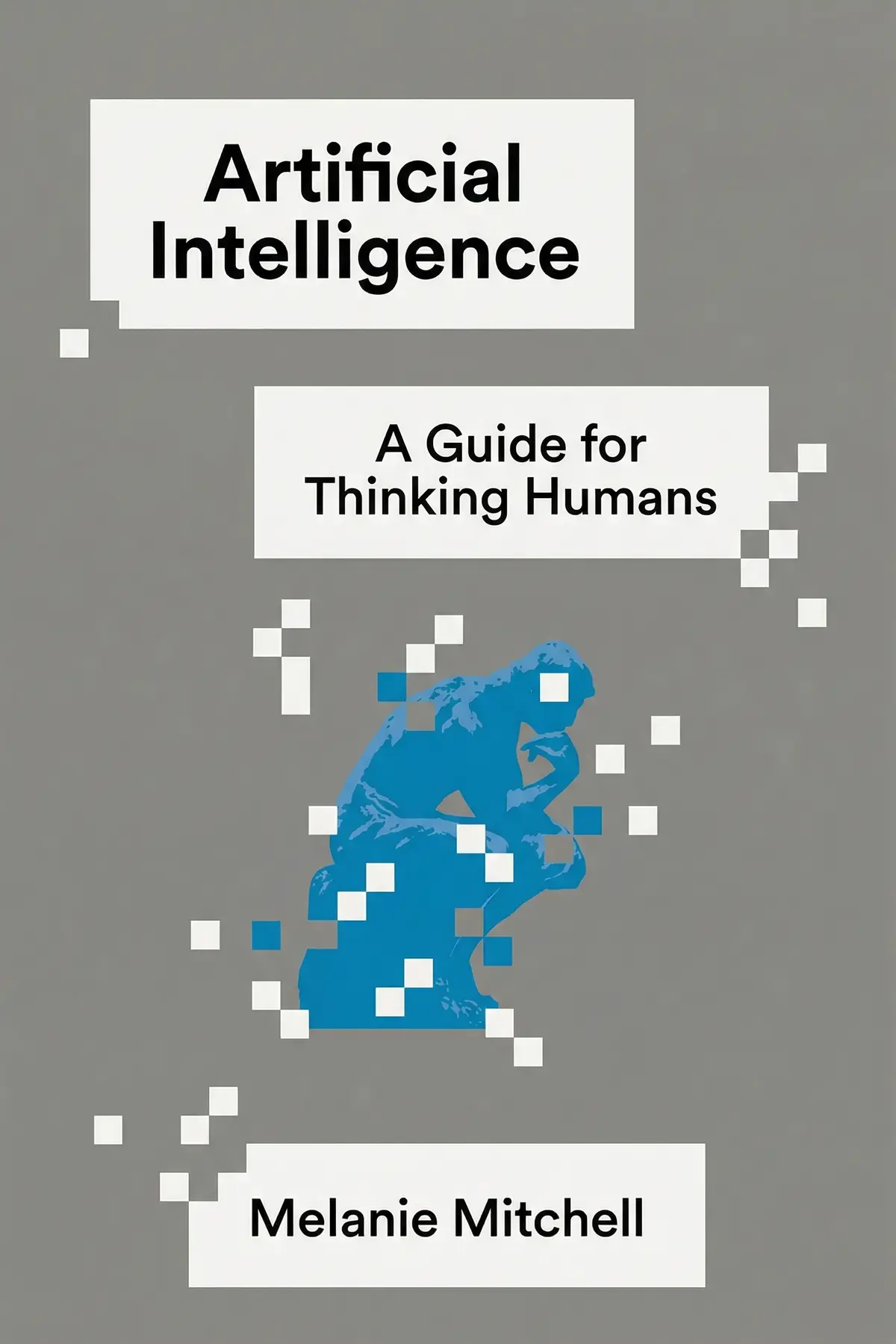
Table of Content
1. Introduction
1 min 08 sec
If AI headlines leave you swinging between awe and dread, a plainer question helps: what these systems can actually do, and where they break. In Artificial Intelligence: A Guide for Thinking Humans, computer scientist Melanie Mitchell answers with a paradox. As one piece of advance praise for the book put it, AI can beat people at chess yet mistake a school bus for an ostrich.
Mitchell, who studied under Douglas Hofstadter, tours the field from its birth in 1956 through machines that see, play games and handle language. Each time she explains the mechanics, credits the breakthrough, then tests the boldest claims. Her conclusion ties it all together. Today’s AI runs into a barrier of meaning: it lacks common sense, real understanding and the gift for analogy. So the nearer danger is brittle systems trusted too far, not machines that outthink us. What she offers in return is judgment, a set of questions for the next AI claim you meet at work or in the news.
2. Read every AI forecast with history in mind
2 min 08 sec
Confident predictions that machines would soon match people are nothing new. One pioneer gave the machines twenty years. The record of what followed offers a simple test for the next bold forecast you hear.
3. See what an image classifier actually learned
1 min 54 sec
A network can sort over a million photos with impressive accuracy and still be fooled by a sticker no driver would notice. The reason has to do with what it was really paying attention to all along.
4. Spot the narrow skill behind a winning machine
1 min 58 sec
When a program beats the best human player in the world, it feels like a turning point for intelligence itself. Mitchell looks closely at how those victories were built and finds something much smaller.
5. Learn to tell fluent machine language from understanding
1 min 56 sec
Software now writes polished paragraphs and passes professional exams. So why would a chatbot count the same state twice? The answer changes how much you should trust any text a machine produces for you.
6. Know the human edge machines still lack
2 min 02 sec
A one-year-old knows things no AI system has managed to learn, and a simple letter puzzle shows another. Mitchell’s own research points to the skill that still separates people from their software.
7. Worry about the right AI risk, machine stupidity
1 min 57 sec
A famous thinker told a room of Google engineers he was terrified of AI, and most of them disagreed. Mitchell suggests both sides were looking in the wrong place, and names the risks that deserve attention now.
8. Conclusion
1 min 21 sec
Mitchell’s book gives you a way of reading AI news. Since the Dartmouth workshop, confident forecasts have arrived on schedule and the machines have not. Her chapters on vision, games and language find the same pattern each time. Results are impressive on the task as defined and fall apart just outside it. The barrier of meaning explains why. These systems have learned statistics about the world, but not the common sense, intuitive physics and eye for analogy that let a child see why pqrs should become pqrt.
That moves the worry somewhere more useful. The machine to watch is the one trusted beyond its training, not the one plotting to outthink us. When a system impresses you, change the question slightly, rotate the picture or ask about a rare case, and see whether it holds. When a decision matters, prefer a tool that can show how it reached its answer. And when you hear that human-level AI is a few years away, remember Simon’s twenty-year forecast and Minsky’s warning that the easy things are the hard ones.
Hofstadter feared that machines would make the human mind look ordinary. Mitchell’s careful tour leaves the opposite impression. The closer you look at what machines can do, the more remarkable ordinary human understanding appears.
About this book
What is this book about?
Artificial intelligence gets described in two loud voices. One promises machines that will soon think like us. The other warns that they will replace us. Melanie Mitchell, a computer scientist who has spent her career on analogy and complex systems, sets out to measure the real distance between those claims and what the technology can do. She traces the field from the 1956 Dartmouth workshop through its winters and booms. Then she explains, in plain terms, how image classifiers, game-playing systems like AlphaGo and language software actually work. Each tour follows the same pattern. She explains the mechanics, gives the breakthrough its due, then tests the bold claims made about it. Again and again the machines turn out to be strong inside a narrow task and fragile just outside it. Her name for the gap is the barrier of meaning. Machines lack common sense, real understanding and the human talent for analogy. Readers come away able to judge AI claims for themselves, to spot the shortcuts a system may be taking, and to focus their concern on brittle, opaque systems rather than imagined superminds.
Book Information
Who it's for
Professionals using AI tools
Professionals who use AI tools at work and want to know when to trust them.
Weighing AI claims
Managers and founders weighing AI claims from vendors, investors or the press.
Between hype and fear
Curious readers torn between AI hype and AI fear who want a calm, clear explanation.
About the Author
Melanie Mitchell
Melanie Mitchell is an American computer scientist who has held positions at Los Alamos National Laboratory and the Santa Fe Institute. Her research spans cellular automata, genetic algorithms, complex systems and analogical reasoning. She earned her PhD at the University of Michigan in 1990 under Douglas Hofstadter and John Holland, building the Copycat cognitive architecture as part of it. Her book Complexity: A Guided Tour won the Phi Beta Kappa Science Book Award in 2010, and she started Complexity Explorer, the Santa Fe Institute's free online courses on complex systems.
Ratings & Reviews
Ratings at a glance
What people think
Listeners find this book offers an extensive yet accessible survey of intricate AI themes. They value the way it provides a deep dive into the technology while clarifying the technical processes that make artificial intelligence function. The writing is frequently commended for its clarity, with one listener mentioning that it demystifies the industry hype using everyday language. Listeners also admire the quality of the prose, with one describing it as beautifully composed for both beginners and professionals. Finally, the substance of the work is highly regarded, as one review highlights how it maintains a very balanced perspective on the topic.
Top reviews
Gor
Ever wonder why your "smart" assistant still can’t follow a basic conversation? Melanie Mitchell breaks down that barrier between recognition and actual understanding in a way that feels both intellectual and deeply accessible. I was particularly struck by the discussion on "suitcase words"—those terms like "intelligence" or "thinking" that carry so much human baggage they confuse our perception of what machines are actually doing. The book is thick and looks like a dry textbook, but the prose is surprisingly light. She handles complex topics like ImageNet and the morality of algorithmic loan applications with a balanced hand. No Sarah Connor-style hysteria here! Just a clear, calm look at where we are and how far we have to go. It’s a mandatory read for anyone who wants to stop being fooled by AI influencers and start understanding the actual science.
Show moreElla
Look, I’m no computer scientist, but Mitchell makes me feel like I could hold my own in a conversation about neural networks. She has this incredible gift for taking the "magic" out of the technology and replacing it with clear, conceptual logic. I loved the anecdote about her getting lost in the Google Maps building—it humanized the whole experience right from the start. The way she explains how AI lacks the unwritten knowledge (Cyc) that humans take for granted was a real "aha" moment for me. It’s rare to find a science book that you actually want to pick up during your commute. She avoids the usual eye-glazing equations while still giving you the "nuts and bolts" of the discipline. This should be required reading for every journalist and politician trying to regulate this space. An absolute tour de force.
Show morePot
As someone who works in data, I appreciated how Mitchell didn't shy away from the messy reality of labeled data sets and the labor required to make AI "smart." She gives a fantastic overview of the status of speech recognition and why it still fails at basic tasks like distinguishing background noise. The book is incredibly thorough. I loved the deep dive into EMI’s music algorithms and the questions of creativity. It's rare to see a practitioner who can write this beautifully for both laypeople and experts alike. She presents the history of the field—from Perceptrons to deep learning—without making it feel like a dry lecture. Personally, I think her perspective on how we trust human cognitive perception but distrust AI is one of the most intriguing parts of the book. Highly recommended for anyone in the tech space.
Show moreSangduan
After hearing all the doom and gloom about AI taking over the world, this was the reality check I needed. Mitchell finds a middle way between the enthusiasts and those who are terrified of a robotic uprising. She manages to explain the history of AI and the way current systems like AlphaGo work without any of the usual hyperbole. I was fascinated by the section on Cyc and the "unwritten knowledge" that makes human conversation so complex. The book is a bit fat, but it's rare that I keep wanting to go back to a science book when I'm not "scheduled" to be reading it. She makes the magic behind making AI work comprehensible and grounded. Whether you're a skeptic or a believer, this book provides the balanced view we desperately need right now.
Show moreHana
This book is probably the most sober take on machine learning I've encountered in years. Mitchell manages to strip away the glossy marketing layers that companies like IBM or Google often use to sell their products as "magic." Frankly, it’s refreshing to see a practitioner admit that AI isn't nearly as close to human-level understanding as the headlines suggest. The explanation of how self-driving cars can be fooled by a simple sticker on a stop sign was genuinely sobering. However, the 2019 publication date does mean some of the cutting-edge discussions feel a bit like ancient history now. We've moved so fast in just five years! If you want to understand the foundational "hype" and the actual mechanics like backpropagation without getting lost in a sea of equations, this is the gold standard. It’s beautifully written for both laypeople and those with a bit of a tech background.
Show morePop
The chapter on adversarial attacks really changed how I think about the safety of our digital future. It is terrifying that an AI can see a speed limit sign as a stop sign just because of a few invisible pixels or a strategically placed sticker. Mitchell is a professor who clearly knows her stuff, but she writes with the clarity of a seasoned journalist. I appreciated the balanced view she took on the moral questions, like how AI handles prison sentences or credit scores. My only gripe is that the technical explanation of Word2Vec and vector spaces felt a bit rushed compared to the earlier chapters. It’s a minor flaw in an otherwise excellent guide. She manages to be realistic without being a Luddite, which is a very difficult needle to thread in this industry.
Show moreFang
Gotta say, the way this book dismantles the "I-am-become-God" euphoria prevalent in Silicon Valley is incredibly refreshing. Mitchell isn't here to sell you a utopia; she's here to show you the gears and wires. I found her discussion of Douglas Hofstadter and the terror of making humanity feel "mundane" to be particularly poignant. The book provides a thorough high-level overview of complex topics like WordNet and the limitations of Siri. While some of the specific status updates on technology are a bit dated, the underlying philosophy about what makes human intelligence unique is timeless. The Pelican-style cover might look intimidating, but don't let that fool you. This is an engaging, readable, and deeply necessary reality check for the age of automation. A very solid four-star read for the curious mind.
Show moreOak
Not what I expected from a book with such a dry, academic-looking blue cover! Instead of a boring textbook, I found a lively and engaging exploration of what it actually means to "think." Mitchell is excellent at breaking through the hype in laymen's terms, especially when she discusses why self-driving cars aren't ready for prime time. Her explanation of how AI systems lack a "concept" of what they see—recognizing an image without understanding it—was a huge eye-opener for me. To be fair, I did find the parts about Word2Vec a bit difficult to follow on the first pass. But overall, the book offers a very thoughtful consideration of the subject. It’s a great way to understand the "how" behind the magic without needing a PhD in computer science.
Show moreZanya
Finally got around to reading Mitchell's guide, and while it's a solid primer on the history of neural networks, the age is starting to show. In the world of AI, 2019 might as well be the 1950s. The sections on speech recognition and basic image captioning feel a bit elementary compared to what we're seeing today. To be fair, her breakdown of how researchers assign "blame" to weights via backpropagation was helpful, even if it took me three tries to wrap my head around it. The book is quite long and gets bogged down in historical anecdotes that don't always feel relevant to the current "Generative AI" explosion. It’s an ok-ish read if you have zero inkling of the topic, but seasoned techies might find themselves skimming. Useful as a history lesson, but don't look here for a forecast of the future.
Show moreDek
Truth is, I found the middle sections on word vectors and backpropagation a bit like wading through thick mud. I appreciate Mitchell trying to explain the "nuts and bolts," but as a total layman, I felt a bit lost in the weights and layers. The book is definitely approachable in its coverage, but it still requires a fair bit of mental heavy lifting. I also felt that the "future" sections haven't aged particularly well given how fast GPT and other models have changed the landscape. It’s an interesting read for the historical context, but I was hoping for something a bit more punchy and less academic in tone. If you're comfortable with basic math and logic, you'll likely get more out of this than I did. It’s a decent primer, just a bit dry in the middle.
Show moreQuestions about this book
What is the main idea of Artificial Intelligence by Melanie Mitchell?
Mitchell argues that today’s AI is far from humanlike general intelligence because it hits what she calls the barrier of meaning. Systems can beat champions at chess and Go or label millions of photos, yet they lack common sense, real understanding and the ability to make analogies. That is why they fail in ways no child would, such as mistaking a school bus for an ostrich after a few pixels change.
Does Melanie Mitchell think AI is dangerous?
Yes, but not in the way headlines suggest. She sees superintelligence as distant because machines lack commonsense reasoning. The nearer risks come from brittle systems that fail on rare cases, can be fooled by adversarial tricks and cannot explain their decisions. She also names bias, disinformation and voice-cloning scams, and argues regulation should put vulnerability to attack, unreliability and lack of transparency first.
What is the barrier of meaning in AI?
It is Mitchell’s name for what separates current AI from human intelligence. People carry intuitive physics and biology, knowing that dropped things fall and that dogs move on their own, and they spot the abstract sameness between situations. Machines learn statistical patterns instead, so a translation system can handle the word drink without knowing what a drink is. Mitchell suggests crossing this barrier may even require machines with bodies.
How can I apply the ideas in this book at work?
Treat any AI tool as strong on its narrow task and fragile at the edges. Test it on questions it cannot have seen, phrased in more than one way, and on rare cases. Ask what shortcut it might be using, the way one system spotted tumors by noticing rulers in images. For important decisions, prefer tools that can show their reasoning, and keep judgment calls that depend on analogy in human hands.
Readers also enjoyed









AUDIO SUMMARY AVAILABLE
Listen to Artificial Intelligence in 15 minutes
Get the key ideas from Artificial Intelligence by Melanie Mitchell, plus 5,000+ more nonfiction titles.
- 5,000+ titles
- Listen as much as you want
- 7-day free trial
- Cancel anytime









