

16 min 01 sec
Available in: English
 ไทย
EnglishไทยAn Autobiography: The Story of My Experiments with Truth
By M. K. Gandhi
Shows how Gandhi turned teenage failures, crippling shyness and racist humiliation into a tested method of nonviolent resistance, and what his habit of correcting himself first can teach anyone trying to lead change.
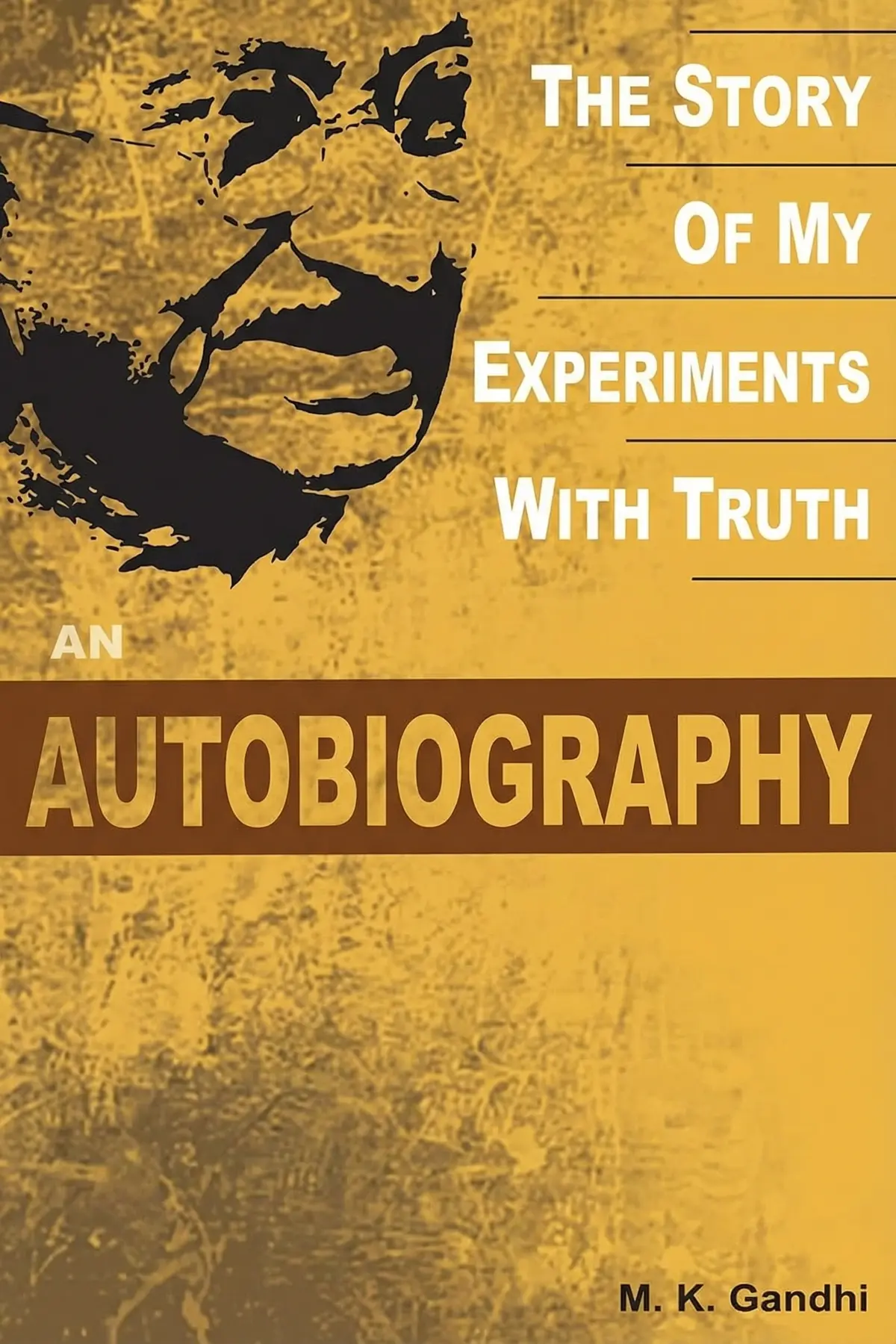
Table of Content
1. Introduction
1 min 03 sec
Gandhi is easy to admire and hard to picture as a nervous teenager who stole money to buy cigarettes. Yet that is the boy M. K. Gandhi describes in An Autobiography, subtitled The Story of My Experiments with Truth, where he shows that his famous nonviolence was assembled piece by piece, out of failures he refused to hide. He means the word experiments literally. He made vows touching his diet and his marriage, and in South Africa he also swore that he would not drag anyone before a court because of a personal insult.
That is the thread through his whole story: a person who corrects himself in small things learns how to change large ones. Follow it from a child marriage in Gujarat, through London dining rooms and a South African train, to a nation refusing to cooperate with an empire. What emerges is a working model of how courage and moral authority are built, and a way of handling conflict you can try in your next disagreement.
2. Recover from early failures without excusing them
2 min 04 sec
The man who later asked millions for self-discipline spent his teens lying, stealing and sneaking away from duty. What he did with those memories matters more than the memories themselves.
3. Keep a hard promise when no one is watching
1 min 48 sec
A young man alone in a foreign city, surrounded by everything he swore to avoid. His solution was less about willpower than about where he chose to eat and whom he chose to join.
4. Turn a public humiliation into a lifelong cause
1 min 54 sec
A first-class ticket, a turban and an unprovoked kick from a police officer. Each insult could have made him bitter, but after the kick he forgave the officer and vowed never to take anyone to court over a personal offense.
5. Fight the system and spare the person
2 min 08 sec
He won his first big case, then made sure the losing side kept its dignity. That instinct grew into a principle that helped end racialized bribery in the region without turning it into a personal attack on the officers.
6. Keep a humble routine as your influence grows
1 min 59 sec
A mob in the street, a war he joined against his sympathies, and a growing bank balance that left him worried he might give in to greed. His remedy involved buttoning another man’s shirt.
7. A new method for when the old ones fail
1 min 59 sec
Petitions, lawsuits and prayer had carried him far, until one law made them look useless. What he built next had a name chosen by friends and roots in three Western writers.
8. Pause a movement before it turns violent
2 min 02 sec
At the very moment his campaign caught fire across India, he called it off and stopped eating. The reason he gave is a lesson in responsibility few leaders accept.
9. Conclusion
1 min 04 sec
Gandhi’s subtitle sounds modest and turns out to be bold. He called his life a set of experiments and meant it. The boy who lied about eating meat, the student hunting for a vegetarian restaurant and the lawyer frozen in front of a judge all became evidence for a man who would later ask a nation to stop cooperating with an empire. The discipline he asked of millions was first tried on a dinner plate.
That gives any reader somewhere to start. Write down one failing as plainly as he wrote down his, and turn it into a rule you can test for a month. In your next conflict, separate the arrangement you want changed from the person defending it. And look after the body that does the work: Gandhi kept up long walks from his youth, though he disliked sports, stressed exercise as a way to enhance one’s work, and paired it with care for his diet.
The search for Truth was what steered everything he did. He pursued that quest by continually working to develop himself.
About this book
What is this book about?
Gandhi is usually remembered as a finished figure, calm and certain, leading millions without violence. His own account tells a messier and more useful story. He describes a teenager who ate meat in secret, stole money for cigarettes and failed his dying father. Later he was a young lawyer too frightened to speak in court. The book's subtitle, The Story of My Experiments with Truth, is the key to his angle. Gandhi treats his life as a series of trials. Before London he vowed to abstain from women, meat and wine, kept that vow there, and later added a vow of celibacy. Racism on a train to Pretoria and a kick from a police officer informed his study of oppression, and two principles took shape: ahimsa, drawn from Hindu scripture, which attacks systems but never persons, and satyagraha, launched in 1907 as firm, nonviolent noncooperation. Readers see how character and public influence are built one correction at a time. They also take away a practical lens for conflict: separate the unfair arrangement from the person defending it, and pause anything you lead the moment it starts causing harm.
Book Information
Who it's for
Professionals admiring principled leaders
Professionals who admire principled leaders and want to see how such character is actually built.
Managers and organizers
Managers and organizers handling conflict who want a way to push for change without making it personal.
Curious about nonviolent resistance
Readers curious about Indian independence, South African history and the roots of nonviolent resistance.
About the Author
M. K. Gandhi
Mohandas Karamchand Gandhi (1869 to 1948) was born in coastal Gujarat into a Hindu Bania family, the son of a senior government official. After training in law in London, he worked for the rights of Indian immigrants in South Africa, where he developed new methods of nonviolent civil disobedience. Back in India from 1915, he organized peasants against heavy land taxes and, after taking the leadership of the Indian National Congress in 1921, led nationwide campaigns toward Swaraj, independence from British rule. He was assassinated in January 1948.
Ratings & Reviews
Ratings at a glance
What people think
Listeners find this autobiography a superb account that offers profound perspective on Gandhi’s pursuit of spiritual growth and truth. The prose is described as enchanting, and they value its historical precision, with one listener pointing out its detailed account of colonial India. Although listeners enjoy the biographical format, they mention that it doesn't cover much of Gandhi's later life. Additionally, the writing quality gets varied reactions, as several listeners pointed out mistakes in grammar within the text.
Top reviews
Prinya
Finally got around to reading Gandhi’s own words rather than just reading about him in history textbooks. The writing is mesmerizing in its simplicity, almost like he’s sitting right across from you sharing his deepest insecurities. I was particularly struck by his detailed account of life in colonial India and South Africa, which provides a vivid backdrop for his spiritual evolution. To be fair, if you’re looking for a fast-paced political thriller, you’ll be disappointed. This is a slow burn about the 'experiments' he conducted on his own soul. His dedication to truth is frankly humbling, even when he discusses mundane things like his diet or cleaning latrines. Some might find the language a bit dated or notice the occasional grammatical quirk in translation, but it adds to the authenticity. It’s an essential read for anyone trying to understand how a single man could move a nation without lifting a finger in violence.
Show moreMaja
This book is a masterclass in integrity. Gandhi doesn't just preach non-violence; he shows the agonizing internal work required to actually live it. I was deeply moved by his vulnerability regarding his youth and his constant battle against his own ego. Many reviewers complain that the book is 'dry,' but I found the simplicity of his prose to be its greatest strength. It reflects his philosophy: no frills, no pretension, just the raw truth. His insights into the 'culture of the spirit' are as relevant today as they were a century ago. Frankly, it’s refreshing to read a leader who is more interested in his own flaws than in his successes. The detailed accounts of his time in South Africa were especially enlightening, showing the roots of his 'Satyagraha' movement. It’s a long read, but if you approach it with patience, it will fundamentally change how you view power and service.
Show moreGame
Wow. I am struck by how a man with no ego could have such a massive impact on the world. This isn't just a book; it's a spiritual exercise. Gandhi’s 'Experiments with Truth' are a reminder that true change starts from within. His honesty about his 'brute nature' and his path to self-restraint is incredibly brave. I found the writing style to be peaceful and meditative, though I can see why some might find it slow. To be fair, you have to be in the right headspace for this. It’s about the journey of a soul, not the highlights of a career. Highly recommended for anyone seeking a deeper understanding of peace and discipline.
Show moreSamira
The honesty here is frankly staggering. Most leaders write autobiographies to polish their legacy, but Gandhi seems intent on exposing every one of his flaws. Whether he’s talking about stealing as a child or his struggles with 'brahmacharya,' he holds nothing back. This creates a deep sense of trust between the reader and the author. His descriptions of the racial injustice in South Africa are heartbreaking and provide crucial context for his later work in India. The writing is mesmerizing because it is so unpretentious. It’s a slow, methodical look at what it means to live a life of total conviction. Yes, there are some translation issues and the pacing is leisurely, but the underlying message is timeless. It’s a must-read for anyone who believes that one person can actually make a difference.
Show moreTaweesak
The chapter on vegetarianism really opened my eyes to how much Gandhi’s political philosophy was rooted in his personal habits. It’s fascinating to see how he views his life as a series of tests rather than a path to glory. I personally found his honesty about his early failures—like his struggle with lust or his mistakes as a young lawyer—to be the most relatable parts of the book. However, the scope is quite limited as it ends in the early 1920s, leaving out the most famous parts of his later life. You really need to have a search engine handy to understand the various political figures he mentions in South Africa. The prose is simple, almost naive, but there’s a quiet strength in it that sneaks up on you. It’s not a perfect book, and the grammar can be a bit clunky in places, but it’s a vital historical document.
Show moreKom
Picked this up during a trip to India and it definitely provided a deep insight into the mindset of the Mahatma. It’s a very intimate look at his development, but it’s worth noting that it stops long before independence. I had to do some extra reading on the side to fill in the gaps regarding the political climate of the 1930s and 40s. The writing is oddly humble—he almost makes his massive achievements sound like happy accidents. I appreciated his focus on 'Ahimsa' as an inner force rather than just a political tactic. Gotta say, the sections on his diet can get a bit tedious, but they are central to who he was. Despite some grammatical errors in the translation I read, the core message remains powerful. It’s a great piece of history that makes Gandhi feel like a real human being rather than a distant god.
Show moreJonathan
After hearing so much about 'Gandhi the Saint,' it was fascinating to meet 'Gandhi the Man.' This book humanizes him in a way that statues and movies never can. You see his stubbornness, his odd obsessions, and his very human fears. The way he describes his childhood and his early days as a bumbling lawyer in South Africa is quite endearing. Look, the book is a bit lopsided—it spends a huge amount of time on his early years and diet, then ends just as things are getting globally interesting. But that’s the point, I think. He wanted to show the process, not the result. The language is simple and direct, though a bit repetitive. If you can get past the lack of 'action,' there is a wealth of wisdom here about self-discipline and the power of truth.
Show moreHana
Ever wonder how a man becomes a monument? This book shows the messy, often frustrating process of Gandhi trying to perfect himself. Truth is, I found him to be a bit of an extremist in his personal life, especially regarding his family and his rigid dietary rules. He treats his wife and children almost like test subjects for his theories on renunciation, which was hard to swallow at times. The narrative is incredibly dense with everyday trifles and 'experiments' that don't always seem to lead anywhere. While his commitment to non-violence is inspiring, the writing style is so dry that it drains the life out of his achievements. It’s a valuable read for the historical accuracy of colonial life, but be prepared for a lot of monotony. He spends more time talking about the benefits of goat's milk than the actual mechanics of the independence movement.
Show moreValentina
As someone who admires Gandhi’s legacy, I found this autobiography surprisingly difficult to get through. The problem is that he is too modest. He downplays his own brilliance to the point where the narrative loses its momentum. It’s a bit like reading a diary that focuses more on what the author ate for breakfast than the revolution he was starting. Personally, I was looking for more about his long-term goals and less about his 'experiments' with bowel movements and raw food. There is no sense of the 'fire' that must have existed to challenge the British Empire. It’s a bland account of an extraordinary life. While the historical accuracy regarding colonial India is top-notch, the prose itself is unengaging. It’s an important book, but certainly not a page-turner.
Show moreJiraporn
Not what I expected at all, and frankly, it was a struggle to finish. While I admire Gandhi’s contributions to humanity, his writing lacks any sort of fire or rhetorical strength. He is far too modest, almost to a fault, which makes the narrative feel detached and cold. He recounts major life-altering events with the same flat tone he uses for his vegetarian recipes. Where is the passion? Where is the human struggle against the British Empire? Instead, we get hundreds of pages about his obsession with diet and 'brahmacharya' that feel repetitive and unengaging. Look, I get that he’s a saintly figure, but as an autobiography, this fails to connect on an emotional level. It felt more like a dry manual for self-discipline than a compelling life story. If you want to understand the man, read a biography by someone else who can actually provide the historical context he leaves out.
Show moreQuestions about this book
What is the main idea of Gandhi's An Autobiography?
Gandhi presents his life as a series of experiments with Truth. He describes his teenage failures, his vows in London, his shyness as a young lawyer and the racism he met in South Africa, and shows how each experience fed into his principles. The result was ahimsa, which attacks unjust systems but never persons, and satyagraha, a firm, nonviolent refusal to cooperate with injustice.
What is satyagraha according to Gandhi?
Satyagraha is the method of nonviolent resistance Gandhi launched in 1907 against the Asiatic Registration Act in the Transvaal, after deciding that petitions, prayer and lawsuits had failed. The name came partly from a call for suggestions among his friends and from the Sanskrit sadagraha, meaning truth and firmness. Its ideas drew on Tolstoy, Thoreau and Ruskin, who urged citizens to withdraw cooperation from oppressive governments.
What is the difference between ahimsa and satyagraha in the book?
Ahimsa is the underlying principle: you may attack a system but never a person, because every person reflects Truth and deserves understanding. Satyagraha is the campaign built on that principle, combining Truth, pacifism and civil disobedience. Gandhi learned how closely they depend on each other in 1919, when a protest turned deadly and he concluded people had joined satyagraha before learning ahimsa.
Why did Gandhi call off a protest in 1919?
A protest held on 6 April 1919 against the Rowlatt Act, which allowed the British army to detain Indians without evidence, ended in deadly violence as police and demonstrators fought. Gandhi halted the campaign and fasted for five days in penance. He blamed himself for asking people to practice satyagraha before they understood nonviolence, and began a weekly newspaper column to teach its principles.
How can I apply Gandhi's lessons in everyday life?
Gandhi’s habits translate well. Name your failings honestly and turn each into a rule you can test, as he did with vegetarianism. Build promises into your surroundings, the way he found a vegetarian restaurant and joined a society in London. In disputes, target the unfair arrangement while protecting the other person’s dignity. He also valued long walks and a simple diet for a clear mind.
Readers also enjoyed

Ali: A Life
Jonathan Eig

Abortion: Our Bodies, Their Lies, and the Truths We Use to
Jessica Valenti

A Life Decoded: My Genome: My Life
J. Craig Venter


Adults in The Room: My Battle With Europe’s Deep Establishment
Yanis Varoufakis

A Long Way Gone: Memoirs of a Boy Soldier
Ishmael Beah

All Creatures Great and Small
James Herriot

AUDIO SUMMARY AVAILABLE
Listen to An Autobiography in 15 minutes
Get the key ideas from An Autobiography by M. K. Gandhi, plus 5,000+ more nonfiction titles.
- 5,000+ titles
- Listen as much as you want
- 7-day free trial
- Cancel anytime









