


15 min 27 sec
Available in: English
 ไทย
EnglishไทยBeing and Time
Heidegger's account of human existence as practical, time-bound and shared. It shows how seeing yourself this way helps you notice borrowed routines, face anxiety and mortality honestly, and step back from efficiency thinking.
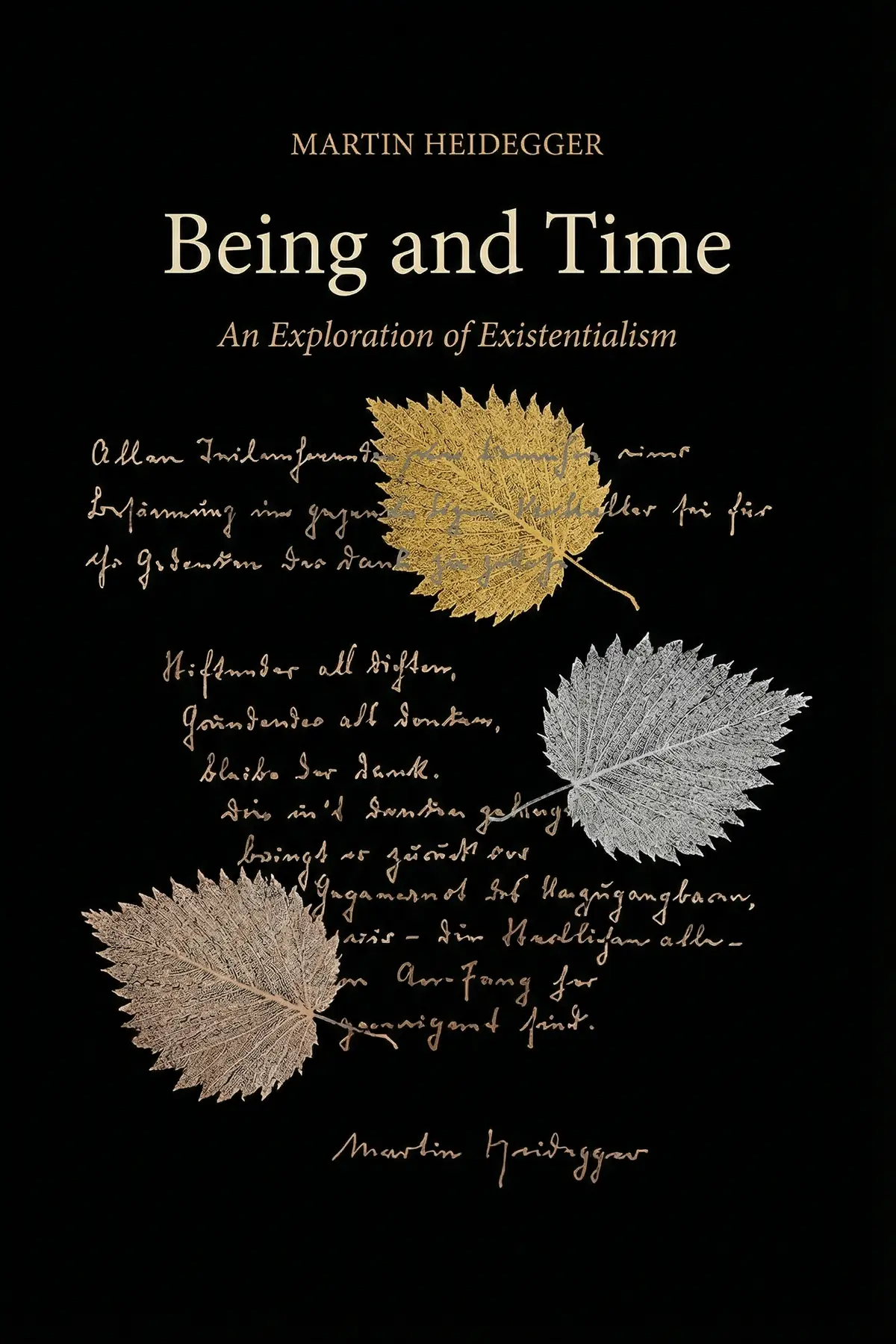
Table of Content
1. Introduction
1 min 04 sec
Most of us picture ourselves as a mind sitting behind the eyes, looking out at a world of objects, yet Heidegger argues we are always already engaged with the things and people around us. In Being and Time, published in 1927, the German philosopher Martin Heidegger argues that the picture is wrong from the start: before you think about the world, you are already busy inside it, reaching, planning and caring. He calls this kind of existence Dasein, a German word meaning being-there.
The argument that runs through his book is easy to state and hard to live. You are thrown into a world you did not choose and stretched across a limited time, and seeing that clearly lets you trade borrowed routines and efficiency thinking for a life you can call your own. Along the way you get a sharper eye for the moments when daily life breaks open, a way to stand back from devices and metrics, and an honest way to read a thinker who joined the Nazi Party.
2. Stop treating yourself as a mind watching the world
1 min 47 sec
Philosophy spent centuries assuming that clear thinking starts by stepping back from life. An ordinary doorknob suggests that assumption gets the order wrong, and that your most basic knowledge was never in your head at all.
3. Turn the life you were handed into possibilities
1 min 45 sec
Nobody chooses their birthplace, their family or their starting talents, and that can feel like a sentence already passed. Heidegger saw the same facts as the launch point for something else entirely.
4. Learn from the moment things stop working
1 min 54 sec
A missing wallet can turn a relaxed morning at the market into a cold inspection of every stall. That sudden switch reveals how you really know the world, and what you rely on without seeing it.
5. Anxiety can point you toward your own life
2 min 07 sec
Most days run on routines and opinions everyone shares, and that feels safe. Then bad news arrives and the floor seems to vanish. Heidegger found something valuable hidden inside that unsettling moment.
6. Let the fact that life ends sort priorities
1 min 53 sec
A traffic jam seems to be about lost minutes on a clock. Heidegger saw in it a far larger kind of time, one that ends with a limit most people avoid looking at, and that limit changes everything it touches.
7. Step back from treating everything as a resource
2 min 02 sec
Apps count your steps, platforms sell your attention and free time gets judged by its output. Heidegger warned about this way of seeing decades ago, and he also pointed to a way out of it.
8. Use a great thinker's ideas without excusing him
1 min 46 sec
One of the most influential philosophers of his century joined the Nazi Party and never expressed regret. Some of his sharpest readers were Jewish thinkers, and how they handled him offers a model for anyone.
9. Conclusion
1 min 09 sec
Being and Time turns an abstract question, what it means for anything to be, into a kind of mirror. The detached mind that Descartes put at the center turns out to be a late arrival. First comes the hand on the doorknob, the avocado tested at the market, the worry about a cold dinner while traffic crawls. You are thrown into all of it, you care how it goes, and your time runs out. Heidegger’s case is that holding those facts in view is what lets a life become your own.
The book supports a few small habits. When something breaks, whether a tool, a plan or a certainty, look at the web of meaning the breakdown exposes. When anxiety comes with no clear cause, ask which borrowed answer just failed, and what you would choose without anyone’s approval. Let the limit of your time weigh your worries, and protect some hours where nothing is measured or optimized. And keep his politics in plain view while you learn from him.
The doorknob will go on turning without a thought. Every so often, notice the door.
About this book
What is this book about?
Most of us picture ourselves as minds looking out at a world of objects, judging and analyzing from a distance. Martin Heidegger thought that picture had the order of things backward. Before we ever theorize about the world, we are already busy inside it: opening doors, shopping, driving, talking, worrying about the people we love. In Being and Time, published in 1927, he calls this kind of existence Dasein, or being-there. He describes it as thrown into circumstances it never chose, always leaning toward future possibilities, and defined by care. He separates everyday absorption in shared routines from the rarer authentic moments, often triggered by anxiety or by facing death, when a person recognizes that their life is theirs alone to shape. His later thinking extends the same concern to technology, which he feared turns everything, people included, into resources. Readers get a clear map of these ideas through everyday scenes, practical ways to use them, and an honest look at Heidegger's membership in the Nazi Party and how thinkers since have engaged with his work critically.
Book Information
Who it's for
Professionals rethinking their choices
Professionals who feel they are living by borrowed scripts and want a sharper way to think about their choices.
Facing a life crisis
People facing a crisis, a career crossroads or a hard diagnosis who want to understand the anxiety it brings.
Wanting Heidegger explained plainly
Students and curious readers who want Heidegger's core ideas, and his Nazi past, explained plainly.
About the Author
Martin Heidegger
Martin Heidegger was born in Meßkirch, Germany, in 1889 and died in 1976. He studied under Edmund Husserl at Freiburg and taught philosophy at Marburg and Freiburg. Being and Time introduced his idea of Dasein and revived what he called the question of being; his later work turned to technology, language, art and poetry. He was elected rector of Freiburg in April 1933 and was a Nazi Party member until 1945, a fact scholars still debate in relation to his philosophy.
Ratings & Reviews
Ratings at a glance
What people think
Listeners find this translation of Being and Time to be exceptional, as one listener points out it is more approachable than older versions. The text also garners praise for its philosophical content, with one listener emphasizing its significance for comprehending 20th-century philosophy. However, reviews are split regarding the formatting; one listener deems it well-structured, whereas another finds the Kindle edition poorly rendered. Additionally, several listeners find the book's density to be a drawback, and perspectives on its aesthetic are mixed, with some finding it beautiful while others question its physical quality.
Top reviews
Ella
After hearing so much about the Joan Stambaugh translation being the most accessible, I finally took the plunge into the 'Seinsfrage.' It’s a lot to process. If you don't have a background in Husserl or Kant, you’re basically walking into a dark room without a flashlight. Heidegger is obsessed with how we’ve 'forgotten' being, and he spends hundreds of pages digging through the history of philosophy to find where we went wrong. The sections on 'ready-to-hand' objects really changed how I look at my daily chores—suddenly a hammer isn't just a tool, but an extension of my own agency. It is a grueling read, but essential for anyone serious about 20th-century thought. Just be prepared for the linguistic gymnastics required to follow his arguments.
Show moreAudrey
As someone who usually finds continental philosophy a bit too airy, I was surprised by how grounded some of this felt. The focus on 'everydayness' and the way we interact with our environment is genuinely transformative. This translation makes the 'unreadable' parts of the original German much more palatable for a modern audience. You can see the roots of existentialism on every single page, especially when he dives into the anxiety of being. It’s a towering achievement that deserves its reputation, even if you have to ignore the author's personal failings to get through it. Don't go into this expecting a quick summary of 'what life means.' Instead, expect a deep, rigorous investigation into the very structures that allow 'meaning' to exist in the first place.
Show moreYok
Wow. I didn't expect a technical treatise on ontology to hit me like a ton of bricks. Once you get past the initial barrier of the terminology, you realize Heidegger is describing the very air we breathe. He captures that 'uncanny' feeling of existing in a way no other writer has managed for me. It’s not just an intellectual exercise; it’s an emotional realization of what it means to be finite. The translation is crisp and manages to preserve the strangeness of the original without being totally unintelligible. It’s a life-changing book if you’re willing to sit with the discomfort of not knowing what’s going on for the first hundred pages. Truly a masterpiece of the human spirit’s attempt to understand itself.
Show moreKrisada
Martin Heidegger’s magnum opus demands everything from the reader, and in return, it offers a total paradigm shift. Frankly, I think people complain about the difficulty because they want philosophy to be easy, but some questions require this level of depth. The way he deconstructs the subject-object divide is nothing short of revolutionary. This edition is particularly valuable for its footnotes and clear rendering of complex terms like 'Vorhandenheit.' While the book’s length is intimidating, the internal logic is consistent and rewarding once you find the rhythm. It’s the kind of text that stays with you, coloring every interaction you have with the world. A must-own for anyone building a serious philosophy library.
Show moreMay
This book is a jagged mountain that refuses to be climbed without the right gear. Martin Heidegger doesn’t just write; he builds a new language from the ground up to describe our experience of existing. To be fair, the density of the prose is legendary for a reason, and you will find yourself reading the same paragraph ten times just to find the verb. However, this specific translation is a godsend compared to older versions, offering a much-needed clarity to the concept of Dasein. I struggled with the sheer length, yet the insights into how we inhabit the world are incomparable. It isn’t just a philosophy text; it’s a fundamental restructuring of how you perceive your own 'being-in-the-world.' You’ll hate the gunk, but you’ll cherish the moments when the clearing finally opens up.
Show moreOwen
Ever wonder if the tools you use are actually part of your own body? Heidegger’s analysis of 'readiness-to-hand' is probably the most relatable part of this massive volume. When you’re hammering a nail, you don’t think about the hammer—it just becomes part of your action. It’s a brilliant insight buried under layers of linguistic gunk. The book itself is stunning; the binding and cover look great on a shelf, which is good because you’ll be staring at it in frustration for months. Personally, I think the stylistic difficulty is a bit overblown if you have a decent guide, but the conceptual weight is very real. It’s a demanding, beautiful, and occasionally infuriating masterpiece of modern ontology.
Show moreAnawin
Picked this up for a graduate seminar and quickly realized that Heidegger isn't just a philosopher, he's a linguistic architect who builds his own house and then locks the doors. You need to know your Aristotle and Descartes to even understand who he’s arguing against. If you jump in cold, it will seem like the ramblings of a man who lost his mind in the Black Forest. However, once you grasp the concept of 'Dasein' as being-in-the-world, everything starts to click. It’s a rigorous, often exhausting journey through the nature of temporality. This edition is excellent, though I did notice some minor typos in the later chapters. Essential reading for anyone who wants to understand why 20th-century philosophy looks the way it does today.
Show moreFord
The sheer density of the prose makes it feel like trying to swim through wet concrete. I wanted to love this, especially given its massive influence on Sartre and Camus, but the payoff often feels too small for the effort required. To be fair, there are sections on the 'clearing' of being that are poetic and profound. But those are rare gems in a sea of 'being-towards-death' and other hyphenated abstractions. It’s a paradox: the book is beautiful to behold on my desk, but a slog to actually open. I’d recommend it only to those who have already read Husserl and are prepared for a long-term commitment. It’s a four-star book because the ideas are foundational, but the readability is a struggle.
Show morePrae
Finally got around to finishing this behemoth, and I’m still not sure if I’m Dasein or just completely exhausted. The truth is, Heidegger is a brilliant thinker trapped in the body of a terrible writer. There are moments of pure, mind-blowing lucidity where he explains how time and being are inextricably linked, but those moments are separated by miles of dense, repetitive terminology. It’s like trying to find a diamond in a rock quarry. I appreciated the physical quality of the hardcover—it’s a beautiful book to hold—but the contents are a different story. It’s a 3-star experience because while the ideas are 5-star, the delivery is a total chore. Read it for the prestige, but keep your highlighter ready.
Show moreNarong
Total nightmare to navigate if you’re using the Kindle version, as the formatting is absolutely abysmal and makes an already difficult text nearly impossible to follow. Beyond the technical glitches, the content itself is a swamp of jargon and self-indulgent neologisms. I get that he’s trying to redefine our entire ontological framework, but does it have to be this opaque? It honestly feels like he’s playing a glass bead game where only he knows the rules. Plus, knowing his Nazi background makes it very hard to stomach some of the rhetoric about 'destiny.' I stuck with it for 200 pages before realizing my time was better spent elsewhere. If you aren't an eccentric academic with years to kill, maybe just watch a summary video.
Show moreQuestions about this book
What is the main idea of Being and Time by Heidegger?
Heidegger argues that humans are not detached minds observing objects. We are Dasein, being-there: thrown into circumstances we did not choose, already engaged with tools, people and practices, and always leaning toward future possibilities. Our existence matters to us, which he calls care. We usually live absorbed in shared routines, but anxiety and facing our own death can reveal that our life is ours to shape.
What is the difference between ready-to-hand and present-at-hand?
Ready-to-hand describes smooth, practical dealing with things, like grabbing a doorknob or squeezing avocados at a market without thinking about it. Present-at-hand is the detached, analytical stance that appears when something breaks or goes missing, such as discovering your wallet is gone. Heidegger’s point is that the analytical view comes second and depends on the practical involvement that came before it.
What does Heidegger mean by authenticity and being-toward-death?
Authenticity means recognizing that your life is uniquely yours, with choices nobody else can make for you, as at a career crossroads. Being-toward-death is seeing death as your final limit, the possibility of no further possibilities, without morbid obsession. Facing it can shift priorities, so a promotion may matter less than neglected relationships. Heidegger treats authenticity as something you must keep reclaiming, never a permanent state.
How can I apply Heidegger's ideas in everyday life?
Treat breakdowns as information about what you were relying on without noticing. When anxiety arrives without a clear cause, ask which borrowed answer just stopped working. Weigh current worries against the fact that your time is limited. And notice how devices and apps frame you as a resource, then make room for time in nature, unmeasured creative work or rituals whose meaning has nothing to do with usefulness.
How should readers deal with Heidegger's Nazi past?
Heidegger became rector of Freiburg in 1933, joined the Nazi Party, stayed a member until 1945 and never expressed remorse, even after the Holocaust. Scholars still debate how his politics relate to his philosophy. Jewish philosophers Hannah Arendt and Emmanuel Levinas engaged critically with his thought while building their own ethics, which suggests a stance of neither full acceptance nor full rejection.
Featured in
Readers also enjoyed

A Guide to the Good Life: The Ancient Art of Stoic Joy
William B. Irvine

A Little History of Philosophy
Nigel Warburton

A Theory of Justice
John Rawls

Anarchism: A Very Short Introduction
Colin Ward
AUDIO SUMMARY AVAILABLE
Listen to Being and Time in 15 minutes
Get the key ideas from Being and Time by Martin Heidegger, plus 5,000+ more nonfiction titles.
- 5,000+ titles
- Listen as much as you want
- 7-day free trial
- Cancel anytime









