
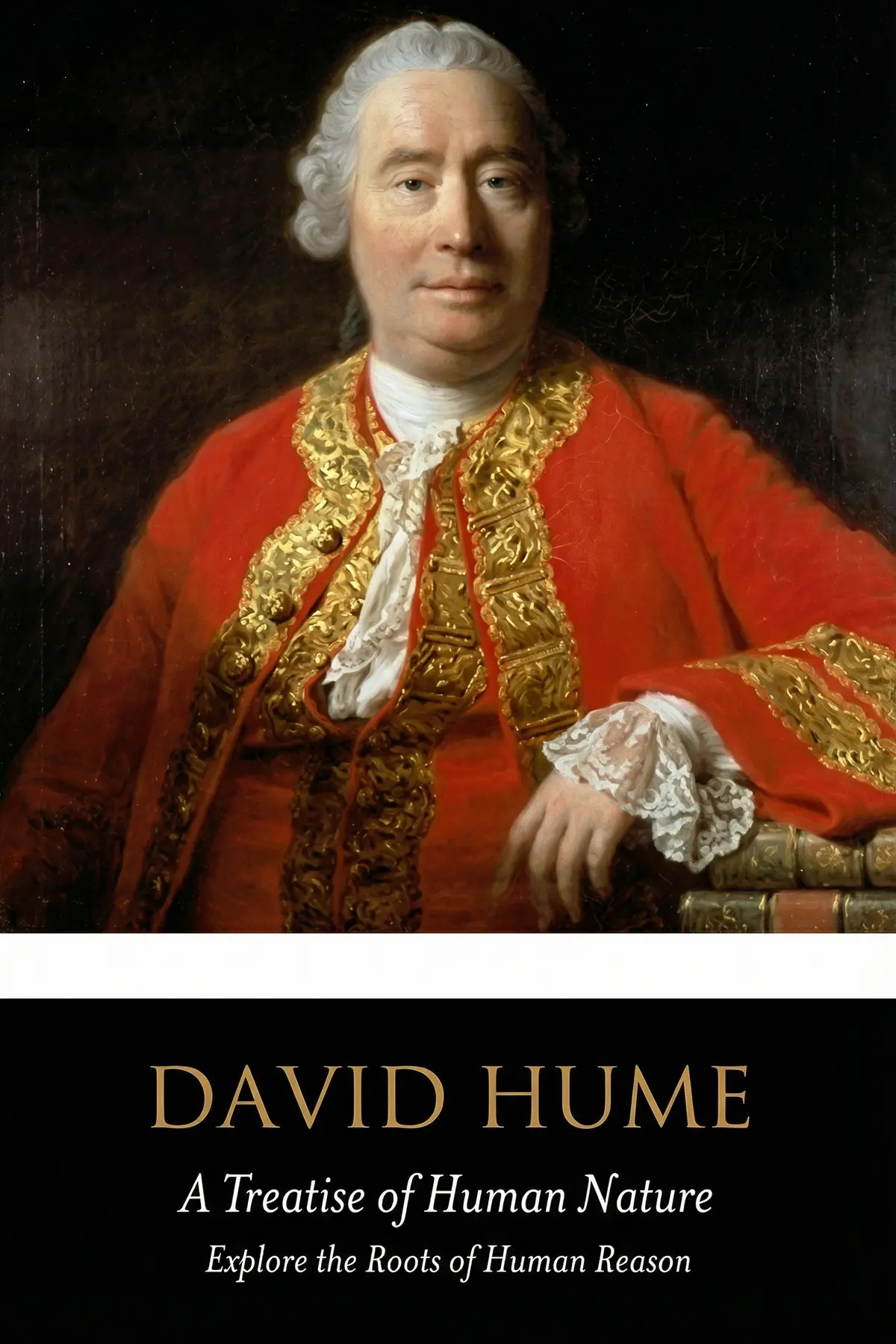
14 min 25 sec
Available in: English
An Enquiry Concerning the Principles of Morals
By David Hume
Hume explains why judgments of right and wrong come from feeling, not logic. He shows how sympathy, a wider point of view and social convention turn private feelings into shared standards, including justice itself.
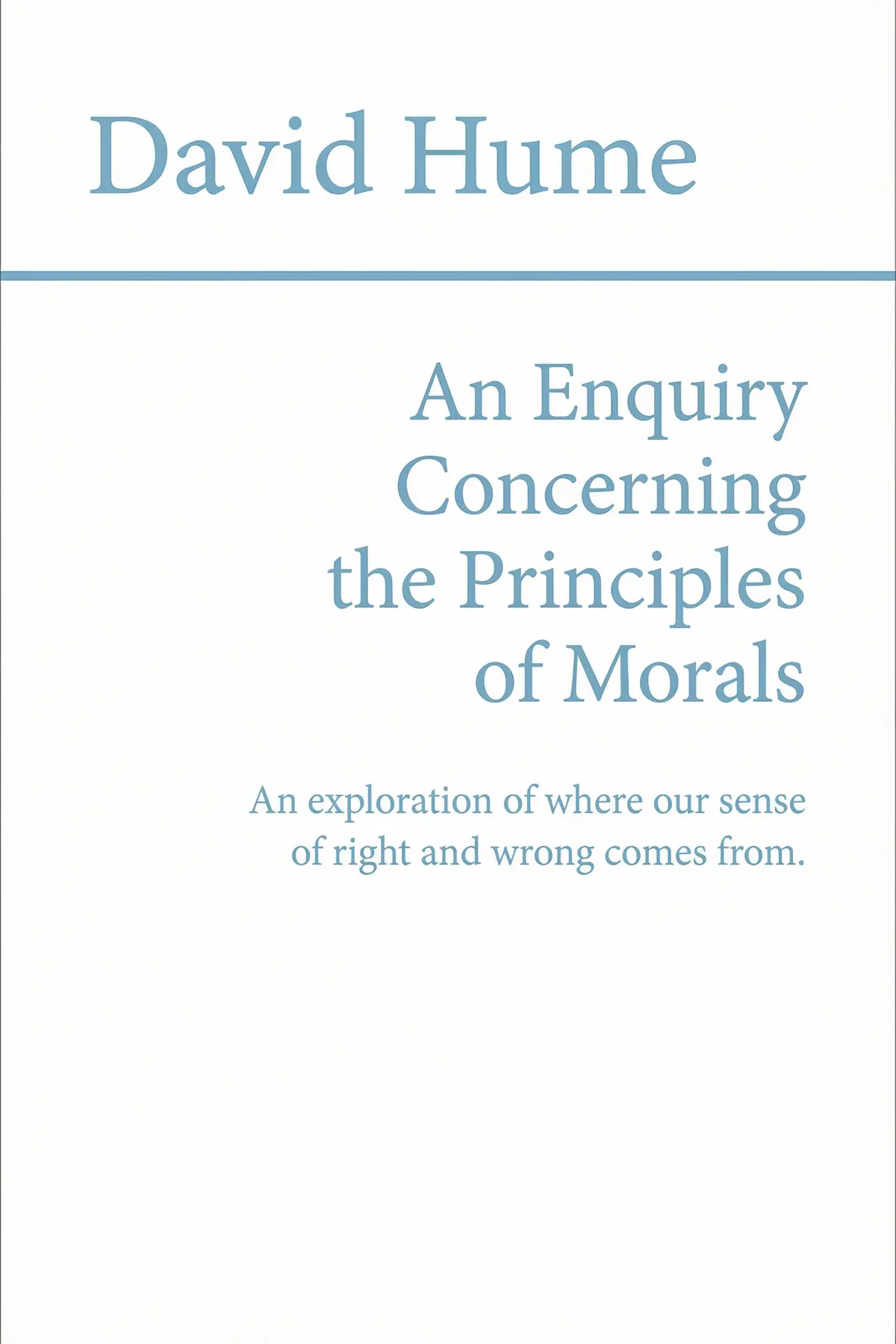
Table of Content
1. Introduction
59 sec
If you have ever lost an argument about right and wrong to someone with neater logic, David Hume offers firmer ground. In An Enquiry Concerning the Principles of Morals, the Edinburgh philosopher argues that moral judgments come from feeling, not reasoning, and that facts alone can never settle what anyone ought to do. He published it at the height of the Scottish Enlightenment, when his city was nicknamed the Athens of the North. Hume himself rated it his finest work, a clearer reworking of ideas his earlier Treatise had failed to get noticed.
His case is that morality is a natural human capacity. We feel what others feel. We approve of whatever makes people better off. Over time, society shapes those feelings into shared standards, and even into justice. Follow his steps and you get a working map of why you praise and blame, where your judgments lean, and how to make them fairer.
2. Trace your moral judgments back to feeling
1 min 56 sec
Pile up every fact about a situation and something still seems to be missing when you decide what should happen. Hume located that gap, and what he put in it unsettled the philosophers and theologians of his day.
3. Feel what others feel, and judge from there
2 min 00 sec
A stranger’s wince can make your own stomach tighten. Hume built a whole theory of right and wrong on that reflex, and modern brain research later turned up a possible physical trace of it.
4. Judge fairly by stepping back to a wider view
2 min 06 sec
Left to itself, sympathy would make you approve of whatever pleased you this afternoon. Hume described the move that turns a jumpy reaction into a judgment other people can trust, and the role others play in it.
5. See why useful qualities earn praise everywhere
2 min 01 sec
Honesty and loyalty are admired in societies that agree on almost nothing else. Hume traced that pattern to a single source, then refused to turn it into the cold arithmetic later thinkers would build on it.
6. Justice is a human invention we cannot lose
2 min 09 sec
Nobody feels a natural glow at the thought of contract law. Hume argued that justice was built by people rather than born in them, and that this origin makes it more important, not less.
7. Four ways a character earns lasting approval
1 min 59 sec
A reliable, hardworking colleague can still be hard to be around, and a charming one can be careless. Hume’s map of character explains why we approve of both, and what each might be missing.
8. Conclusion
1 min 15 sec
What Hume finally offers is a morality anyone can possess, because it rests on equipment everyone already has: the capacity to feel with other people. Approval and blame grow from shared emotional responses to what helps or harms. A wider view makes them steadier, and society extends them into conventions as durable as justice. That single account explains why moral feelings are so similar across humanity, and why the specific rules still change from place to place and age to age.
For daily life, his picture suggests a few habits. When an argument about right and wrong stalls, separate the facts from the verdicts and look for the feeling underneath. Before judging someone, imagine how a fair observer with no stake in the matter would see it, and deliberately bring distant people into view so your sympathy can reach them. When you weigh a rule, ask what cooperation it protects.
Kant later credited Hume with ending his “dogmatic slumbers,” and in ethics Hume insisted on something plain: we are moved by what we feel. The work of a good life is teaching those feelings to see further.
About this book
What is this book about?
Most people defend their moral views with arguments, as if right and wrong could be proved like a sum. David Hume, writing in Edinburgh at the height of the Scottish Enlightenment, argued that this gets ethics backward. Facts alone never tell anyone what they ought to do. Our verdicts of praise and blame come from sentiment. That claim does not make morality a matter of private taste. Hume grounds it in sympathy, the human capacity to feel what others feel. He then shows how a general point of view makes our judgments steadier and fairer. He also explains why useful qualities are praised almost everywhere, and why justice, a human invention built on rules about property and promises, comes to feel like second nature. He ends with a generous map of character, sorting the virtues into four kinds by their effects. Readers get a clear account of where their own moral reactions come from, where those reactions tend to be biased, and how to widen and correct them. Hume himself rated this book his finest. It anticipates later work in psychology and utilitarian ethics, and it challenged the reason-first and religion-first views of morality common in his time.
Book Information
Who it's for
Curious about moral origins
Curious readers who want to know where their sense of right and wrong actually comes from.
Students starting Hume's ethics
Students of philosophy, psychology or economics meeting Hume's ethics for the first time.
Hoping to judge fairly
Managers and parents who want a fairer way to judge people and the rules they enforce.
About the Author
David Hume
David Hume (1711 to 1776) was an Edinburgh philosopher, historian, economist and essayist, known for empiricism, philosophical skepticism and a naturalistic study of people. His early Treatise of Human Nature aimed at a science of man built on psychology but drew little notice. In his lifetime he was best known for his bestselling History of England. He argued that passions, not reason, govern behavior, and Immanuel Kant credited him with ending Kant's own dogmatic slumbers.
Ratings & Reviews
Ratings at a glance

What people think
Listeners find that David Hume offers a deep exploration of where morality begins, stressing the innate human potential for altruism rather than pure egoism. Even though perspectives on the work's tempo are mixed, listeners value the writer's sharp analysis of how justice contributes to societal welfare. Moreover, they point to the volume's long-standing historical weight, with one listener remarking that Hume’s support for the "particle of the dove" in our nature persists as a compelling and fundamental element of the human experience.
Top reviews
Penelope
David Hume’s Enquiry is a masterpiece of secular ethics that avoids the coldness of pure logic. He captures that essential "particle of the dove" within our nature, arguing that our moral sense isn't just hidden self-interest or a social construct. Instead, it is an irreducible part of being human. I found his defense of benevolence incredibly moving, even if his 18th-century prose requires some patience. To be fair, the way he links justice to public utility makes more sense than almost any other theory I've encountered in my studies. It’s a grounded, humanist perspective that still feels fresh. While some chapters feel repetitive, the core insight is undeniable.
Show moreTan
As someone who usually finds Enlightenment philosophy a bit detached, I was surprised by how much heart is in this work. Hume argues that our moral feelings are naturalistically irreducible, essentially saying we are wired for empathy. This Enquiry is far more accessible than his earlier writings, though it loses some of that sharp, skeptical edge that made him famous. He focuses heavily on how justice acts as a stabilizer for private property and public peace. Personally, I think he hits the nail on the head regarding our social instincts. It’s a fascinating bridge between the old world of religious morality and the new world of psychological observation.
Show moreOoi
Hume's second Enquiry is a foundational text that every student of ethics needs to grapple with. He rejects the idea that morality is purely rational, instead placing it firmly in the realm of sentiment and feeling. By arguing that benevolence is a primary instinct, he offers a much more optimistic view of humanity than the grim "war of all against all" suggested by Hobbes. The way he ties the merit of justice to its usefulness for the community is nothing short of revolutionary. It’s a dense read, but the payoff is a deeper understanding of why we value what we value. This is the work Hume himself considered his best.
Show moreNit
Picked this up after finishing the Treatise, and the shift in tone is immediately apparent. Hume seems much more concerned with being a "common moralist" here, providing concrete instances of virtue rather than just abstract reasoning. He dismantles the cynical Hobbesian view that everything we do is rooted in narrow self-interest. Instead, he highlights how justice serves the community's needs, creating a framework where we can all flourish together. Look, the book can be a bit of a slog when he starts listing every possible virtuous trait known to man. However, his focus on the social utility of our moral choices remains a powerful cornerstone of modern ethical thought.
Show moreAkira
Wow. Not what I expected at all from the man known for his radical skepticism! Here, Hume is almost warm, defending human nature against those who claim we are purely selfish creatures. He uses the phrase "particle of the dove" to describe our innate kindness, and it’s a beautiful image that stays with you. The book does an excellent job of showing how justice isn't an abstract soul-virtue but a practical necessity for society. Not gonna lie, some of the middle chapters where he lists various virtues feel like reading a very long grocery list. But when he sticks to the big picture of benevolence versus utility, his brilliance truly shines through.
Show moreWillow
Frankly, it’s refreshing to see a philosopher acknowledge that humans aren't just calculating machines. Hume’s exploration of how we praise actions from centuries ago simply because they please our "moral sense" is a fantastic observation. He understands that our empathy doesn't always have a direct benefit to us, which is a massive blow to the egoists of his time. My only real complaint is his tendency toward prolixity; his sentences can be so long you forget how they started. To be fair, though, the historical context makes these stylistic quirks understandable. It’s a profound examination of the human condition that remains relevant to this day.
Show moreDek
Finally got around to reading this classic, and I was struck by how much it anticipates modern sociology. Hume isn't looking for divine laws; he's looking at how humans actually behave and what makes a society function. His argument that justice is tied to utility—especially in regards to property—is a very grounded take for the 1700s. I particularly enjoyed the thought experiment about a post-scarcity world where justice would be unnecessary. It shows a level of practical thinking often missing from philosophy. While he can be a bit of a "pontificating prefect" at times, the core logic is sound and incredibly influential.
Show moreMo
In my experience, David Hume is the most readable of the Great Philosophers, but this book still requires a significant mental investment. He moves away from the deep skepticism of his youth to present a more constructive view of human nature. He emphasizes that we have a natural capacity for benevolence that cannot be reduced to mere self-love. I found his discussion on the "utility" of virtues to be the most compelling part of the entire work. It’s a bit dry in the sections where he categorizes every minor social grace, but the overall message is one of human solidarity. A true staple of Western thought.
Show moreSai
Ever wonder why we feel a swell of pride when we see a stranger do something kind for someone else? Hume attempts to solve this riddle, though he often gets bogged down in an endless parade of historical examples. While his primary argument—that morality stems from utility and a natural spark of benevolence—is compelling, the delivery is incredibly dense. Truth is, I spent more time wrestling with his long, winding sentences than I did contemplating the actual philosophy. He’s clearly brilliant, but he writes like a man who never met a comma he didn’t want to turn into a semi-colon. It's an important read for philosophy buffs, but perhaps too dry for the casual observer.
Show moreLucas
The chapter on the origins of justice starts off strong, but the book quickly devolves into a repetitive lecture. It felt like Hume was trying to convince himself as much as the reader, piling on example after example of the same point. Frankly, if you’ve read the first ten pages of his argument on utility, you’ve basically read the whole book. He dons the hat of a lecturing schoolmaster, and it becomes quite grating after a while. While his rejection of the "selfish system" is historically important, the actual reading experience is a test of endurance. I expected the profound insights of his first Enquiry, but found a lot of fluff instead.
Show moreQuestions about this book
What is the main idea of An Enquiry Concerning the Principles of Morals?
Hume argues that moral judgments come from sentiment, not reason. Reason tells us facts, but facts alone cannot tell us what we ought to do. Our approval of kindness or honesty is a feeling, made possible by sympathy, our capacity to share what others feel. Because human nature carries common sentiments, morality is shared and social, not just private taste.
What is the is-ought problem in Hume?
Hume noticed that many thinkers described how the world is and then jumped, without justification, to claims about how it ought to be. He saw this as a basic error. No pile of facts, however large, logically produces an ought. For Hume, what bridges the gap is moral sentiment, the feeling of approval or disapproval that human beings share.
Why does Hume call justice an artificial virtue?
Natural virtues like benevolence arise directly from feeling. Justice, which Hume ties to rules about property, contracts and promises, grew from convention as people learned that cooperation benefits everyone where resources are limited and generosity has bounds. Through education and social approval, justice becomes naturalized and feels like second nature. Hume considered it essential: without it, cooperation would collapse.
How did Hume influence later thinkers?
Hume’s emphasis on utility, the tendency of traits and actions to promote happiness, influenced the utilitarian philosophers Jeremy Bentham and John Stuart Mill, though Hume never reduced morality to a calculation of pleasure and pain. Immanuel Kant credited Hume with waking him from his dogmatic slumbers. His idea of sympathy also finds a possible echo in the mirror neurons discovered at the University of Parma in 1992.
How can I apply Hume's moral philosophy in everyday life?
When a moral argument stalls, separate the facts from the verdicts and look for the feeling beneath. Before you pass judgment on someone, take up the view Hume described as a general point of view and picture how a fair observer would see the matter. Bring distant people into view so sympathy can reach them. And review your own character against his four kinds of virtue to see which you neglect.
Readers also enjoyed

A Guide to the Good Life: The Ancient Art of Stoic Joy
William B. Irvine

A Little History of Philosophy
Nigel Warburton

A Theory of Justice
John Rawls

Anarchism: A Very Short Introduction
Colin Ward
Anarchy, State, and Utopia
Robert Nozick
Antifragile: Things That Gain from Disorder
Nassim Nicholas Taleb
AUDIO SUMMARY AVAILABLE
Listen to An Enquiry Concerning the Principles of Morals in 15 minutes
Get the key ideas from An Enquiry Concerning the Principles of Morals by David Hume, plus 5,000+ more nonfiction titles.
- 5,000+ titles
- Listen as much as you want
- 7-day free trial
- Cancel anytime









