

14 min 23 sec
Available in: English
Leadership BS: Fixing Workplaces and Careers One Truth at a Time
Stanford professor Jeffrey Pfeffer argues that popular leadership advice about authenticity, honesty and caring hides how people really reach the top, and shows how to read leaders by behavior and protect your career.
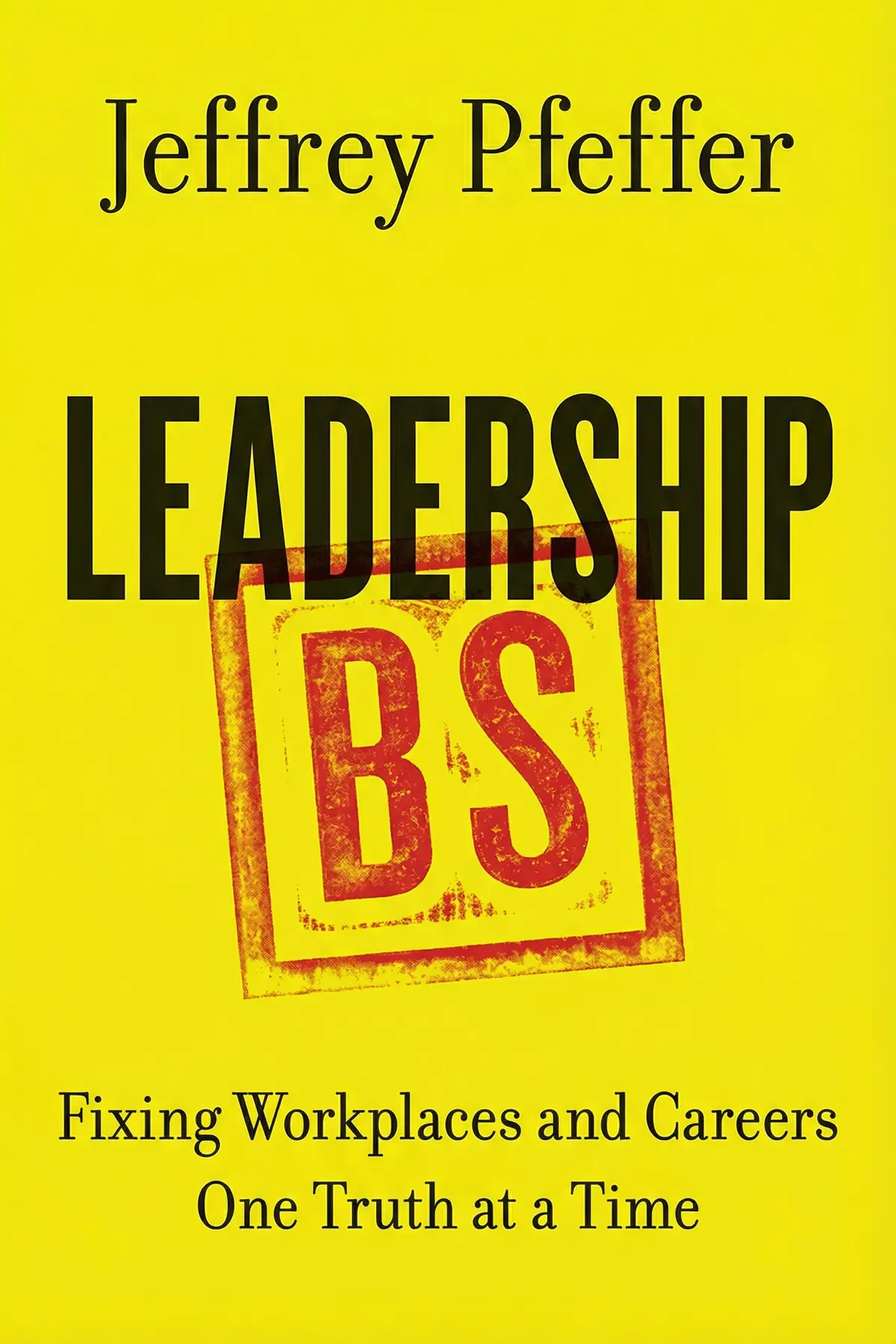
Table of Content
1. Introduction
1 min 01 sec
If you think you must become humble, authentic and endlessly caring before you can lead, you may be waiting to become a kind of leader who barely exists. In Leadership BS, Stanford business professor Jeffrey Pfeffer argues that the popular picture of the good boss, modest, honest and devoted to staff, is largely a myth, and that believing it holds people back. A generation ago, he notes, nobody was surprised to hear that a top CEO had to be tough. Now the magazines preach empathy instead.
Pfeffer’s case is that the people who reach the top usually promote themselves, perform roles they do not feel, bend the truth, break deals and look after their own position first. It is an uncomfortable picture, and he means it to be. Seeing it lets you stop blaming yourself for falling short of a fairy tale, read powerful people by what they do, and decide how much of your career to place in anyone else’s hands.
2. Stop measuring yourself against flawless business heroes
1 min 45 sec
The most celebrated CEO stories inspire millions of readers, yet they may be the very thing keeping ordinary people from trying to lead. What gets cut from those stories turns out to matter more than what stays in.
3. Visible confidence earns you respect and promotions
1 min 48 sec
Leadership books praise modesty, but hiring panels and peer groups seem to reward something else entirely. Even overconfidence that everyone can see through brings a surprising payoff, in offices, boardrooms and the White House.
4. Rehearse the leader you need to be
1 min 46 sec
Being true to yourself is the most repeated advice in leadership writing. One famous chip company took its shy managers in a very different direction, and a study of emotional labor suggests why it worked.
5. Expect powerful people to bend the truth
1 min 46 sec
Children learn that lying is wrong, often through a story that probably never happened. Research on power, and a striking figure about promotion promises, suggests that many leaders learned a different lesson on the way up.
6. Plan for deals and promises that change
1 min 41 sec
Leadership books call trust the foundation of success, yet worker surveys show remarkably little of it, and many companies thrive anyway. A founder’s sale to a rival shows why commitments in business are built to bend.
7. Protect your own career before the company's
1 min 44 sec
Army officers famously eat only after their soldiers have eaten. In companies, power tends to flow in the opposite direction, and a study of school administrators shows how it quietly reshapes who keeps their job.
8. Read leaders by what they do
1 min 39 sec
Star athletes fall to the ground at the lightest touch because it costs nothing and sometimes wins a free kick. Leaders have their own version of the trick, and spotting it takes a different kind of attention.
9. Conclusion
1 min 13 sec
Pfeffer’s book is a deliberate splash of cold water. The leadership industry sells a portrait of humble, truthful, caring bosses, and he argues that the portrait costs people jobs and fills workplaces with frustration, because it ignores social science and the daily reality of running a company. The people who rise tend to promote themselves, act out confidence, bend facts, rewrite deals and guard their own position. You do not have to like that picture to benefit from seeing it.
Seeing it changes a few habits. Measure yourself against a leader’s full record, flaws included, and your own chances may look better than the legends suggest. State what you have achieved with conviction, and practice the behavior a role demands until it stops feeling like an act. When someone asks for your trust, study their history first, since a person who has broken commitments before is likely to break them again.
None of this asks you to become a GE jerk or to start lying. It asks you to stop being surprised. The leaders who disappoint you were rarely the saints the books described, and the most useful leadership skill may be watching the hands while everyone else listens to the mouth.
About this book
What is this book about?
Business magazines and leadership gurus tell a reassuring story: the best leaders are modest, authentic, trustworthy and devoted to their people. Jeffrey Pfeffer, a long-serving Stanford business professor, thinks that story is mostly myth, and that believing it costs people jobs and leaves workplaces full of frustration. Drawing on social-science studies and well-known cases from General Electric, Intel, Apple and General Motors, Pfeffer describes what successful leaders actually tend to do. They promote themselves and project confidence, even unjustified confidence. They act out qualities they do not feel. They bend the truth, break deals when conditions change, protect their own positions and shift blame downward. Employees, meanwhile, often discover that the loyalty they offered was never going to be repaid. The book does not ask readers to admire this behavior. It asks them to see it clearly. Readers learn why flawless hero stories discourage would-be leaders, why rehearsed confidence beats waiting to feel authentic, why a hinted promotion is not a commitment, and why a colleague's track record predicts their next move better than anything they say.
Book Information
Who it's for
Honest, ambitious career starters
Ambitious early-career professionals who feel their modesty and honesty are not being rewarded.
Staff burned by promises
Employees who trusted promises of promotion or loyalty and were let down.
Skeptical founders and managers
Founders and managers tired of inspirational leadership advice that does not match what they see at work.
About the Author
Jeffrey Pfeffer
Jeffrey Pfeffer, born in 1946, holds the Thomas D. Dee II Professor of Organizational Behavior chair at Stanford's business school, where he has taught since 1979 after posts at the University of Illinois and the University of California, Berkeley. He teaches the MBA elective Paths to Power. His books include 7 Rules of Power, Dying for a Paycheck and Hard Facts, Dangerous Half-Truths, and Total Nonsense. He has written for Fortune and Harvard Business Review and received the Academy of Management's Richard I. Irwin Award.
Ratings & Reviews
Ratings at a glance
What people think
Listeners value this leadership guide for its data-driven methodology and thoroughly researched concepts, and one listener points out that it offers specific statistics to support its claims. The author’s prose is notably honest, which many find creates an engrossing experience. There are varied responses concerning how useful the book is, as some do not find it beneficial, and the speed of the narrative draws split views, with some calling it detached. While the main title gets good reviews, one listener mentions that the subtitle is misleading.
Top reviews
Isabelle
Finally, a business book that doesn't treat you like a gullible child. Jeffrey Pfeffer strips away the veneer of the 'Leadership Industry' to show that what we are taught in seminars rarely aligns with how people actually climb the ladder. The truth is, the data he presents on narcissism and self-interest is genuinely unsettling but impossible to ignore. I appreciated how he used meticulously sourced data to debunk the 'leaders eat last' myth. It's a candid, evidence-based look at the messy reality of power. Some might find his tone a bit abrasive, but it’s a necessary antidote to the usual inspirational fluff. If you want to understand how organizations actually function rather than how they should function in a perfect world, this is essential reading. It provides the cold, hard numbers we often overlook in favor of feel-good anecdotes.
Show moreJom
Ever wonder why the most successful CEOs often behave like absolute jerks? Pfeffer explains this through the lens of psychology and raw data, rather than the usual fairy tales. Not gonna lie, the sections on the 'Stockdale paradox' and the reality of authenticity were eye-opening. We want our leaders to be modest and kind, but the world rewards those who are immodest and self-promoting. It is a bitter pill to swallow. The author’s writing is refreshingly blunt, cutting through the usual corporate jargon that clogs up most business shelves. My only gripe is that the book leans heavily on the dark side of leadership without offering enough of a roadmap for the 'good guys' to survive. Still, the evidence-based approach is a breath of fresh air. It is a must-read for anyone who feels like they are failing because they aren't 'authentic' enough.
Show moreJai
The evidence-based approach here is a breath of fresh air compared to the usual fluff found in the management section. Pfeffer doesn't just give opinions; he provides a wealth of documented cases and psychological principles like implicit egotism to explain why we fall for bad leaders. I loved the critique of 'charismatic leadership' and how it often masks a total lack of competence. The book is well-documented and offers a truly fascinating look at the 'leadership industry' as a profit-driven machine that rarely delivers results. Some readers might find the focus on figures like Bill Gates and Larry Ellison to be a bit much, but they serve as perfect examples of the 'before and after' delusion. This book will fundamentally change how you view your boss and your own career trajectory. It’s easily one of the most important business books of the last decade.
Show moreSamuel
As a veteran of the corporate grind, I found this to be a refreshing, if slightly cynical, splash of cold water. Frankly, the chapter on the cult of authenticity was worth the price of admission alone. Pfeffer argues that being your 'authentic self' is often a luxury that those in high-stakes roles simply cannot afford. While the book is a bit of a rant, it’s a well-documented one that connects back to his earlier work in 'Power.' The writing is sharp and fast-paced, though it occasionally feels like he's beating a dead horse regarding how much he dislikes TED-style talks. I did feel the pacing dragged slightly in the middle, but the conclusion ties the descriptive reality of the workplace together brilliantly. It’s not for the faint of heart or those who want a pep talk.
Show moreIngrid
Pfeffer takes a sledgehammer to the 'feel-good' industry, and it is absolutely fascinating to watch. He challenges the five sacred cows of leadership: modesty, authenticity, truthfulness, trustworthiness, and selfless concern for others. In my experience, he is right that there is a massive disconnect between what we say we want and who we actually promote. The book is empirically grounded and provides a much-needed reality check for anyone entering the workforce. However, the author can be quite repetitive. He makes his point in the first three chapters and then spends the rest of the book providing variations on the same theme. It’s a great read, but you could honestly get the gist of it by reading the intro and the conclusion. Regardless, the evidence-based approach makes it a standout in a crowded field of fluff.
Show moreYuki
Not what I expected from a Stanford professor, but in a mostly positive way. Most academic books are dry and overly cautious, but Pfeffer is out for blood here. He argues that we are failing to create good workplaces because we refuse to look at how leaders actually behave. The sections on how narcissistic CEOs often outlast their peers were particularly enlightening. Look, it’s an uncomfortable read because it forces you to acknowledge that 'behaving badly' is often a functional strategy for career advancement. I wish he had spent more time on how to improve the system rather than just describing its failures. The tone is very similar to 'Bullshit Jobs,' making it a great companion piece for anyone interested in the darker side of organizational psychology. It’s a solid four-star read for the honesty alone.
Show moreThanit
Few books manage to be this uncomfortable and this necessary at the same time. Pfeffer forces you to confront the reality that organizations are often political minefields where the 'nice guys' don't always win. I found the discussion on the 'endowment effect' and ownership to be a brilliant way to explain employee motivation. The writing is candid and fast, though I can see why some might describe the tone as disengaged. It’s as if the author is tired of seeing the same mistakes repeated for forty years. Got to say, the Stockdale Paradox section was a highlight for me. It reminds us that unfounded optimism is often a death sentence in high-pressure environments. If you’re tired of the 'leaders eat last' mantra and want the truth about how to survive your workplace, pick this up. It’s a fascinating, data-driven wake-up call.
Show moreBrooklyn
The title is catchy and the data is solid, but the execution left me feeling a bit disengaged by the halfway point. To be fair, Pfeffer makes an excellent case against the 'feel-good' literature that dominates the market today. He provides plenty of numbers to back up his claims, which is refreshing for a management book. However, the pacing feels repetitive, as if the same points are being hammered over and over in every chapter. I also found the subtitle a bit misleading; he’s much better at pointing out the BS than he is at actually 'fixing' anything. It’s a fascinating read for the first sixty pages, but then it turns into a seemingly endless-looping rant against his colleagues. It’s worth your time if you can skim the middle sections. I expected more actionable solutions from a Stanford professor.
Show moreRatchanee
While I agree with the core premise that most leadership advice is garbage, the author spends too much time throwing rocks at his own peers. Pfeffer is a part of the very system he is blasting, which makes some of his absolute statements feel a bit hypocritical. He rails against inspiration and fables, yet he uses plenty of his own anecdotes to prove his points. To be fair, the research he cites is interesting, especially regarding gender roles and immodesty in the workplace. But after a while, the negativity becomes draining. The book feels like a long-form version of a very good blog post. If you have no time, just read the first and last chapter and it would be enough to get the value. It’s a 3.5-star book for me, rounded down because it lacks a clear path forward for those of us who don't want to be Machiavellian.
Show moreRin
This book is basically just a 200-page rant that borders on being harmful to aspiring managers. Promoting the idea that a successful leader must be a lying, untrustworthy narcissist is a dangerous oversimplification of complex organizational dynamics. Personally, I think Pfeffer is cherry-picking specific scandals and high-profile outliers like Steve Jobs to justify a Machiavellian worldview that doesn't hold up in most professional settings. He engages in what I’d call 'definitionism,' beating down strawmen instead of engaging with the high-quality research that does exist. The writing style is certainly candid, but it feels more like an angry lecture than a scientific inquiry. While it’s good to be skeptical of 'inspirational' TED talks, this book goes too far in the opposite direction. It leaves you feeling cynical and confused rather than empowered. Skip the anecdotal negativity and find a book that offers a balanced perspective on human behavior.
Show moreQuestions about this book
What is the main idea of Leadership BS by Jeffrey Pfeffer?
Pfeffer argues that popular leadership advice, which praises modesty, authenticity, honesty, trust and care for employees, mostly describes a myth. Using social-science studies and cases from companies such as General Electric, Intel, Apple and General Motors, he shows successful leaders often promote themselves, perform confidence, bend the truth, break deals and protect their own positions. Believing the myth, he says, costs people jobs and creates unhappy workplaces.
Does Leadership BS say leaders should lie?
Pfeffer does more than describe; he argues these tactics work. He reports a 2014 study finding that powerful people lie more often and more easily, and another finding that 73 percent of 200 talent-management companies let employees believe they could be promoted when they could not. His point is that readers should expect such behavior from leaders and plan for it, instead of being shocked when it happens.
What does Pfeffer say about authenticity in leadership?
He thinks authenticity is overrated. Leaders, in his view, perform different versions of themselves and build their strongest qualities by rehearsing them until they feel natural. Andy Grove of Intel sent shy managers to a workshop called wolf school to practice forceful behavior, teaching them to act confident before they felt it. A 1979 study found such emotional display stressful but good for business.
How can I apply the ideas in Leadership BS at work?
Present your achievements with confidence in interviews and reviews. Practice the behaviors a role demands rather than waiting to feel them. Treat hinted promotions as signals and ask for concrete steps. Write agreements expecting the other side may change course. Above all, judge colleagues by their track record, since Pfeffer argues past behavior predicts future behavior better than anything people say about themselves.
Who should read Leadership BS?
It suits ambitious professionals who suspect that modesty and loyalty are not paying off, employees who have been let down by broken workplace promises, and founders or managers skeptical of inspirational leadership books. Anyone who wants a realistic view of how power works inside organizations, drawn from research and well-known corporate cases, will find it useful, even if its picture is uncomfortable.
Featured in
Readers also enjoyed



A Year with Peter Drucker: 52 Weeks of Coaching for Leadership Effectiveness
Joseph A. Maciariello



60 Seconds & You’re Hired!
Robin Ryan

Acting with Power: Why We Are More Powerful Than We Believe
Deborah Gruenfeld

All In: How Great Leaders Build Unstoppable Teams
Mike Michalowicz

AUDIO SUMMARY AVAILABLE
Listen to Leadership BS in 15 minutes
Get the key ideas from Leadership BS by Jeffrey Pfeffer, plus 5,000+ more nonfiction titles.
- 5,000+ titles
- Listen as much as you want
- 7-day free trial
- Cancel anytime









