

15 min 12 sec
Available in: English
You Should Test That!: Conversion Optimization for More Leads, Sales and Profit or The Art and Science of Optimized Marketing
By Chris Goward
Shows how to turn more of your existing website visitors into customers by replacing design opinions with careful tests, using a six-factor model to find what makes people hesitate, wander off or leave.
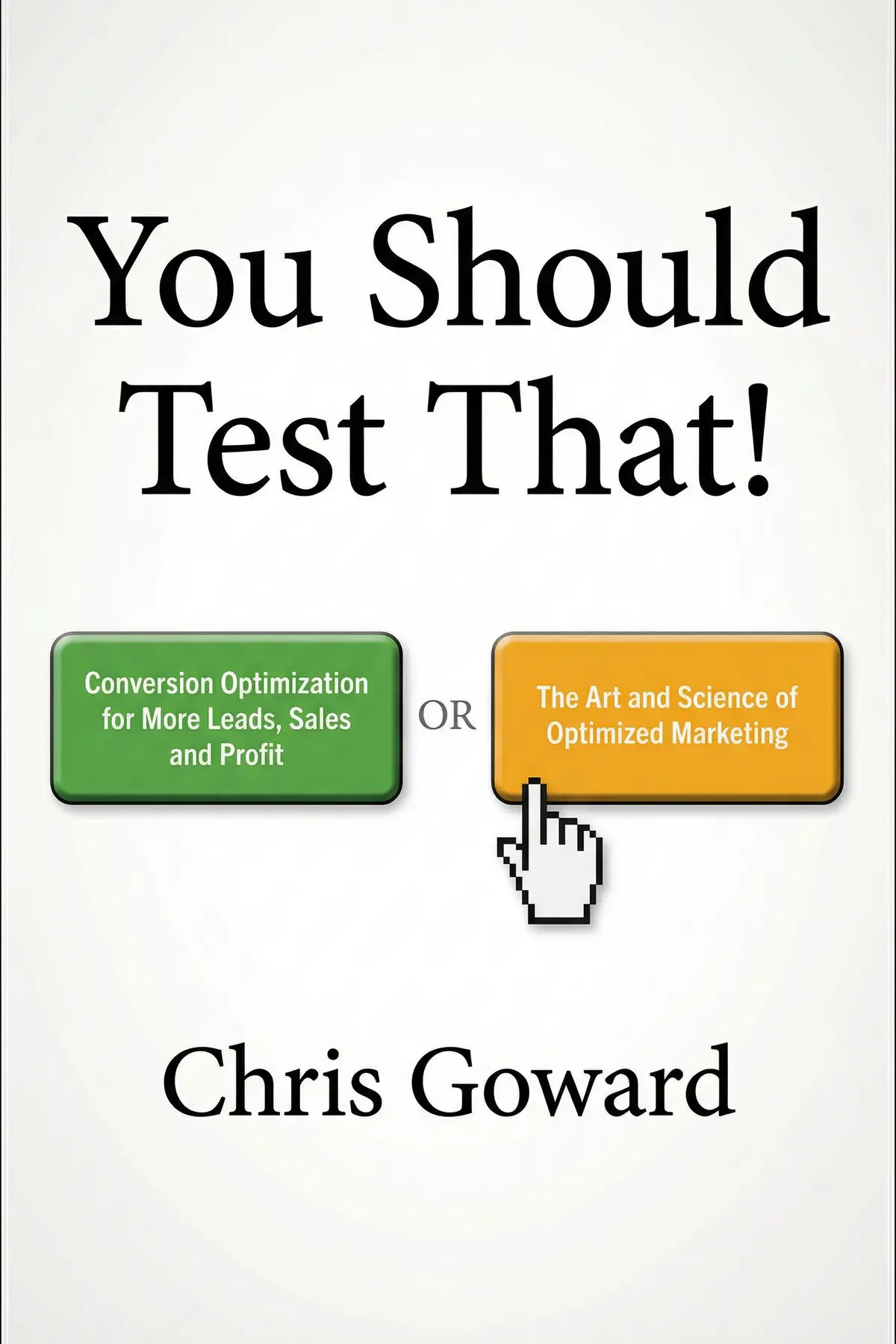
Table of Content
1. Introduction
54 sec
Plenty of businesses work hard to attract visitors, then watch most of them leave without buying or signing up. In You Should Test That!, conversion specialist Chris Goward argues that the cheapest growth sits inside that existing traffic, waiting for a better page. He pictures a good website as a motorcycle: a machine you keep taking apart, adjusting and testing so it runs better.
The throughline is simple. A site earns more when its owners stop trusting taste, rank and opinion, and let real visitors decide through careful experiments. Goward supplies the tools: a ladder of goals, a six-part model for spotting what holds visitors back, a formula for hypotheses and rules for running a fair test. With them, the next argument over a headline at work can turn into a question the data answers within a couple of weekends.
2. Earn more from the visitors you already have
1 min 33 sec
Even companies that sell mostly in stores live or die by their website. One phone maker’s headline about speed shows how a page can undermine the very product it is trying to praise.
3. Let customers settle your design debates
1 min 40 sec
Most redesigns are shaped by one opening question and one powerful person in the room. Goward explains why both are poor guides, and what he puts in their place.
4. Keep your search ranking while you test
1 min 32 sec
Teams that fought their way up Google’s results often see conversion experiments as a threat. Goward argues the fear is mostly misplaced, and two small precautions handle the rest.
5. Rank your site's goals before changing anything
1 min 34 sec
Wanting more sales sounds like a clear goal, yet Goward finds it far too vague to guide a single test. His alternative also makes arguments over page space much easier to end.
6. Six levers that decide whether visitors act
1 min 44 sec
Knowing your goal still leaves you guessing which part of a page is failing it. Goward’s model names six forces at work, and one of them can make every other fix pointless.
7. Make wary visitors feel safe on your site
1 min 49 sec
A single moment of doubt at a sign-up form can cost a sale, even for a great product. One blogging platform found a way to handle user mistakes that keeps people from walking away.
8. Clear the page so one message wins
1 min 40 sec
Visitors decide whether to stay before they have read a word, and even a background texture can tip that choice. Politicians, oddly enough, offer the model for what should happen next.
9. Turn hunches into tests you can trust
1 min 43 sec
A preference for one font over another sounds like something you could test, yet as usually phrased it can never be proven. Goward shows what a usable hypothesis looks like and how long to wait for an answer.
10. Conclusion
1 min 03 sec
Goward’s book comes down to a change in who gets the final word on a website. The designer, the executive and the competitor with the impressive pages all step aside for the visitors themselves, measured carefully. The site becomes a machine that is never finished, and every opinion about it becomes a hypothesis waiting for its data.
The habits follow directly. Before the next redesign, agree on what the site is for and rank its goals, so each test serves the top one. Walk through your main page as a nervous first-time buyer would, counting the form fields, reading the error messages and noticing anything that pulls the eye from the offer. Then choose the weakest spot, write one hypothesis with a goal and a trigger, and let it run across two weekends before anyone draws conclusions.
BlackBerry promised speed on a page that could barely load. The fix for a gap like that was never a bigger budget. It was asking customers, through a test, before anyone started arguing.
About this book
What is this book about?
Most companies judge their websites the way they judge a poster: by how it looks. Chris Goward argues that this habit costs them money. What counts is the conversion rate, the share of visitors who buy, sign up or take whatever action the business needs, and a slow or confusing site can even make the product itself look worse. Goward's answer is to treat a website as a machine that is never finished. He shows why design agencies, copied competitors and the opinion of the highest-paid person in the room are poor guides, and why conversion work and search rankings support each other. He then lays out a working method: rank the site's goals, diagnose each page with his LIFT model of six factors, write hypotheses that a test can prove wrong, and run experiments long enough to trust them. Readers get concrete fixes, from shorter forms and kinder error messages to fewer competing messages per page, and a routine for making testing a permanent part of how a business grows.
Book Information
Who it's for
Too few visitors buying
Founders and marketers who pay for website traffic but see too few visitors buy or sign up.
Managers in redesign debates
Managers stuck in redesign debates decided by taste or by the most senior person in the room.
Teams starting regular testing
Web and product teams starting a regular testing routine without hurting their search ranking.
About the Author
Chris Goward
Chris Goward built and later sold Widerfunnel, an agency devoted to web experimentation that now operates under the name Conversion. HP, Microsoft, The Motley Fool and Dollar Shave Club have sought his help to improve their digital experiences and growth, and the agency's clients also included Google, Electronic Arts and Babyage.com. He has spoken at hundreds of events worldwide and now advises and invests in founder-led companies that need help with growth, digitization and optimization.
Ratings & Reviews
Ratings at a glance

What people think
Listeners find this book highly beneficial for conversion optimization, with one individual pointing out its in-depth look at web conversion strategies and another emphasizing the LIFT Model framework. Additionally, the writing is clear and engaging, as one listener specifically values the sections focused on hypothesis development. Listeners also regard it as required reading for digital marketing experts. However, there are conflicting perspectives concerning its overall value for money.
Top reviews
Samart
Digital marketing professionals who aren't currently testing their landing pages are essentially leaving money on the table. Goward makes a compelling case for why conversion rate optimization should be an ongoing process rather than a one-time project. I loved the emphasis on 'scent trails' and ensuring that the most prominent message on a page matches the search terms closely. It’s about creating a seamless, painless, and enjoyable experience for the user. The book is packed with actionable insights, such as moving SEO-centric content below the fold if it isn't helping the funnel. To be fair, some of the case studies feel a little dated now, but the underlying methodology is timeless. If you want to increase revenue without increasing your ad spend, this is the blueprint you need. It’s easily one of the most practical business books on my shelf.
Show moreSaovapa
The chapter on hypothesis creation was a total game-changer for our internal marketing team. We used to just throw things at the wall to see what stuck, but Goward’s structured approach changed our entire workflow. We now focus on isolating variables and understanding the 'fuzzy edge' of emotional decision-making. I was especially intrigued by the section on 'anchoring' and how font sizes can influence a prospect's perception of savings. Small tweaks, like putting the sale price in a smaller font, are things we never would have considered without this book. Look, the result is what matters: increased revenue. We’ve already seen a jump in our average order value by applying the principles outlined here. It’s a must-read for anyone who actually wants to understand the psychology of their customers.
Show moreWatcharin
Picked this up on a whim after seeing it referenced in a few case studies and I’m so glad I did. It’s a much more condensed and inspiring study of CRO than Tim Ash’s work, which can sometimes feel a bit overwhelming. Goward uses an inspiring language that makes you want to go out and start an experiment immediately. The way he breaks down 'Anxiety'—from brand equity to the fear of post-purchase disappointment—is brilliant. I also appreciated the technical notes on using 301 redirects and monitoring tests to ensure they run properly. It’s a comprehensive guide that covers everything from copy to layout to psychological triggers. In my experience, this is the best starting point for anyone who wants to take their digital marketing to the next level. Absolutely essential reading.
Show moreJom
After hearing so much about the LIFT Model, I finally dove into Chris Goward's work. Frankly, I expected a dry manual. Instead, I found a highly accessible guide to the psychological triggers behind conversion. Goward breaks down complex ideas into manageable pillars like Relevance and Anxiety, which helps demystify why certain landing pages fail. I particularly enjoyed the focus on making goals as close to revenue as possible. However, the book does gloss over the more rigorous statistical analysis required for true A/B testing. If you are looking for deep math, you might be disappointed. Still, for a marketer trying to convince a skeptical manager to invest in CRO, this is a goldmine. It’s an inspiring read that encourages you to stop guessing and start measuring.
Show moreSelin
Look, most people think a great product is enough, but this book argues that the process of scrutinizing and experimentation is what actually moves the needle. Goward explains how to turn weaknesses into strengths by addressing fulfillment anxiety and managing expectations with clear language. I found the tips on form design particularly useful, especially the advice to move optional fields to a post-signup page. The book is very readable and avoids overly dense jargon, which makes it great for sharing with team members. My only gripe is that it can feel a bit like a long-form advertisement for the author's agency at times. Regardless, the strategies regarding 'intangible benefits' like comfort and control are worth the price of admission alone. It’s a highly practical manual for building a better user experience.
Show moreSiraporn
Ever wonder why users bounce within milliseconds of landing on your page? This book provides the answer by looking at the intersection of persuasion marketing and experience design. The concept of the 'scent trail' resonated with me because it explains how search engine visitors are actively hunting for specific solutions. If your page doesn't match their search terms immediately, they are gone. Goward’s 7-step testing process is a clear roadmap for anyone looking to professionalize their marketing efforts. Not gonna lie, I was skeptical about how much I could learn from a book about A/B testing, but the insights into cognitive load and visual cues were eye-opening. The CrystalReports landing page example is absolutely gorgeous and worth studying. It’s a great resource for anyone involved in web design or sales.
Show moreAmy
Finally got around to finishing this and the biggest takeaway for me was the focus on relevance. Goward points out that synonyms are often invisible to users who are pattern-matching, which is a huge insight for keyword strategy. I’ve already started re-evaluating our headlines to match our inbound search terms more closely. The advice to use image captions because they are the most-read text on the page is another small but powerful tip. Gotta say, the book is full of these 'aha' moments that make you rethink your entire site layout. I do wish there was more information on mobile-specific optimization, as the web has changed a lot since this was published. However, the core principles of reducing distraction and building urgency remain incredibly relevant today. It's a solid, practical guide for any digital professional.
Show moreYindee
Brushing up on conversion optimization is always a good idea, but I found this specific guide to be a bit of a mixed bag. On one hand, the case studies are fun and offer plenty of inspiration for my next design sprint. The LIFT model is clearly explained and easy to apply to any landing page. On the other hand, the book is quite misleading when it comes to the actual statistics of testing. It brushes over the complexities of sample sizes and analysis, making CRO look a bit easier than it actually is in practice. Personally, I think it’s a fantastic start for those unfamiliar with the 'why' of testing, but it lacks the 'how' for advanced users. It’s a solid 3.5 stars that provides a good high-level overview without getting its hands too dirty in the data.
Show moreBrooklyn
Not what I expected in terms of statistical depth, yet the inspiring language kept me turning pages until the end. Frankly, I was not the target demographic for this one as a developer, but I can see why a marketer would love it. It’s very focused on the 'persuasion' side of the web, explaining how adjectives and image captions can influence a user's intent. While I found the LIFT model informative, I felt the book ignored some of the technical challenges of modern web frameworks. To be fair, it’s a great way to show doubting managers why we need to test instead of just following 'best practices.' It’s a good overview, but if you are already an expert in CRO, you might find the insights a bit elementary. A decent read, but not revolutionary.
Show moreAva
This book feels like it’s stretching a handful of excellent blog posts into a full-length manuscript, which makes the value for money a bit questionable. Truth is, if you’ve followed the WiderFunnel blog for any length of time, most of these frameworks will feel like retreads of old content. While the LIFT model is undoubtedly a powerful way to look at value propositions, the repetitive nature of the chapters can be frustrating. I wanted more technical depth on isolating variables and less marketing fluff. The advice to keep your control page untouched is solid, but the surrounding filler is hard to ignore. It’s a decent overview for a complete novice, but seasoned digital professionals will likely find themselves skim-reading most of the sections. It just didn't provide the level of new insight I was hoping for.
Show moreQuestions about this book
What is the main idea of You Should Test That!?
Chris Goward argues that a website should be judged by how well it turns visitors into customers, not by how it looks. Instead of trusting designers, copied competitors or the highest-paid person’s opinion, businesses should form hypotheses about what will raise conversions and test them on real visitors. Because customers keep changing, he treats this testing as an ongoing part of running the business rather than a one-time project.
What is the LIFT model in conversion optimization?
The name LIFT is short for Landing page Influence Function for Tests. Using this framework, Goward evaluates pages on six dimensions: the value proposition along with relevance and clarity, then anxiety, distraction, plus urgency. The value proposition is the foundation, since a weak offer is hard to sell on any page. The other five can each be improved, and Goward warns that neglecting any one of them means missing conversions.
Does conversion rate optimization hurt SEO?
Goward argues the two work together. Pages built to keep visitors engaged, with clear structure, relevant images and fast loading, also meet criteria Google uses for ranking. To protect a ranking during tests, he advises using a testing tool with a JavaScript redirect so search engines do not see test versions, and keeping the original title tags, meta tags and heading content on every tested page.
How do you write a good hypothesis for a website test?
Goward’s formula names a weakness, states what it should become and predicts that the change will improve conversions for a specific goal. A wine shop might predict that adding wine terms to its headline keeps more visitors on the page. The hypothesis must also be testable: switching a headline font from Arial to Helvetica to raise newsletter sign-ups can be checked, while a vague preference for a font cannot.
How long should a website conversion test run?
Goward recommends running each test for at least 10 days that include two weekends. A few days of data can mislead, because a strong result on a Sunday may simply reflect people having more free time to shop. He also advises defining a goal trigger, such as a thank-you page after a download, so you can count exactly how often the goal was reached.
Featured in
Readers also enjoyed




AUDIO SUMMARY AVAILABLE
Listen to You Should Test That! in 15 minutes
Get the key ideas from You Should Test That! by Chris Goward, plus 5,000+ more nonfiction titles.
- 5,000+ titles
- Listen as much as you want
- 7-day free trial
- Cancel anytime









