

14 min 30 sec
Available in: English
You Say More Than You Think: A 7-Day Plan for Using the New Body Language to Get What You Want
Shows how to read people by first learning their normal behavior, then spotting shifts in torso direction, posture and split-second facial expressions. It also shows how to adjust your own body so your confidence feels real.
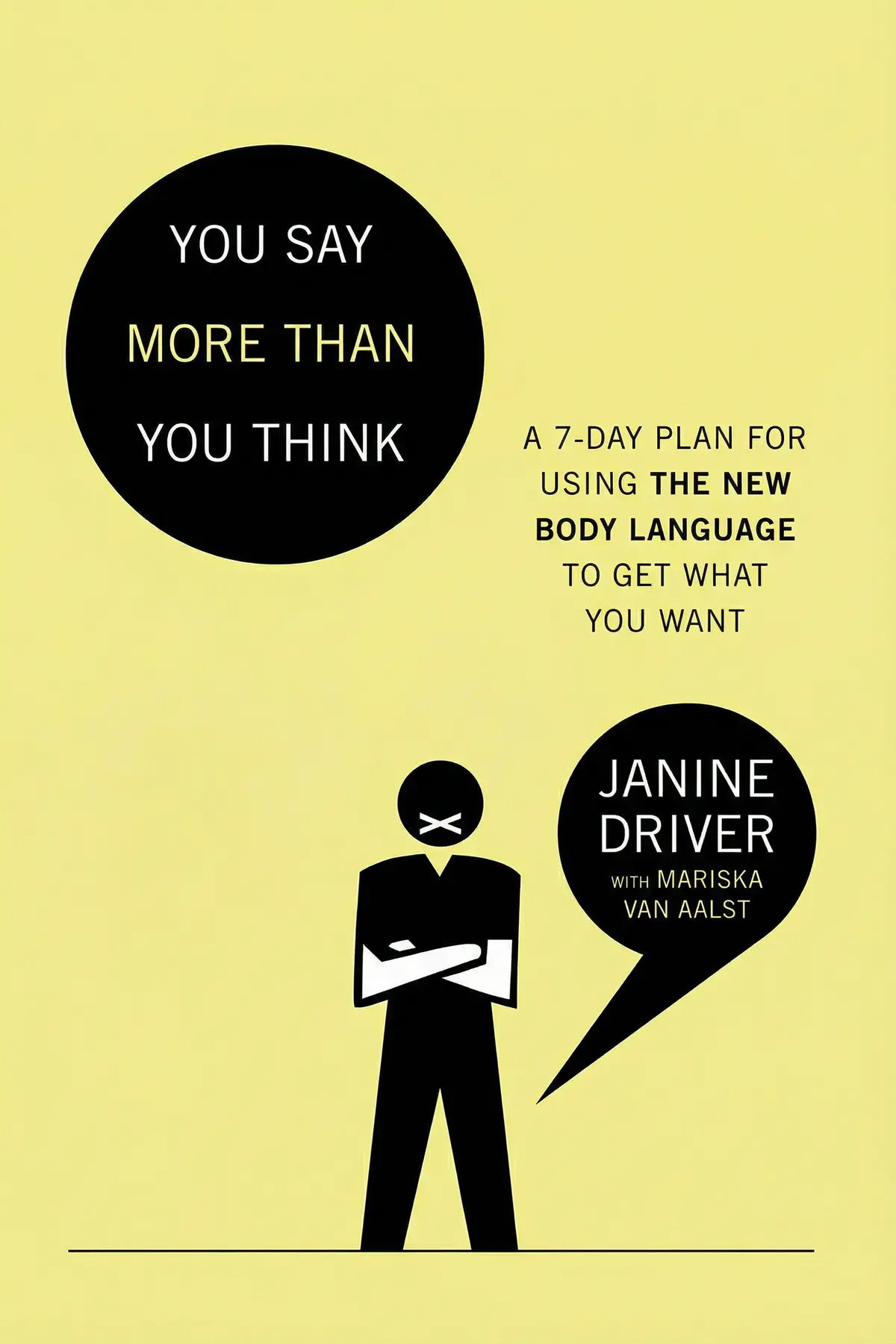
Table of Content
1. Introduction
1 min 05 sec
Most people sense that a conversation is going wrong long before anyone says so, yet few can name the signal or answer it on purpose. In You Say More Than You Think, body language trainer Janine Driver and writer Mariska van Aalst argue that one of the clearest signals sits in plain sight: the direction of a person’s belly button shows where their attention really is. Driver spent more than ten years at the Bureau of Alcohol, Tobacco, Firearms and Explosives teaching officers to separate truth from lies, and the book turns that training into a plan built around seven days, though the steps work at any pace.
The throughline is simple. Confidence, in reading others and in showing yourself, does not come from memorized poses but from context: knowing what is normal for someone, noticing when it changes, and adjusting your own body in reply. By the end you will have a handful of signals to watch in your next meeting, date or family argument, and a few small moves that change how people respond to you.
2. Real confidence starts with reading the room
2 min 07 sec
Firm handshakes, steady eye contact and constant smiles are the standard advice for looking confident. Driver thinks most of it backfires, and her alternative begins with a simple question about an executive’s sore back.
3. Learn someone's normal before you judge a change
2 min 07 sec
A colleague goes silent when one topic comes up. Is it guilt, or just who they are? An ATF investigator’s routine inspection shows why the answer depends on something most people never stop to observe.
4. Follow the belly button to find real interest
2 min 04 sec
Someone can smile at you, nod and still be halfway out the door. One part of the body rarely gets managed, and Bill Clinton used it to make strangers feel singled out in seconds.
5. Stand so your presence speaks first
2 min 10 sec
Hands clasped politely in front of you can look professional. Driver reads that familiar pose very differently, and she offers a stance that changes how a room sees you before you say a word.
6. Catch the four expressions people try to hide
1 min 57 sec
A smile during crime scene photos. A nose that wrinkles while someone agrees with you. Some feelings leak out in a fraction of a second, and when spouses often show one of them, the chance of divorce rises sharply.
7. Answer a hidden feeling without starting a fight
1 min 54 sec
When you catch a flash of anger or contempt, the instinct is to call it out. Driver suggests something calmer, including a three-step move in which the most useful part is saying nothing at all.
8. Conclusion
1 min 06 sec
The case Driver and van Aalst make is that the confidence people try to copy from checklists is really a by-product of attention. Watch someone long enough to know their normal, and the important moments announce themselves: the torso that swings toward the exit, the hand that rises to the throat, the smirk that lasts a fraction of a second. Answer those moments with your own body, and people feel understood without knowing why.
The habits worth starting are small. Before your next difficult meeting, spend a few minutes learning one person’s baseline while the talk is still easy. When someone speaks to you, turn your belly button toward them, as Clinton did in every receiving line. Plant your feet shoulder width apart instead of folding your hands in front of you. And when anger flickers across a face, ask your question, then wait.
Neal Earl found hundreds of pounds of explosives by noticing a calm man stop being calm. That is the whole skill in one picture: know the normal, and the change will show you where to look.
About this book
What is this book about?
Most advice on body language reads like a rulebook: crossed arms mean defensive, a firm handshake means power, eye contact always wins. Janine Driver, who spent more than ten years training law enforcement officers to tell truth from lies, argues that rules like these mislead people. The same gesture can mean different things, and only context tells you which. With writer Mariska van Aalst, Driver builds a method on a simple formula: accuracy plus application equals attitude. First you learn a person's baseline, so you can see when their behavior shifts. Then you read the signals that are hard to fake, such as which way someone's belly button points, which of three power zones they protect, and four fleeting facial expressions that betray hidden pleasure, anger, disgust and contempt. The book is set out as a seven-day plan, but its steps work at any pace. Readers get concrete moves for meetings, negotiations, dates and family talks, from how to stand before a presentation to what to say, and when to stay silent, when a flash of anger crosses someone's face.
Book Information
Who it's for
Presenters, negotiators and sellers
Professionals who present, negotiate or sell and want to read the room as it shifts.
Leaders sensing unspoken pushback
Managers and team leads who sense hidden resistance in meetings but cannot name it.
Wanting natural social confidence
Anyone who feels awkward in social settings and wants confidence that does not rely on rehearsed poses.
About the Author
Janine Driver
Janine Driver is a New York Times bestselling author and speaker who teaches people to read body language and spot deception. She spent more than a decade at the Bureau of Alcohol, Tobacco, Firearms and Explosives training thousands of law enforcement officers, and she founded and leads the Body Language Institute in Washington, DC. She has appeared on the Today Show, Good Morning America and CNN. Mariska van Aalst is a researcher and writer who also coauthored Master Your Metabolism with Jillian Michaels.
Ratings & Reviews
Ratings at a glance
What people think
Listeners find the writing thoroughly documented and simple to follow, with one review highlighting that it is packed with practical tips that can be applied right away. Furthermore, they appreciate its focus on essential body language and how it helps refine interpersonal skills, particularly in social environments. Listeners also value the humor found throughout the book and feel it is well worth the price.
Top reviews
Sebastian
Driver’s background in federal law enforcement adds a level of credibility you don’t usually find in these types of books. I loved how she explains the 'belly button rule' for showing interest because it’s a simple trick I could use at work immediately. While her tone is incredibly high-energy—bordering on a sales pitch at times—the practical value is undeniably there for anyone looking to sharpen their social skills. Some of the humor is a bit corny, but it keeps the heavier research from feeling like a dry textbook. If you can ignore the constant self-promotion, the core strategies for projecting confidence are actually quite brilliant. It’s worth the price just for the insights on how to avoid looking vulnerable in high-stakes meetings.
Show moreRotjanee
Picked this up on a whim and ended up fascinated by how law enforcement tactics can apply to everyday life. Janine Driver has a very unique, humorous voice that makes learning about psychology feel like a fun conversation rather than a lecture. I’ve read a lot of books on communication, and this is easily one of the most practical ones I’ve encountered lately. The tips on projecting a specific persona through posture and movement are incredibly helpful for job interviews or networking events. While some of the '7-day journey' exercises are a bit over-the-top, the core message about self-confidence being the foundation of success really resonated with me. This is definitely a book I’ll be keeping on my shelf for future reference.
Show moreAkira
Finally got around to reading this, and while it's definitely 'self-helpy,' the humor made it a breeze to get through. I’m excited to see if some of these strategies work in my next big presentation at work! The author’s energy is infectious, and she does a great job of breaking down complex psychological concepts into bite-sized, practical tips. I especially appreciated the breakdown of how we subconsciously broadcast our insecurities through small movements. Even if you only take away two or three of the 'power moves,' the book pays for itself in the boost of confidence it provides. It’s an engaging, fun, and ultimately very useful guide to understanding the silent messages we all send every day.
Show moreMeen
Ever wonder why your conversations feel flat even when you’re saying all the right words? This book dives deep into the non-verbal cues that actually dictate how people perceive us. I found the sections on foot direction and torso positioning to be eye-opening, especially for social situations where I usually feel awkward. However, I have to mention that the companion website mentioned throughout the text seems to have expired, which is a bit of a letdown. It feels like a sign of bad faith when an author pushes a digital resource that no longer exists. Still, the physical content is easy to read and full of actionable advice that I’ve already started using in my daily interactions.
Show moreKob
After hearing so much about non-verbal cues, I decided to give this a shot to boost my social game. The book is written in a very punchy, accessible style that makes it easy to breeze through in a weekend. I particularly liked the advice about not covering your neck or face with your hands, as it really does make a difference in how confident you appear to others. There is a slight 'self-helpy' vibe that might turn some people off, but the research feels grounded in real-world experience. Some of the interrogation examples felt a bit extreme for my everyday office life, but the underlying principles are sound. It's a solid 4-star read for anyone looking to improve their interpersonal communication.
Show morePla
Not what I expected from a body language guide, yet I still found myself taking notes on almost every page. The writing style is very casual—sometimes a bit too casual—but the content is undeniably effective for improving social skills. I was frustrated by the dead links to the companion website, which felt like a major oversight by the publisher. However, the book itself is full of practical tips that you can apply the moment you put it down. Whether it’s learning to keep your hands out of your pockets or understanding how to point your torso toward someone to show engagement, the advice is solid. It’s a great resource for anyone who feels like they’re missing the 'hidden' part of human communication.
Show moreSomsak
The 7-day plan sounded great on paper, but the reality of the execution was a bit of a chaotic mess. I was genuinely confused when the very first day kicked off with a story about a serial killer and then immediately pivoted to 'go skydiving' as an exercise. It felt like the author was trying way too hard to push me out of my comfort zone without explaining how it actually helps me read a room. I eventually stopped trying to follow the schedule and just flipped through to find the actual tips on non-verbal cues. There is some solid research hidden in here, but you have to dig through a lot of fluff and weird pacing to find it. It's okay, but Joe Navarro covers similar ground with much more depth.
Show moreSiriporn
Truth is, I found the constant focus on manipulation a little off-putting. The book seems geared toward using body language to 'win' interactions or get people to confess things, which doesn't really apply to my life as a happy person in a stable relationship. A lot of the dating examples felt irrelevant to me, and I wish there had been more focus on building genuine connections rather than just reading others' secrets. That being said, the information on how feet and belly buttons indicate true interest was actually quite useful. It’s a well-researched book with plenty of humor, but it just wasn't as helpful for my specific needs as I had hoped. It’s a decent middle-of-the-road guide for social beginners.
Show moreVarinee
To be fair, there are some decent takeaways buried here, but the logical inconsistencies kept pulling me out of the experience. The author spends the first half of the book warning readers not to judge individual gestures because context is everything. Then, she spends the second half teaching us specific 'power moves' as if they have universal meanings! You simply cannot have it both ways if you want to be taken seriously as a researcher. It felt like a collection of body language myths mixed with some genuinely new thinking, which is a dangerous combination for a novice. I also found the focus on manipulating others to get what you want to be a bit distasteful. I'd recommend 'What Every Body is Saying' instead.
Show moreRoongsak
This felt less like a book and more like a 200-page brochure for the author's consulting firm. I was looking for deep psychological insights, but instead, I got a disjointed jumble of content that felt like a constant sales pitch for her private business. Also, can we please stop using the phrase 'naughty bits' when referring to the pelvic region? It’s not professional, it’s not endearing, and it makes the entire reading experience feel incredibly awkward. Between the cringey terminology and the blatant self-promotion, it was hard to take any of the actual advice seriously. I’m surprised a singing hologram of the author didn't jump out at the end to sell me a timeshare. Save your money and find a more academic source.
Show moreQuestions about this book
What is the main idea of You Say More Than You Think?
Janine Driver and Mariska van Aalst argue that body language cannot be read from fixed rules, because the same gesture means different things in different contexts. Their formula is accuracy plus application equals attitude: read signals against a person’s normal behavior, adjust your own body in response, and genuine confidence follows. The book is organized as a seven-day plan, though the steps can be taken at any pace.
What is the Belly Button Rule?
The Belly Button Rule says the direction of someone’s torso shows where their real attention and interest lie, even when their face and words say otherwise. Bill Clinton faced each person in a receiving line squarely, which made people feel valued. In meetings, torsos can reveal who holds influence, and on dates, a torso pointed away suggests someone wants to leave.
What are the Dangerous Four micro-expressions?
They are four facial flashes lasting a fraction of a second. Psychopathic happiness is an out-of-place smirk that can signal pleasure in deceiving. Fleeting anger shows in drawn brows and a tight jaw. Disguised disgust wrinkles the nose and lifts the upper lip. Killer contempt is a one-sided smirk of superiority, which the authors link through research to a higher risk of divorce.
How can I use body language to look more confident?
Driver recommends a default stance with feet about shoulder width apart and weight balanced, which opens the three power zones: throat, belly button and lower body. Replace protective habits such as the fig leaf, with hands clasped in front of you, and crossed arms. In presentations, keep your chin level and arms relaxed; in sensitive talks, angle your torso slightly to soften your presence.
Who should read You Say More Than You Think?
It suits people whose work depends on reading others, such as managers, salespeople, negotiators and presenters, as well as parents and anyone who feels unsure in social settings. The methods come from Driver’s years training law enforcement officers, and they translate into everyday moves like watching someone’s baseline, turning your torso toward people and using silence after a question.
Readers also enjoyed









AUDIO SUMMARY AVAILABLE
Listen to You Say More Than You Think in 15 minutes
Get the key ideas from You Say More Than You Think by Janine Driver, plus 5,000+ more nonfiction titles.
- 5,000+ titles
- Listen as much as you want
- 7-day free trial
- Cancel anytime









