

59 Seconds: Change Your Life in Under a Minute
Richard Wiseman
 English
Shows how to plan your week and your money around the life you want, then fit work around it, using an even four-way time split, a backwards budget and a realistic target for meaning.
1 min 04 sec
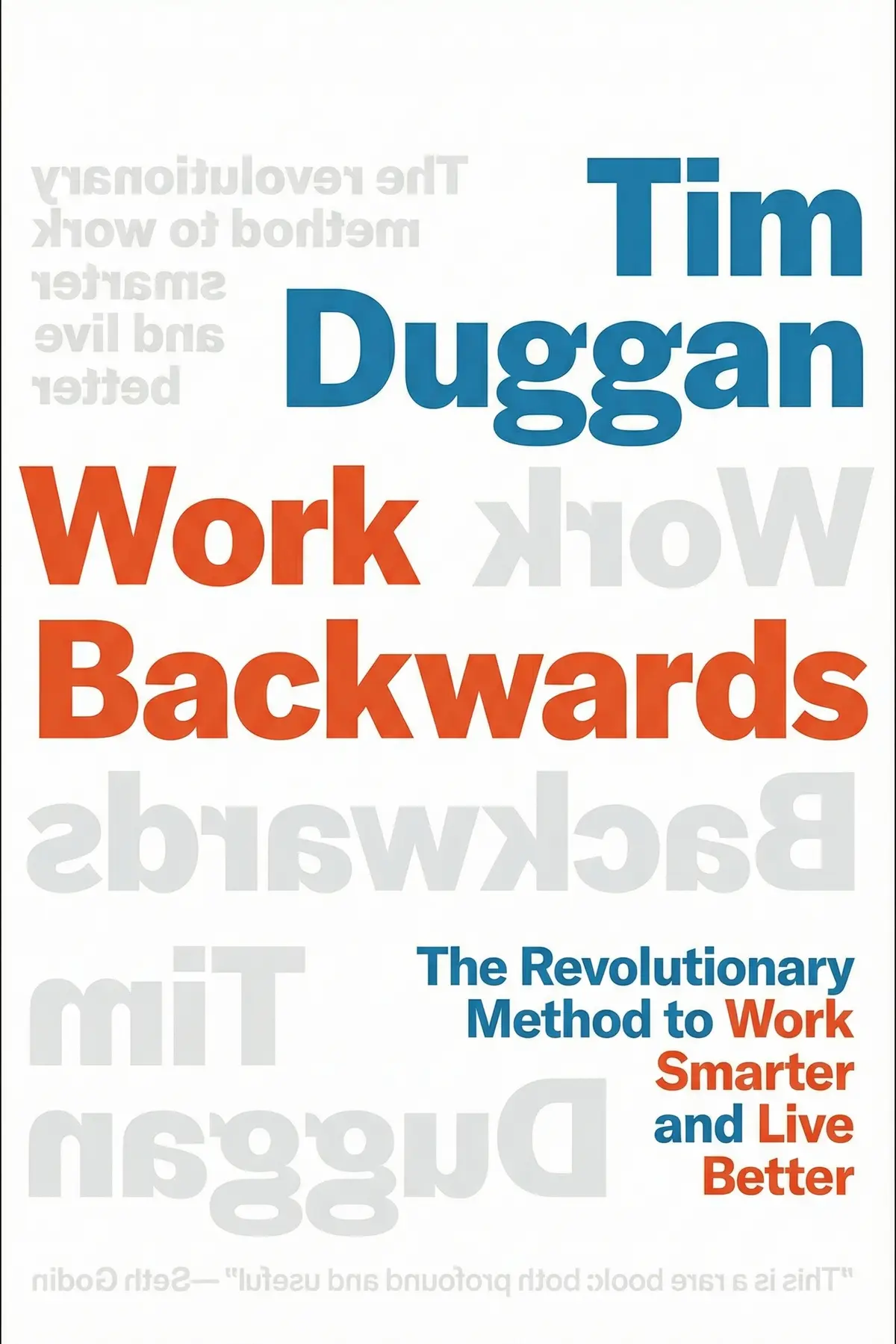
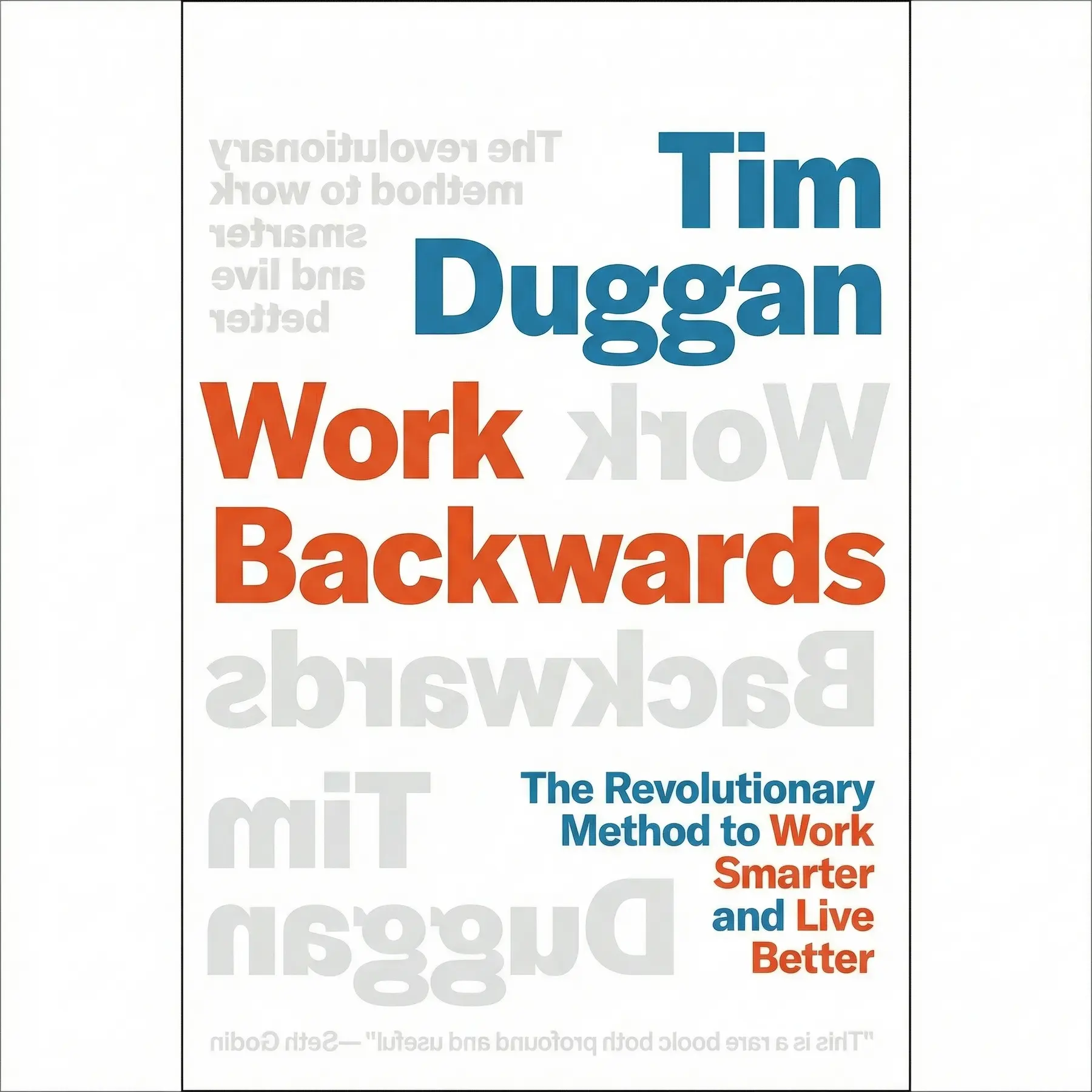
If your week has turned into work with a little life squeezed around the edges, Tim Duggan’s Work Backwards offers a different place to start. The digital media founder argues that you should design your life first and fit work in afterward, and he even puts a number on it: about 28 hours of focused work a week. That figure comes from splitting your waking hours evenly between work, relationships, mind and body.
The stakes are real. A global Gallup study found that work-related stress rose 42 percent between 2009 and 2022, and Japan officially recognizes a word for death by overwork. Duggan’s answer runs through every idea that follows: begin with the life you want, then work out how much time, money and meaning your job actually needs to supply. Along the way you get a weekly time plan, a way to price your ideal life, a modest target for meaning at work and a test for how you handle the line between office and home.
1 min 54 sec
Rising stress, longer hours and a pandemic that reshaped how we see the boundary between office and home all point to the same flaw. Duggan locates it in a phrase almost everyone uses without thinking about it.
2 min 02 sec
Four hours a day with the people you love sounds out of reach for anyone with a job. Duggan’s arithmetic says otherwise, and his trick for finding the time is hiding in ordinary weekends.
1 min 57 sec
Most budgets start with income and end in guilt. Duggan borrows a method from company finance departments and points it at a different question, one whose answer can turn out surprisingly small.
2 min 00 sec
A famous saying promises that the right job will never feel like work. A study of burned-out doctors suggests a far smaller and more reachable target, and it changes what you should ask from your own role.
1 min 48 sec
Some people answer emails over dinner without a second thought, while others feel invaded by a single message after six. Google asked thousands of employees which kind they were, and the split was lopsided.
1 min 13 sec
Most advice about overwork tries to fit life into whatever time the job leaves behind. Work Backwards runs in the opposite direction. Duggan starts with the life worth having, four equal slices of 112 waking hours and a monthly cost you can actually name, and only then asks what work must contribute. Looked at from that end, the demands shrink: roughly 28 hours of focused effort, enough income to cover a priced and buffered life, and about a fifth of your time on tasks that feel meaningful. Past those points, the research he cites suggests, extra hours and extra meaning add little.
The method fits the week ahead. Price your ideal month and set it beside what you earn. Track a week against the four slices and feed the one that is starving, ideally by pairing it with another, the way a run with a friend serves body and friendship together. At work, find the tasks that matter to you and steer a little more time toward them, then decide honestly whether you need a firm border at the end of the day or just a few protected hours.
Work is one slice of the pie. Duggan’s case is that it was never meant to be the whole plate.
Work stress has climbed sharply around the world, and for many people the week has become work with a little life squeezed in at the edges. Tim Duggan argues that the fix starts with the order of planning. Instead of letting the job claim time first, decide what a good life needs and give work only what is left. Duggan divides life into four slices: work, relationships, mind and body. Splitting 112 waking hours evenly gives each one 28 hours, which points to roughly a 32-hour working week. He pairs that time plan with a Backwards Budget that prices the life you want and names the minimum income it needs. He also lowers the bar for meaning at work, drawing on a study of doctors suggesting that about a fifth of time on meaningful tasks protects against burnout. Finally, he shows why knowing whether you separate work from home or blend them should shape your schedule. Readers get a time budget, a money target and a calmer, more realistic view of what a job should give them.
Professionals working 50-hour weeks who feel stress rising and want a concrete plan for fewer, better hours.
People who feel they have failed because their job is not a calling.
Remote workers struggling to stop working at home, and anyone who finds budgets restrictive.
Tim Duggan co-founded several digital media ventures, including Junkee Media, a publisher for Australian audiences later acquired by oOh!media. He started out as a music journalist at Rolling Stone and now chairs the Digital Publishers Alliance, which represents more than 150 independent digital titles. His first book, Cult Status, won the 2021 Australian Business Book Awards prize for entrepreneurship and small business, and his second, Killer Thinking, on creativity, was named among Apple Books' Best Books of 2022. He lives in Mallorca with his husband.
Listeners view the work as a genuine effort to rethink how labor fits into our existence, though views differ on how actionable the suggestions are for those lacking substantial career autonomy. Numerous people enjoy the "IRL exercises" and the transition from "work-life balance" to "life-work balance," a concept highlighting personal health and establishing limits. Furthermore, they find value in the author’s discussion of "job crafting" and the way he redefines productivity based on boundaries instead of grand gestures. They also point to the compelling case studies included, with one listener remarking that the text acts as a crucial nudge that it is a "fallacy to think that a lot of our emotional needs can be fulfilled at work."
What if we stopped treating our careers like a secular religion? This book poses that exact question, and the answers are both challenging and refreshing. Duggan argues that we’ve overloaded our jobs with emotional expectations they simply cannot fulfill, leading to an inevitable sense of moral injury. I loved the deep dive into 'job crafting'—the idea that you can reshape your current role to better align with your values. It’s a smart, sincere attempt to rescue our identity from our paychecks. The case studies provided real-world context that made the abstract theories feel tangible and applicable. Some might find the tone a bit too 'gentle coach,' but I appreciated the sincerity. If you’re tired of answering emails at midnight and feeling like a failure for wanting a life, buy this. It’s a vital reminder that our calendars shouldn't be our masters.
Show moreWow, this was exactly the wake-up call I needed after a decade of chasing a 'calling' that didn't actually exist. I’ve been living the 'learn-earn-burn' cycle for so long that I forgot there were other options. Duggan’s suggestion to run learning and earning in parallel, rather than waiting for retirement to enjoy life, is brilliant. I’m already planning how to implement a mini-sabbatical thanks to the frameworks provided here. The book is part life manual, part toolkit, and entirely inspiring. It’s not just about working smarter; it’s about working differently to ensure your happiness and relationships don’t fall by the wayside. Some of the corporate-speak can be a bit grating, but the heart of the book is in the right place. It’s a refreshing way to examine the component of work in your life and find joy again.
Show moreEver wonder why we wait until we're sixty-five to actually start living? This book challenges that linear trajectory and offers a new way of thinking about our time. I loved the focus on 'job crafting' and the examination of the '3 Cs' in a remote-working world. Tim Duggan has written a guide that feels very 'now,' addressing the transformation of work after the pandemic. It’s about understanding what you value and working backwards from that point. While I agree with other reviewers that it assumes a bit of professional flexibility, the core principles of connection and collaboration are universal. If you want to stop feeling like a hero for being busy, read this. It’s a refreshing, well-intentioned toolkit for anyone looking to reclaim their joy outside of the office.
Show moreTim Duggan has a knack for making you question the grind. While the business world often preaches a 'hustle harder' mentality, this book advocates for the opposite—a total inversion of priorities. I found the shift from 'work-life balance' to 'life-work balance' to be more than just clever wordplay; it’s a necessary psychological pivot that we all need after the chaos of the last few years. By putting life first, the author forces you to define what 'enough' actually looks like before you burn out entirely. The writing is accessible and engaging, though some chapters feel a bit more grounded in the reality of a corporate CBD office than a blue-collar workplace. Still, the core message about setting limits rather than performing heroics is something every modern professional needs to hear. It’s not about doing more; it’s about doing what matters so you can actually enjoy your time off. If you are looking for a refreshing way to examine your life, this is a solid choice.
Show moreFinally got around to reading this, and the exercises alone make it worth the price of admission. Duggan doesn't just theorize; he provides actual tools to help you identify your 'anchors' and rethink your trajectory. I was particularly struck by the discussion on the '3 Cs'—connection, communication, and collaboration—and how remote work has shifted those dynamics. We often think of productivity as a series of heroic acts, but this book reframes it as a set of healthy limits. It’s about creating a sane life by design. Regardless, for anyone feeling overworked and disconnected, this is a solid toolkit for change, especially if you focus on the practical ways to reclaim your time from the ever-expanding demands of the modern office. It is an invitation to stop drifting and start choosing how you spend your energy.
Show moreLook, the concept of 'life-work balance'—putting life first—might sound like a simple semantic shift, but it changed my perspective. Duggan validates the choice to prioritize mental health over an overflowing inbox. While some advice feels tailored for the corporate crowd, there are nuggets of wisdom for everyone. We often take the path of least resistance, and this book offers a way to tackle that tendency. It’s an inspiration for anyone feeling apprehensive about the future of their career. Grab a copy if you’re ready to reset your priorities and create a life full of meaning, satisfaction, and happiness.
Show moreAs someone who lives and dies by their Outlook calendar, the reminder to stop seeking salvation in a schedule hit home. Duggan identifies that we’ve made work a bloated religion, and his attempt to rescue our lives from that trap is sincere and well-timed. The book shines when discussing how work expands to fill time and how we can set boundaries to prevent that. While I did find the author's economics a bit lacking in places, the 'IRL exercises' kept me engaged and made me reflect on my own values. It’s a book you hand to a friend who is answering emails at midnight. It's a smart step toward a sane existence.
Show moreTo be fair, much of the advice here feels like it was written for a very specific subset of society—specifically those with the financial cushion to take a sabbatical. Duggan is a thoughtful writer, and his critique of work as a 'bloated religion' is spot on, but I kept waiting for tips that felt applicable to people who aren't digital entrepreneurs. If you’re pushing paper in a high-rise in Sydney, you’ll find this revolutionary. For those of us in different sectors, it feels like a glimpse into a bubble of privilege. The IRL exercises are a nice touch, especially the ones focused on 'job crafting' to find meaning in the mundane. However, the assumption that we all have the agency to simply 'work backwards' from a dream life is a bit simplistic. It's a pleasant read, but it lacks the grit needed for a broader audience whose realities don’t align with Duggan's assumed baseline.
Show moreThe truth is that Duggan’s exploration of 'productivity as limits' is the book's strongest asset. Most of us are stuck in the trap where work expands to fill every available hour, a phenomenon known as Parkinson’s Law. This book provides a modern suit for those ancient truths, making them feel urgent and applicable to the post-pandemic world. I appreciated the distinction between a job, a career, and a calling, though the advice for those in 'callings' felt a bit underdeveloped. The author’s 'gentle coaching voice' is pleasant, if occasionally a bit too tidy for the mess of real life. It’s a smart read, but it’s best consumed with a grain of salt regarding the statistics mentioned. Still, the core message is sound: stop demanding salvation from your desk. It’s a useful guide for anyone on the verge of a breakdown who needs a push toward sanity.
Show moreHonestly, I went in with high hopes but ended up feeling like this was a manual for the already-comfortable. The author’s suggestions are well-intentioned, yet they frequently overlook the financial realities of most everyday readers. It’s easy to talk about sabbaticals and 'life-work balance' when you have professional flexibility, but what about the person living paycheck to paycheck? I found the tone a bit patronizing at times, as if the solution to burnout is just a few mindset shifts and a new perspective on Parkinson’s Law. While the writing is clean and Duggan seems like a reasonable person, the book operates in a vacuum. It assumes a level of luxury and choice that simply doesn’t exist for many. It’s practical if you’re already in upper management, but otherwise, it’s just another self-help book that misses the mark on accessibility for the average worker.
Show moreDuggan argues that people should plan life first and fit work around it, which he calls life-work balance. He divides life into four slices, work, relationships, mind and body, and suggests giving each about 28 of the 112 waking hours in a week. He adds a Backwards Budget that prices the life you want, a modest target for meaning at work, and a test for how you separate work from home.
About 28 hours of focused work, which Duggan says roughly matches a 32-hour week once breaks are included. The figure comes from splitting 112 waking hours evenly across four parts of life. He supports it with a review of global studies suggesting that 30 to 35 working hours a week is best for well-being, well below the 50-hour weeks many people work.
It is a budget built from the bottom up, like the method some companies use when teams set budgets from real needs. You list the monthly cost of a life that would make you happy and content, across every area of life, and add a buffer. The total is the minimum income you need from your job, side work or investments, which can show you need less work than you assumed.
Not according to Duggan. He separates work into a job, a career and a calling, and rejects the idea that only a calling counts. He points to a 2009 study of doctors published in the Archives of Internal Medicine, in which spending roughly one fifth of working hours on tasks they found meaningful clearly reduced burnout, whereas going beyond that added no further benefit. Leaning slightly toward the parts of work you enjoy is enough.
Segmenters keep a firm line between work and personal life and switch off fully after hours. Integrators let work blend into the rest of the day, answering emails at dinner or during a film. A Google study of 4,000 employees found about two-thirds were integrators and about 31 percent segmenters. Duggan says neither is better, but knowing your style helps you set boundaries, especially when working from home.
Richard Wiseman





Margaret Heffernan

William B. Irvine



AUDIO SUMMARY AVAILABLE
Get the key ideas from Work Backwards by Tim Duggan, plus 5,000+ more nonfiction titles.









