

14 min
Available in: English
Words Can Change Your Brain: 12 Conversation Strategies to Build Trust, Resolve Conflict, and Increase Intimacy
Twelve practical steps for being heard and trusted in conversation. It covers preparing a calm, positive mind, showing warmth through your face and voice, speaking slowly in short turns and listening without interrupting.
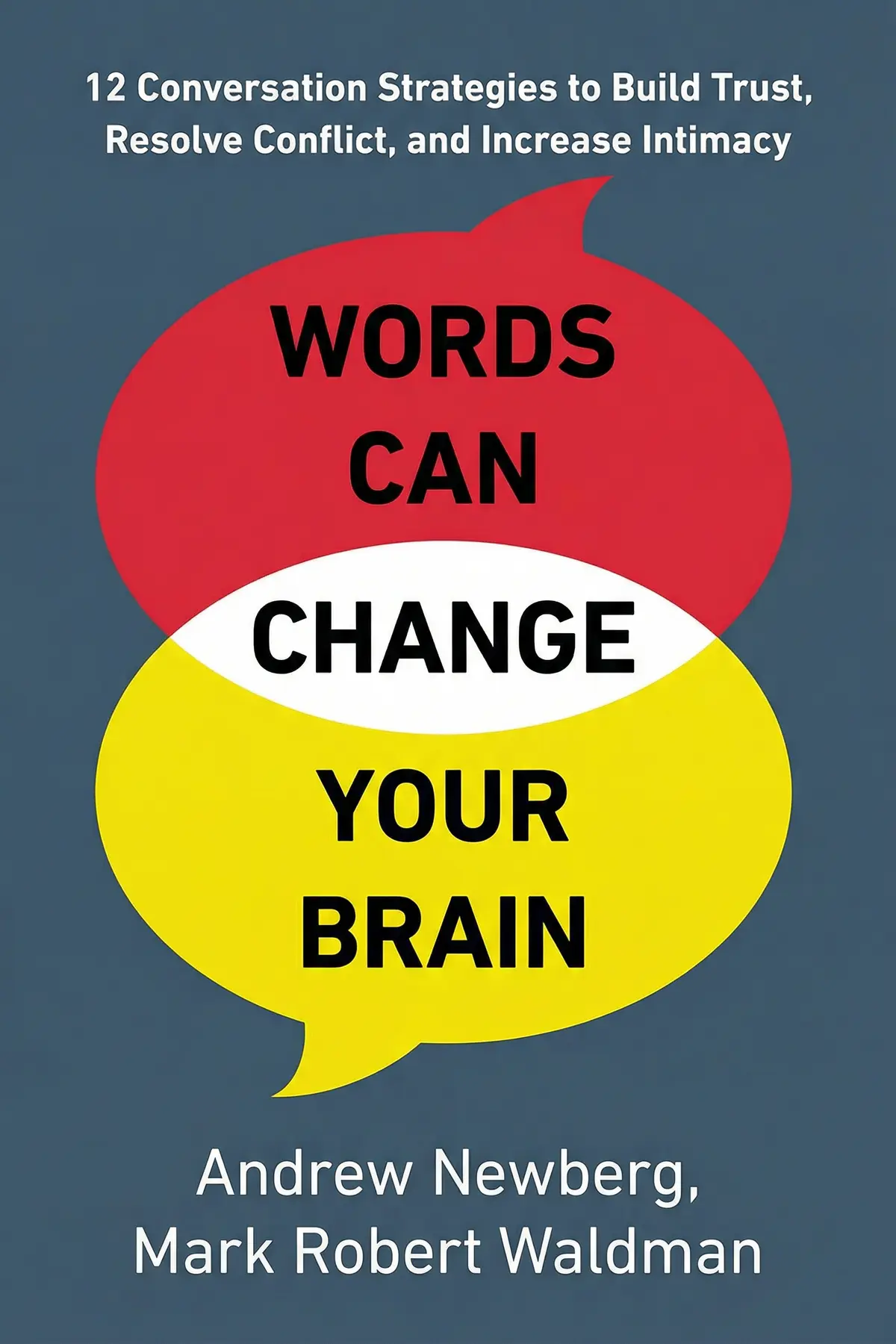
Table of Content
1. Introduction
1 min 08 sec
Most of us talk all day and still get misunderstood. A small shift in someone’s tone or face can turn a calm exchange into a fight. In Words Can Change Your Brain, physician Andrew Newberg and NeuroLeadership teacher Mark Robert Waldman argue that the fix starts before anyone speaks. One minute of slow breathing before a conversation, they report, is enough to activate the brain areas behind mood, social awareness and communication.
Their book sets out 12 steps with one thread running through them. Good communication is trained, first in your own mind and then in your face, your voice and how long you talk. Calm yourself, lean your thoughts toward the positive, know your values, show warmth you really feel, speak slowly and briefly, and listen fully. Do that, and people trust and understand you more. Each step comes with a small exercise, such as a ringing bell, a remembered face or a thirty-second limit, that you can test in your next hard talk.
2. Quiet your mind before you open your mouth
1 min 56 sec
Most people prepare their words for a difficult talk and ignore the state they walk in with. The authors’ fix takes about a minute, and a bell can train the harder part of it.
3. Outweigh every worry with five good thoughts
1 min 56 sec
A single grumble about the weather seems harmless. The authors claim it changes the chemistry of everyone within earshot, and they give a precise ratio for how much positive thinking a conversation needs to succeed.
4. Steer hard conversations with your own values
2 min 02 sec
Two people can talk for an hour and never really reach each other. The authors compare it to driving through a foreign country without a map, and they offer a pen-and-paper exercise that draws one.
5. Wear a face people want to talk to
1 min 57 sec
You probably have no idea what your face is doing when a meeting begins. A famous painting offers the ideal expression, but it cannot be faked, and the authors explain how to produce it honestly.
6. Open people up with praise and a warmer voice
1 min 58 sec
A publisher’s habit of praising him first made one of the authors more open to feedback on his manuscript. Cancer doctors breaking bad news revealed another lever, and it has nothing to do with the words themselves.
7. Get understood in turns of thirty seconds
1 min 54 sec
The brain has a quadrillion connections and still struggles to follow a long explanation. The authors set a hard time limit for speaking, and they explain why answering what was actually said matters so much.
8. Conclusion
1 min 09 sec
What Newberg and Waldman describe is a conversation that begins well before the first word. By the time you speak, your breathing has slowed, your thoughts lean toward the good, your values are clear and a real memory has softened your face. After that, the visible part is almost simple: honest praise, a lower and warmer voice, short turns and full attention to the reply.
The method is tested hardest when someone answers you in anger. Stepping away is best, but when you can’t, the authors suggest thinking about what you value in that person. It brings up real compassion and lets you speak to whatever is causing their anger.
Start small. Breathe for one minute before your next difficult conversation. Find five good thoughts for every worry you have about the other person. Open and close with a compliment you mean, and stop after 30 seconds so they can answer.
None of this asks you to become someone else. It asks you to arrive calm, look kind because you feel kind, and say less than you planned, which leaves the other person room to be heard.
About this book
What is this book about?
We talk to people all day and still misunderstand each other. A tense tone, a frown we never noticed making or a point buried in a long speech can turn an ordinary exchange into a falling-out, at home and at work. Physician and brain researcher Andrew Newberg and NeuroLeadership teacher Mark Robert Waldman treat communication as something you train, the way a runner trains for a marathon. Their 12 steps start inside your own head. Calm the mind with a minute of breathing, quiet its inner chatter, push its thoughts toward the positive and anchor it in your deepest values. Then the steps move outward: a genuine half-smile drawn from a happy memory, awareness of body language, sincere compliments, a warm and lower voice, slow speech, turns of 30 seconds at most, and deep listening. Each step comes with a simple exercise and a study or example from the authors, from Purdue and UCLA research to oncologists breaking bad news. Readers get a toolkit they can try in their very next difficult conversation.
Book Information
Who it's for
Workers facing tense meetings
Professionals whose meetings and feedback sessions keep turning tense or going nowhere.
Partners and parents
Couples and parents who want hard conversations at home to end in understanding.
Team leaders needing trust
Managers and team leads who need people to hear them and trust them.
About the Author
Andrew Newberg
Andrew Newberg is a physician and researcher at Thomas Jefferson University, where he directs research at the Marcus Institute of Integrative Health. He is board certified in internal medicine and nuclear medicine and is regarded as a pioneer of neurotheology. Mark Robert Waldman teaches NeuroLeadership in the Executive MBA program at Loyola Marymount University and has written 14 books. The two have worked together on the study of spirituality and the brain, including How God Changes Your Brain.
Ratings & Reviews
Ratings at a glance

What people think
Listeners find this work highly accessible and appreciate the practical tips it offers for mindfulness and healthy communication. The text is grounded in neuroscience and provides excellent details about brain function, with one listener noting it is backed up by significant research. They feel it is an enjoyable read that is useful for daily living, with one review highlighting how it helps focus on happier things.
Top reviews
Eye
Finally got around to finishing this, and I’m genuinely impressed by how Newberg and Waldman bridge the gap between hard neuroscience and everyday conversation. The central idea is that our choice of words actually shapes our brain's structure, which sounds like sci-fi but is backed by serious research. I particularly loved the '12 strategies' for compassionate communication, especially the advice to speak slowly and keep sentences brief. It sounds simple, but try doing it during a heated argument! Gotta say, focusing on positive language has already shifted the vibe in my household. While some might find the tone a bit repetitive, the practical application is where this book shines. If you want to improve your relationships through mindfulness, this is a must-read.
Show moreJeeranan
This book arrived at the perfect time for me. I’ve been struggling with work stress, and the sections on using personal strengths to make decisions really resonated. It’s one thing to be told to 'be positive,' but seeing the neuroscience behind why a positive attitude opens up the brain’s creative centers is a total game-changer. The 12-step plan is easy to follow and doesn't require a total life overhaul—just small, intentional shifts in how you speak and listen. I’ve been speaking more slowly and pausing to let others respond, and the depth of my conversations has increased significantly. It’s a wonderful blend of science and soul. I can’t recommend it enough for anyone looking to find more peace in their daily interactions.
Show moreKek
As someone who navigates high-stakes meetings daily, I found the section on 'Compassionate Communication' incredibly relevant. The authors suggest that by calming your mind and staying present, you can drastically change the outcome of any interaction. I’ve started using the 'deep listening' techniques they describe—basically pausing more and speaking less—and the results were almost immediate. People seem more relaxed around me. Truth is, much of this feels like active listening repackaged with a brain-scan twist, but the neurological explanation makes it more persuasive. It’s a bit dry in parts, and the writing isn't going to win any literary awards, but the takeaways are gold for professional growth. Definitely worth a look if you’re into personal development.
Show moreDuang
The core premise here—that our word choice physically alters our neural pathways—is absolutely fascinating. I appreciated how the book breaks down complex brain functions into digestible bits for the average reader. One of my favorite parts was the focus on using happy memories to generate an inviting facial expression; it’s a small trick that makes a huge difference in how others perceive you. Not gonna lie, the book is a bit heavy on the 'sales pitch' for the first two chapters, which felt unnecessary. However, once you get into the actual 12 steps, it becomes a very useful manual for better living. It reminds us that being kind isn't just a moral choice, but a biological benefit. A very solid 4-star read.
Show moreSam
Ever wonder why you feel instantly defensive when someone uses certain 'trigger' words? This book explains the 'why' behind that reaction and offers a way out through mindfulness. I found the 12-step framework for communication very helpful, particularly the emphasis on affirming others with genuine compliments. It’s not just about being 'nice'—it’s about creating a brain-to-brain connection that fosters trust. I did feel that some of the 'new' concepts were just meditation and progressive relaxation with different names, but the neurological context added a layer of depth I hadn't considered before. I marked several pages regarding values reflection to share with my colleagues. It’s a practical, insightful guide that serves as a great reminder to slow down and listen.
Show moreOwen
Look, I’ll be the first to admit that 'compassionate communication' sounded a bit too touchy-feely for me at first. But after reading the data on how speaking slowly and warmly affects the listener’s frontal lobe, I’m a believer. The authors provide a very clear roadmap: calm your mind, stay positive, and listen intently. It’s simple, yet we so rarely do it. I’ve been practicing the 'speak briefly' rule in my emails and phone calls, and it’s a game-changer. My only complaint is that the book is quite repetitive and drags in the middle. They could have cut about 50 pages and lost none of the impact. Still, the core message is vital for anyone looking to reduce stress in their life.
Show moreWacharapol
Gotta say, the practical exercises in the middle of the book are where the real value lies. I loved the idea that the meaning of communication is the connection itself, not just the exchange of information. We often listen just to reply, but this book challenges you to listen to understand, which is much harder than it sounds. The 12 steps provided a structured way to practice this every day. I especially liked the part about using a warm tone to keep the other person's brain from going into 'fight or flight' mode. While the writing style is a bit academic and dry at times, the information is easily applicable to real life. I’ve already noticed my conversations feeling more meaningful and less rushed.
Show moreDarawan
After hearing about Newberg’s work on a podcast, I was eager to see the data behind his claims. The neurological insights are top-notch, and the connection between speech and brain health is compelling. However, the book feels padded. Much of the advice—like active listening and pausing before you speak—is standard communication theory that’s been around for decades. Frankly, I was hoping for more 'new' neuroscience and less 'repackaged' self-help. It’s not a bad read by any means, and the section on reflecting on personal values was actually quite profound. But if you’ve already read much on mindfulness or communication, you might find yourself skimming large sections. It's a decent primer, just not groundbreaking.
Show morePita
Frankly, this book could have been a long-form article and been just as effective. The authors spend an enormous amount of time in the beginning trying to convince you that their method works, which felt like a bit of a slog. Once you get to the actual strategies, like speaking in short sentences and using positive imagery, the book picks up. It’s definitely backed by research, which I appreciate, but the '12 steps' feel a bit like a collection of existing mindfulness techniques. I did find the bit about how negative words affect the brain's ability to process logic quite eye-opening. It’s a helpful book if you can get past the repetitive nature of the prose. Good information, just a bit bloated.
Show moreHenry
Not what I expected, given the high praise I'd seen online. While the initial concept is intriguing, I felt like I was being sold a product for the first fifty pages. To be fair, the research on how negative words trigger the amygdala is interesting, but then the author starts discussing microexpressions. Look, that’s clearly Paul Eckman’s territory from 'Telling Lies,' and it felt a bit like they were claiming his research as their own. My biggest gripe is the suggestion that we should avoid almost all negative vernacular to protect the listener’s brain. How are we supposed to offer constructive criticism or solve real-world problems? It feels a bit too 'toxic positivity' for me. The book could have been a pamphlet.
Show moreQuestions about this book
What is the main idea of Words Can Change Your Brain?
Andrew Newberg and Mark Robert Waldman argue that good communication is a trained skill. Their 12 steps start by preparing your mind: calming it, staying present, quieting inner chatter, thinking positively and reflecting on your values. They then move outward to a genuine expression, awareness of body language, sincere compliments, a warm tone, speaking slowly and briefly, and listening deeply.
How long should you talk before pausing, according to the book?
The authors set a limit of 30 seconds at most. They note that the brain can hold only about four bits of information at once, so long speeches overload listeners. Pause after each new piece of information so the other person can process it or ask a question. If you truly need to speak longer, tell them first so they know to pay closer attention.
What is the positivity ratio mentioned in the book?
Citing psychologist Barbara Fredrickson, the authors argue that a conversation is unlikely to go well unless you can keep three positive thoughts about the other person for each negative one, at minimum. For the best possible outcome, they suggest five positive thoughts for each negative. If you are in too bad a mood to find any, they recommend postponing the conversation.
How can I apply the book's ideas to an angry conversation?
The authors say taking a break is ideal when someone reacts with anger, but it isn’t always possible. Instead, think about what you value in that person. This helps you find genuine compassion and respond to the source of their anger. Keeping your tone warm, speaking slowly and listening without interrupting also support a calmer exchange.
Readers also enjoyed









AUDIO SUMMARY AVAILABLE
Listen to Words Can Change Your Brain in 15 minutes
Get the key ideas from Words Can Change Your Brain by Andrew Newberg, plus 5,000+ more nonfiction titles.
- 5,000+ titles
- Listen as much as you want
- 7-day free trial
- Cancel anytime









