

11 min 57 sec
Available in: English
Winning at Sales: How to Get So Good People Say "Thank You" for Letting Them Buy
A practical guide to selling with conviction instead of nerves. It shows how to earn trust, turn price objections into a talk about the cost of waiting, and stay firm without becoming pushy.
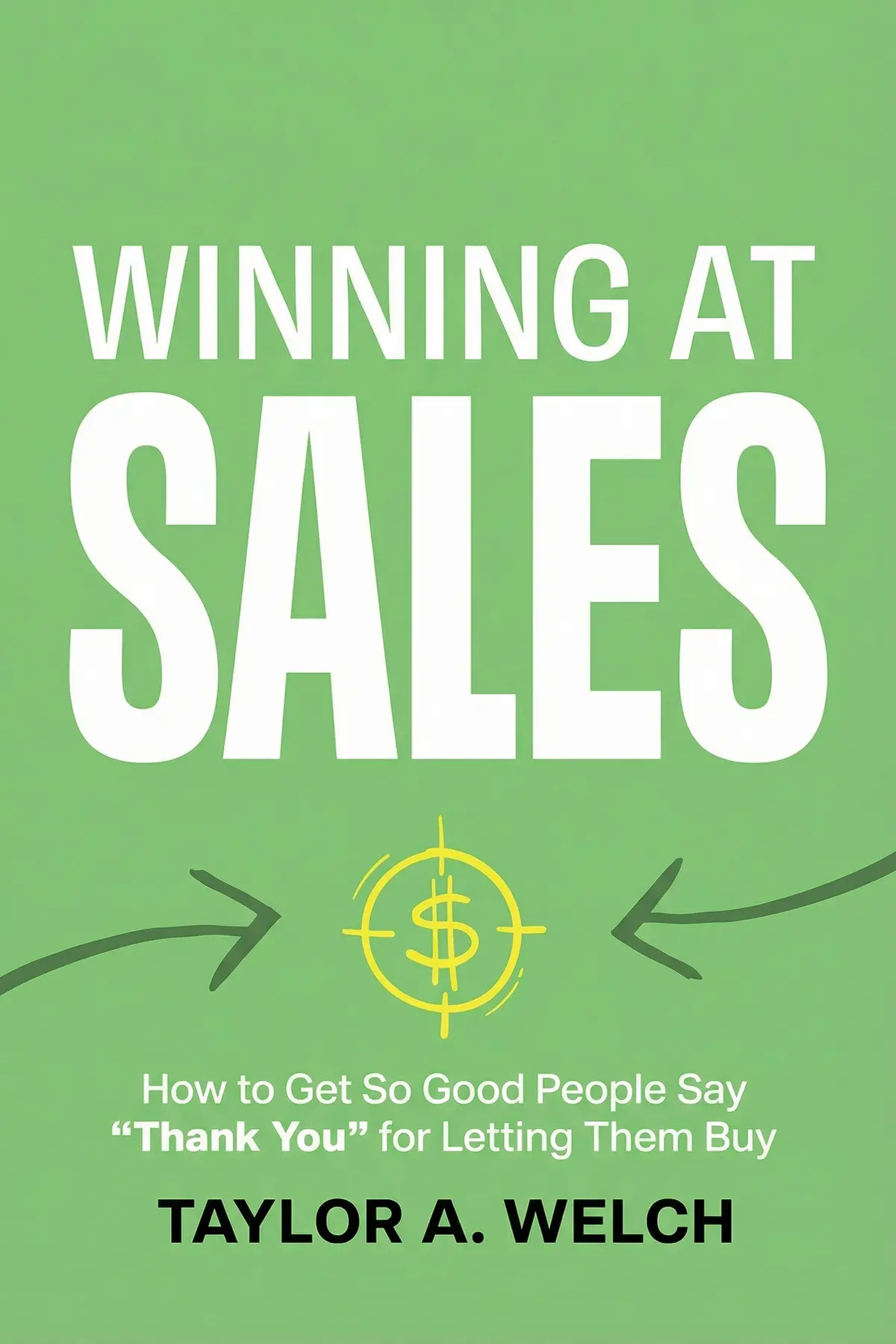
Table of Content
1. Introduction
58 sec
Many people who sell for a living treat each call as a contest they might lose, and buyers feel that tension before a word is said. In Winning at Sales, consultant Taylor A. Welch argues that the fix starts inside the seller: prospects trust an offer only as much as the seller visibly trusts it.
From there, his method is about guidance more than persuasion. Win a buyer’s trust, point out how far their present situation sits from the one they desire, then care enough to nudge them, gently but firmly, beyond the fear that holds them in place. People end up grateful for a sale when the seller believes, listens and leads.
Along the way you will meet a prisoner of war whose golf game improved during years in a tiny cage, a single mother deciding whether to bet on her business, and a simple scale for checking whether your firmness has tipped into pushiness.
2. Let your belief in the offer persuade
1 min 34 sec
Two sellers can say exactly the same words and get opposite reactions. Welch traces the difference to something buyers read long before they weigh any feature, and to one question worth asking before every call.
3. Rehearse success in your head before the call
1 min 42 sec
A soldier held for years in a space too small to stand up in came out and played better golf than ever. Welch argues the same hidden practice can steady a seller through weeks of rejection.
4. Turn price objections into the cost of waiting
1 min 38 sec
When a buyer says it costs too much, most sellers start defending the number. Welch thinks the number is rarely the real issue, and that the more honest conversation is about a cost nobody has added up.
5. Earn trust first, then guide the climb
1 min 32 sec
A struggling entrepreneur on a sales call was hesitating to invest in her own business, unsure she could succeed. What changed her mind was not a better argument, and Welch turns what happened into a map any seller can draw.
6. Push past fear without turning pushy
1 min 47 sec
Too soft and the buyer stays stuck; too hard and they feel bullied. Welch draws a simple scale between those two failures and shows where a seller who cares should stand.
7. Make your script automatic so you can listen
1 min 40 sec
Most sellers spend part of every call thinking about their next sentence, and the buyer notices. Welch’s fix sounds rigid at first, yet it is what frees a seller to sound human.
8. Conclusion
1 min 06 sec
Welch’s subtitle promises buyers who say thank you, and the argument behind it is that gratitude follows guidance. People thank a seller who believed in the offer, understood their fear, showed them what waiting was costing and held steady while they decided. Pressure alone earns resentment, and politeness alone leaves people stuck where they started. The work sits between the two, close to what a good mountain guide does.
The book supports a few things to try this week. Before your next call, ask whether your energy shows real belief in what you sell, and if it does not, fix that first. When someone says the price is too high, turn the talk to the monthly cost of leaving the problem unsolved, and listen for the fear underneath. Keep a recording of your best call for the days when rejections pile up. And practice your script until you can forget it, so your attention goes to the person instead of your next line.
Nesmith did not touch a real club for seven years and still played better than ever. Preparation done in your head counts.
About this book
What is this book about?
Plenty of people who sell for a living know their product and their pitch, yet still watch interested buyers drift away. Taylor A. Welch argues that the problem often starts with the seller. Prospects sense doubt before they hear the details, and they hesitate when a seller's energy does not match the words. Welch recasts selling as guidance. The seller has faith in the offer, gains what he calls moral authority through careful listening and ethical conduct, and then helps the buyer notice how far their current situation is from the one they desire. Price objections, in his view, usually hide fear, so the real work is showing what delay is costing. To push without bullying, he offers a scale running from passive weakness to domineering behavior, and he backs it with mental rehearsal, practiced scripts and steady, clean energy. Readers get a set of habits to use on the next call: questions to ask themselves, a way to handle hesitation, and a picture of the kind of seller buyers are glad to have met.
Book Information
Who it's for
Selling their own offers
Coaches, consultants and founders who sell their own offers and freeze when buyers hesitate.
New to sales
New salespeople who feel pushy when they ask for the sale, or too soft to close.
Worn down by rejection
Sellers worn down by rejection who want steadier energy and a repeatable call routine.
About the Author
Taylor A. Welch
Taylor A. Welch is a consultant in the online training and education industry. He founded The Wealthy Consultant, which helps coaches, trainers and educators grow their businesses without sacrificing their wellbeing and happiness. Through Welch Equities he runs a portfolio of education brands. He also wrote the best-selling book The Wealthy Consultant, about building businesses that last and make a difference.
Ratings & Reviews
Ratings at a glance

What people think
Listeners find the book very accessible, with one noting it's a must-read for the modern era. They also value the text's deep insights, as one listener highlights its excellent explanations of psychology. Furthermore, the content is well-regarded for its sales techniques, with one listener specifically praising its amazing frameworks and strategies.
Top reviews
Noi
This book is a masterclass in shifting your perspective from "selling at" people to "serving for" people. Taylor Welch manages to strip away the typical grease of sales culture and replaces it with actual psychology that works in the modern era. I found the section on the 'underside of the iceberg' to be incredibly enlightening because most training just focuses on the surface-level scripts. Truth is, those scripts fail if your inner game is off. It’s a quick read but dense with wisdom, making it perfect for anyone who hates the feeling of being a "salesperson." You get actionable frameworks without the usual fluff found in business books.
Show moreMats
Picked this up after seeing a few colleagues mention the concept of "Dark Energy" versus "Clean Energy." I’ve spent a decade in high-ticket sales, yet this book challenged several deeply ingrained habits I didn't even know I had. The breakdown of the inferior and superior frames is probably the most useful tactical advice I've received all year. It helps you navigate those awkward power dynamics that often kill a deal before it even starts. Frankly, the bonus materials included with the purchase are worth ten times the price of the book itself. My only complaint is that I wish I had this five years ago.
Show moreAmy
Ever wonder why some closers seem to glide through objections while others are constantly fighting an uphill battle? This book explains that it isn't about the words you say, but the energy and frame you bring to the conversation. Taylor Welch does a brilliant job of explaining how to guide a prospect through fear-based thinking using specific psychological anchors. It’s heart-centered, which is refreshing in an industry often dominated by "alpha" personalities that just want to crush the competition. This feels more like a guide to human connection than a manual for manipulation. I’ve already recommended it to my entire remote closing team.
Show moreSayan
Not what I expected, but exactly what I needed to get out of my recent sales slump. Most gurus focus on the "how," but Taylor spends significant time on the "why" and the "who" behind the salesperson. The writing style is punchy, direct, and avoids the usual bloat that makes business books a chore to finish. You can tell this comes from actual experience in the trenches rather than some theoretical ivory tower. It’s a 5/5 for me because it treats the reader like an intelligent professional. If you want to stop looking like a desperate salesperson, just buy it.
Show moreMoo
The chapter on Moral Authority changed the way I look at my leads and my responsibility to them. For years, I thought sales was about convincing people, but Taylor shows how it’s actually about leading them to make a decision for their own benefit. Look, there are no shortcuts here, and you’ll have to do the work to internalize these concepts. The book is very readable and can be finished in a weekend, though you'll want to keep it on your desk for reference. It’s a beautiful blend of philosophy and strategy that feels very authentic. This is easily in my top three sales books of all time.
Show moreKamol
Wow, I did not expect to get this much value from a book that costs less than a lunch at Chipotle. The frameworks Taylor provides go way beyond a simple script and enter the realm of genuine human influence and leadership. I’ve been in the game for 15 years, and yet the "underside of the iceberg" analogy gave me a totally new perspective on my failures. To be fair, it’s not a "tactics only" book, so if you’re looking for 50 ways to close a car deal, look elsewhere. This is for professionals who want to build a long-term career based on trust and results.
Show moreEleni
Finally got around to reading this after it sat on my nightstand for a month, and I'm kicking myself for waiting. The way Taylor Welch explains the psychology of fear versus pride in a prospect is simply masterful. It allows you to tailor your approach in real-time without sounding like a robot reading from a teleprompter. In my experience, most sales books are 300 pages of fluff wrapped around one good idea, but this is high-density information from start to finish. The bonuses are genuinely helpful and not just some hidden upsell for a coaching program. This is the new gold standard.
Show moreYothaka
After hearing so much hype about Taylor's approach to "Clean Energy" sales, I had to see if it lived up to the reputation. It does. This isn't just about winning at sales; it's about winning at life by becoming a more influential and grounded person. The writing is clear and the examples are relatable, even if you aren't in a traditional "remote closer" role. I did find one or two sections a bit repetitive, but the core message is so important that the repetition actually helps it stick. It’s a rare book that makes you feel better about your profession while simultaneously making you more profitable.
Show moreBird
While some of the concepts felt a bit high-level for a complete beginner, the actual meat of the strategy is undeniable. I struggled initially with the philosophical tone of the first few chapters because I wanted immediate scripts to close my next lead. However, once I reached the part about Moral Authority, the lightbulb finally clicked on for me. To be fair, Taylor isn't trying to give you a "get rich quick" script; he’s trying to rebuild your entire sales identity from the ground up. It takes some serious reflection to implement, but the results are starting to show in my daily calls. It’s a solid four stars for the depth alone.
Show moreYuwadee
As someone who has always felt a bit "icky" about traditional selling, this book was a breath of fresh air. I finally understand that sales can be a transformative experience for the buyer if you approach it with the right mindset. Personally, I think the discussion on avoiding the "salesperson" persona is worth the entry price alone. Some of the psychological frameworks are quite deep, so you might need to read those sections twice to fully grasp them. My conversion rates have seen a steady climb since I started applying the "inferior frame" logic. It's a must-read for the modern entrepreneur who cares about their reputation.
Show moreQuestions about this book
What central idea does Taylor A. Welch put forward in the book Winning at Sales?
Welch argues that selling works best as guidance. Buyers trust an offer only as much as the seller clearly believes in it, so conviction comes first. The seller then earns trust by listening and acting ethically, helps the buyer see the gap between their current situation and their goals, and applies firm but caring pressure to move them past the fear that keeps them from acting.
How does Winning at Sales suggest handling price objections?
Welch believes price objections usually hide fear of risk, failure or change. Instead of defending the number, he suggests showing the hidden cost of doing nothing: lost income, missed chances and wasted time while the problem grows. He also recommends understanding a prospect’s worries early, so you can guide them through hesitation with empathy before the objection becomes a wall.
What is the buying pocket?
The buying pocket is Welch’s name for the moment when a seller’s energy matches a prospect’s readiness and needs, so urgency and understanding meet. He says you reach it by building trust and making clear why acting matters, which makes the decision feel clear and achievable to the buyer rather than forced on them.
How can I be assertive in sales without being pushy?
Welch pictures aggression as a scale running from passive weakness, where the seller never asks, to abusive, domineering selling. The aim is the firm middle. He calls it tough love: honestly naming what the prospect risks by staying where they are, then pointing them back to what acting would bring, while staying ethical, respectful and ready to ease back when someone hesitates.
Who should read Winning at Sales?
It suits people who sell their own expertise, such as coaches, trainers and consultants, as well as newer salespeople who struggle with nerves or with closing. Its tools are practical habits: asking whether your energy shows belief, rehearsing calls mentally, keeping recordings of strong calls, mapping a buyer’s goal and steps, and drilling scripts until they become automatic.
Readers also enjoyed

AUDIO SUMMARY AVAILABLE
Listen to Winning at Sales in 15 minutes
Get the key ideas from Winning at Sales by Taylor A. Welch, plus 5,000+ more nonfiction titles.
- 5,000+ titles
- Listen as much as you want
- 7-day free trial
- Cancel anytime









