

15 min 25 sec
Available in: English
Win Every Argument: The Art of Debating, Persuading, and Public Speaking
By Mehdi Hasan
Explains why correct facts so often lose debates and how to make them land, using Aristotle's three modes of persuasion, the power of one person's story, and a case for when personal attacks are fair.
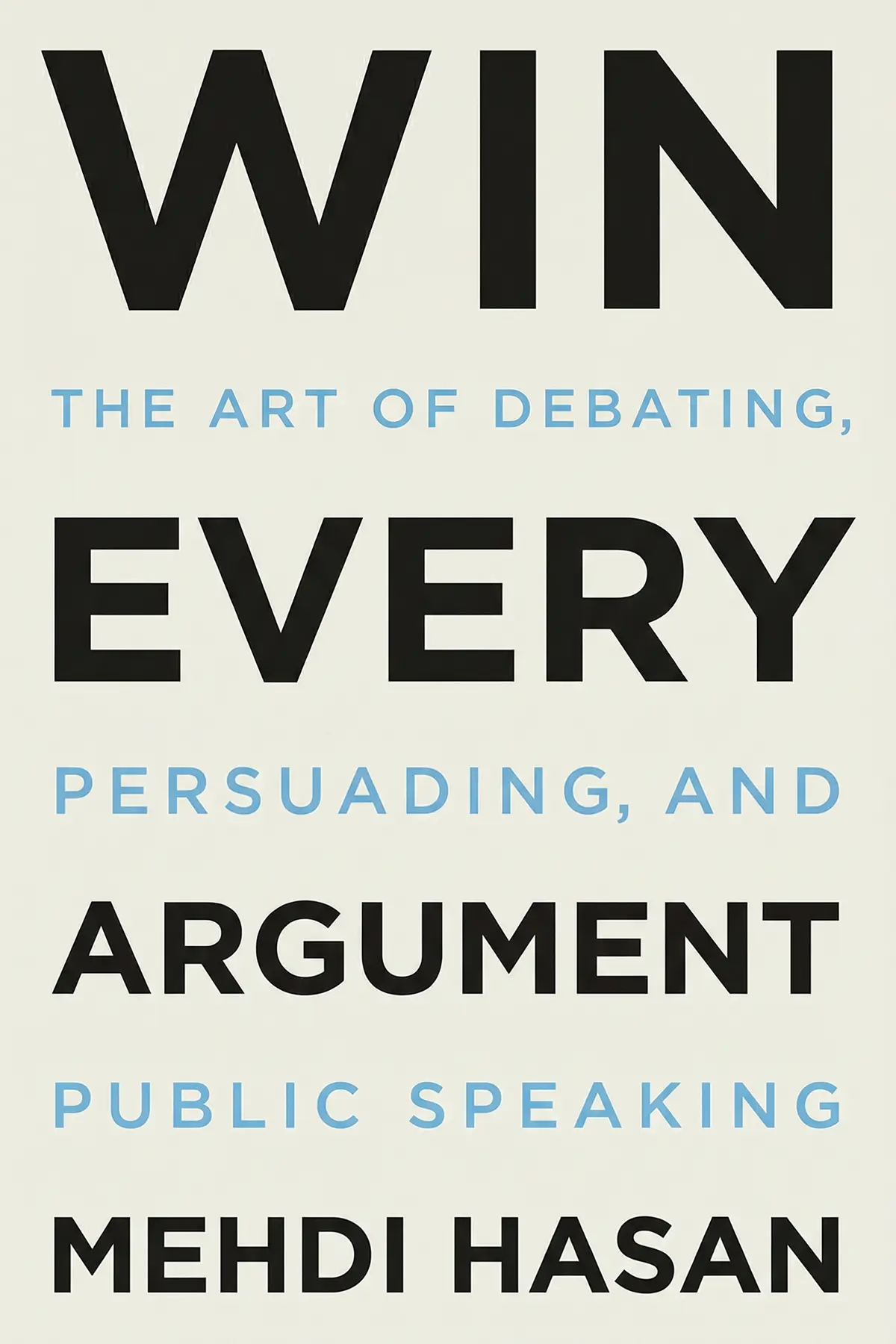
Table of Content
1. Introduction
1 min 02 sec
If you have ever lost an argument you knew you were right about, your facts may not have been the problem. In Win Every Argument, broadcaster Mehdi Hasan, who has questioned presidents, prime ministers and spy chiefs for a living, argues that evidence alone rarely wins, because people decide with their feelings first. Winning, in his view, comes down to persuasion.
That does not make the facts optional. It means they need help to land: a speaker the audience trusts, an emotional connection, a story with a real person in it, and sometimes the nerve to question the credibility of the person on the other side.
Hasan builds that case from Aristotle’s ancient theory of rhetoric, a neuroscientist’s patients who could no longer feel, a study of charity giving and a congressman’s resignation. What follows is a working toolkit for meetings, interviews and debates: how to make a true argument felt, and how to tell when a personal attack is fair.
2. Test your own views by hearing the other side
1 min 56 sec
Most people treat arguments as noise to avoid. A nineteenth-century philosopher suggested something more unsettling about anyone who has only ever heard their own side, and an ancient quarrel shows why persuasion still makes people nervous.
3. Win trust with character, emotion and evidence
2 min 18 sec
A doctor trying to convince a hesitant patient has three very different tools available. Modern debate leans almost entirely on one of them, and that habit may explain why so many airtight cases fail.
4. Win over listeners by reaching their feelings first
2 min 05 sec
Patients who lost the ability to process emotion looked like perfect logical thinkers. What happened to their decisions overturns a common belief about reason, and changes how you should approach any audience you need to convince.
5. Turn dry statistics into one person's story
2 min 18 sec
A figure describing hundreds of millions of hungry people should shock anyone, yet it barely registers. A study of charity donors reveals what does move people to act, and how to use it in any serious discussion.
6. Know when going after the person is fair
2 min 10 sec
Everyone learns that attacking the speaker instead of the argument is a cheap trick. Yet the tactic keeps winning elections, and Hasan believes refusing to use it can hand your opponent an unfair head start.
7. Expose bias and hypocrisy without name-calling
2 min 19 sec
A study funded by oil companies and a congressman who resigned in disgrace both seem irrelevant to the arguments they touch. Hasan explains why they matter anyway, and offers a test for telling scrutiny apart from insult.
8. Conclusion
1 min 17 sec
Hasan’s book rests on an uncomfortable admission: being right is not enough. The person with the better evidence can still lose the room, and the person throwing insults can still win the election. That leaves anyone who cares about truth with a choice. They can complain that audiences are irrational, or they can learn how persuasion really works and put it behind better arguments.
Hasan takes the second path, and his tools come straight from Aristotle. Earn credibility and protect it. Reach people’s feelings, because Damasio’s patients show how hard choosing becomes without them. Carry your numbers inside a story about one person with a name, the way charities turn a single child into a symbol of millions. And when an opponent’s funding, record or double standards bear on whether they deserve belief, say so plainly.
Before your next hard conversation, write out the strongest case against yourself, then find the human story hidden in your best fact. When you hear a personal attack, ask whether it changes how far a claim should be trusted, or only the mood in the room.
Mill’s warning still stands. If you know only your own side, you barely know it.
About this book
What is this book about?
Many people assume the best evidence wins the argument. Mehdi Hasan, a broadcaster who has questioned presidents, prime ministers and spy chiefs, argues that this almost never happens on its own. Audiences are stubborn and emotionally attached to their beliefs, and a logically perfect case can still leave them cold. Hasan builds his alternative from Aristotle's three modes of persuasion: the speaker's character, the audience's emotions and the reasoning itself. He draws on neuroscientist Antonio Damasio's research into patients who lost their emotional processing and found decisions nearly impossible, and on a Wharton study showing that one named victim moves people more than millions of statistical ones. He then makes a provocative case that attacking the messenger is sometimes legitimate, when it exposes a conflict of interest, a double standard or an assault on your own credibility. Readers get a practical way to prepare for meetings, interviews and debates. They learn how to pair evidence with feeling and story, and how to judge when questioning an opponent's character is fair play or just name-calling.
Book Information
Who it's for
Professionals outtalked at work
Professionals whose well-researched proposals keep losing to louder, more emotional colleagues.
Students, debaters and candidates
Students, debaters and job seekers preparing for interviews, panels or public speaking.
Arguing about politics
People who argue about politics and want to know when calling out hypocrisy is fair.
About the Author
Mehdi Hasan
Mehdi Hasan studied at Christ Church, Oxford, and started in television as a researcher and then producer on ITV's Jonathan Dimbleby program. He became editor of news and current affairs at Channel 4 and, in 2009, senior politics editor at the New Statesman. From 2012 he presented UpFront and Head to Head on Al Jazeera English, then hosted The Mehdi Hasan Show on Peacock and MSNBC until November 2023. He now writes a column for The Guardian and launched Zeteo in February 2024. He also co-wrote a biography of former Labour leader Ed Miliband.
Ratings & Reviews
Ratings at a glance
What people think
Listeners find this guide on debating to be both educational and well-crafted, with one noting it provides research techniques that can win debates. The work successfully demonstrates how arguments are won, and listeners appreciate its clear prose as a quick listen. They value the author’s professional expertise and find the book engaging, with one review highlighting its combination of rhetorical history.
Top reviews
Audrey
Aristotle meets MSNBC in this fast-paced guide to rhetoric that covers everything from ancient history to modern-day viral clips. Hasan is a master of the 'rule of three,' and he uses it here to great effect to explain how to structure your thoughts under pressure. I loved the deep dive into ethos, pathos, and logos, as it provided a much-needed theoretical backbone to his very practical tips. Look, the guy is obviously brilliant, even if his confidence borders on arrogance at times. He shares some incredible stories about catching interviewees off guard through sheer preparation. It’s an essential read for anyone who wants to understand how the media landscape really works. You might not agree with his politics, but you can’t argue with his results.
Show moreKanchana
Ever wonder why some people just seem to dominate every conversation? Hasan breaks it down through the lens of a professional interrogator, focusing heavily on the power of intense preparation and research. The chapter on 'the rule of three' alone is worth the price of admission for anyone who does public speaking. I particularly loved the behind-the-scenes look at how he handled high-profile guests like Michael Flynn and John Bolton. It isn't just about being right; it is about having the receipts and knowing exactly when to deploy them. This is a masterclass in modern rhetoric that feels both ancient and incredibly relevant for today’s media landscape. Highly recommended for those who want to level up their communication skills.
Show moreRotjanee
Rarely do I find a book that manages to be this entertaining while teaching actual skills. Mehdi Hasan is a polarizing figure, but you cannot deny his effectiveness in a debate setting. He breaks down the psychology of how people process information, emphasizing that preparation is the ultimate weapon against a liar. I found the anecdotes about catching politicians in their own contradictions to be the highlight of the text. The book moves quickly. It never drags. By the end, you’ll feel like you’ve inherited a secret toolkit for every social interaction you’ll ever have. It’s brilliant, sharp, and incredibly useful. It combines rhetorical history with very modern research techniques that can actually win debates.
Show morePia
Wow, this was exactly what I needed to step up my game during office meetings. Hasan provides a fascinating look at how to structure an argument using the rule of three, which makes even complex ideas feel digestible. I used to think arguing was just about having the best facts, but this book taught me that performance and preparation are just as vital. The writing is punchy and direct. Not gonna lie, I’ve already started practicing his tips on eye contact and posture during my Zoom calls. It’s rare to find a book that is both this entertaining and this practical for a professional setting. Highly recommended for anyone who wants to speak with more authority and win over their audience.
Show moreRung
If you listen to the audio version, you’re in for a treat because Hasan actually includes clips from his famous interviews. Hearing him deploy a zinger in real-time against a defensive politician adds a layer of depth you just won't get from the printed page alone. He focuses on the 'mechanics' of a good performance—everything from how you breathe to how you maintain eye contact under pressure. While some might find his confidence a bit grating, the techniques he teaches are objectively effective. It is much more than a simple guide; it is an exploration of how to command a room. The emphasis on research and structure provides a solid foundation for anyone nervous about public speaking. Just be prepared for some strong political opinions along the way.
Show moreWeera
Picked this up to help with my presentation skills at work, and I walked away with much more than I expected. The book explores the 'rule of three' and other rhetorical devices that help a message stick. However, I did have some reservations about the overall philosophy of winning at all costs. The truth is, sometimes discourse should be about finding a middle ground rather than just crushing an opponent. Hasan is a fierce debater, but his style can feel a bit predatory if applied to every friendship or casual conversation. That said, the section on debunking the 'naked audience' myth was both funny and practical. It’s a solid resource for performance, even if I disagree with the 'winner-takes-all' ethos.
Show moreKanokwan
Most debate books tell you to play fair, but Hasan takes off the gloves in a way that feels refreshing and realistic. His defense of the ad hominem attack is controversial, yet he explains perfectly why questioning someone's character is sometimes a necessary part of a public argument. You have to be able to protect your own credibility while pointing out the flaws in your opponent’s authority. This isn't a dry academic textbook; it's a field manual for the verbal trenches of the 21st century. The writing is snappy, though I could have done with a bit less of the author's self-congratulatory tone. Still, the practical advice on using 'zingers' and keeping your cool is gold. If you want to stop being a doormat in discussions, read this.
Show moreWit
As someone who hates conflict, I found this surprisingly empowering and easy to follow. Hasan goes all the way back to ancient Greece to explain why certain arguments work, yet he keeps the tone modern and accessible. One of my favorite suggestions was to randomly challenge a friend to a friendly argument just to build up your 'debate muscles.' It sounds a bit chaotic, but it actually works for building confidence! The book is a quick read that doesn't get bogged down in too much jargon. I do wish the author spent a little more time on the 'logos' or logical side of things, but he makes a compelling case that emotion and character are what actually move an audience. Truly helpful stuff.
Show moreVilaiporn
To be fair, the title is a bit of a misnomer because this isn't really about logic as much as it is about theater. Hasan is an incredibly talented performer, but his personal political agenda frequently bleeds into the advice, which might alienate readers looking for a neutral guide. I appreciated the sections on ethos and the ancient Greek foundations of debate, yet the 'win at all costs' mentality felt a bit hollow at times. If you want to learn how to crush an opponent in front of an audience, this is perfect. However, if you are looking for a way to have a productive, truth-seeking conversation with a friend, you might find this approach too aggressive. It’s a fast read, but the bias is impossible to ignore.
Show moreStella
The truth is, there is no bigger fan of Mehdi Hasan than the man himself. While the tips on ethos and logos are standard fare, the constant self-promotion becomes a chore to read through after three chapters. He clearly knows his stuff, yet he can't seem to stop reminding us of his own brilliance in every single paragraph. I wanted a guide on logic, but I got a manifesto on his political worldview instead. It’s a shame because the technical advice is buried under layers of unearned arrogance and heavy-handed bias. If you can stomach the ego, there are a few nuggets of wisdom, but there are better books on debate out there that don't feel like an extended MSNBC audition.
Show moreQuestions about this book
What is the main idea of Win Every Argument by Mehdi Hasan?
Hasan argues that winning an argument depends on persuasion, not just on having the right facts. Drawing on Aristotle, he says strong arguments combine the speaker’s credibility, an appeal to emotion and sound reasoning. Facts still matter, but they persuade best when an emotional connection and a good story carry them, and when bad-faith opponents are called out in the right context.
What are ethos, pathos and logos?
They are Aristotle’s three modes of persuasion. Ethos is the speaker’s character and credibility, such as a practicing doctor speaking about vaccines. Pathos is emotion, like the doctor’s story of a healthy couple who refused the vaccine and died within 15 days of each other. Logos is reasoning with evidence, such as studies showing vaccines cut hospitalization and death risk by 90 percent.
Why does Hasan say emotion matters in arguments?
He cites neuroscientist Antonio Damasio, who studied patients with damage to the brain region that processes emotion. Instead of becoming more rational, they struggled to value one option over another and to make decisions. Since winning an argument means getting listeners to choose you, Hasan concludes that pure logic is not enough, and that emotion is often what lets a truthful argument land.
Does Win Every Argument say personal attacks are acceptable?
Sometimes. Hasan rejects simple insults, but he argues ad hominem moves can be legitimate in the right context: answering an opponent who attacks your credibility, flagging a conflict of interest such as a climate study funded by fossil fuel companies, or exposing hypocrisy, as when congressman Tim Murphy resigned in 2017. Dismissing an argument only because of who made it remains a fallacy.
How can I apply the ideas in Win Every Argument at work?
Prepare your case with all three modes of persuasion, not only data. Find one real person whose story illustrates your numbers, since a study by Deborah Small found an identifiable victim moves people far more than statistics. Know the strongest arguments against you, as Mill advised. If someone attacks your credibility, answer it directly instead of only defending your facts.
Readers also enjoyed









AUDIO SUMMARY AVAILABLE
Listen to Win Every Argument in 15 minutes
Get the key ideas from Win Every Argument by Mehdi Hasan, plus 5,000+ more nonfiction titles.
- 5,000+ titles
- Listen as much as you want
- 7-day free trial
- Cancel anytime









