

15 min 17 sec
Available in: English
Widen the Window: Training Your Brain and Body to Thrive During Stress and Recover from Trauma
Shows why everyday overload and trauma strain the same survival system, how skipped recovery shrinks the stress you can handle well, and which short mindfulness exercises help the body settle and widen that capacity.
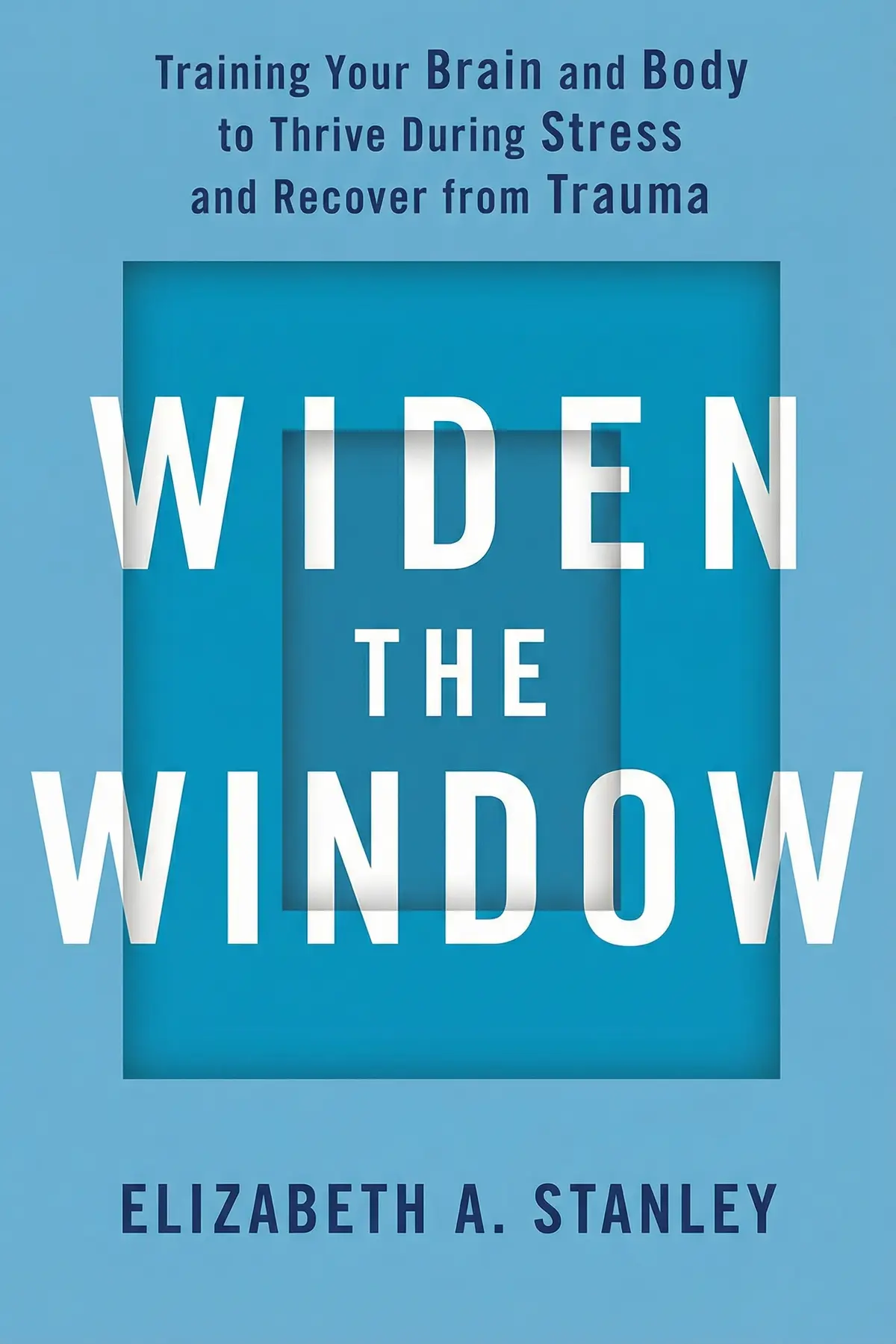
Table of Content
1. Introduction
58 sec
If you work long hours on little sleep and call it ordinary stress, Elizabeth A. Stanley has unwelcome news: your body may be responding much as it would to trauma. In Widen the Window, the Army veteran and Georgetown professor argues that an angry email from your boss and a gun held to your head set off the same ancient survival system. Only the degree differs. That system knows how to switch itself off, but only when a deep part of your brain senses safety, and no amount of reasoning can force that signal.
Stanley’s case is that everyone has a window of stress they can handle well. Chronic strain and unresolved trauma shrink it, and trained attention plus real recovery can widen it again. Along the way you’ll learn why you crash after a hard week, why some pressure sharpens you, and two short sitting exercises, first built for soldiers, that let the body finish its stress cycle.
2. Treat everyday stress and trauma as one scale
1 min 49 sec
We brag about being stressed and whisper about trauma, as if they had nothing in common. A night walk through an empty park shows why your body may not draw the same line your vocabulary does.
3. Calm returns once your body feels safe
1 min 52 sec
You can tell yourself a hundred times that everything is fine and still lie awake with a racing heart. The reason sits below conscious thought, and it changes what recovery actually requires.
4. Catch the push-then-crash cycle before it catches you
1 min 57 sec
A week of heroic discipline followed by a weekend of collapse looks like a willpower problem. Stanley reads it as two parts of the brain taking turns at the wheel, and neither one is steering well.
5. Find the stress level where you perform best
1 min 46 sec
A stress-free life sounds like the healthy ideal. An old curve from psychology suggests otherwise, and it explains why spilled coffee can feel like nothing one month and like the end of the world the next.
6. Accept your starting window and map what shaped it
2 min 00 sec
Two colleagues face the same deadline, and one shrugs while the other unravels. Stanley traces the gap to forces set long before either took the job, including a startling result from three generations of mice.
7. Two exercises that teach your body it is safe
2 min 06 sec
A training program built for soldiers taught them to recover from stress by sitting still and paying attention to something most people never notice. The method is simple, and the strange sensations it can bring are part of the point.
8. Turn the same practice on pain, emotion and habits
1 min 44 sec
Chronic pain, overwhelming feelings and the evening snack habit look like three separate problems. Stanley treats them as one, and her approach to pain starts somewhere most people would never think to look.
9. Conclusion
1 min 05 sec
Stanley’s book turns stress from a test of toughness into a question of completion. Your survival brain was built to fire hard at a threat and then settle, and the settling is the part modern life tends to skip. A deadline week, a run of bad nights or years of worry can keep the alarm running as surely as a single catastrophe, and each skipped recovery leaves the window a little narrower.
The encouraging part is that the window responds to practice. Because it widens through repeated cycles of arousal and full recovery, small daily work counts. Sit for a few minutes each morning and feel where your body meets the chair and the floor. After the next argument or tense meeting, name the activation and rest your attention on those contact points until your body starts to let go. And when you catch yourself reaching for the snack or the screen, ask what comfort you are really after and find a slightly better way to get it.
Strength, on this view, is not how much stress you can swallow. It is how completely you let yourself come back down afterward.
About this book
What is this book about?
Many people treat chronic overwork as normal and save the word trauma for disasters. Elizabeth A. Stanley argues that both sit on one spectrum. An angry email and a gun to the head trigger the same ancient survival brain, which switches the alarm off again only when it senses safety. No amount of reasoning can force that signal. When recovery keeps getting skipped, the body becomes dysregulated. People swing between grinding through and collapsing, their health and judgment suffer, and the window of stress they can handle shrinks until small mishaps feel overwhelming. Stanley explains what sets the size of that window in the first place: genes, early care and later trauma. The book then turns practical. Drawing on Mindfulness-based Mind Fitness Training, the method Stanley first built for soldiers, it offers journaling to map your stress, two grounding exercises that let the body finish its stress cycle, and ways to apply them to strong emotions, chronic pain and unhealthy coping habits. Readers learn why they crash after hard weeks and get a daily practice for recovering fully.
Book Information
Who it's for
Professionals crashing on weekends
Professionals who push through brutal weeks and then crash on the weekend.
Wanting body-based recovery
People living with past trauma, chronic pain or overwhelming emotions who want a body-based way to recover.
Preparing teams for pressure
Managers and trainers who prepare teams for high-pressure work.
About the Author
Elizabeth A. Stanley
Elizabeth A. Stanley is a US Army veteran, an award-winning author and an associate professor of security studies at Georgetown University. She holds degrees in political science and strategy from Harvard, Yale and MIT. Combining military experience and scholarship, she created Mindfulness-based Mind Fitness Training, or MMFT, a method for soldiers and civilians who work under heavy stress and need to recover from trauma.
Ratings & Reviews
Ratings at a glance

What people think
Listeners describe the book as highly educational, with one noting it is packed with research that validates its concepts. They also value the depth of information provided; one listener emphasizes how it explains the science behind stress and trauma, while another mentions it provides multiple tools for managing dysregulation and trauma. Additionally, the book earns praise for its accessible writing style, and listeners appreciate its approach to trauma awareness, with one remarking on how it masterfully explains trauma's impact. However, the section concerning heart rate draws mixed reactions.
Top reviews
Yuwadee
Finally got around to reading this after seeing it referenced in several trauma-informed workshops. Stanley provides an incredibly thorough examination of how our survival brain dictates our reactions to high-pressure environments. The science is dense, but it's presented with a level of authority you only get from someone who has lived it. I particularly appreciated the distinction between the thinking brain and the survival brain. Sometimes we try to 'reason' our way out of stress, but this book proves that physiology must be addressed first. While the technical terminology can occasionally feel like a mountain to climb, the payoff is a much clearer understanding of allostatic load. It is a vital resource for anyone feeling perpetually burnt out.
Show morePaisley
Wow. Elizabeth Stanley has written something that feels less like a self-help manual and more like a tactical briefing for the soul. Coming from a military background, her no-nonsense tone is refreshing in a genre often filled with vague platitudes. She treats mental fitness with the same discipline as physical training, which resonated deeply with me. The MMFT program isn't just about 'feeling better'; it is about recalibrating your entire nervous system to handle the chaos of modern life. There is a grit here that you won't find in typical mindfulness books. If you are tired of soft advice and want a research-backed strategy to build resilience, this is the one.
Show moreSupranee
After listening to the author on a podcast, I knew I needed the full text to understand allostatic load better. This book is a masterclass in how chronic stress erodes our decision-making capabilities and physical health over time. Stanley's research is impeccable, and her bibliography is a goldmine for anyone who wants to go even deeper into the studies. She bridges the gap between clinical psychology and lived experience beautifully. It’s rare to find a book that is this rigorous yet still offers actionable steps for daily regulation. This has become a permanent fixture on my shelf for whenever I feel my window narrowing. Highly recommended for clinicians and laypeople alike.
Show moreFrida
This book offers a profound shift in how we perceive our own 'weakness' during times of crisis. I used to think my anxiety was a character flaw, but Stanley shows it’s just a survival brain that needs better training. The grounding exercises have become a staple in my daily routine, helping me stay present when work gets overwhelming. I appreciate that she includes the military and first responder perspective, as it validates that even the 'toughest' people need these tools. It is a long read, and yes, it repeats itself quite a bit, but the repetition helps the concepts stick. I finally feel like I have a map for my own recovery.
Show moreAubrey
As a working mother with two kids, some of the lifestyle recommendations in these pages felt like they were written for a different species. The author suggests setting aside an entire day each week for 'recovery' without errands or chores. Who actually has that luxury in the real world? Despite the elitist tone regarding time management, the 'ground and release' exercises are actually quite practical and easy to slip into a busy morning. I found the explanation of how childhood experiences shape our current stress window to be eye-opening. You have to sift through some unrealistic expectations to find the gems, but they are definitely there if you look.
Show moreDream
The deep dive into neuroception and the sympathetic nervous system makes this a standout for anyone interested in the biology of trauma. Stanley doesn't just tell you that you're stressed; she explains exactly how your body is accumulating energy it can't discharge. It’s fascinating to see the data backing up why we freeze or fight in situations that aren't actually life-threatening. I did find the middle section a bit repetitive, as she drives the same points home multiple times. However, the clarity she brings to the concept of the 'window of tolerance' is worth the price of admission alone. It’s a solid, evidence-based guide for those who prefer facts over fluff.
Show moreNan
To be fair, I was skeptical of another mindfulness book, but the 'Mindfulness-based Mind Fitness Training' approach is uniquely effective. It moves away from the 'stuff it down' mentality that is so prevalent in high-achieving circles. Instead, Stanley teaches you how to recognize when your system is red-lining before you actually crash. I’ve started implementing the awareness practices during my commute, and the difference in my reactivity is noticeable. My only gripe is the constant promotion of her specific MMFT program, which starts to feel like a sales pitch by the third chapter. It’s an excellent framework, even if the delivery is a little commercial at times. Still, it's a four-star read for the insights.
Show moreBoss
Ever wonder why your brain just shuts down when you're under pressure? This book provides the biological answer in a way that is both convicting and encouraging. Stanley masterfully explains how our windows of tolerance are built and, more importantly, how they can be expanded through intentional practice. The chapters on sleep and social connection as primary defenses against dysregulation were particularly convicting for me. I’ve already recommended this to several colleagues who are on the brink of burnout. It’s not a quick fix, but it is a comprehensive one. A very strong four stars for anyone ready to do the hard work of mental conditioning.
Show moreJirapat
Not exactly a light weekend read, but certainly an informative one. The writing style is quite dense and Stanley has a tendency to use three adjectives where one would suffice. It makes the reading experience feel a bit like a marathon rather than a sprint. I found myself skimming through some of the more repetitive medical jargon to get to the actual exercises. That being said, the core message about widening your capacity for stress is life-changing. If you can handle a prose style that takes the 'scenic route,' there is a wealth of knowledge here. It’s a three-star experience for the writing, but a five-star concept for the health benefits.
Show moreLucia
Look, I really wanted to love this, but the author's constant mention of her PhD felt a bit misleading given it's not in psychology or counseling. There are moments where her personal biases about weight and 'personal accountability' feel very out of touch with modern trauma research. She frames systemic issues as individual failures of willpower, which is a dangerous path to walk. While the science on the nervous system is mostly accurate, the delivery is wrapped in an elitist package that ignores the reality of most people's lives. It felt more like an advertisement for her expensive training courses than a genuine helping hand. I’ll stick to authors who have actual clinical experience in the field.
Show moreQuestions about this book
What is the main idea of Widen the Window?
Elizabeth A. Stanley argues that everyday stress and trauma run on the same survival system and differ only in degree. That system recovers only when the survival brain senses safety. When chronic stress or trauma keeps blocking recovery, the window of stress a person can handle well narrows. Mindfulness and healthier habits help the body finish its stress cycles, which widens the window again.
What is the window described in Widen the Window?
Stanley describes each person’s capacity for stress as a window. Inside it, the thinking brain and survival brain cooperate: one raises arousal, the other plans a response and then helps recovery happen. Moderate stress inside the window actually improves performance, as the upside-down U of the Yerkes-Dodson curve shows. Chronic stress and unresolved trauma shrink the window, so smaller events push a person over the edge.
What are the MMFT exercises in Widen the Window?
Mindfulness-based Mind Fitness Training begins with two exercises. In Contact Points, you sit and hold your attention on where your seat and feet touch the chair and floor, daily for 5 to 20 minutes. Ground and Release follows a mild or moderate stressor: notice the signs of activation, name them, then shift attention to your contact points and allow release signs such as tingling, warmth or tears.
Why do people crash after a stressful week, according to Stanley?
Stanley calls it a swing between two forms of dysregulation. During the push, thinking brain override forces the body onward and denies the strain, leaving the system stuck on high. When resources run out, survival brain hijacking takes over, and impulse and emotion drive behavior as the body tries to discharge stress. The result is the weekend in bed with TV and junk food.
Who should read Widen the Window?
It suits people who live under constant pressure and keep crashing after it, as well as those dealing with past trauma, chronic pain or strong emotions. The author first designed her method for soldiers, so it also fits anyone who works in high-stress conditions or leads people who do. Its practices are simple: journaling, sitting exercises and small swaps for unhealthy coping habits.
Readers also enjoyed


ADHD an A-Z: Figuring It Out Step by Step
Leanne Maskell






Alcoholics Anonymous
Alcoholics Anonymous World Services
AUDIO SUMMARY AVAILABLE
Listen to Widen the Window in 15 minutes
Get the key ideas from Widen the Window by Elizabeth A. Stanley, plus 5,000+ more nonfiction titles.
- 5,000+ titles
- Listen as much as you want
- 7-day free trial
- Cancel anytime









