

14 min 52 sec
Available in: English
Why Taiwan Matters: A Short History of a Small Island That Will Dictate Our Future
By Kerry Brown
Explains why an island of 23 million people now sits at the center of world politics: a distinct democratic identity, a near monopoly on advanced chips and a rising risk of war with China.
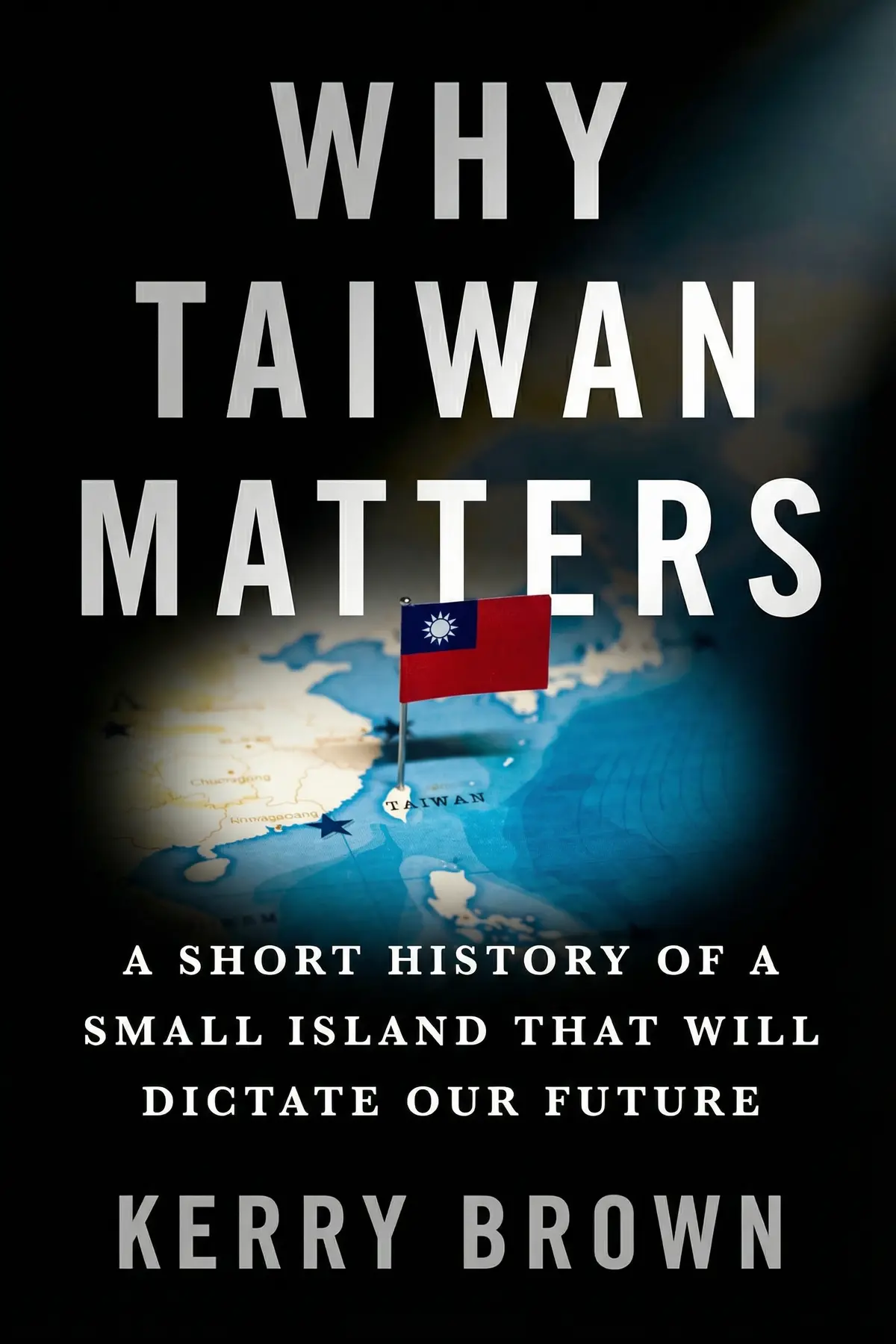
Table of Content
1. Introduction
1 min 09 sec
If you follow the news, Taiwan probably reaches you as a map, a missile alert or a line about chips, and the pieces never quite fit together. In Why Taiwan Matters, China scholar and former British diplomat Kerry Brown argues that they form one story: an island of 23 million people now sits where democracy, technology and the risk of great-power war meet. His first surprise is how calmly Taiwanese people live with that risk. In 2022 Chinese military planes crossed into Taiwan’s airspace 1,727 times, yet daily life in Taipei went on as usual.
Brown’s case is that Taiwan’s long, mixed history produced a people who increasingly see themselves as Taiwanese, and an industry the global economy depends on. Pressed against a China that wants the island back, those two facts make Taiwan’s stability everyone’s concern. By the end, the next headline about the Taiwan Strait will make sense: who wants what, why the chips matter and why a war nobody plans could still begin.
2. Understand a country the world won't officially name
2 min 09 sec
A missile alert flashes on every phone, and a shopkeeper barely looks up. That shrug hides a puzzle about identity, passports and a diplomatic formula designed so that no one would be fully satisfied.
3. Trace the layers that set Taiwan apart
2 min 15 sec
Forty thousand crates of imperial treasure crossed the sea to Taiwan as one regime collapsed. They explain only half of the island’s story. The other half was written by colonizers, refugees and a war in Korea.
4. What Taiwan's voters really disagree about
2 min 01 sec
Politics in Taipei splits families at the dinner table, and an American alliance exists in a legal gray zone. Yet beneath the noise sits a surprising point of agreement that events in Hong Kong made firmer.
5. Discover how one Taiwanese company powers your phone
2 min 05 sec
Behind trees and statues in a science park stand plain buildings guarded with unusual care. What happens inside affects nearly every device you own, and experts disagree on whether it protects Taiwan or endangers it.
6. Learn how goodwill between Taipei and Beijing collapsed
1 min 58 sec
Two leaders met over tea in Singapore and spoke like old friends. Within months the mood had soured sharply. The turn came after Taiwan voted in a new president who took a more independent stance.
7. Understand how a war nobody wants could still happen
2 min 02 sec
An American president said the same thing three times, and three times his staff took it back. That pattern reveals how peace in the Taiwan Strait is kept, and how fragile the arrangement has become.
8. Conclusion
1 min 13 sec
What makes Taiwan matter, in Brown’s telling, is that several of this century’s biggest forces meet on one island. A people shaped by indigenous roots, Dutch traders, Japanese schools, a crackdown in 1947 and a peaceful turn to democracy now see themselves as Taiwanese first. The same island builds most of the advanced chips the world runs on. And across a narrow strait, a leader who once expected trade to bring Taiwan home watches it drift further away.
You do not need to pick a side to follow this. When a story about Taiwan reaches you, separate its strands: identity, chips and military power, and notice how each one makes the others harder to settle. Look past the headline numbers to the deliberate vagueness that has kept the peace since the 1970s, and to the statements that keep testing it.
On a Taipei street, a sign pointing to an air raid shelter stands a few steps from a crowded bubble tea shop. Twenty-three million people live inside that contrast every day, and the rest of the world is only starting to see how much depends on their calm holding.
About this book
What is this book about?
Taiwan appears in the news as a missile alert one day and a chip shortage the next, and the pieces rarely add up. Kerry Brown, a scholar of China and a former diplomat in Beijing, connects them into one account of how a small island came to matter so much. He follows Taiwan through its many layers of influence: indigenous peoples, Dutch traders, Qing rule, Japanese colonization, a violent crackdown in 1947 and a peaceful move from dictatorship to democracy. Along the way most of its people came to see themselves as solely Taiwanese. At the same time, a single company, TSMC, made the island indispensable to the world's technology. Readers get a clear map of the forces in play: the competing parties in Taipei, the role of the United States, the hopes Xi Jinping built on trade, and the military scenarios analysts fear. Brown shows why a conflict would reach far beyond Asia, and why the drift toward confrontation continues even though no one wants war.
Book Information
Who it's for
Professionals relying on chips
Professionals in tech, manufacturing or finance who want to understand the risk behind their chip supply.
Confused by Taiwan headlines
News readers confused by headlines about the Taiwan Strait who want the history and the stakes in one place.
Students of world politics
Students of politics and international relations looking for a clear introduction to the China and Taiwan question.
About the Author
Kerry Brown
Kerry Brown is a professor of Chinese studies, author and columnist who has directed the Lau China Institute at King's College, London, and earlier led the China Studies Centre at the University of Sydney. Before academia he joined the Foreign and Commonwealth Office, serving as First Secretary in Beijing from 2000 to 2003. His commentary on China and Asia has appeared in the New York Times, The Guardian and the Financial Times.
Ratings & Reviews
Ratings at a glance
What people think
Listeners find this an easy-to-digest and brief overview of Taiwan’s history, politics, and its crucial position in today’s global geopolitics. Although views are split regarding the author’s case for "strategic ambiguity" to handle current tensions, listeners generally prize the work's even-handed and trustworthy breakdown of the US-China-Taiwan dynamic. They also highlight the insightful coverage of Taiwan’s semiconductor lead and its shift toward a modern democracy, with one listener describing it as the "perfect start book" for those seeking clarity on global flashpoints. Furthermore, the writing is lauded for its level-headed, diplomatic outlook that helps outsiders grasp why the region carries such weight.
Top reviews
Ern
Wow. This book makes a compelling case for why a democratic Taiwan is fundamentally indispensable to the modern world order. Brown argues that if Taiwan’s autonomy were to vanish, it wouldn’t just be an economic disaster—it would be a moral failure for the West. I was particularly fascinated by the section on how Taiwan’s internal identity has shifted from being 'the real China' to something entirely unique and fiercely independent. The prose is sharp and the stakes feel incredibly high throughout. A must-read for anyone who cares about the future of liberal democracy and global trade.
Show moreDylan
Ever wonder why a tiny island has the entire world holding its breath? This book explains the 'why' with surgical precision. The narrative moves from the colonial history to the tech-heavy present with ease, making the argument that Taiwan's existence is the ultimate test for 21st-century diplomacy. I loved the breakdown of how the US has shifted its stance over the decades, moving from 'ambiguous neutrality' to a more urgent, value-based support. It is a terrifying look at a potential flashpoint, but Brown’s call for patience and prudence provides a thin silver lining of hope in a dark landscape.
Show moreEthan
Picked this up before a trip to East Asia and it was exactly the kind of foundational text I needed. Brown does an incredible job of condensing decades of complex tension into a narrative that doesn’t feel like a dusty, academic textbook. The way he weaves together the semiconductor industry with democratic identity shows why this isn't just a local squabble but a global necessity. My only gripe is that it feels a bit light on the actual cultural life of the island, focusing heavily on the big-picture geopolitics instead. Still, if you want to understand the 'Silicon Shield' and why the US remains so invested, this is a solid starting point.
Show moreWoramet
As someone who keeps a close eye on the news, I thought I knew most of this, but Brown’s diplomat-style analysis added much-needed nuance. He explores the 'cryogenic stasis' of the current situation—where no one is happy but everyone is safe—and explains why 'doing nothing' might actually be the bravest choice for leaders in D.C. and Beijing. The book is remarkably balanced, giving credit to the land reforms of the Shek era while acknowledging the brutality of martial law. It’s a tight, sobering volume that will probably keep you up at night thinking about the fragility of our global supply chains.
Show morePakpoom
The chapter on the triangular relationship between the US, China, and Taiwan was worth the price of the book alone. Personally, I appreciated how Brown didn't try to offer a 'magic solution' to the problem because, frankly, there isn't one. Instead, he treats the reader like an adult, laying out the catastrophic consequences of any sudden moves in either direction. It’s a bit dry in the middle sections when he gets into the weeds of political theory, but the historical context regarding the KMT and the transition to democracy is essential reading for understanding today’s headlines.
Show moreNan
Kerry Brown manages to deliver a high-level overview of a prickly subject without falling into the trap of being one-sided. Truth is, most Western books on this topic are either overly aggressive toward China or dismissive of Taiwan's agency, but this stays right in the middle. He highlights how the island endured 38 years of martial law to become the vibrant democracy it is today, which makes the threat of invasion feel even more tragic. The pacing is generally good, though some of the segments on international law could have been simplified for a general audience looking for a lighter read.
Show morePrasarn
Finally got around to reading this and it’s a solid 4-star effort. It’s the kind of book you can finish in a weekend and come away feeling significantly smarter about global affairs. Brown doesn't sugarcoat the reality that Taiwan is essentially in a state of geopolitical limbo, but he argues convincingly that this limbo is better than the alternative. The focus on the 'Silicon Shield' was particularly enlightening for me. I wish there was more about the younger generation’s perspective on independence, but as a primer on the Straits conflict, it’s hard to beat this.
Show moreSomrutai
To be fair, the first half of this book is a fantastic summary of the KMT’s retreat and the subsequent 'economic miracle' that turned Taiwan into an industrial titan. However, by the time I hit the final chapters, I felt like the author was just rephrasing the same three points about strategic ambiguity over and over again. It reads more like a long-form academic essay than a cohesive book at times, with a lot of wordy filler that could have been trimmed for a punchier delivery. It is a reliable and balanced resource, sure, but it lacks that spark of original insight I was hoping for after the strong start.
Show moreThanit
Look, I wanted to love this, but it felt a little too much like a policy briefing rather than a deep dive into the soul of Taiwan. The technical details about TSMC and the semiconductor dominance are well-researched, yet the human element feels missing from the pages. Why do the people on the ground feel the way they do? The history is there—the 228 Incident, the Kaohsiung Incident—but it’s viewed through a lens of international relations rather than social history. It’s a decent primer if you’re a complete novice, but if you’ve already read a few articles on the Straits, you might find it a bit basic.
Show moreYuki
Actually, I found this to be quite a slog. While the premise is vital, the writing style is incredibly dense and repetitive to the point of frustration. Brown spends way too many pages explaining why the status quo matters without offering any fresh perspective on the recent developments, like the new plants opening in Arizona. It felt like he had about fifty pages of solid material and stretched it out into a full-length book with a lot of circular reasoning. Not the 'swiftly moving' read I was promised by other reviewers. I’d suggest looking for a more updated or concise resource for your bookshelf.
Show moreQuestions about this book
What is the main argument of Why Taiwan Matters?
Kerry Brown argues that a small island of 23 million people has become central to global democracy, technology and peace. Its layered history produced a distinct identity, with 67 percent of people seeing themselves as only Taiwanese. Its company TSMC controls over 90 percent of advanced chip production. Combined with China’s growing pressure, those facts make Taiwan’s stability a concern for the whole world.
What is the silicon shield in Why Taiwan Matters?
The silicon shield is the idea that TSMC protects Taiwan, because any war would wreck industries worldwide, including China’s own, which still depends on Taiwanese chips. Brown reports that others see the reverse: the factories turn the island into a still more attractive prize for Beijing. In both readings, the company lies at the center of the relationship between the two sides.
Why did relations between China and Taiwan get worse after 2015?
The 2015 meeting between Ma Ying-jeou and Xi Jinping in Singapore was warm, but within months Taiwan elected a president with a more independent stance. Brown explains that Xi expected economic ties to lead to reunification, yet China became more assertive under him. Meanwhile, Hong Kong’s crackdown hardened Taiwanese opinion, and a 2023 poll showed record support for independence.
What would happen if China attacked Taiwan, according to the book?
Analysts cited by Brown expect cruise missiles and cyberattacks, then a naval blockade, then a landing larger than anything since World War II. Taiwan’s cities would suffer urban warfare while the blockade cut off food and fuel. Globally, one estimate puts the starting cost at $2 trillion in lost output, with advanced chip supplies halted and a severe depression likely.
How can I use the ideas in Why Taiwan Matters?
The book gives a way to read the news. Separate any Taiwan story into identity, chips and military power, and ask how each affects the others. Pay attention to small statements, such as Biden’s remarks and his staff’s walk-backs, because peace rests on strategic ambiguity. And when supply chains come up at work, remember how much depends on one company in Hsinchu.
Readers also enjoyed


A Promised Land
Barack Obama


A River in Darkness: One Man’s Escape from North Korea
Masaji Ishikawa

A Splendid Exchange: How Trade Shaped the World
William J. Bernstein

A Theory of Justice
John Rawls

A Spy Among Friends: Philby and the Great Betrayal
Ben Macintyre


AUDIO SUMMARY AVAILABLE
Listen to Why Taiwan Matters in 15 minutes
Get the key ideas from Why Taiwan Matters by Kerry Brown, plus 5,000+ more nonfiction titles.
- 5,000+ titles
- Listen as much as you want
- 7-day free trial
- Cancel anytime









