

11 min 39 sec
Available in: English
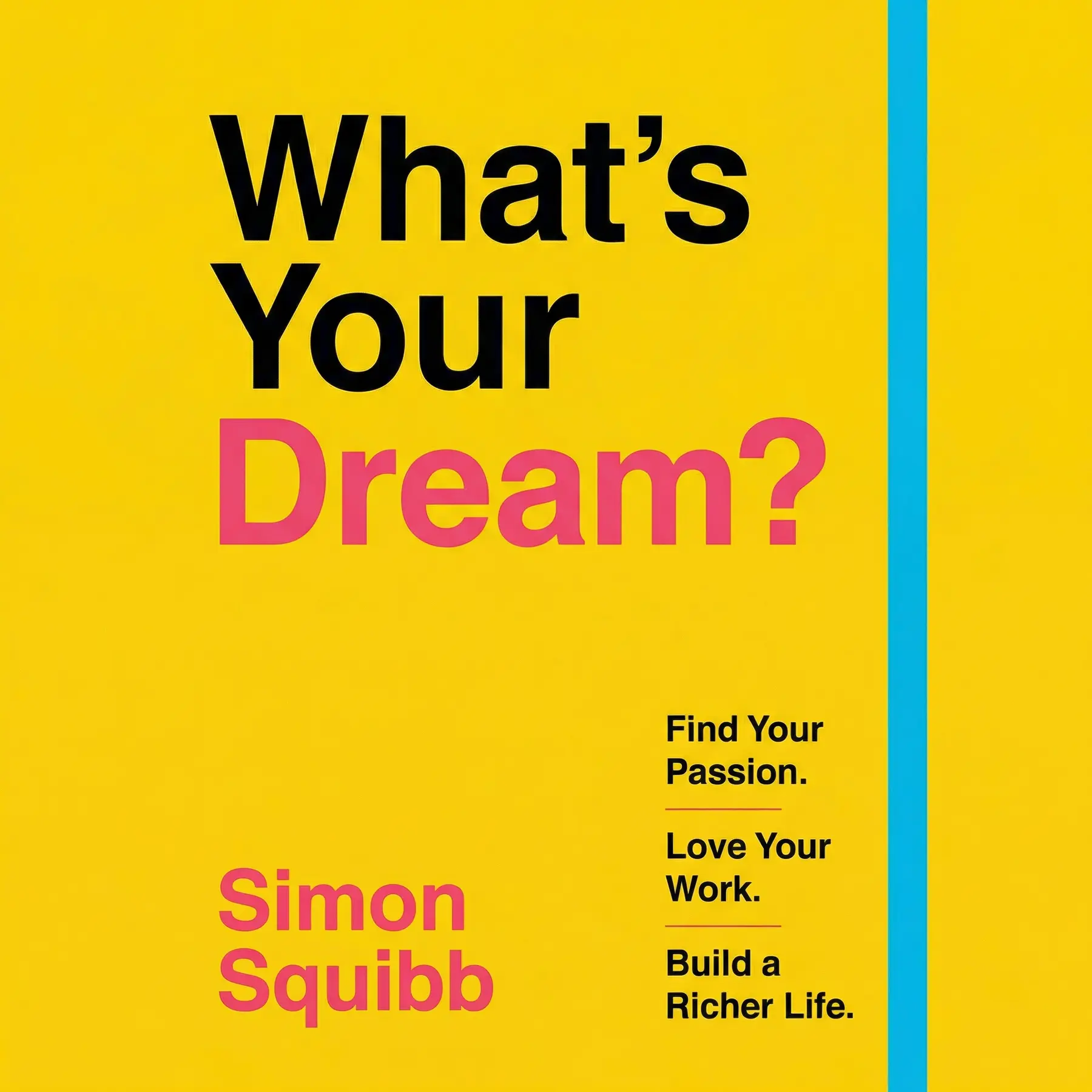
What’s Your Dream?: Find Your Passion. Love Your Work. Build a Richer Life.
By Simon Squibb
A plain guide to naming the dream behind a restless working life, using three questions about enjoyment, pain and service, then making room for it and testing it with a first customer.

Table of Content
1. Introduction
1 min 00 sec
If your days blur into routine and the question of what you really want keeps sliding to next week, Simon Squibb has a direct answer: that restless feeling is worth listening to, because it points somewhere. In What’s Your Dream?, the entrepreneur and investor argues that a dream is open to anyone, whatever their money, credentials or circumstances, and that it can guide everyday choices. A goal snaps under pressure. A dream, in his view, is big enough to absorb setbacks and keep you moving.
His case runs in a clear line. First you clear away the inherited beliefs that crowd a dream out. Then you find it by asking what you enjoy, what has hurt you and whom you could help. Finally you make room for it and act, with one concrete target: a first customer. By the end, you will have three questions to answer tonight and a six-month plan to test what you find.
2. Trade fragile goals for a dream that lasts
1 min 50 sec
Resolutions tend to collapse at the first bad week, yet some people keep going through grief and even homelessness. Squibb points to one difference between them, and it has little to do with discipline.
3. Drop four beliefs that keep your dream small
2 min 05 sec
Some of the ideas holding you back were taught as sensible advice in school and at work. Squibb names four of them, including one that most ambitious people treat as a virtue.
4. Find your dream with three honest questions
2 min 06 sec
Most people assume a dream has to be invented from nothing. Squibb thinks it is already there, hidden in three places you probably dismiss, and one of them is something you would rather forget.
5. Buy back time before you buy status
1 min 56 sec
A clear dream still stalls when the mortgage, the car payment and your own doubts get a vote. Squibb describes three kinds of freedom to win first, and the last one makes most people uncomfortable.
6. Land your first customer within six months
1 min 41 sec
Squibb’s plan fits on a calendar page and has a single target. Hitting it changes how you feel, what you know and what comes next, and it leads to a decision many people put off for years.
7. Conclusion
1 min 01 sec
What Squibb offers is a change in who is steering. Before, the days are run by obligation, inherited beliefs and a steady pressure to own more. After, they are run by a dream you can name: something you enjoy, rooted in a pain you understand, aimed at a problem you can solve for other people. That mix gives an energy ordinary goals lack, and setbacks shrink when the reason behind them is personal.
None of it waits for perfect timing. Write your answers to the three questions and say the result aloud to someone this week, in the present tense. Look at one expense that buys status and ask how much time it could buy back. Then set the six-month date and put a first customer at the end of it. Any failures along the way count as information about timing, strategy or people.
The question in the title works best when you can answer it in one breath, and when the life you are living starts to look like that answer.
About this book
What is this book about?
Many people get through their weeks on obligation. They follow rules they never chose and keep putting off the question of what they actually want. Simon Squibb argues that this restlessness deserves attention. In his view a dream is open to anyone, whatever their money, credentials or circumstances, and it lasts longer than any goal or resolution. Squibb sets out a clear path. First, question four inherited beliefs that crowd a dream out: that hustle guarantees success, that failure is a disaster, that hard things are best avoided and that possessions bring happiness. Second, define the dream by asking what you like and dislike, what your pain is and how you can help others. Third, create financial, mental and idea freedom, so that the dream has time, belief and allies. The book ends on action. Squibb proposes a six-month window with one target, a first customer, followed by a full commitment. Readers come away with honest questions to answer and a short timeline for turning the answers into work they care about.
Book Information
Who it's for
Workers outgrowing their jobs
Employees who feel stuck in jobs they have outgrown and can't yet say what they want instead.
Founders in the making
Would-be founders with a half-formed idea who need a first customer and a deadline.
Undecided young adults
Young people unsure whether chasing status or chasing purpose is the better bet.
About the Author
Simon Squibb
Simon Squibb is an entrepreneur and investor who started his first business at 15 while homeless and later sold his agency, Fluid, to PricewaterhouseCoopers. He founded HelpBnk, a platform that helps people start businesses at no cost. He bought a staircase in London and added a doorbell so people could pitch their dreams, and his street interviews asking strangers about their dreams have built a large social media following. His stated aim is to help 10 million people start businesses.
Ratings & Reviews
Ratings at a glance
What people think
Listeners find the book captivating and uplifting, noting that it pushes them to take real steps toward changing their lives. They value how accessible the writing is and deem it essential reading, with one listener portraying it as an excellent manual for entrepreneurs. The content earns high marks for its educational impact; one listener draws attention to the functional tools included, while another mentions how well it tackles typical worries and mental barriers.
Top reviews
Chai
Picked this up because I’ve been following Simon on TikTok for a while and his energy is infectious. The book captures that same "go-getter" spirit perfectly, moving from his personal story of homelessness to practical ways to launch a business. I loved the anecdotes about ordinary people—like the dog walkers and bakers—rather than just the usual corporate giants. It’s written in a way that makes you feel like anyone can do it if they just stop overthinking. Truth is, it’s more of a motivational manifesto than a technical manual, but that’s exactly what I needed. It addresses those nagging fears that keep you stuck in a 9-to-5. If you're looking for deep, complex business strategy, you might find it a bit light. However, for sheer inspiration and the push to finally start, it’s a winner.
Show moreSuda
Finally got around to reading this, and frankly, it’s the kick in the teeth I needed to stop dreaming and start doing. Squibb emphasizes the "risk muscle" in a way that feels achievable rather than terrifying. The advice to "think poor" while building your dream was a standout concept for me. It’s about resourcefulness and grit, not just having a big bank account to start with. The readability is fantastic; I polished it off in two sittings because the tone is so conversational. Some might say it’s oversimplified, but I think that’s the beauty of it. It strips away the jargon and gets to the heart of what’s holding most of us back. This is a must-read for anyone currently stuck in a rut.
Show moreArnav
Wow. I started this book expecting to find it a bit too surface-level, but the personal stories really won me over. Simon's history of homelessness and his eventual success is the perfect backdrop for this kind of advice. It feels earned, not just like someone reciting tropes from a stage. The practical tools he offers for identifying your strengths are actually quite helpful if you actually sit down and do the work. I’ve been in a midlife rut lately, and this was exactly the spark I needed to start looking at my career differently. It’s a fast-paced, high-energy read that doesn't waste time on fluff. Highly recommend it to anyone who needs a push.
Show moreOrathai
This book starts with a really strong message about resilience and finding purpose, which hooked me immediately. Simon’s journey is undeniably impressive, and his genuine desire to help strangers comes through on every page. I particularly liked the sections on building a team and the mindset shift required for entrepreneurship. However, I have to agree with some other readers that the title is slightly misleading. It starts off as a general "find your passion" guide but quickly pivots into being purely about starting a business. If your dream isn't entrepreneurial, you might feel a bit left out by the middle of the book. Still, the energy is great and the "Take Four" concept was interesting enough to keep me engaged.
Show moreMaksim
As someone who has always been terrified of leaving a stable job, Squibb’s words on the "risk muscle" resonated deeply. The truth is, most self-help books are just fluff, but this one provides actual tools to evaluate your likes and dislikes. It helped me realize that the obstacles in my path were mostly self-imposed illusions. The writing style is punchy and direct, which fits Simon’s public persona well. My only gripe is that it can be a bit repetitive at times, hammering home the same point about taking action. I appreciated the specific examples of small businesses rather than just hearing about Apple or Google again. It’s a solid guide for anyone who feels like they’re playing by someone else’s rules.
Show morePor
Ever wonder if those 30-second clips of a guy with a microphone actually translate into a useful book? I was skeptical, but Simon Squibb actually delivers a lot of heart and some very practical nuggets here. It’s an encouraging read that focuses on the reality of building something from nothing. I especially enjoyed the stories about his time in Hong Kong and how those experiences shaped his view on business. Look, it’s not reinventing the wheel, and you’ve heard some of this advice before in other entrepreneurship books. But there is a certain magic in the way he presents it. It’s approachable, honest, and doesn't feel like it's coming from a place of greed.
Show moreYui
After hearing so much hype, I found the first few chapters incredibly engaging, but then the momentum slowed down. Simon is clearly a generous bloke, and his mission to help people is inspiring. However, the section on "I don’t know what my dream is" felt a bit oversimplified and even a little dismissive. Telling people they are "lying to themselves" if they haven't found their purpose is a bit harsh, in my opinion. Humans are multifaceted, and sometimes it takes more than a like/dislike list to figure things out. If you already have a clear business idea, this book is a fantastic motivational tool. If you’re genuinely lost, you might find the advice a bit thin.
Show moreSakura
Not what I expected, but in a way that actually worked for my current situation. I initially thought this would be a deep dive into psychological purpose, but it’s really more of a "Business 101" for the TikTok generation. Squibb repeats his main points ad nauseam, which can be a bit grating if you're a fast reader. That said, the focus on resilience and the power of dreams is genuinely moving. To be fair, he’s not trying to be a philosopher; he’s trying to be a mentor. It’s on the same level as "Think and Grow Rich" in terms of its vibe. It’s a good entry point for beginners, though seasoned entrepreneurs might not find many new insights here.
Show moreThitima
To be fair, Squibb is clearly a well-meaning guy with a lot of heart, and that shines through in the writing. The book is very readable and works well as a motivational guide to get you moving. My main issue is that it feels a bit like a collection of his social media posts expanded into chapters. The advice is solid—focus on purpose, build a team, take risks—but it doesn't go very deep into the "how-to" of any of it. It’s a "proof of concept" book that uses real-world examples to show what's possible. It’s decent for a bit of Sunday afternoon inspiration, but don't expect a step-by-step business plan. A solid 3 stars for the encouragement.
Show moreTen
Honestly, I feel a bit misled by the marketing of this book. I bought it hoping for a deep dive into finding passion, but it’s almost entirely about starting a business. Not everyone’s dream is to be an entrepreneur, and the book seems to ignore that possibility entirely. The section on "I don't know" was especially disappointing and felt a bit disrespectful to those of us who are genuinely struggling. It’s very repetitive, essentially saying "stop being lazy and start a business" over and over again. While Simon seems like a nice guy on social media, the book lacks the nuance I was looking for. If you want to be a business owner, go for it, otherwise skip this.
Show moreQuestions about this book
What is the main idea of What's Your Dream? by Simon Squibb?
Squibb argues that everyone can have a dream, whatever their money or circumstances, and that a dream lasts longer than goals or resolutions. You find it by asking what you like and dislike, what your pain is and how you can help others. You live it by freeing up money, mindset and voice, then aiming for a first customer within about six months before committing fully.
What myths does Simon Squibb say stop people from dreaming?
He names four. The belief that hard work alone guarantees success, which can crowd out curiosity and creativity. The belief that failure is a disaster, learned from pass or fail schooling. The belief that avoiding hard things is wise, when dreams need discomfort. And the belief that possessions bring happiness, when status objects often cost money, upkeep and freedom.
How do I find my dream according to What's Your Dream?
Squibb suggests three questions. What do you like and dislike? If you are unsure, picture a day free of social and financial pressure. What is your pain? Past hurt can give a dream weight when enthusiasm fades. How can you help others? Linking your interests to a problem you can solve gives the dream staying power. He says the answers improve with repeated honest rounds.
How can I apply the ideas in What's Your Dream?
Cut costs and status purchases to buy back time. Speak about your plan in the present tense, as in saying you are doing it, to strengthen commitment. Share your dream openly so family, friends and acquaintances can help. Then give yourself roughly six months to find a first customer, and use what that sale teaches you before going all in.
Readers also enjoyed


A Guide to the Good Life: The Ancient Art of Stoic Joy
William B. Irvine

Alibaba: The House That Jack Ma Built
Duncan Clark



A High-Performing Mind: Strengthen Your Mind and Live Your Best Life
Andrew D. Thompson


Abundance: The Inner Path to Wealth
Deepak Chopra

AUDIO SUMMARY AVAILABLE
Listen to What’s Your Dream? in 15 minutes
Get the key ideas from What’s Your Dream? by Simon Squibb, plus 5,000+ more nonfiction titles.
- 5,000+ titles
- Listen as much as you want
- 7-day free trial
- Cancel anytime









