

14 min 41 sec
Available in: English
 ไทย
EnglishไทยWhat Would Google Do?: Reverse Engineering Business Strategies for Survival and Success in the Internet Era
By Jeff Jarvis
Shows how the internet moved power to customers and what businesses must do about it: listen in public, admit mistakes, answer searchers' questions, join networks, serve niches and earn from knowledge, even while giving products away.
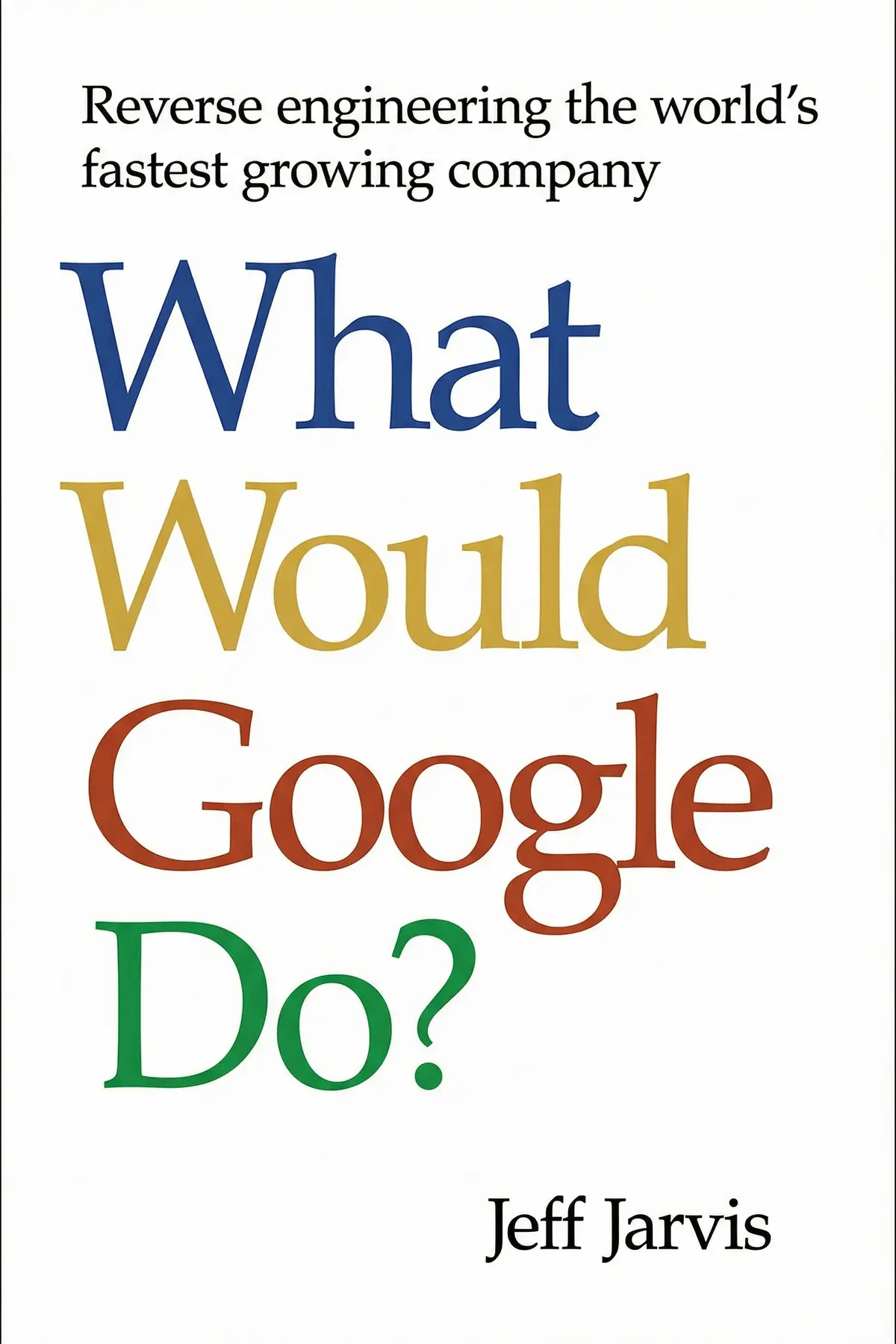
Table of Content
1. Introduction
54 sec
If your business still treats the internet as one more place to advertise, it is losing ground to companies that treat it as a conversation. In What Would Google Do?, journalist Jeff Jarvis argues that the web handed power to customers, and that the firms thriving now are the ones that stopped resisting. His test for any hard decision is to ask how Google would handle it.
The answer, again and again, is to open up. A business wins online, Jarvis shows, by talking honestly with customers, letting them shape what it makes, specializing in its strengths, linking to everyone else and earning money from what it knows. The stories run from his own public fight with Dell to the New York Times tearing down its paywall. They add up to a short set of questions you can put to your own company, beginning with a strange one about giving your main product away.
2. Treat every unhappy customer as a public broadcaster
1 min 38 sec
A frustrated laptop owner wrote one post on his blog, and soon it was among the first things people saw when they searched for a giant computer maker. The real damage came from what the company assumed about feedback.
3. Let customers help design and sell your product
1 min 31 sec
For decades, companies believed their advantage lay in keeping plans locked away. A computer maker and a search engine found that the people outside the building had ideas the insiders never would.
4. Own your mistakes fast to earn lasting trust
1 min 52 sec
A well-known journalist and a news organization were both caught out by bloggers within two years of each other. One waited eleven days and blamed its critics; the other did something that made it more credible than before.
5. Answer every question your customers type into search
1 min 44 sec
Most visitors arrive at a website carrying a question. One content service built hundreds of sites around that simple fact, and its writers learned to answer questions before anyone had asked them.
6. Do your best work and link to everything else
1 min 44 sec
A blog written near the World Trade Center started a conversation that crossed a continent. That exchange reveals why newspapers can drop whole beats and why a retailer might happily send customers to someone else’s site.
7. Build networks and serve niches instead of chasing the masses
2 min 12 sec
Small online sellers once moved more goods in a year than the biggest department store chain in America. Behind that number sits a different idea of growth, one where letting other sites freely build on your product can pay.
8. Profit from what you know and give products away
2 min 00 sec
A famous newspaper started charging readers for its columns and quietly reversed course two years later. Its retreat, and the way two online giants make money, suggest a startling question about what your business really sells.
9. Conclusion
1 min 06 sec
Jarvis’s question works because Google stands for habits any business can copy. Dell lost ground by trying to own the conversation about its laptops, while Reuters earned trust by thanking the bloggers who caught its mistake. About.com, Glam and Google Maps grew by giving people what they came for and letting others build on top. Even the New York Times found a bigger audience, and more advertising, once it stopped charging at the door. The web keeps favoring the company that opens its doors and keeps punishing the one that hides.
Starting is modest. Spend an hour reading what customers say about you on blogs and forums. Jarvis rates this above any focus group, because the people already talking clearly have something to say. Answer the questions they keep asking, plainly, on your own site. Then take his free-product thought experiment seriously and look hard at what you know about your customers that someone would pay for.
When the next hard decision arrives, ask what Google would do. Most of the time, the answer begins with letting the customer in.
About this book
What is this book about?
A single angry blog post about a Dell laptop once rose to the top of Google searches for the company, and Dell could do little to stop it. Jeff Jarvis uses that episode, his own, to show how far the internet has moved power to customers, who now talk to each other in public and on their own terms. His response is to study the company that understands this best and ask, before any big decision, what Google would do. The habits he finds are concrete: fix problems fast and in the open, invite customers to shape and promote products, admit mistakes the way Reuters did, make your site the best answer to people's searches, specialize and link to others, and build or join networks and platforms. Jarvis also argues that the mass market has broken into countless niches where small firms thrive, and that the most successful companies, Amazon and Google among them, make their money from knowledge about customers. Readers get a set of questions to test any business against, including what would happen if its main product were free.
Book Information
Who it's for
Business owners feeling outgunned
Founders and small business owners who feel outgunned by big competitors online.
Managers facing public complaints
Managers stung by public complaints or bad reviews who want a better response than silence.
Marketing and media teams
Marketers and media professionals rethinking how to earn traffic, trust and revenue on the web.
About the Author
Jeff Jarvis
Jeff Jarvis, born in 1954, is an American journalist, speaker and former television critic who reviewed TV for TV Guide and People. He created Entertainment Weekly and was its first editor, then served as president and creative director of Advance Net, the online arm of Condé Nast and Advance Local. He is an emeritus professor at the City University of New York's Newmark School of Journalism, where he held the Tow chair in journalism innovation. He co-hosts the podcasts This Week in Google and AI Inside, writes the blog Buzzmachine and champions the Open Web.
Ratings & Reviews
Ratings at a glance

What people think
Listeners find the writing exceptionally clear and well-crafted, with one remarking that it’s a must-read for business managers. The standard of information is also highly rated, as one listener points out its excellent insights into Google's operations. Furthermore, listeners enjoy the straightforward method and innovative concepts, while one listener describes the book as a great mental exercise.
Top reviews
Tuck
Ever wonder how our daily interactions changed so drastically over the last decade? Jarvis captures that shift perfectly by examining the 'Googley' mindset through a lens that is both accessible and provocative. The book operates as a brilliant mental exercise, forcing readers to reimagine stagnant industries like insurance and real estate through the power of platforms and distribution. While some might find his optimism boundless, I found the simplicity of his approach refreshing in an era of over-complicated business jargon. It is essentially a guide to the G-Generation, where openness and customer trust are the new currencies of success. For any business manager looking to understand why the old rules are crumbling, this is an absolute must-read that provides excellent insights into the mechanics of the digital avalanche.
Show moreErn
This book is a total mental workout that pushes you to rethink everything from airlines to parking meters. Jarvis has a knack for distilling complex economic shifts into simple, actionable ideas that any manager can grasp. I loved the focus on distribution and the idea that being 'Googley' means pocketing less value than you actually create for others. It’s a call to action for the open-source gift economy, proving that generosity can actually be a viable business strategy in the long run. The writing style is punchy and direct, making it one of the most engaging business books I’ve picked up in years. Frankly, if you aren't thinking about these platforms and how they disrupt your field, you're already falling behind the curve.
Show moreAlejandra
Wow, the way Jarvis describes Google as an unstoppable avalanche really puts the modern economy into perspective. This is a must-read for entrepreneurs who want to understand the power of the platform over the product. It’s full of a gazillion ideas that spark creativity and make you question why you ever did things the old way. Some people might find his tone arrogant, but I think he’s just passionate about the potential for a more open world. Seeing how he connects 'Dell Hell' to broader corporate transparency issues was fascinating. This book is a wonderful title that is well-served by its exploration of the gift economy. If you want to improve your business, start here.
Show moreSing
Picked this up during a commute and found it surprisingly digestible for a business text. The truth is, the way we perceive value has changed, and Jarvis does a stellar job of explaining why your worst customer might actually be your best friend. By inviting the crowd in and trusting the community, companies can scale in ways that were previously impossible. I particularly enjoyed the chapters on how Google would theoretically run an airline, even if some of the proposals about in-flight gambling seem a bit far-fetched for reality. It’s an eminently readable manifesto that challenges you to stop being territorial and start being collaborative. Though it’s a bit dated now, the core principles regarding transparency and building a platform remain deeply relevant for today's entrepreneurs.
Show moreAdam
As someone who works in a traditional corporate environment, the 'Googley' philosophy feels both terrifying and liberating. Jarvis explores how companies flail when they can’t decide what business they are really in, suggesting that the solution is to trust the customers more than the executives. The case studies on media and journalism were particularly poignant, though the author's self-referencing can get a bit tiresome after a while. I found the information quality to be excellent, providing a clear window into why certain startups thrive while legacy giants stumble. It’s not a perfect book, and it’s definitely 50 pages too long, but the perspective it offers on modern culture is invaluable. It serves as a great reminder that being open is usually better than being closed.
Show moreAisha
Finally got around to reading this tech classic, and I must say the insights on 'reverse-scarcity' still hold weight. Jeff Jarvis has written a guide book to the internet that I found intriguing because it focuses on the psychological shift required for modern business. Instead of being meddling and jealous, he argues we should be magnanimous and helpful. It sounds like common sense, yet so few organizations actually practice it. The chapter on the 'G Generation' was a highlight, especially regarding how knowledge is now distributed rather than hoarded. My only gripe is that he glosses over the downsides of Google's dominance, focusing almost entirely on the benefits. Still, for a book from 2009, it’s remarkably prescient about where our economy was headed.
Show moreYulia
Look, despite the author's constant self-referencing of his 'Dell Hell' fame, the core message remains vital for anyone in leadership. He asks a great rhetorical question that most companies are too scared to answer: what would happen if we gave up control? The book is essentially a series of case studies proving that closed-system corporation culture is dying. While his predictions about parking meters being extinct might have taken longer than he thought, his grasp of distribution is spot on. The prose is lively and energetic, though it sometimes feels like he’s trying to convince himself as much as the reader. Personally, I found it to be a fantastic starting point for reimagining how my own department interacts with the public. It’s a solid four-star effort.
Show moreRod
Compared to the academic rigor of Clay Shirky, Jarvis feels more like a hype-man for the digital age than a serious analyst. I appreciate the central question of what happens when we apply Google’s ethos to other sectors, but the execution is often thin on data and heavy on anecdote. He jumps to pie-in-the-sky proposals without really addressing the institutional inertia that prevents companies from actually changing. Look, the ideas are great on paper—who wouldn't want a more open and collaborative world? However, the book falls into the gap between knowing what to do and actually doing it. It’s a decent starting point for a conversation about the internet's influence, but don't expect a concrete roadmap for solving complex organizational problems.
Show moreChokdee
To be fair, the first hundred pages are golden, but then the repetition starts to sink in. The formula of 'What if Google ran X industry?' becomes a bit predictable toward the end of the book. Jarvis is clearly a brilliant blogger, but the transition to a full-length book results in some 'yada yada yada' moments where the content feels stretched. I also struggled with his constant pumping of his own resume and investments, which occasionally made the advice feel like a marketing pitch for his friends. That said, the basic, bedrock fundamentals of business he discusses—like scalability and low overhead—are hard to argue with. It’s a fine read if you skim the middle, but it lacks the depth needed for a five-star rating.
Show moreTalia
Let’s be real: the irony of this book is thicker than its spine. Jarvis spends hundreds of pages preaching about the end of the traditional publishing model while simultaneously pocketing a massive advance from a legacy house. He even admits his hypocrisy in the text, claiming he has to 'eat,' which makes the rest of his sermons on 'free' and 'open' models feel remarkably hollow. The content is also incredibly repetitive, cycling through the same 'Dell Hell' anecdotes and self-promotional links to his own blog ad nauseam. If you've spent more than five minutes on the internet, you already know the basic tenets he’s trying to sell as revolutionary insights. It lacks the academic weight of a Clay Shirky book and feels more like a collection of disjointed blog posts bound together for profit.
Show moreQuestions about this book
What is the main idea of What Would Google Do?
Jeff Jarvis argues that the internet moved power to customers, who now discuss companies openly and on their own terms. Businesses that thrive respond the way Google does: they listen and fix problems in public, stay honest, invite customers to shape products, specialize and link to others, build or join networks, and earn from knowledge about customers, sometimes giving their main product away for free.
What happened between Jeff Jarvis and Dell?
In 2005 Jarvis bought a Dell laptop and was unhappy with the support he received, so he posted a rant on his blog. Other dissatisfied customers joined in, and the post became highly visible in Google searches for Dell. Jarvis later wrote the company an open letter explaining that one lost customer can tell many friends online, and that fast, real customer service is the fix.
How can a business apply the ideas in What Would Google Do?
Start by reading the blogs and forums where customers discuss your products, which Jarvis prefers to focus groups. Fix complaints quickly and admit mistakes openly, as Reuters did. Make your site answer the questions people search for, and link to others for what you do not do best. Finally, imagine giving your main product away and ask where you could earn money instead.
Why does Jarvis think free products can be profitable?
Jarvis points out that companies such as Google earn from targeted advertising and from what they know about users, while offering services like search and maps for free. When the New York Times removed its 50 dollar yearly paywall in 2007, visitors returned and advertising grew. Craigslist charges only for job listings, and Jarvis argues no rival can undercut a great service that already costs nothing.
Readers also enjoyed









AUDIO SUMMARY AVAILABLE
Listen to What Would Google Do? in 15 minutes
Get the key ideas from What Would Google Do? by Jeff Jarvis, plus 5,000+ more nonfiction titles.
- 5,000+ titles
- Listen as much as you want
- 7-day free trial
- Cancel anytime









