

13 min 34 sec
Available in: English
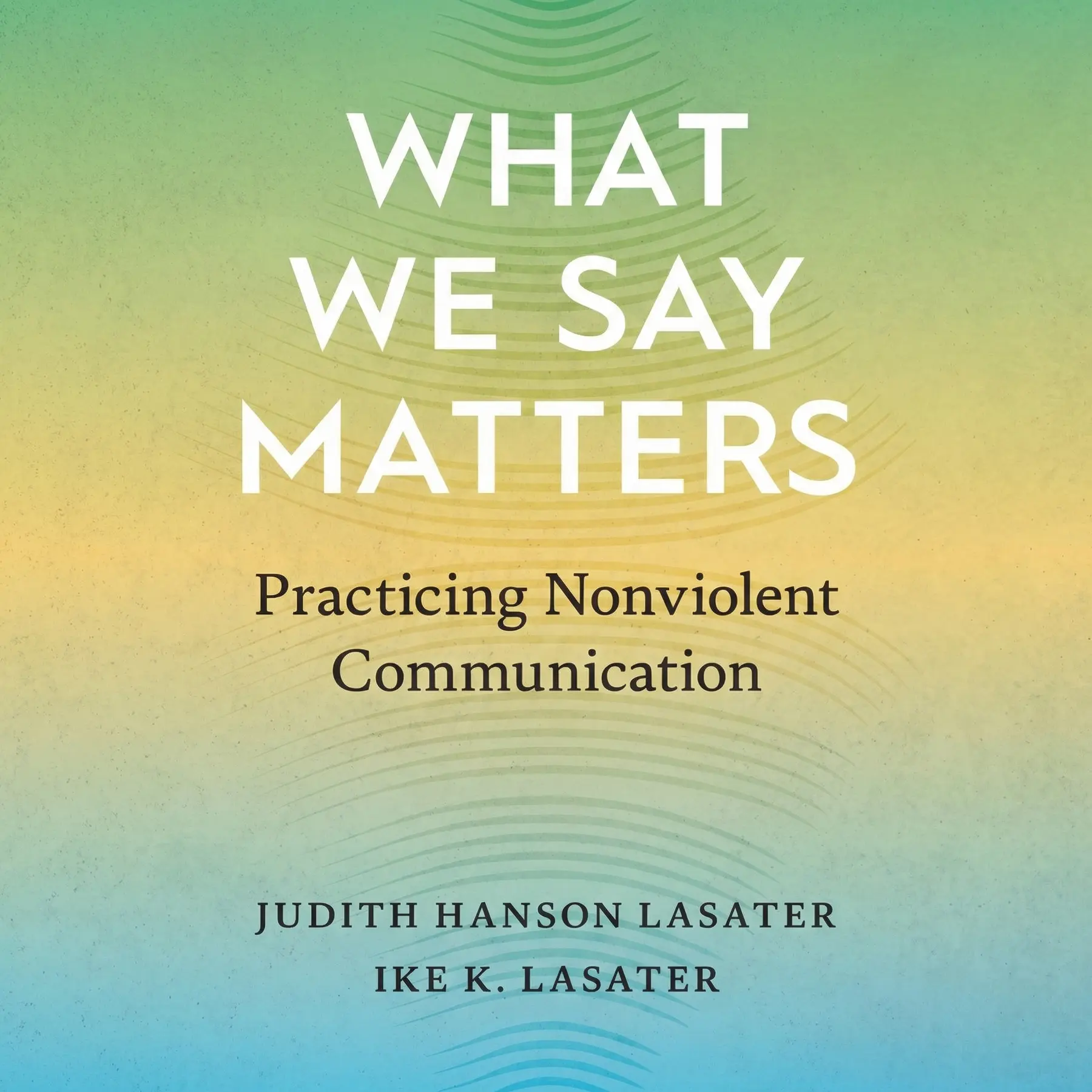
What We Say Matters: Practicing Nonviolent Communication
A practical guide to Nonviolent Communication that shows how to say what is true without wounding anyone, by turning judgments into observations, naming feelings and needs, and asking instead of demanding, at home, at work and inwardly.

Table of Content
1. Introduction
1 min 04 sec
If your honest words keep turning into arguments, the problem usually lies in the shape of the sentence. Telling a housemate they are a slob starts a fight, while describing what you saw, what you felt and what you need starts a conversation. In What We Say Matters, physical therapist and yoga teacher Judith Hanson Lasater and former trial attorney Ike K. Lasater show how to make that shift a habit. Their tool is Nonviolent Communication, a method created by the psychologist Marshall Rosenberg, joined to an old yoga ideal of speech that is both true and harmless.
Their case is that truth and kindness stop pulling against each other once you separate facts from judgments, find the need under each feeling and ask instead of demand. The same sequence works with a partner, a child, your parents, a noisy meeting and the critic in your own head. Expect a sentence pattern ready for the next dirty sink, and a way to steady yourself before you speak.
2. Speak the truth without leaving a wound
1 min 43 sec
You come home tired to a sink full of someone else’s plates, and the words that come out make everything worse. The frustration is fair, so what exactly went wrong between the feeling and the sentence?
3. Turn any complaint into a four-part request
2 min 07 sec
One small word in a complaint is enough to start an argument about the word itself. A psychologist’s method from the 1960s shows which pieces of a sentence invite a fight and which invite help.
4. Listen to yourself before you speak
2 min 01 sec
The right words can still sound like a script when the person saying them is closed off. The missing step happens in silence, before anyone opens their mouth, and it changes how a stranger’s rage looks too.
5. Say no without guilt and cool your anger
1 min 54 sec
Eating a cookie you do not want seems harmless, until you notice who you start resenting afterward. A simple scoring habit and a second look at anger show how to stop paying for other people’s approval.
6. Family requests that land as gifts
1 min 45 sec
The people we love most are often the hardest to talk to, and old ideas about who may have needs make it worse. A change in how you think about asking can turn a chore into an offer.
7. Calmer meetings and kinder self-talk after mistakes
1 min 48 sec
Admitting a feeling at work can look like a risk to your standing. One carefully framed sentence can win you a hearing in a chaotic meeting, and a silent practice changes what follows your own errors.
8. Conclusion
1 min 12 sec
What We Say Matters comes down to one discovery: truth and kindness only seem to compete when a sentence carries judgment and demand where fact and need should be. Separate them and you can say almost anything. The housemate still hears that the dishes bother you. The child still hears that the kitchen must be cleaned. What changes is that neither has to defend who they are.
The method also starts earlier than most advice about talking. It begins inside, with a silent check on what you feel and need, before a single word reaches anyone else. That is why it serves a meeting, a family dinner and the moment after a mistake equally well.
The practice can start small. Write your next complaint as an observation, a feeling, a need and a request, and strip any judgment words from the first part. Score the next favor you are tempted to accept out of ten before you say yes. When anger rises, look for the hurt or fear beneath it.
The dishes will still need washing. The difference is that you can ask for it and remain on the same side as the person holding the sponge.
About this book
What is this book about?
Most people have said something honest that came out as an attack. A housemate leaves the dishes, a child ignores a chore, a meeting turns into a shouting match, and the words we choose push everyone further apart. Judith Hanson Lasater and Ike K. Lasater argue that the fault usually lies in the shape of what we say, and that the shape can be learned. They join an old yoga ideal, speech that is both truthful and non-harming, with Marshall Rosenberg's Nonviolent Communication. The method breaks speech into four parts: an observation free of judgment, the feeling it stirs, the need behind that feeling, and a request that is present and doable. It also asks for empathy in two directions, toward yourself before you speak and toward the other person while you listen. The authors then apply the method to the places where talking is hardest: fear of disappointing others, anger, partners, children, parents, colleagues and the harsh voice that follows a mistake. Readers get a sentence pattern they can use the same day and simple practices for calming themselves first.
Book Information
Who it's for
Complaints that become arguments
Housemates, partners and parents whose honest complaints keep turning into arguments.
Wanting to be heard
Team leads and colleagues who want to be heard in crowded meetings without fighting for airtime.
Guilt, anger and self-blame
People who say yes out of guilt, snap in anger or punish themselves after every mistake.
About the Author
Judith Hanson Lasater
Judith Hanson Lasater is a physical therapist with a Ph.D. in East-West Psychology who has taught yoga around the world since 1971. She helped found the California Yoga Teachers Association, the Iyengar Yoga Institute in San Francisco and Yoga Journal, and her books include Relax and Renew and Living Your Yoga. Ike K. Lasater spent 20 years as a civil trial attorney in California, then trained for more than a decade with Marshall B. Rosenberg, the founder of Nonviolent Communication. With John Kinyon he co-developed the Mediate Your Life training, now offered in five countries, and he has taught conflict resolution to elder leaders in Afghan refugee camps in Pakistan.
Ratings & Reviews
Ratings at a glance
What people think
Listeners find the guide practical and straightforward to grasp, noting the inclusion of excellent exercises. They also value the communication techniques presented, with one listener highlighting how the content integrates Yoga Philosophy. Additionally, the work receives praise for its overall worth and the durability of the physical book.
Top reviews
Sebastian
Finally got around to reading the updated 2022 edition and the new content regarding workplace communication is a total game-changer. Dealing with performance evaluations and tense emails used to give me so much anxiety, but the steps outlined here provide a clear roadmap for staying centered. The Lasaters explain that all criticism is just a tragic expression of an unmet need, which shifted my entire perspective on my difficult boss. I’ve written nearly twenty pages of notes and started practicing the 'four components' with my partner at home. It’s rare to find a book that offers both deep philosophical insight and such concrete, tactical advice for modern life. Highly recommended for anyone looking to reduce the angst in their daily interactions.
Show moreArm
Wow, I didn't expect a book on communication to hit me this hard emotionally. The focus on self-empathy was exactly what I needed at this point in my life. It turns out that I’ve been incredibly violent in the way I talk to myself, which naturally spills over into how I treat others. The Lasaters’ writing is warm and inviting, making complex psychological shifts feel doable. I particularly appreciated the examples of communicating with children; they were eye-opening and immediately applicable in my own household. This book is a beautiful blend of yoga philosophy and practical psychology. It has genuinely changed how I approach every single conversation I have. It’s a must-read for anyone seeking more peace.
Show moreJun
This isn't just a book about talking; it's a manual for living with integrity. Linking NVC with the yogic concepts of ahimsa and satya makes perfect sense, and the Lasaters articulate this connection brilliantly. Every chapter is peppered with memorable gems that challenge your existing worldview. I was especially struck by the idea that unless we are connected with ourselves, our speech cannot be true. The exercises provided me with a way to interact with the information rather than just passively consuming it. Not gonna lie, I was skeptical about the 'nonviolent' label at first, but now I see how much hidden aggression was in my 'normal' speech. This book is an essential tool for personal growth.
Show moreJonathan
Integrating yoga philosophy into daily conversation is something I’ve struggled with, but the Lasaters make it feel attainable. The way they weave the concepts of ahimsa and satya into the mechanics of NVC provided me with a spiritual framework I hadn’t considered before. I found the exercises at the end of each chapter incredibly helpful for anchoring the lessons, especially the sections on self-empathy. Truth is, I used to think I was a good listener, but this book highlighted how often I’m actually just waiting for my turn to speak. The tone is gentle yet firm in its call for personal responsibility. My only minor gripe is that it can feel a bit repetitive towards the end. It’s definitely a resource I’ll keep on my nightstand for a long time.
Show moreFort
Ever wonder why certain conversations always end in a blow-up even when you mean well? This book dives deep into the 'why' behind our communication failures and offers a way out through mindfulness. I loved the connection to Buddhist right speech, as it made the NVC process feel less like a mechanical technique and more like a spiritual practice. The exercises are where the real work happens; they forced me to look at my own habits of judgment. Look, it’s not a magic wand, and some of the scripts provided feel a bit stiff for casual use. However, the underlying principles of identifying feelings and needs are absolutely vital for healthy relationships. I feel more equipped to handle conflict now.
Show morePraepimon
As someone who struggled through Marshall Rosenberg’s original text, I found this version much easier to digest. The Lasaters address many of the common pitfalls that people run into when first trying out NVC, like the tendency to sound like a robot. Frankly, the phrasing still feels a bit weird at times, but the authors are honest about that struggle. The 'four communication choices' section is something I’ve already reread three times because it’s so foundational. It helps you see that you always have a choice in how you receive a message, even a critical one. I gave it four stars instead of five because the 2022 updates, while good, felt a bit tacked on in places. Still, it’s a very solid manual.
Show moreClaire
Picked this up specifically for the chapters on professional environments and found the advice on meetings and emails to be quite helpful. We often forget that our coworkers have needs too, and this book serves as a persistent reminder of our shared humanity. The authors do a great job of explaining how to stay connected to your own feelings without oversharing in an inappropriate way. To be fair, I think I’ll need a few more passes through the text to really filter out the awkwardness of the NVC scripts. It takes a lot of practice to make this sound natural. The sturdy construction of the physical book is a nice bonus too, since I’m constantly flipping through it.
Show moreSom
Not what I expected, but exactly what I needed. I thought this would be a dry textbook on linguistics, but it’s actually a very practical guide to human connection. The Lasaters use plenty of real-world examples that make it easy to see where we usually go wrong in our interactions. I did find some of the phrasing, like 'seduce me with your needs,' to be a bit much for my taste. Regardless, the core message of identifying needs instead of hurling judgments is incredibly powerful. It’s a rewarding read that requires you to actually do the work, not just read the words. I’ve already recommended it to several friends who are interested in yoga and mindfulness.
Show moreOak
While I truly appreciate the intent behind this guide, some of the suggested dialogue felt incredibly unnatural to me. Phrases like 'seduce me with your needs' or the 'duck index' had me rolling my eyes, and I frankly couldn't imagine saying them to a coworker without an awkward silence following. The book provides a decent introduction to NVC, yet I found it lacked the depth of Marshall Rosenberg’s foundational work. It’s a bit lighter and perhaps more accessible for some, but I wanted more nuance. The exercises are a highlight, offering a practical way to engage with the material. If you can get past the occasionally cringey language, there is real value here regarding how we express unmet needs.
Show moreZanya
The core concepts of nonviolent communication presented here are solid, but the book gets bogged down in way too much detail toward the second half. I started with a lot of enthusiasm, specifically enjoying the chapters on parenting and romantic partners. Then, the pacing slowed down significantly, and I found my mind wandering through the more technical explanations. Personally, I think it works better as a reference guide you dip into rather than a cover-to-cover read. It’s a good overview, but it doesn't quite reach the thoroughness of the original NVC texts. If you are new to the subject, this is a friendly entry point, just be prepared for some sections to drag.
Show moreQuestions about this book
What is the main idea of What We Say Matters?
Judith and Ike Lasater argue that honesty need not wound anyone when two yoga ideals are combined with Marshall Rosenberg’s Nonviolent Communication: satya, meaning truthfulness, and ahimsa, meaning a commitment to avoid harm. In practice that means stating a fact without judgment, naming the feeling and the need behind it, and making a present, doable request instead of a demand, after first checking in silently with yourself.
What are the four parts of Nonviolent Communication in the book?
Observation, feeling, need and request. An observation is a checkable fact, such as dishes on the counter, not a judgment like calling the kitchen messy. A feeling signals whether a need is met. A need is something you require to feel content, such as cleanliness. A request must concern the present and be doable, for example asking someone to wash the dishes within the next half hour.
How does What We Say Matters suggest dealing with anger?
The authors treat empathy as the way through anger. Before reacting, take a moment to find what sits beneath it, usually some mix of hurt, fear and frustration, which points you toward what actually needs solving. Empathy for the other person can also prevent anger: someone who keeps interrupting may simply be eager to be heard, and seeing that takes the sting out of it.
Can Nonviolent Communication work in the workplace?
The Lasaters say yes, despite the common fear of losing status by talking about feelings. In a chaotic meeting, instead of forcing your point in, you can offer to tell a colleague how you understood what they said and ask if they will listen. They also recommend silent self-empathy after mistakes, and writing down your feelings and unmet needs during crowded group events.
Who should read What We Say Matters?
It suits anyone whose honest words tend to start fights: people sharing a home, parents of children who resist orders, adults with difficult conversations with their own parents, and colleagues in noisy meetings. It also helps those who agree to things out of fear of judgment or who are hard on themselves after errors, offering simple tools such as scoring choices out of ten.
Readers also enjoyed





AUDIO SUMMARY AVAILABLE
Listen to What We Say Matters in 15 minutes
Get the key ideas from What We Say Matters by Judith Hanson Lasater, plus 5,000+ more nonfiction titles.
- 5,000+ titles
- Listen as much as you want
- 7-day free trial
- Cancel anytime









