

13 min 33 sec
Available in: English
What To Do When Machines Do Everything: How To Get Ahead In A World Of AI, Algorithms, Bots and Big Data
Shows why AI and automation tend to remove tasks rather than whole jobs, and how a company can prepare by collecting data from everything it does, going digital and automating its back office first.
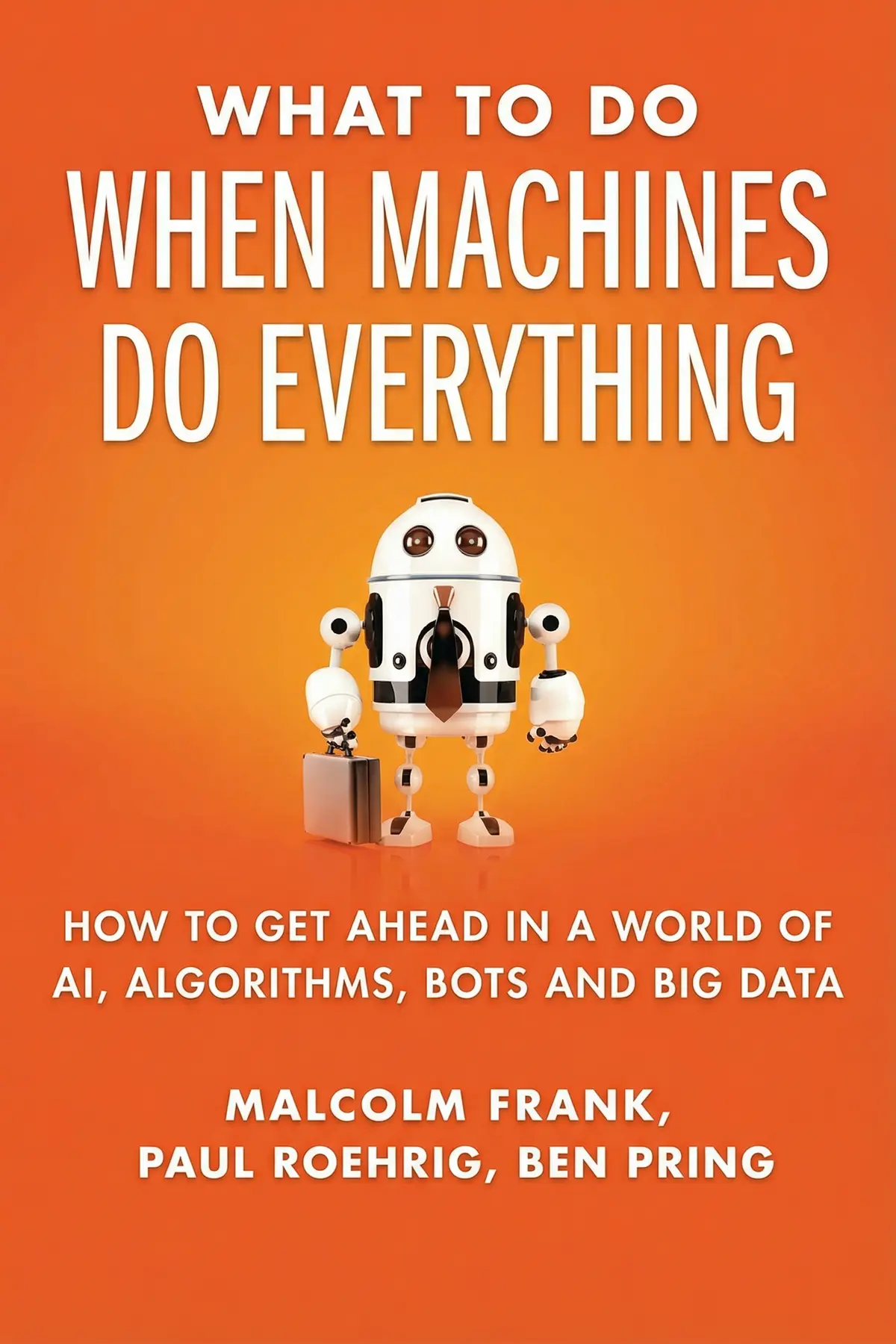
Table of Content
1. Introduction
1 min 06 sec
Most professionals who worry about AI picture losing their job, but the stronger case is that machines will take the most boring parts of their work and leave the rest. In What To Do When Machines Do Everything, Malcolm Frank, Paul Roehrig and Ben Pring, three strategists linked to Cognizant’s Center for the Future of Work, argue that a new industrial revolution is already running, and that data is its fuel the way coal and steel fueled earlier ones.
Their case is that self-learning software will strip tasks out of jobs far more often than it ends them, and that the winners will be those who gather their data, redesign how they work and start automating before rivals do.
The argument moves from history’s long record of machine panic to the software behind Uber and Facebook, then to the practical work of wiring a company for data and clearing out its back office. Along the way comes a calmer way to read job headlines, a test for which parts of your own work a machine will take first, and one exercise that makes a team imagine its own replacement.
2. Read today's automation fears as an old pattern
1 min 51 sec
Textile workers in England were right that the new looms would take their work, and farm jobs nearly vanished. So why do the authors think the current wave of alarm tells only half the story?
3. Automation takes tasks, not whole jobs, so you can adapt
1 min 56 sec
Factories now run with a tenth of the people they once had, yet the authors expect American unemployment to hold steady. The explanation lies in a teacher’s stack of homework.
4. See the learning software behind every app you use
1 min 52 sec
A taxi ride used to leave three scraps of information behind. An Uber ride leaves a trail. That difference explains how today’s machines learn, and why they need no programmer to get smarter.
5. Turn every product and process into a data source
1 min 57 sec
Companies that read their data better than rivals cut costs and grew revenue by the same margin. The authors think your desk, your shoes and your toothbrush are about to look as dated as an old phone.
6. Rebuild your business model for app-first customers
1 min 53 sec
Many employees spend the weekend living through apps, then return on Monday to forms and filing cabinets. Airlines found a middle path between the paper office and the pure start-up.
7. Start automating in the back office first
1 min 49 sec
You may already have read newspaper stories that no person wrote. The same software points to the corner of a company where automation should begin, and it is far from the customer.
8. Conclusion
1 min 09 sec
The book’s real message is about who gets to decide. Machines will take over a great deal of work, as they did with the looms and the farms, but what they take first is the dull part, and what they need is data. That puts the choice with people inside companies: feed the new machines and redesign around them, or wait for a start-up to do it for you.
The authors offer one exercise that pulls all of this together. Ask every employee to dream up five new products or services capable of killing the company they work for. The people living Sunday evening, Monday morning lives already know what a better app feels like. The exercise lets them bring that knowledge to work, and one of their ideas could change the company’s direction.
From there, the moves are small. Break your own job into tasks and notice which ones are repetitive enough for software. Find one process that leaves three traces where it could leave thirty. Choose one back-office report to automate before anything else.
The Luddites were right that the looms would take their work. What they could not see was the work that would come after.
About this book
What is this book about?
Headlines about robots taking jobs arrive every week, and many professionals feel they are watching their careers become obsolete. Malcolm Frank, Paul Roehrig and Ben Pring argue that the fear is old, the threat is real, and the outcome is more hopeful than the headlines suggest. The authors trace a long line of machine panic, from the Luddites who smashed looms to the collapse of farm work. Then they explain the new machine: self-learning software that finds patterns in huge amounts of data, the system running Uber and Facebook. Drawing on dozens of studies and on research from their own consultancy, they argue that automation mostly removes repetitive tasks and creates new jobs alongside the ones it ends. The practical half of the book is a plan for companies. Collect data from every product and process, a practice the authors call instrumenting. Replace paper-based processes with a part-physical, part-digital model that app-first customers expect. Begin automation in the back office, where the numbers already live. Readers get a calmer way to read automation forecasts and concrete first moves for their own team or business.
Book Information
Who it's for
Professionals wary of automation
Professionals uneasy about AI headlines who want to know which parts of their job a machine will take first.
Managers and team leads
Managers and team leads in paper-heavy offices looking for a sensible place to begin automating.
Leaders expecting data-driven rivals
Founders and executives who expect a data-driven start-up to come after their market.
About the Author
Malcolm Frank
Malcolm Frank has served as Chief Strategy Officer and Chief Marketing Officer at the technology services firm Cognizant, studied economics at Yale and is often quoted on the digital economy. Paul Roehrig helped found Cognizant's Center for The Future of Work, led strategy for its digital business unit, was a Principal Analyst at Forrester Research and holds a PhD from Syracuse University. Ben Pring is an IT futurist who has worked with fast-growing technology vendors and demanding corporate buyers.
Ratings & Reviews
Ratings at a glance
What people think
Listeners find the material both revelatory and simple to digest, providing excellent observations on where AI might be headed. The information is also highly valuable for individuals in technology leadership, with one listener specifically pointing out the benefit of the provided framework. In addition, the text is praised for its all-encompassing scope and direct style. However, the work’s cheerful perspective draws varied responses from listeners.
Top reviews
Charles
Finally, a book that doesn’t treat the rise of AI like a scene from Terminator! The authors provide a beautifully optimistic and pragmatic overview of where technology stands today and where it’s headed. I loved the breakdown of how every major economic boom follows an S-curve, moving from initial bubble to eventual stability. It puts our current anxieties into a much-needed historical perspective. Not gonna lie, I was worried this would be too technical, but it’s actually very straightforward and easy to read. The examples of how machines can handle the mundane 'drudge work' so humans can focus on creativity are inspiring. We’ve been here before with the assembly line and the car, and we came out better on the other side. This is essential reading for anyone feeling anxious about their job security in the age of bots.
Show moreWit
Picked this up on a recommendation from my boss and I'm glad I did. It’s a comprehensive guide that finally demystifies what 'big data' actually means for a regular business. The presentation is straightforward, making complex topics like machine learning accessible to non-techies. I particularly enjoyed the section on the Luddites; it’s a great reminder that fear of new technology is as old as time. The book argues that AI will eventually create more jobs than it destroys, which is a perspective we don't hear often enough in the media. It’s eye-opening to think about how much 'invisible' data we generate and how that can be turned into a competitive advantage. If you're in a leadership role and feel like you're falling behind the curve, this book offers a very actionable framework to get back on track.
Show moreSiraporn
Just finished this and it’s a total breath of fresh air. Instead of the usual binary of 'AI will save us' or 'AI will kill us,' the authors take a very pragmatic stance. They show that while certain tasks will definitely be automated, the uniquely human elements of work—creativity, empathy, and complex problem-solving—will become more valuable than ever. The book is well-illustrated with case studies that show these theories in practice. I found the actionable steps for individuals particularly helpful. It’s not just about what companies should do, but what *you* should do to stay relevant. The writing style is engaging and the data they use to back up their historical claims is quite impressive. It’s a rare tech book that manages to be both informative and genuinely encouraging. Highly recommended for anyone trying to make sense of the digital economy.
Show moreAndrei
As someone who manages a small dev team, I found this to be a surprisingly practical guide for navigating the current tech landscape. The authors steer clear of the usual doom-and-gloom scenarios and instead offer what they call the AHEAD model, which focuses on data collection and refining business processes. It’s refreshing to see a focus on how humans can actually leverage these tools rather than just fearing them. To be fair, some of the analogies to the Industrial Revolution feel a bit stretched, and the writing can get a bit dry in the middle chapters. However, the strategic roadmap they lay out for organizational digital transformation is genuinely useful. It’s not a technical manual by any means, but for leadership roles, it’s a solid primer on why the 'fourth industrial revolution' is more about evolution than total replacement.
Show moreJib
The authors really nailed the historical S-curve pattern here. It’s easy to get caught up in the hype of the moment, but seeing how the steam engine and the assembly line followed the exact same path of innovation, bubble, and crash is incredibly grounding. I found the 'AHEAD' model—Automate, Halo, Enhance, Abundance, Discovery—to be a very helpful way to categorize different digital strategies. It isn't just about cutting costs; it's about finding new value. Truth is, most companies are still stuck in the paper-based mindset, and this book provides a clear kick in the pants to move toward a more data-driven approach. My only real complaint is that it occasionally feels like a sales pitch for the authors' consulting firm. If you can look past the corporate gloss, there’s some really high-quality strategic guidance in here.
Show moreSiriphen
Looking past the heavy corporate jargon, there’s a lot of meat here. The authors do a fantastic job of explaining why we are currently in a 'stagnation' period where the technology has arrived but the economic benefits haven't quite spread to everyone yet. It’s a balanced view that acknowledges the fear of job loss while remaining fundamentally hopeful. The chapter on the 'Halo' of data surrounding every physical product was a lightbulb moment for me. It completely changed how I think about my company's inventory and customer interactions. Personally, I think the section on self-diagnosing cars was a bit too 'sci-fi' for a business book, but it did a good job of illustrating the potential of the Internet of Things. Overall, a very informative read that helped me visualize a future where machines and humans work in tandem.
Show moreAom
While the strategic insights are solid, I struggled with the tone of this book at times. The authors are clearly experts in their field, but the focus is so overwhelmingly business-centric that it ignores the very real social disruptions automation causes. They dismiss a lot of valid concerns as 'hogwash' or simple growing pains. In my experience, the transition for workers isn't nearly as smooth as their charts suggest. On the plus side, the AHEAD framework is a decent tool for visualizing how to integrate data analytics into a legacy business model. The chapter on 'Enlightening' processes was particularly thought-provoking. However, the book was written in 2017, and some of the predictions already feel a bit dated or overly simplistic given how fast LLMs have moved lately. It’s a good primer, just take the optimism with a grain of salt.
Show moreGoy
Ever wonder how quickly a tech book can age? Reading this now is a strange experience because while the core principles hold up, the specific examples feel like they’re from a different era of AI. The book focuses heavily on 'bots' and 'algorithms' in a way that feels a bit pre-Generative AI. Still, the underlying message that we need to adapt our skills is timeless. The authors do a great job explaining why the middle of the S-curve is so painful for the workforce. I appreciated the section on how automated cars might change our daily lives, even if their vision of a car self-driving to a repair shop feels like it’s still decades away. It’s a decent introductory text, though it lacks the 'technical grit' that some readers might be looking for. Good for a flight read, but don't expect it to change your life.
Show moreYuki
This felt like a collection of LinkedIn articles that someone decided to stretch into a full-length book. While the central premise—that we shouldn't fear AI—is comforting, the execution is incredibly repetitive and light on actual substance. Look, I understand the need for historical context, but comparing the current AI boom to the steam engine or the power loom over and over again doesn't count as 'unique insight.' It’s mostly corporate-speak designed to sell consulting services. Frankly, the most interesting part of the book is its ridiculously long title, which promises far more than the content actually delivers. If you’ve spent more than five minutes reading tech news in the last three years, you probably already know everything this book has to say. Not exactly the eye-opening experience I was hoping for after seeing it on so many 'must-read' lists.
Show morePiyanart
I found this incredibly frustrating to get through. The authors seem to live in a world where free markets solve everything and 'ingenuity' magically fixes mass unemployment. Their ultraliberal approach completely ignores the human cost of these technologies. It’s a corporate manifesto disguised as a guide to the future. They spend so much time talking about how machines will make our lives easier, but they don't address the police-state dystopia that could arise from the very data collection they champion. The writing is repetitive, the arguments are far-fetched, and the tone is smug. If you want a book that actually explores the ethics of AI or the technical reality of how these systems work, look elsewhere. This is just a manual for how CEOs can replace their staff with algorithms while feeling good about it. Truly disappointing and lacks any real social conscience.
Show moreQuestions about this book
What is the main idea of What To Do When Machines Do Everything?
Malcolm Frank, Paul Roehrig and Ben Pring argue that a new industrial revolution is under way, driven by self-learning software that finds patterns in huge amounts of data. They say this technology will automate many tasks, yet it will also create new jobs and free workers for better work. The companies that thrive, in their view, will build automation into their business models and make full use of their data.
Will AI and automation take my job, according to the authors?
The authors expect automation to remove particular tasks more often than whole jobs. Drawing on dozens of studies, they forecast that about 12 percent of US jobs will be automated over ten years, displacing roughly 19 million workers, while about 21 million new jobs appear. Their example is a teacher whose homework grading is automated, leaving more time for the parts of teaching that need a person.
What does instrumenting mean in business?
Instrumenting is the authors’ term for collecting data from every product, service and source in an organization, so analysts have good material to work with. They compare today’s ordinary objects to old phones that could not store numbers, and predict that by 2025 desks, shoes, toothbrushes and doors will seem just as dumb once small data collectors are built into them.
Where should a company start automating?
The authors recommend starting in the back office, such as human resources and finance, where core operations happen away from customers. These departments collect a lot of data and turn numbers into information, which software handles well. They point to journalism as proof of what is already possible: by 2017 the Associated Press was publishing about 20,000 automated articles a year.
How can I apply the ideas in What To Do When Machines Do Everything?
Break your own work into tasks and mark the repetitive ones, since those are likely to be automated first. Audit which products and processes record no data. Look for places where customers still wait on paper. The authors also suggest asking each employee to invent five new products or services that could put the company out of business, as a way to design its future.
Readers also enjoyed








AUDIO SUMMARY AVAILABLE
Listen to What To Do When Machines Do Everything in 15 minutes
Get the key ideas from What To Do When Machines Do Everything by Malcolm Frank, plus 5,000+ more nonfiction titles.
- 5,000+ titles
- Listen as much as you want
- 7-day free trial
- Cancel anytime









