

13 min 34 sec
Available in: English
We Need to Talk: How to Have Conversations That Matter
Public radio host Celeste Headlee shows how to keep conversations focused on the other person by asking open questions, listening actively and speaking briefly, even with people whose views you oppose.
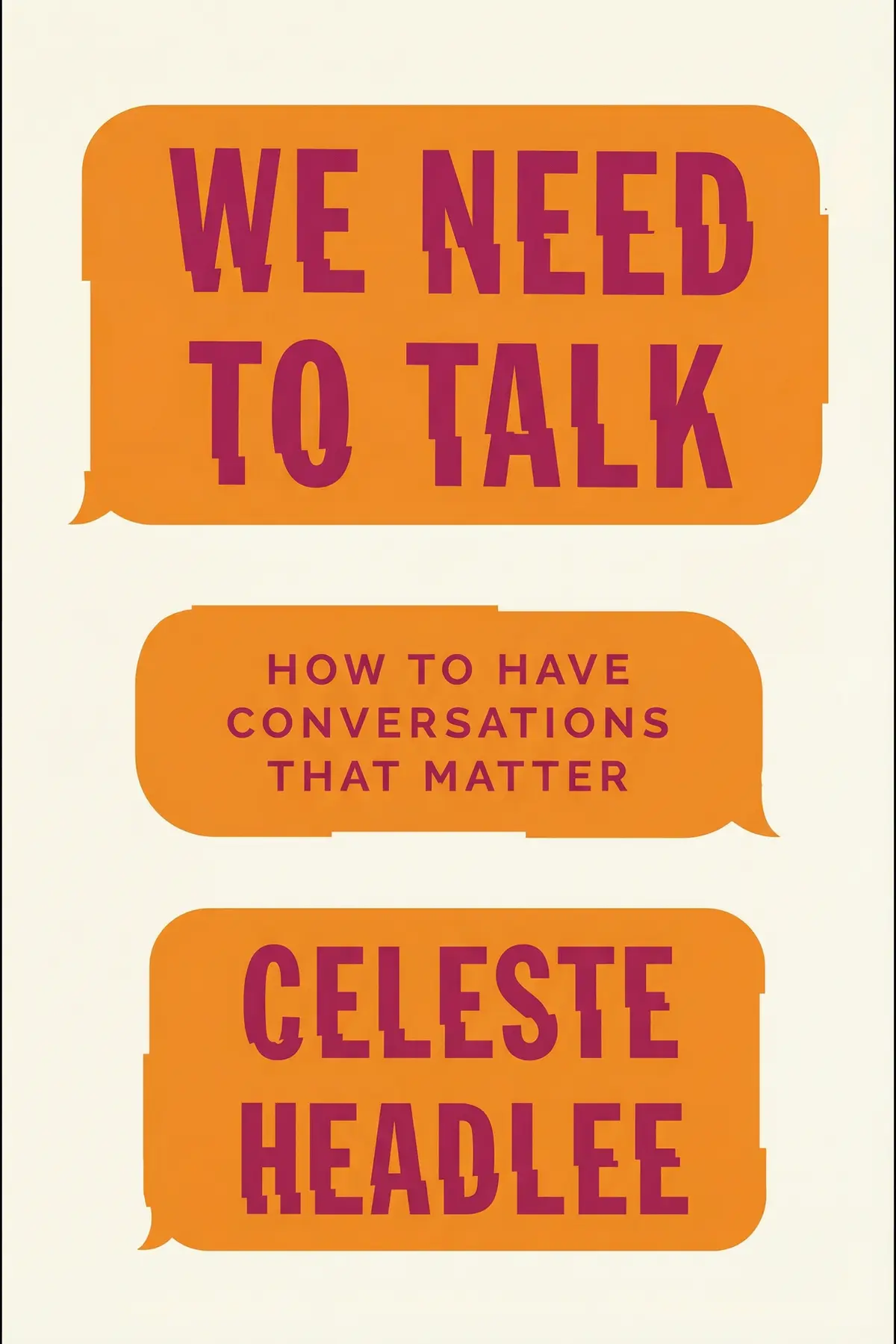
Table of Content
1. Introduction
58 sec
Most people blame a dull conversation on the other person, and Celeste Headlee thinks that gets it backward. In We Need to Talk, the public radio host behind programs such as Talk of the Nation argues that you are the one who builds a good conversation. How you show up counts for more than who sits across from you. She starts from a worrying trend: we are more connected than ever, yet we listen less and feel less empathy.
Her case is that conversation is a skill you can learn, and nearly every rule comes down to one move. Take your attention off yourself and put it on the other person: their views, their experience, their words and their ability to follow you. Headlee draws on her interviews, her own mistakes as a friend and studies that include one on what a phone does just by sitting on a table. A tense talk with a rival, a grieving friend or a quiet colleague then becomes something you can steer toward real connection.
2. Stop blaming the other person for dull talk
1 min 44 sec
A phone lying silent on a table, never touched, still changed how much two strangers trusted each other. Headlee uses that finding to argue that bad conversations have a cause much closer to home than we think.
3. Find common ground with your fiercest opponent
1 min 45 sec
A civil rights activist and a prominent Klansman had to work together as colleagues in Atlanta. What happened between them over the following years suggests that the hardest conversations may be the ones most worth having.
4. Keep the spotlight on the person who is hurting
1 min 37 sec
Headlee tried to comfort a grieving friend by sharing her own loss, and her friend left feeling worse. The mistake has a name, and most of us make a small version of it every day.
5. Short questions that get people talking
1 min 32 sec
A long, careful question seems like the best way to draw out a long, thoughtful answer. A veteran interviewer explains why the opposite works, and what to do in the pause that follows.
6. Learn to listen, because it takes real effort
1 min 38 sec
Talking about yourself lights up the same brain region as some of life’s strongest pleasures. Listening gets no such reward, which may explain why so many people who think they listen well do not.
7. Speak so the other person can catch it
1 min 41 sec
Most radio interviews end faster than a frozen pizza heats up, yet they feel full. Headlee explains what that tells us about the stories we tell at work and at home, and why more detail often means less heard.
8. Deeper talks make both people happier
1 min 33 sec
Students who talked the most were not the happiest in one study from Arizona. The ones who came out on top had a different kind of conversation, and the gains reached beyond them.
9. Conclusion
1 min 06 sec
Headlee’s book makes a modest claim with large consequences: conversation is something you do well or badly, and doing it well depends mostly on where your attention goes. The phone on the table, the me-too reply, the comeback planned in advance and the rambling story all fail the same way. Each one pulls the focus back to you. Xernona Clayton showed what happens when the focus stays on the other person. A Klansman found her good company, and in time he walked away from the Klan.
The book supports a few changes you can make this week. Put your phone out of sight before a talk that matters. When someone shares news, good or bad, answer with a question about them instead of a story about you, and admit it when you do not know what they are going through. Ask questions that begin with what or how, then let the silence after them breathe. When your turn comes, make your point once and stop.
None of this needs charm. It needs attention, given fully, to one person at a time.
About this book
What is this book about?
We are more connected than ever, yet many of our conversations feel shallow. Celeste Headlee points to studies suggesting we listen less and feel less empathy than earlier generations, and to research showing that a phone lying unused on a table can still weaken trust between two people. Headlee has spent her career interviewing people on public radio, and she argues that conversation is a skill you can practice like any other. Her method rests on one habit: moving your attention away from yourself and onto the person in front of you. She uses the sociologist Charles Derber's distinction between shift responses and support responses. She shows why short open questions get people talking, why listening takes real effort and how long, repetitive stories lose an audience. Readers get concrete practices for hard talks, with grieving friends, quiet colleagues and even ideological opponents. They also get the case, drawn from a study of students in Arizona, that deeper conversations make people happier than frequent small talk.
Book Information
Who it's for
Professionals in shallow meetings
Professionals whose meetings and one-on-ones feel shallow and who want colleagues to open up.
Unsure how to comfort
Friends and partners who freeze or say the wrong thing when someone shares bad news.
Avoiding talks across divides
Anyone who avoids talking with people on the other side of a political divide.
About the Author
Celeste Headlee
Celeste Headlee built her career in public radio, anchoring programs such as Talk of the Nation and All Things Considered and co-hosting the morning news show The Takeaway. Her TEDx Talk on having better conversations has drawn more than 40 million views. We Need to Talk, her first book, won the 2017 Silver Nautilus Award in Relationships and Communication. She also wrote Do Nothing and leads Headway DEI, a non-profit that trains organizations in racial justice and equity.
Ratings & Reviews
Ratings at a glance
What people think
Listeners value the research-driven advice and the direct way this work navigates effective communication. They describe it as an accessible, skillfully written guide that emphasizes empathy and genuine curiosity, with one listener highlighting its particular relevance in the current political landscape. They respect the author’s honesty and feel the content is well worth the investment.
Top reviews
Yindee
As a public radio listener, I was already familiar with Headlee's poise, but this book adds so much depth to her philosophy on human connection. She argues that conversation is a dying art, and frankly, looking at our digital habits, it is hard to disagree with her assessment. Her insights into how curiosity can bridge gaps between people who fundamentally disagree are both practical and incredibly moving. I particularly appreciated the section on “conversational narcissism”—it's a humbling concept that made me realize how often I shift the focus back to myself without even noticing. While some chapters feel a bit anecdotal, the core message is vital for anyone trying to navigate our current polarized climate. It’s a quick read that packs a punch, blending research with the kind of candor you'd expect from a seasoned journalist. If you want to actually hear people instead of just waiting for your turn to speak, buy this.
Show moreChatchai
After hearing so much about our divided culture, I picked this up hoping for a way to have better dialogues with people I disagree with politically. Headlee delivered exactly what I needed. Her perspective as a biracial woman navigating difficult interviews provides a unique backdrop for her advice on empathy and active engagement. She doesn't just tell you to be nice; she explains the science of why our brains struggle to listen when we're stressed or distracted. The part about how “we need to talk” is often a phrase of dread was a great opening to her argument for making conversation a joy again. Personally, I found the second half of the book, which offers concrete strategies for asking open-ended questions, to be the most valuable. It’s a beautifully written call to action for a more connected world.
Show moreRoo
Wow, what a timely read for anyone navigating tough work dynamics or family holiday dinners. Celeste Headlee manages to make a book about “rules” feel incredibly warm and human. I loved the insight that a good conversation shouldn't require work to appear engaged; if you're actually listening, you don't need to fake the eye contact. This book pushed me to be more present and to value the “spiritual experience” of truly hearing another person’s story. In an era where we just shout at each other on social media, this is a breath of fresh air. It’s well-written, engaging, and contains practical strategies that I started using the very next day. Everyone should read this—especially the people who think they don’t need it.
Show moreGung
Ever wonder why conversations feel so draining lately? Headlee points the finger at our decreasing attention spans and our obsession with ourselves, and she has the data to back it up. The concept of the “yellow light” at twenty seconds was a total game-changer for me; I never realized I was hitting the “red light” so often in casual chats. This book is less of a “how-to” and more of a “how-to-be,” focusing on the mindset of curiosity rather than just robotic social tricks. I found the chapter on the benefits of silence particularly striking because we live in a world that is terrified of a quiet moment. Look, it’s not a revolutionary scientific text, but it’s a very necessary mirror for our self-absorbed culture. I've already started applying the rule of not repeating myself, and the results at work have been surprisingly positive.
Show moreSupranee
The concept of 'conversational narcissism' hit me like a ton of bricks while I was reading this on my commute. It’s that subtle urge to hijack a story—someone tells you about their loss, and you immediately jump in with your own experience to “relate,” when really you're just taking the spotlight. Headlee uses her background in journalism to show why this behavior kills real connection. I loved the practical tips, especially the advice to avoid multitasking at all costs during a serious discussion. To be fair, she uses “I” quite a bit for a book about not talking about yourself, which felt slightly hypocritical at times. Still, the research she cites from sociologists like Charles Derber adds a layer of intellectual weight that makes the book feel authoritative. It’s a helpful, accessible tool for anyone who feels like they’re losing touch with the people around them.
Show morePear
Picked this up because I’m a chronic over-sharer and I wanted to learn how to rein it in. Headlee’s breakdown of why we repeat ourselves—and why it doesn't actually help people understand us better—was eye-opening. The book is structured logically, moving from the philosophy of why we talk to the practical “how-to” of better listening. I found the advice on when not to have a conversation just as important as the tips for having one. It’s easy to read and doesn’t feel like a dry textbook, which I appreciated. My only gripe is that it feels a bit repetitive in the final third, but the core message is strong enough to carry it. It’s a solid investment for your personal growth.
Show moreIngrid
Headlee’s background as a journalist shines through in the way she structured this guide. She knows how to tell a story while weaving in facts, making the advice stick much better than a standard self-help book. The discussion on “conversational narcissism” was the standout for me, as it gave a name to a behavior I see everywhere. While the book can be a bit heavy on personal anecdotes, her points about the 40-second rule and the importance of open-ended questions are gold. It’s a practical, straightforward approach to a skill we all assume we have but most of us have actually lost. I’d recommend it to anyone who wants to improve their professional relationships or just have more meaningful dinners with their spouse. Definitely worth the time.
Show moreMint
If you’ve already seen Celeste Headlee’s TED talk, you might find that this book feels like a very long expansion of those same ten minutes. It is a solid, well-written guide, but I didn't find much “new” information that isn't already common knowledge for anyone who has studied basic communication. The advice is fundamentally sound: listen more, talk less, and stop checking your phone every thirty seconds. However, I did enjoy her debunking of “active listening” tropes like constant nodding or forced eye contact, which she correctly identifies as distracting. Truth is, while the writing is engaging, the pacing drags in the middle when she recounts too many personal stories from her time at the grocery store or in meetings. It’s a decent refresher for those needing a nudge toward empathy, but it could have been half the length.
Show morePranee
To be fair, much of the advice here feels like common sense dressed up in journalistic flair. We all know we should put our phones away and listen more, so do we really need a whole book to tell us that? That said, Headlee’s writing style is very conversational and easy to digest, making it a quick weekend read. I appreciated her honesty about her own failures in communication, which made the “preachy” parts a bit easier to swallow. The sections on the impact of technology were interesting, though they felt a bit dated already. It’s a good book for someone who has never thought about their social habits, but if you’re already a self-aware person, you might find it a bit redundant. Three stars for the effort and the few research bits that were actually new to me.
Show moreNatalie
Frankly, I struggled with the irony of this book. While Headlee spends hundreds of pages telling us to stop talking about ourselves and to avoid conversational narcissism, nearly every page is filled with her own anecdotes. I lost count of how many times she mentioned her career in radio or her personal shopping trips. It felt less like a guide to conversation and more like a memoir disguised as self-help. There are some okay nuggets of wisdom, but you can get the same value from a ten-minute YouTube video without the repetitive filler. If you’re looking for real depth, I’d suggest “Thanks for the Feedback” instead. This one just felt a bit too “surface-level” for me, and the tone occasionally veered into being slightly preachy. Not the life-changing manual I was hoping for.
Show moreQuestions about this book
What is the main idea of We Need to Talk by Celeste Headlee?
Headlee argues that good conversation is a skill, not a gift, and that we are losing it as technology encourages shallow contact. Her method centers on shifting attention from yourself to the other person: finding common ground, giving support responses instead of shift responses, asking open questions, listening actively and speaking briefly. Done well, she says, conversation makes people happier and more empathetic.
How does a shift response differ from a support response?
The terms come from sociologist Charles Derber. A shift response moves the conversation’s focus to you, even with something as small as saying me too. A support response keeps the focus on the other person. If a friend says they are busy, answering that you are too is a shift; asking what is filling their schedule is support.
How do you get someone to open up in conversation?
Headlee recommends short, open-ended questions starting with who, what, where, when, why or how, since they cannot be answered with yes or no. Instead of asking a tornado witness whether they were scared, ask what it was like, what they heard and how it felt. Then tolerate silence and keep your mind from drifting to your next line.
How does We Need to Talk suggest talking to people you disagree with?
Headlee points to Xernona Clayton, a civil rights activist who worked alongside Ku Klux Klan member Calvin Craig in Atlanta. By being good company rather than forcing her views, she built a bond, and Craig left the Klan in 1968, crediting their relationship. Show respect, commit to the conversation and listen, even if you still disagree.
Who should read We Need to Talk?
It suits people who want deeper conversations at work or at home: managers and colleagues trying to get quiet people talking, friends unsure how to comfort someone in grief, and anyone who avoids people with opposing views. Its advice is practical and drawn from Headlee’s years of radio interviewing, from short questions to keeping stories brief.
Featured in
Readers also enjoyed










AUDIO SUMMARY AVAILABLE
Listen to We Need to Talk in 15 minutes
Get the key ideas from We Need to Talk by Celeste Headlee, plus 5,000+ more nonfiction titles.
- 5,000+ titles
- Listen as much as you want
- 7-day free trial
- Cancel anytime









