

14 min 07 sec
Available in: English
Verbal Judo: The Gentle Art of Persuasion
Shows how police officers, including an English professor who also walked a beat, calmed an armed man, a screaming couple and stubborn suspects with words alone, and how anyone can use the same methods with colleagues, children and partners.
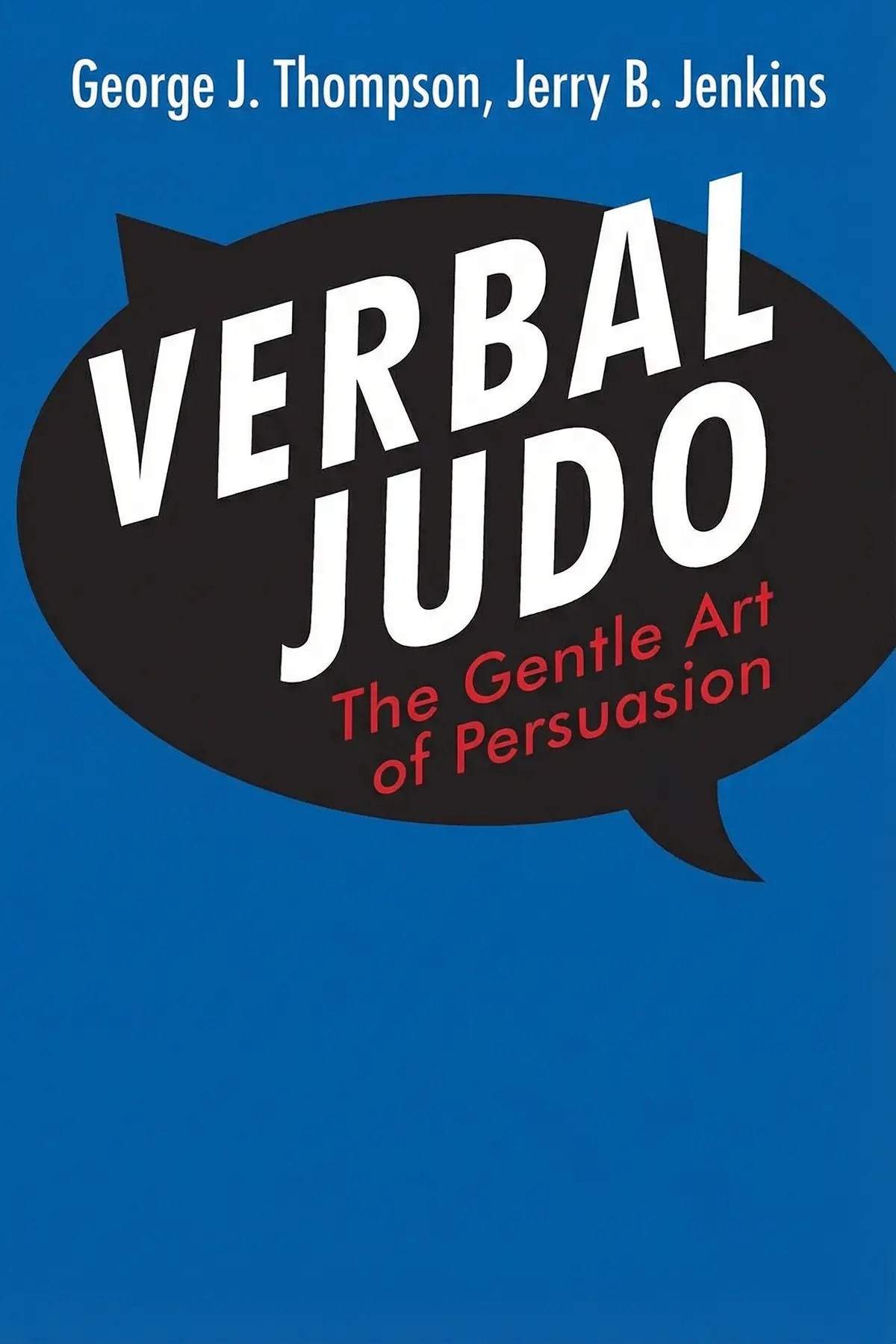
Table of Content
1. Introduction
55 sec
When a conversation turns hostile, most people either push harder or back down, and both usually make things worse. In Verbal Judo, George J. Thompson, an English professor who also worked as a police officer, and writer Jerry B. Jenkins argue that you can hold your ground without any aggression at all. Thompson learned this on the street, where one careless sentence can start a fight and one well-chosen sentence can end it.
His claim is that calm persuasion under pressure is a skill with parts you can study, and the parts are gentle ones: reasons instead of orders, empathy, restating what you heard, laying out the consequences and keeping your own temper. The stories range from an armed man in an alley to a couple screaming at two in the morning. They give you words for an angry customer, a stubborn teenager or a partner who meets you at the door with an accusation.
2. Break the rhythm of a fight before it grows
1 min 33 sec
Two people are screaming in the middle of the night, and a veteran officer walks in and opens a newspaper. What he did next ended the fight, though even he could not explain why it worked.
3. Trade orders for reasons people can accept
1 min 28 sec
A handful of everyday phrases, used by parents, teachers and police alike, almost guarantee resistance. Thompson explains why they backfire and what to say in their place.
4. See the situation through the other person's eyes
1 min 31 sec
Pleading that life is precious seems like the only thing to say to a man threatening to end his. Thompson said the opposite, and it reveals what empathy actually demands.
5. Stop a monologue with one neutral word
1 min 35 sec
Some people talk without pausing, and telling them to calm down only adds fuel. A single word and one careful sentence can hand you control of the conversation instead.
6. Make the stakes plain and let people choose
1 min 31 sec
A huge man with a broken bottle was walking toward a young officer who had no reason to expect cooperation. A short lesson about two kinds of charges changed the man’s mind.
7. Fit your words to the person in front of you
1 min 33 sec
There are countless ways to say sorry, and many of them make things worse. Thompson explains how to find the version that actually reaches the person you are talking to.
8. Keep your head when someone challenges your authority
1 min 28 sec
Thompson’s biggest obstacle on the job was never a suspect. It was a voice in his own head, and the way he tamed it can work on any trigger you carry.
9. A domestic fight that ends closer than it began
1 min 31 sec
A newly married man came home tired and was hit with an accusation he never saw coming. His long, bitter night was avoidable, and the fix uses two simple moves.
10. Conclusion
1 min 02 sec
Verbal judo reverses a common belief about authority. The person who gets results is rarely the loudest one in the room. It is Bruce Fair asking to borrow a phone, or a young Thompson explaining the gap between one night in jail and a felony to a man holding a broken bottle. Respect, reasons and understanding, in Thompson’s account, are what make people cooperate, and that holds in a kitchen as much as in an alley.
The habits it asks for are small enough to start tomorrow. Attach a reason to every request, and drop the phrases that talk down to people. When someone is heated, break in with one neutral word and tell them back what you heard, checking the words that sting most, like always or on purpose. And give your worst reflex a name, so you catch it before it speaks for you.
None of this means agreeing with the other person or even liking them. It means seeing where they stand and speaking to them from there, which is often all it takes for a shouting match to end before it starts.
About this book
What is this book about?
Most arguments go wrong in the first few sentences. Someone gives an order, talks down to the other person or hides behind a rule, and a small disagreement becomes a standoff. George J. Thompson saw this happen again and again on police patrols, and he also saw experienced officers end dangerous scenes without raising their voices. With writer Jerry B. Jenkins, Thompson turns those street instincts into a method he calls verbal judo. Its tools are gentle: swap commands for explanations, practice empathy without needing to like the other person, interrupt with a single neutral word and paraphrase what you heard, lay out the facts so people can choose, fit your words to each listener, and name the inner reflex that makes you lose your cool. The stories come from real calls, including a man in an alley with a broken bottle and a couple fighting at two in the morning, and from ordinary homes. Readers get a practical way to stay calm, be heard and keep authority in tense conversations at work and in family life.
Book Information
Who it's for
Managers handling workplace anger
Managers and team leads who handle angry staff or customers and want to stay calm and in charge.
Parents of defiant kids
Parents tired of saying rules are rules to children who refuse to listen.
Couples whose spats escalate
Partners whose small disagreements keep turning into long, bitter arguments.
About the Author
George J. Thompson
George J. Thompson, known as Doc Rhino, was an English professor who also worked as a police officer on an urban beat, where he created and tested verbal judo. He held a doctorate in English from the University of Connecticut, did post-doctoral work in rhetoric and persuasion at Princeton, founded the Verbal Judo Institute and trained more than 700,000 people before his death in 2011. Co-author Jerry B. Jenkins has written more than 200 books, including the Left Behind series.
Ratings & Reviews
Ratings at a glance
What people think
Listeners find this guide provides useful strategies and guidance applicable across multiple professions, especially within law enforcement. The book is lauded for being highly readable; one listener mentions it is mandatory reading for their organization, and they appreciate the straightforward communication advice that helps enhance personal connections. Listeners value the high-caliber information provided, with one pointing out that the compact volume is filled with substance. They are also drawn to the verbal judo methodology, as one review emphasizes how effectively it works for de-escalating tense interactions.
Top reviews
Phimwan
Finally got around to reading this classic on communication. It’s easy to see why it’s required reading for so many organizations. Thompson’s background as both an English professor and a cop gives him an effective edge in explaining how words function in high-pressure situations. He breaks down how to use 'strip phrases' to deflect insults and keep a conversation on track. The book is definitely dated in parts—some anecdotes feel like they’re straight out of a 70s cop show—but the core principles of de-escalation are sound. I’ve already started using the 'let me be sure I heard what you said' technique with my coworkers, and it actually works to lower the temperature of a room. It's a quick read, though a bit repetitive toward the end with the constant acronyms like LEAPS and SAFER. If you deal with difficult people daily, you need this in your toolkit.
Show moreIsaiah
Dr. Thompson has a unique perspective that bridges the gap between academia and the street, and it shines in this text. I picked this up because it’s a staple in law enforcement training, and I was surprised by how applicable it is to general management. The book teaches you how to get people to do what you want without creating an enemy in the process. I loved the breakdown of dealing with 'difficult' people—it’s a helpful framework when you’re in the heat of a moment. Some might find his tone a bit callous, but I think he's just being realistic about human nature. The focus on 'voluntary compliance' is something every leader should study. It’s a quick, high-impact read that I’ll likely revisit. It definitely helped me improve my relationships at work by teaching me to respond rather than react.
Show moreDen
Ever wonder why some people can talk their way out of a confrontation while others escalate it? This book explains the art of 'voluntary compliance' in a way that is easy to understand and immediately applicable. Thompson isn't interested in your feelings; he’s interested in results. He teaches you how to stay calm when someone is screaming in your face, which is a superpower in today's world. I found the 'Ultimate Empathetic Sentence' to be a particularly powerful tool for my marriage, ironically enough. The book is short and dense, which I appreciate. No fluff, just practical strategies. Even though some of the examples are dated, the psychology behind them is timeless. It’s one of those rare books that actually changes how you speak to people the next day. Five stars for the impact it’s had on my temper.
Show moreEmma
As someone who works in the security industry, I found the tactical advice here invaluable for daily interactions. It’s not about being nice; it’s about being professional and keeping yourself safe. The book is packed with content in a small format, focusing on how to maintain emotional distance during a conflict. Thompson’s emphasis on 'looking good and sounding good' is a harsh reality in our field. Sometimes you have to fake empathy to de-escalate a situation before it turns physical. I do agree with other reviewers that the acronyms are a bit much—it starts to feel like alphabet soup after a while. However, the 'Sword of Insertion' technique for interrupting a tirade is a total game-changer. It’s a very readable guide that offers practical 'street smart' material instead of just dry theory. A solid 4 stars for real-world utility.
Show moreTeng
Picked this up on a recommendation from my supervisor, and it’s been surprisingly helpful for my customer service role. I’m not a cop, but I deal with angry people all day, and the 'strip phrases' Thompson suggests really do help de-escalate things. Using a phrase like 'I 'preciate that, but...' allows the other person to vent without you losing control of the situation. I will say, the book is a bit heavy on the acronyms—PAVPO, LEAPS, SAFER—it’s a lot to memorize. The audio book narrator has a crazy, gravelly voice and an accent that makes him sound like he’s right out of a police precinct. While I don't agree with every 'rule' he lays out, the core message of keeping your professional face on is vital. It’s a solid manual for anyone who has to provide service to difficult people.
Show morePing
The chapter on 'strip phrases' alone made this worth the purchase for me. I work in a high-stress environment where insults fly frequently, and learning to 'strip' the power from those words has saved my sanity. Thompson’s writing is definitely an acquired taste—he’s got that old-school, 'jock' energy that can be a bit much. But if you can get past the bravado, there is real gold here. He explains the difference between reacting and responding in a way that finally clicked for me. I do wish the book was better edited; it gets very repetitive and the 'guru' vibe is a little cringey. However, the techniques for paraphrasing to ensure you're actually hearing the other person are brilliant. It's a 4-star book because while the delivery is flawed, the content is life-changing for professionals dealing with the public.
Show moreRome
Look, the writing isn't exactly Pulitzer-winning material, but the core message is solid. George Thompson was a man who clearly knew how to handle himself in a conflict. I’ve read a lot of communication books, and most are too 'soft' for the real world. This one isn't. It's about how to win a verbal fight without actually fighting. I liked the section on the 'Sword of Insertion' and how to interrupt people politely. It’s definitely directed toward police officers, but as a teacher, I found plenty of takeaways for my classroom. My only gripe is that it feels a bit like a sales pitch for his seminars at times. Still, the advice on 'looking good or no good' is a reality check we all need. If you want practical tips that work on the street, this is it.
Show moreWanphen
Is this book useful? Yes, but it's also incredibly frustrating. On one hand, the concept of 'Verbal Judo'—using an opponent's energy against them—is a brilliant metaphor for communication. On the other hand, the writing style is unnecessarily verbose and the structure is a mess. Thompson repeats himself constantly, and the 'gurules' are hard to keep track of. I appreciated the sections on paraphrasing and the fourteen benefits he lists, but did we really need a hundred pages of 'why this matters' before getting to the 'how to do it' part? To be fair, there are some gems hidden in the fluff. The advice to treat everyone with respect but talk to them differently is a perspective shift I needed. It's a 3-star read for me because I had to dig through too much bravado to find the actual skills.
Show moreYuki
Not what I expected based on the title. I was hoping for deep psychological insights, but instead, I got a lot of macho bravado and a guru-like presentation that rubbed me the wrong way. The author describes himself as a jock with a chip on his shoulder, which makes it hard to take his advice on 'gentle' communication seriously. He spends way too much time boasting about his PhD and his street smarts rather than just giving us the tools. While the idea of 'voluntary compliance' is interesting, the methods often feel like you're just pretending to care to get what you want. Personally, I found the stories about people in crisis more disturbing than helpful. The way he categorized people into 'Nice, Difficult, or Wimps' was far too simplistic for the complexities of real human behavior. If you’re looking for genuine connection, read Nonviolent Communication instead.
Show moreWilliam
Truth is, I felt like I was being taught how to manipulate people rather than actually empathize with them. The author admits that whether you're actually interested in the other person is 'irrelevant' as long as they believe you are. That’s a pretty cynical way to view human interaction. Coming from a background in behavioral health, I found his approach to crisis intervention borderline dangerous. The story about the man in the bathtub was horrifying; his lack of genuine compassion for someone in a mental health emergency was hard to read. There are some okay tips on active listening, but they are buried under layers of toxic masculinity and chest-beating stories. Frankly, I think the popularity of 'Verbal Judo' is just because the name sounds cool. If you want real communication skills that build trust, look elsewhere. This felt like a time capsule of bad 90s attitudes.
Show moreQuestions about this book
What is the main idea of Verbal Judo?
George J. Thompson argues that you can assert authority and be heard without aggression. Drawing on his years as a police officer, he shows that people cooperate when you avoid orders and condescension, explain your reasons, see things from their side, paraphrase what they say and lay out the consequences of their choices. He adds that you must also identify and manage your own communication weaknesses.
What phrases does Verbal Judo say to avoid?
Thompson warns against barking at someone to come here, which sounds threatening and gives no reason to comply. He also rejects telling someone they wouldn’t understand, which implies they are stupid or inferior, and falling back on the line that rules are rules. In each case he suggests a respectful alternative, such as asking for a word politely or explaining the reason behind a rule.
How does paraphrasing work in Verbal Judo?
First interrupt with a single neutral word, such as whoa or listen, instead of telling the person to calm down. Then say you want to make sure you understood correctly and restate their point in your own words. This shows you were listening, makes them more willing to listen to you, and often shrinks an exaggerated complaint, like always being late, into something specific you can discuss.
Is Verbal Judo only for police officers?
No. Thompson developed his methods on police patrols, but he applies them to parents explaining bedtimes, partners handling accusations and anyone dealing with someone who will not stop talking. The book’s stories include a couple fighting at night, a newly married man blindsided by his wife, and an apology for a missed anniversary, so the tools fit work and home as well as the street.
What is an inner enemy in Verbal Judo?
An inner enemy is a personal weakness that makes you communicate badly under pressure. Thompson’s was his anger when suspects challenged his authority, which made him want to snap back with wanna bet. By naming it his wanna bet voice, he could recognize it faster, step back and stay calm. He recommends naming your own triggers the same way.
Featured in
Readers also enjoyed





AUDIO SUMMARY AVAILABLE
Listen to Verbal Judo in 15 minutes
Get the key ideas from Verbal Judo by George J. Thompson, plus 5,000+ more nonfiction titles.
- 5,000+ titles
- Listen as much as you want
- 7-day free trial
- Cancel anytime









