

13 min 25 sec
Available in: English
UX Strategy: How to Devise Innovative Digital Products That People Want
By Jaime Levy
Shows how to join business strategy and user experience design so a digital product has a real edge. You check demand with personas, interviews and competitor research, then design only the experiences that matter.
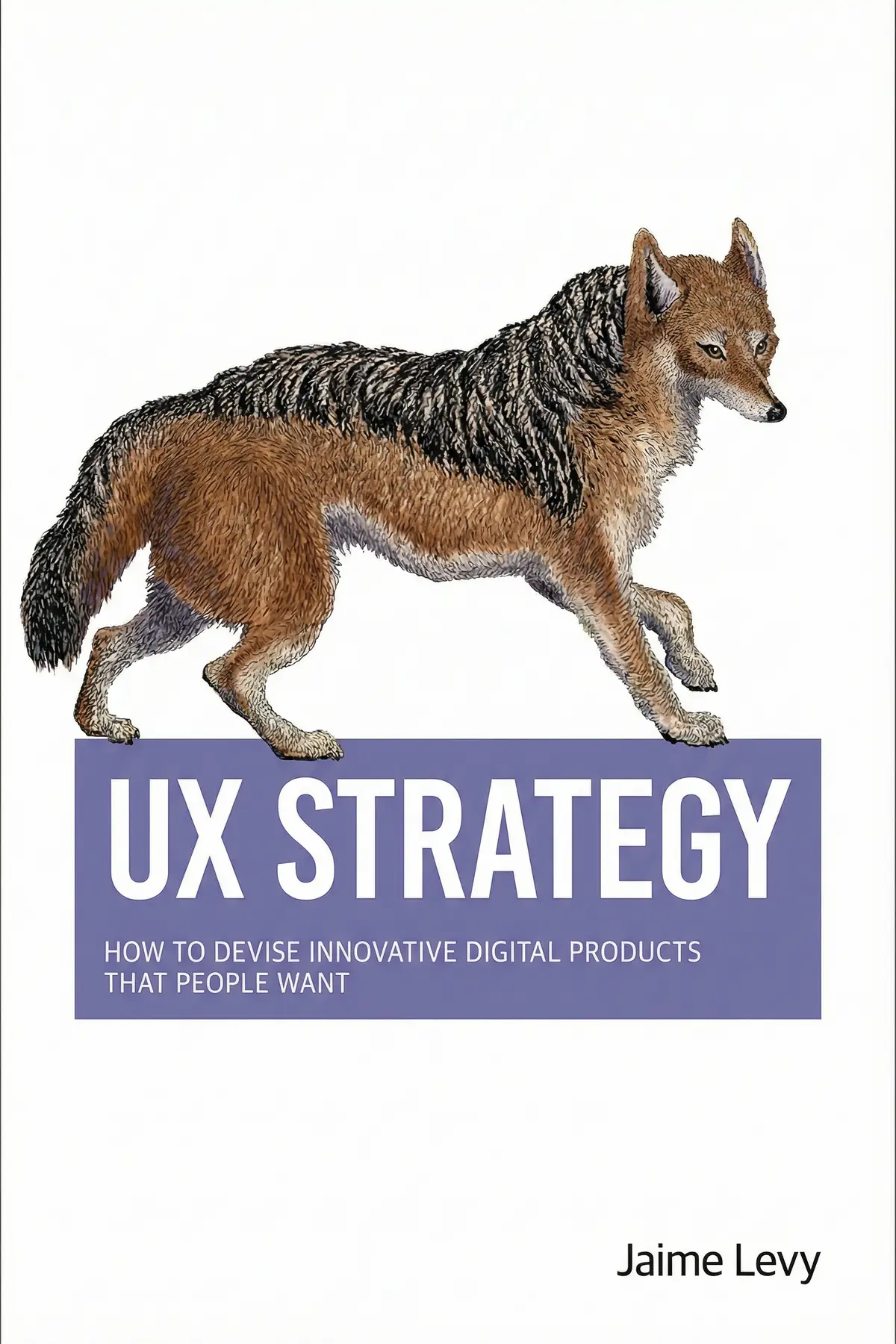
Table of Content
1. Introduction
59 sec
Plenty of teams build a polished app that nobody signs up for, then spend months redesigning screens that were never the problem. In UX Strategy, product strategist Jaime Levy argues that the fix starts earlier. User experience design only works when it fits a business strategy that gives people a real reason to choose you.
Her method joins the two. First you find your competitive advantage. Then you check with real users and real rivals that the advantage holds. Only then do you design the few experiences that deliver it. Along the way she draws on Starbucks and Walmart, on Facebook’s first months at Harvard and on Airbnb’s map, plus a wedding-planning app built step by step as a running example.
What you get is a sequence you can run on your own product idea: sketch the user, interview real ones, map the competition in a spreadsheet and storyboard the path from first click to finished task.
2. Fix the strategy before you polish the screens
1 min 49 sec
A small company with a worthy mission built a database, a website and an app, then redesigned the app when nobody came. The redesign changed nothing, and the reason it failed applies to almost every struggling product.
3. Find the edge that makes customers choose you
1 min 57 sec
Starbucks and Walmart win in opposite ways, and both stay in business for the same reason. A third path, which Facebook took, combines their methods and opens a market with nobody else in it.
4. Prove the idea on a small crowd first
1 min 48 sec
Facebook did not open its doors to the world on day one. What its founders did instead, and what Airbnb did with a simple map, shows how to lower the cost of being wrong.
5. Sketch your user, then go meet the real one
1 min 52 sec
An imagined user with a name, a salary and a busy schedule can sharpen any product idea. It can also mislead you badly, unless you take it somewhere unexpected, like a shopping mall.
6. Map your rivals to see what is truly yours
1 min 55 sec
Digging into competitors can reveal that your brilliant idea is not as original as you thought. That discomfort, handled the right way, is exactly how you find the part nobody else owns.
7. Build only the moments that set you apart
1 min 51 sec
The best products leave most possible features out. Airbnb found one of its defining features in a completely different kind of company, and a few rough sketches can show you where yours might come from.
8. Conclusion
1 min 14 sec
Levy’s book adds up to a warning and a remedy. The warning comes from the rehab start-up: a beautiful app cannot save a product whose reason to exist was never tested. The remedy is to treat strategy and design as one piece of work. Decide where your advantage lies, check it against real people and real rivals, and then design only the experiences that carry that advantage to the user.
She ends by pointing readers toward fresh ideas. Look for features in existing products that could be borrowed, spliced together and improved. Look for separate experiences that could be folded into one place that owns a task, the way Instagram became the default place people share photos and videos. And look for a product that brings two groups together to strike deals that were not possible before, as Airbnb did with hosts and travelers.
Then run your most promising answer through the cheapest test you have: one persona, ten conversations at a mall, one row in a competitor spreadsheet. If eight of those ten people lean in, start drawing the storyboard. If they shrug, you have just saved yourself a redesign nobody would ever have used.
About this book
What is this book about?
Many digital products fail even with careful planning and attractive screens. A team builds an app, launches it, sees no sign-ups and starts redesigning, but the design was never the real problem. Jaime Levy argues that user experience only works when it fits a business strategy that gives people a reason to choose the product. Her approach starts with competitive advantage, drawing on Michael Porter's ideas of differentiation and cost leadership and on the blue ocean idea of a market with no competitors. It then moves to evidence. Levy shows how to sketch provisional personas, test them by interviewing real people, and study competitors with a spreadsheet of prices, funding, business models and traffic. The last step is design. Pick out the few key experiences that set the product apart, borrow features from companies outside your market, and storyboard the user's path from start to finish. A running example, a wedding-planning app, shows each step in practice, alongside cases from Facebook, Twitter, Starbucks, Walmart and Airbnb.
Book Information
Who it's for
App founders facing silence
Founders whose app launched to silence and who suspect the design is not the real problem.
Strategy-minded PMs and designers
Product managers and designers who want their UX work tied to business strategy.
Product and UX newcomers
Career switchers moving into product or UX who need a clear, step-by-step method.
About the Author
Jaime Levy
Jaime Levy is an American product strategist, author and speaker based in Los Angeles and Berlin. She first became known in the 1990s for new media work, including the floppy disk that came with Billy Idol's album Cyberpunk and the online magazine WORD. Her consultancy helps business leaders and in-house teams turn product visions into digital solutions, and she has led UX work in entertainment, healthcare, finance and technology. She has taught product design and strategy, and her teaching or guest talks include the University of Southern California, New York University and the University of Oxford, among others. UX Strategy has been translated into nine languages.
Ratings & Reviews
Ratings at a glance

What people think
Listeners find that the book delivers a methodical framework for UX strategy, using lucid examples and a phased process that simplifies the learning curve. Additionally, the text shares practical wisdom and is highly relevant for entrepreneurs, with one listener pointing out that it addresses everything from guerilla research to heuristics evaluations. Listeners also prize its effective foundation in UX design and its talent for explaining principles plainly without the use of jargon.
Top reviews
Tawee
Finally got around to reading this, and it’s essentially a field guide for building digital products that actually make money. Levy doesn't get bogged down in academic definitions; instead, she focuses on the intersection of business goals and user needs through a systematic approach. I found the sections on guerrilla research and value innovation particularly helpful because they offer actionable steps rather than vague theories. Some of the product examples feel a bit dated, but the core methodology remains incredibly relevant for anyone trying to launch a startup today. If you're an entrepreneur who thinks UX is just about making things look pretty, this will be a wake-up call for your business strategy.
Show moreKwame
Ever wonder how to actually prove value to a stakeholder who only cares about the bottom line? This book gives you the vocabulary and the methods to do exactly that by aligning design decisions with business outcomes. The jargon-free language makes it accessible for non-designers, which is why I’ve started recommending it to the product managers at my firm. It covers everything from heuristics evaluations to designing for conversion, providing a comprehensive roadmap for the entire product lifecycle. Personally, the interview section at the end was the highlight, offering a fascinating look at how different pros define their roles. It’s a must-read for anyone looking to transition from 'pixel pusher' to a strategic partner.
Show moreChiw
Picked this up after a colleague suggested it for our latest sprint, and I was immediately impressed by the clarity of the step-by-step process. In my experience, most 'strategy' books are just a collection of buzzwords, but Jaime Levy provides actual worksheets and protocols you can implement tomorrow. The focus on 'guerrilla' tactics is perfect for startups where time and money are always in short supply. I especially appreciated the clear distinction between UX design and UX strategy, as it helped me redefine my own role within my organization. While some of the tools mentioned are common knowledge, seeing them integrated into a cohesive strategy is where the real value lies.
Show moreAkosua
As someone who came from a design background into a more product-oriented role, this book was exactly the bridge I needed. The way it breaks down the competitive research process into a structured spreadsheet felt very grounded and practical. Truth is, I’ve seen many designers struggle to communicate with stakeholders, and this text provides the toolkit to solve that exact problem. While I agree with some critics that certain explanations—like how to use Google—are a bit redundant for a tech professional, the overall framework is solid. The funnel matrix concept was a standout for me, helping our team track user engagement more effectively than our previous messy documents.
Show moreAnucha
Jamie Levy manages to bridge the gap between lean startup culture and traditional UX in a way that feels incredibly fresh. This isn't just a book about wireframes or personas; it’s a high-level manual on how to ensure your product actually has a market before you build it. I particularly enjoyed the chapter on guerrilla user research because it offers realistic ways to gather data without a massive budget. Some of the images in the print version are a bit too small to read comfortably, which is ironic for a book about user experience. Despite that minor flaw, the step-by-step guidance on prototyping and validating assumptions is top-notch for mid-level practitioners.
Show moreKiattisak
Look, if you're looking for a theoretical academic text, move on, but if you want a handbook you can actually use at your desk, this is it. Levy’s writing style is punchy and direct, which I appreciated given how dense business strategy books can usually be. The focus on 'Value Innovation' helped my team rethink our current project's direction entirely by looking for gaps our competitors missed. I did find the stories about her personal life a bit long, though they do add a certain 'punk rock' personality to the text. It’s a solid introduction to the field that manages to demystify complex concepts without sacrificing the essential nuances of good design.
Show moreJoseph
After hearing about Jaime Levy's work for years, I finally dove into this book and found it to be a very practical guide for digital product definition. The author’s 'no-nonsense' tone is refreshing, even if it occasionally veers into territory that feels a bit too basic for seasoned professionals. I loved the emphasis on rapid prototyping and getting in front of real users as early as possible. It’s a great reminder that strategy isn’t just a document you write once, but a continuous process of validation and adjustment. My only real gripe is that some of the screenshots are hard to see, making it difficult to follow along with the specific examples.
Show moreWoramet
Honestly, this is a great recommendation for anyone transitioning from a purely creative role into the more business-centric side of product development. The way Levy explains the intersection of UX and business strategy makes it easy to understand how our design choices impact the company’s success. I found the techniques for competitive research and value proposition testing to be very systematic and easy to follow. Though some of the anecdotes about coffee shops and personal history felt like filler, the core methodology is undeniable. It’s a solid resource that provides a clear roadmap for anyone looking to build products that are both user-centric and commercially viable.
Show moreTaweesak
The chapter on competitive research was a mixed bag for me, oscillating between brilliant insights and overly simplistic instructions. On one hand, the distinction between competing on value propositions versus user groups is a fantastic lens for analysis. On the other hand, do we really need fifty pages explaining how to fill out a spreadsheet? The book fluctuates between being a high-level strategic guide and a beginner’s manual for office tools, which makes it hard to pin down the target audience. To be fair, the section on the 'funnel matrix' is quite useful for tracking engagement. It’s a decent resource, but it could have been tightened up significantly by an aggressive editor.
Show moreDome
Frankly, I expected something much more advanced given the author's reputation in the industry. Unfortunately, a significant portion of the book felt like it was written for someone who has never touched a computer, specifically the long-winded sections on basic internet searches. I found the constant personal anecdotes distracting; they took up space that could have been used for deeper dives into complex strategic challenges. There are some gems buried in here regarding value propositions, but you have to wade through a lot of fluff to find them. If you’re a senior designer, you might find yourself skimming more than half the chapters out of pure boredom.
Show moreQuestions about this book
What is the main idea of UX Strategy by Jaime Levy?
Levy argues that good user experience design cannot save a product unless it fits a sound business strategy. You start by defining a competitive advantage, through differentiation, lower cost or both. You then test demand with personas and real interviews, study competitors, and design only the key experiences that set the product apart. Her example of a rehab start-up shows how redesigning an app fails when demand was never proven.
What is a provisional persona in UX Strategy?
A provisional persona is a sketch of a likely user made by you or your team. It has a name, a picture, and details such as education, age, salary and job, plus behavior like device use and free time, and finally needs and goals. Levy treats it as a hypothesis, not a fact, and asks you to test it by interviewing real people with the same questions.
How does Jaime Levy suggest researching competitors?
For her wedding-app example, Levy suggests finding existing services and recording their prices, offerings, founding dates, funding and business model, using sites like techcrunch.com. Traffic can be estimated with free tools she names, such as Alexa or Quantcast, and App Annie for apps. Everything goes into a spreadsheet, sorted by traffic, and competitors are split into direct ones and indirect ones.
What is value innovation and a blue ocean market?
Drawing on Michael Porter’s two routes to advantage, differentiation and cost leadership, Levy describes value innovation as combining both: a product that is new and very cheap. Doing so puts you in a blue ocean market, a space with no competitors and room to expand. She points to Facebook, which was free and offered an easy way to find people, message them and share media when nothing similar existed.
Who should read UX Strategy?
It suits founders, product managers, UX designers and anyone planning a digital product who wants to avoid building something nobody uses. The method is practical and sequential, from personas and mall interviews to competitor spreadsheets and storyboards, so it also works well for people new to product work who need a clear process to follow on a real idea.
Readers also enjoyed



7 Powers: The Foundations of Business Strategy
Hamilton Helmer






Alibaba: The House That Jack Ma Built
Duncan Clark
AUDIO SUMMARY AVAILABLE
Listen to UX Strategy in 15 minutes
Get the key ideas from UX Strategy by Jaime Levy, plus 5,000+ more nonfiction titles.
- 5,000+ titles
- Listen as much as you want
- 7-day free trial
- Cancel anytime









