

14 min 28 sec
Available in: English
UX for Lean Startups: Faster, Smarter User Experience Research and Design
By Laura Klein
Shows how to find out whether a product, service or feature is worth building before you build it, using landing pages, hand-run services, quick prototypes, five-person usability tests and simple A/B tests.
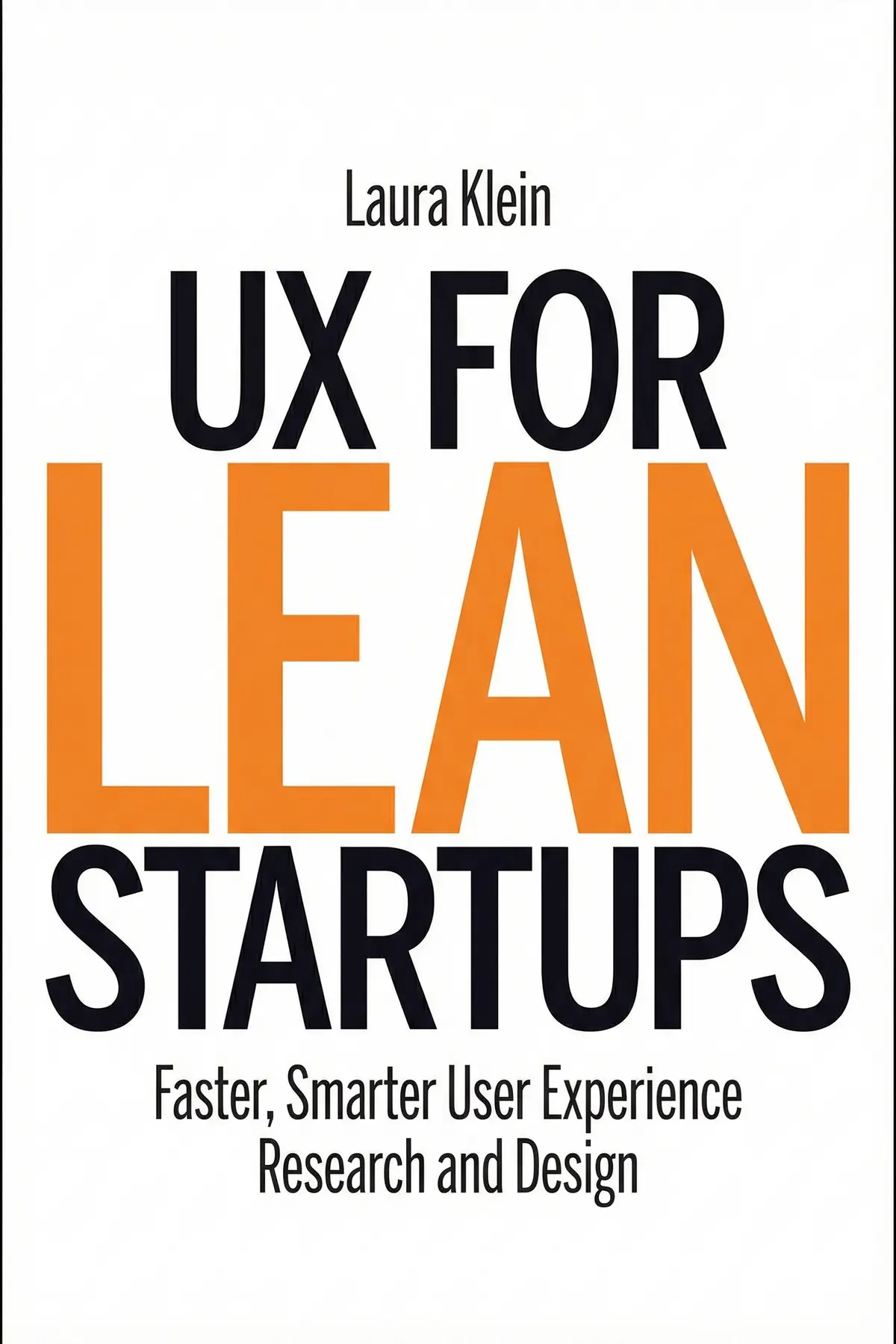
Table of Content
1. Introduction
59 sec
Most founders believe their idea is good, and so did the founders of most start-ups that failed. In UX for Lean Startups, engineer, designer and product manager Laura Klein argues that the gap between the two groups is often the experience customers have with the product. She also argues that you can find out whether you have it right long before you build anything.
Her approach, Lean UX, treats each new product, service or feature as a hypothesis to test fast and cheaply, not an assumption to bet months on. Guessing is expensive, and proving is cheaper than it looks: that is the thread running through every idea that follows.
Along the way come a spa for poodles that may never open, a meal-planning company that did its software’s job by hand, and a spinning wheel that fixed an annoying glitch. Each one shows how much you can learn or fix without spending much time or money.
2. Turn feature ideas into claims you can test
1 min 46 sec
A team spends two months building a feature everyone in the room loved, and customers ignore it. The mistake happened in the very first meeting, and it hides in a single word most teams never question.
3. Find a pain people will pay to remove
1 min 46 sec
Some products are clever, well made and still never earn a cent. Klein asks you to think like a doctor, and her three questions explain why a great cure can fail in the market.
4. Sell the product before it exists
1 min 45 sec
A founder dreams of a luxury spa for pampered dogs and is ready to buy the equipment. Klein suggests something far cheaper that can gauge demand with a single button on a simple landing page.
5. Do by hand what software would do later
1 min 44 sec
A start-up needed data from thousands of grocery stores before its service could run. Instead of building that machine, the team found a much stranger way to learn whether anyone wanted it.
6. Watch five users work and say nothing
1 min 43 sec
The hardest part of testing a prototype has nothing to do with recruiting people or writing tasks. It comes when a user struggles with a task, and the temptation to coach or step in has to be resisted.
7. Count clicks when the question is small
1 min 47 sec
Interviews feel like the serious, careful option, so teams use them for everything. Klein shows a kind of question where talking to users wastes everyone’s time, and what gives a better answer in a fraction of it.
8. Ship the smallest fix that does the job
1 min 45 sec
A meal-planning website kept filling carts with duplicate orders, and the obvious fixes were complicated. The one that worked took almost no code, and it shows how even the biggest tech companies grew.
9. Conclusion
1 min 13 sec
What Klein really offers is a change in where the risk sits. In the traditional way of working, it sits at the end: months of specifications, design and code, then a launch that reveals whether anyone cared. Lean UX moves the risk to the start, where a landing page, a man behind the curtain or five silent observation sessions can expose a bad bet for almost nothing. The good ideas survive that early pressure and get built with more confidence, one small piece at a time.
Launch does not end the testing either. When you finish a new version of your website, Klein suggests running it against the old one in an A/B test and checking whether the numbers you hoped to move, such as retention, revenue or registrations, actually moved. If they did not, you have learned something cheaply instead of assuming success.
Begin with whatever idea your team is most excited about right now. Write it as a hypothesis with a number attached, then find the cheapest way to let real people prove it wrong. In Klein’s view, user experience work is never really finished, and that is good news for anyone willing to keep asking.
About this book
What is this book about?
Most start-ups begin with an idea their founders believe is good, and most of them still fail. Laura Klein argues that the difference often lies in the experience customers have with the product. Getting that experience right usually seems to demand time and money that young companies do not have. Her answer is Lean UX, a way of doing user research and design that treats every new product, service or feature as a hypothesis to test rather than an assumption to bet on. Klein shows how to check demand with a landing page or a dummy upgrade button, how to run a service by hand before automating it, how to watch five users struggle with a prototype, and when a quick A/B test beats an interview. Readers also get a plain test for commercial viability: is the problem painful enough, is the fix good enough, and will enough people pay? From there, Klein makes the case for small, cheap improvements released one at a time, with examples running from a poodle spa that does not yet exist to a single spinning wheel that ended an annoying glitch.
Book Information
Who it's for
Founders on tight budgets
Founders with an idea they believe in and too little money to build it on a guess.
PMs and designers
Product managers and designers tired of shipping features that customers ignore.
Newcomers to product work
Engineers and career switchers moving into product work who want simple, practical research methods.
About the Author
Laura Klein
Laura Klein has worked for more than two decades in Silicon Valley as an engineer, user experience designer, product manager and consultant, for clients and employers ranging from small start-ups to large companies. She writes the blog Users Know and co-hosts two podcasts, What Is Wrong With UX and Engsplaining. Besides UX for Lean Startups, she is the author of Build Better Products.
Ratings & Reviews
Ratings at a glance

What people think
Listeners find this guide highly beneficial for new startups, commending its accessible writing and useful tips. They value the clear explanations of Lean methodology, and one listener remarks that it is essential reading for founders. The content earns praise for being funny and straightforward, and one listener draws attention to the practical steps provided. Opinions on the prose are divided, as some listeners describe it as wonderful while others feel the writing style has room for growth.
Top reviews
End
Finally got around to reading this, and it’s a breath of fresh air compared to typical dry business manuals. Laura Klein manages to make the grueling process of user research feel not just manageable but actually entertaining. I particularly loved the "fixating on the cupholders" analogy because I’ve seen so many teams waste months on minor features while the core product is still broken. The book is packed with actionable steps for anyone in an early-stage startup who needs to validate their ideas quickly without spending a fortune. Truth is, her sarcastic humor won't be for everyone, but for me, it made the dense material stick. It's rare to find a guide that is this ruthlessly pragmatic about building MVPs. If you’re an entrepreneur who wants to stop guessing and start testing, this is a must-read for your collection.
Show moreTom
This book serves as a perfect roadmap for anyone trying to survive the venture capital-funded software world. It cuts through the nonsense and provides a ruthlessly pragmatic approach to user research that most founders ignore until it's too late. I’m a big fan of how Laura explains that an MVP isn't just a "shitty version" of a product, but a tool for learning. The section on "Design Hacks" was especially enlightening for our small team. In my experience, most design books are too theoretical, but this one gives you actual things to do on Monday morning. It’s simple, actionable, and doesn’t pull any punches. Don't make the mistake of thinking this is just for designers; it’s an essential manual for product owners who want to avoid building things nobody needs. Every startup should have a copy on their shelf.
Show moreSuphan
To be fair, the content here isn't revolutionary if you've been in the industry for a decade, but for everyone else, it’s a game-changer. Laura Klein strips away the jargon and gives you the raw truth about what it takes to build a product that survives contact with the market. I loved the emphasis on continuous user research—it’s something everyone says they do, but few actually execute well. The "cupholder" analogy is a permanent part of my vocabulary now. It’s a fast, engaging read that feels more like a conversation with a very smart, very tired mentor. Whether you're an entrepreneur or a designer, the frameworks for validation and A/B testing provided here are worth their weight in gold. Absolutely recommended for any product team that needs to move fast without breaking the wrong things.
Show morePrapaiwan
As a non-designer building a product, I found this guide incredibly valuable for navigating the messy intersection of Lean methodology and user experience. It breaks down complex concepts like quantitative vs qualitative research into something even a developer can appreciate. I appreciated the specific tips on landing page experiments and the "Wizard of Oz" MVP approach. While the writing style is definitely opinionated and a bit informal, the core message about constant iteration is vital. Some parts felt a little repetitive, especially if you have already read Eric Ries, but the specific UX lens makes it worth the purchase. My only real gripe is that it occasionally feels a bit dismissive of traditional design craftsmanship in favor of speed. Still, it’s a solid resource for anyone trying to build something people actually want.
Show moreFinn
Ever wonder why some startups thrive while others crash despite having a "perfect" design? Klein answers that by showing how UX must adapt to the speed of a startup environment. I’ve been through plenty of product cycles, and the advice here regarding early problem/solution validation is spot on. The book is an easy read, though some might find the flippant tone a bit unwelcoming if they prefer a more academic style. Not gonna lie, some of the jokes fall flat, but the substance underneath is gold. I found the distinction between qualitative and quantitative testing to be the most useful part. It helped our team realize we were over-relying on data without actually talking to our users. A very good resource for any early-stage team trying to find their footing in a crowded market.
Show moreSara
After hearing Laura on her podcast, I knew what to expect in terms of voice, and I wasn't disappointed. She brings that same blunt, no-nonsense energy to this book. It’s a great go-to resource for anyone who needs to get up to speed on digital product design without getting bogged down in color theory or typography. The focus is squarely on the process: listen to users, test hypotheses, and iterate. It’s basically a translation of Lean Startup principles for the UX world. While it might feel too familiar for seasoned professionals, it’s a goldmine for managers who are new to the field. I particularly liked the chapter on different types of MVPs; it helped me explain the "Concierge" concept to my stakeholders much more clearly. Definitely worth reading if you're in the early stages of a project.
Show moreHugo
Picked this up during a particularly chaotic sprint, and it was exactly what I needed. The book is highly practical, offering a variety of "Design Hacks" that can be implemented immediately. I appreciate that the author doesn't treat design like a precious, untouchable thing, but as a tool for solving business problems. Some of the chapters felt a bit light on detail, and I would have liked to see more on the transition from MVP to a more mature product. However, as an introductory text for early-stage startups, it delivers exactly what it promises on the tin. The writing is punchy and keeps you moving through the material. It's a solid addition to the Lean series that rounds out the methodology with a much-needed user focus. It's not a deep academic study, but for a busy founder, it’s perfect.
Show moreJack
The chapter on MVP experiments alone makes this worth the read. I’ve seen so many people struggle with the concept of a "Fake Door" test or a "Wizard of Oz" MVP, and Klein explains them with perfect clarity. The book is remarkably easy to read, which is a blessing when you’re already juggling a million startup tasks. Gotta say, the tone is definitely sharp, and I can see why some might find it a bit abrasive, but it fits the "ruthlessly pragmatic" theme. It’s a great companion to 'The Lean Startup' and 'Lean Analytics.' It focuses on the "how" of the build-measure-learn loop specifically from a user interaction perspective. Not a perfect book, and certainly opinionated, but the actionable steps are too good to ignore for any product owner. It will definitely change how you think about your next feature rollout.
Show moreKanchana
Look, if you're expecting a deep dive into interaction design or aesthetic principles, you might want to look elsewhere. This book is strictly about the "Lean" part of the equation, focusing heavily on validation and rapid prototyping. Personally, I found the author's tone a bit grating at times—she tries very hard to be comical, but it often comes across as a series of rants against "delusional" entrepreneurs. To be fair, the advice on A/B testing and early validation is solid, especially for beginners. However, it doesn't offer much more than what you'd find in 'The Lean Startup' or 'Running Lean.' It’s a decent introductory text for a product manager, but if you’re already familiar with the Lean framework, you’ll find yourself skimming quite a bit of fluff. It's not a bad book, just a bit thin on new insights for veterans.
Show moreGoy
I honestly found the writing style in this book to be a major distraction from the actual content. The author spends way too much time on sarcastic asides and mocking examples that don't really add value to the reader. At one point, it felt more like a collection of blog posts and rants than a cohesive guide to user experience. Frankly, the advice is quite narrow and seems to view design as a mere commodity rather than a skilled profession. If you’ve read 'Don't Make Me Think,' you've already got a better foundation than what's provided here. It lacks the nuance needed for complex product development and focuses almost entirely on the hyper-consumer startup niche. It’s far too opinionated for my taste, and the constant "snowflake" comments are just unnecessary and unprofessional for a business text.
Show moreQuestions about this book
What is the main idea of UX for Lean Startups?
Laura Klein argues that teams waste time and money by building on assumptions. Lean UX turns each idea for a product, service or feature into a testable hypothesis tied to a measurable result, then checks it as cheaply as possible, with landing pages, hand-run services, prototypes, user observation and A/B tests, before committing to full design and engineering.
What is a Wizard of Oz test in Lean UX?
It is a way to offer customers a full experience while people do the work behind the scenes that software would later automate. Klein describes Food on the Table, a meal-planning start-up that collected grocery sales flyers and planned meals by hand for a few customers. Customers loved the service, and so the company moved ahead with building the actual system.
When should you use A/B testing instead of user interviews?
Klein says interviews and observation explain why a problem happens, while numbers measure how big it is and which fix works. For small choices, such as where to place a sign-up button, users usually have no real opinion and five people are too few to trust. An A/B test shows different versions to different visitors and lets the clicks decide.
What does Laura Klein mean by Pain-Driven Design?
It is her metaphor for thinking like a doctor. Customers have a pain, and your product is a proposed cure. You ask whether the pain is bad enough, whether the cure works, and whether people will pay for it. The same thinking guides improvements, such as the spinning wheel that stopped duplicate orders on a meal-planning website.
Who should read UX for Lean Startups?
It suits start-up founders, product managers, designers and engineers who need to learn what customers want without large research budgets. Its methods are small and concrete: a landing page to test demand, an upgrade button to test a paid feature, five-person usability tests, and minimum viable products that can be released and improved step by step.
Readers also enjoyed









AUDIO SUMMARY AVAILABLE
Listen to UX for Lean Startups in 15 minutes
Get the key ideas from UX for Lean Startups by Laura Klein, plus 5,000+ more nonfiction titles.
- 5,000+ titles
- Listen as much as you want
- 7-day free trial
- Cancel anytime









