

14 min 44 sec
Available in: English
UnMarketing: Everything Has Changed and Nothing is Different
Shows business owners how to win and keep customers by treating every interaction as marketing, caring for existing buyers, sharing useful expertise and holding real conversations on social media in place of ads and cold calls.
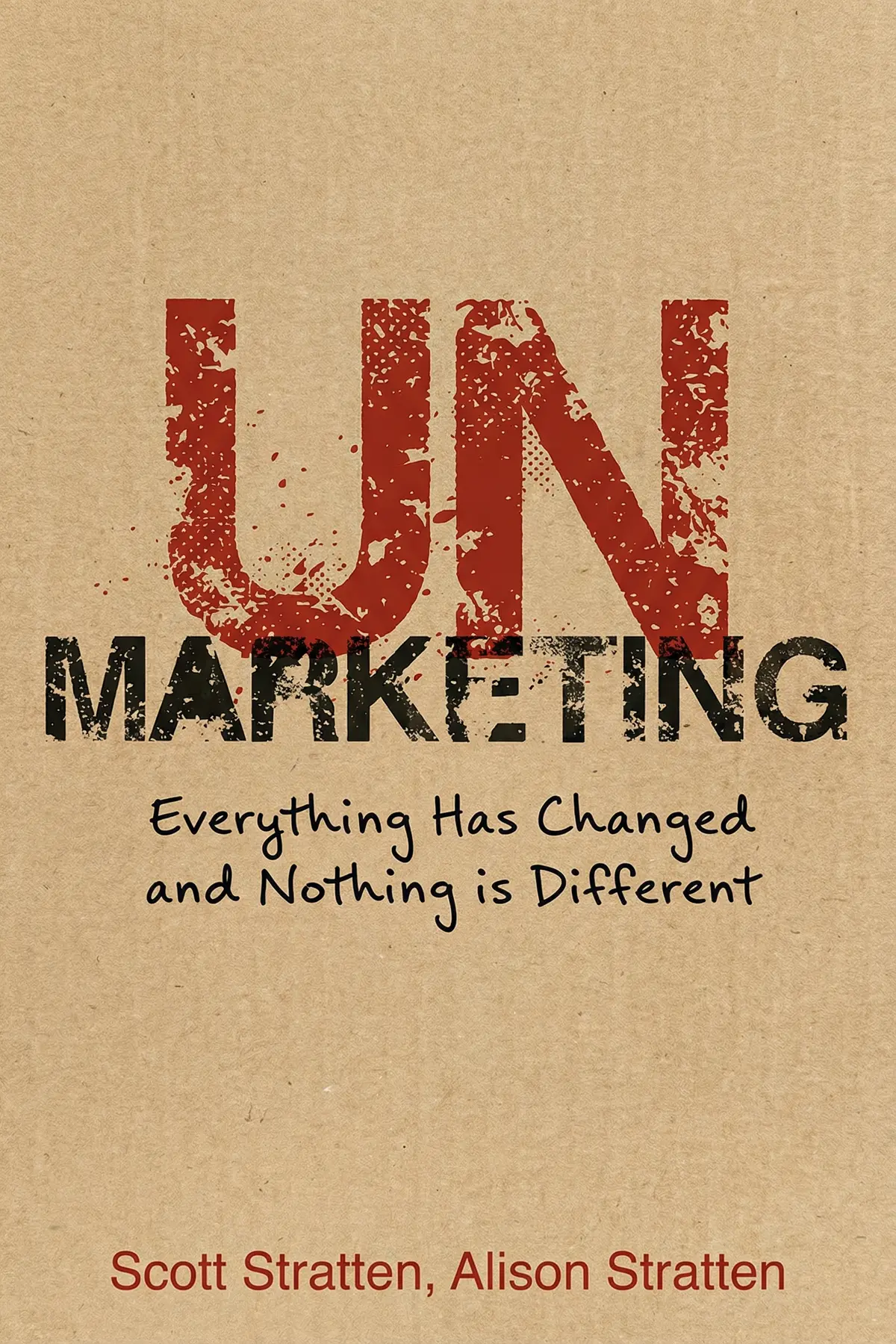
Table of Content
1. Introduction
1 min 00 sec
Most businesses still try to buy attention with cold calls, flyers and endless promotional email, even though almost nobody welcomes any of it. In UnMarketing, Scott Stratten and Alison Stratten argue that the attention worth having is earned, one customer interaction at a time. Their starting point is simple: marketing does not happen in a closed meeting room. It happens every time someone deals with your business, from a late pizza to a reply on Facebook.
That idea carries the whole book. If every contact is marketing, then the real work is building relationships that last, keeping the customers you already have, proving you know your field through useful content and treating social media as a conversation. Along the way come a ranking of why people buy, a three-step recipe for an article that wins trust and a calm way to handle a complaint in public, each one something a small team can start on this week.
2. Turn every customer moment into marketing
1 min 39 sec
A pizza that arrived late and wrong could have cost a chain a customer. It became a video seen by more than 100,000 people instead, and the reason says a lot about where marketing really lives.
3. Know which reasons to buy pay off most
1 min 44 sec
The authors asked more than 1,000 business owners one simple question about their own purchases. The answers form a ladder, and the cheapest way to reach new customers sits on its lowest step.
4. Keep the customers you already have
1 min 40 sec
After twenty years as a loyal coffee customer, one man finally switched to a competitor. No single mistake drove him away. What did it was a pattern that most companies never think to measure.
5. Earn trust by teaching what you know
1 min 58 sec
Many business owners feel too modest to call themselves experts, and it costs them customers. A dictionary definition and a three-step way to write an article suggest the bar is lower than they think.
6. Make videos people want to share
1 min 40 sec
A truck commercial from 2013 has been watched more than 80 million times, and nobody paid for most of those views. The authors argue that only a few kinds of message travel that far.
7. Build a social presence people talk back to
2 min 04 sec
A favorite restaurant’s Facebook page can leave loyal fans feeling ignored. The authors explain which platform suits which purpose, and how to grow an account in stages without losing the human voice behind it.
8. Answer public complaints well and protect your reputation
1 min 40 sec
A complaint used to stay between a customer and a hotline. Now strangers can read it and search engines can find it. One university cafeteria’s reply to a bad apple shows what good handling looks like.
9. Conclusion
1 min 19 sec
The subtitle, Everything Has Changed and Nothing is Different, holds the book’s argument in a single line. The tools are new: tweets, viral videos, dashboards for scheduling posts. What makes people buy and come back is old. They want to be treated well by someone who knows the trade and pays attention. Domino’s late pizza, the Zappos shoes and the Tufts apple are versions of one story, a business that listened when ignoring the customer would have been easier.
The Strattens also warn against copying successful companies. Most of what made them succeed is invisible from outside, and their tools may not work today or in your setting. Their alternative is closer to home: ask friends and associates you trust for honest feedback on your business, and act on it.
From there, the steps are small. Find the gap between your best and worst customer experience and narrow it. Write one useful article with a clear point, real proof and an easy way to act. Answer the next comment on your page, especially the unhappy one.
A two dollar coffee looks like nothing. Lost every day for a year, it becomes $700, and a former regular telling a different story.
About this book
What is this book about?
Almost nobody enjoys cold calls, flyers in the mailbox or one more promotional email. Yet many businesses still spend most of their marketing effort on exactly these things, and then wonder why customers leave the moment a rival is cheaper. Scott Stratten and Alison Stratten argue that marketing happens every time someone deals with a business, from a late pizza delivery to a reply on Facebook. Drawing on interviews with more than 1,000 business owners about why they buy, they rank the reasons people choose a company and place repeat customers at the top. From there they show how to stop losing loyal buyers, how to become a trusted expert through articles built on a simple three-step method, what makes a video worth sharing and how to grow a social media presence that people actually talk to. Readers get a plain, practical case for relationships over interruption, told through cases like Domino's, Zappos, a Canadian coffee chain and a university cafeteria, plus clear steps they can try with the customers they already have.
Book Information
Who it's for
Owners wanting loyal customers
Small business owners who spend on ads and cold calls but struggle to keep customers coming back.
Marketers and freelancers
Marketers and freelancers who want to build trust through articles, videos and social media.
Answering complaints in public
Customer service leads who must answer complaints that anyone online can read.
About the Author
Scott Stratten
Scott Stratten is the President of UnMarketing and the author of five bestselling business books. He has worked as a music industry marketer, a National Sales Training Manager and a college professor, and ran a viral video agency for nearly a decade before turning to speaking full time for companies such as Walmart, Pepsi, IBM and Microsoft. Alison Stratten is an author and podcaster who founded and ran a maternity lingerie company and holds degrees in Social Work and Kinesiology.
Ratings & Reviews
Ratings at a glance

What people think
Listeners find the book highly insightful and easy to follow, with one listener mentioning it serves as a solid introduction to community building principles. The work receives positive marks for its readability, with one listener even calling it the best marketing book they've read. Listeners express mixed opinions regarding the social media content.
Top reviews
Orawan
Finally got around to reading this after seeing it on so many 'must-read' lists. The conversational style makes it feel less like a dry textbook and more like a late-night chat with a mentor who actually gets it. I found the core message about building relationships instead of just shouting into the void to be incredibly refreshing. Some of the social media tactics are clearly from a different era, but the foundational principles of community building are timeless. I walked away with a dozen notes and a whole new outlook on how to handle my newsletter and direct outreach.
Show moreNew
Ever wonder why your social media posts feel like shouting into a hurricane with no one listening? This book tackles that head-on by teaching you how to build a community rather than just a following. The authors use a lot of humor and down-to-earth suggestions that make the concepts easy to digest during a commute. I particularly liked the section on handling trolls, though I think that advice is a bit simplified for anyone who isn't a white male in a safe niche. Regardless, the 25 or so actionable ideas I pulled from these pages made it a great investment.
Show moreSupachai
If you are looking for a marketing book that doesn't make you want to fall asleep, this is definitely the one. It’s written more like a conversation than a lecture, and the humor throughout kept me turning the pages much faster than I usually do with business literature. I really appreciated the focus on 'un-learning' the bad habits we’ve all picked up from traditional sales training. Even though some of the social media content is a bit dated, the principles of trust and transparency are more relevant now than ever. Every business owner needs to read this to understand why their old-school marketing isn't working anymore.
Show moreThanit
This book is probably the best entry point for anyone starting from zero in the modern digital landscape. Stratten focuses heavily on the concept of 'evangelism' and how to turn customers into fans, which is vital for small business owners today. While I would have appreciated more bulleted lists to summarize the action items, the short chapters kept me engaged through the whole thing. It’s a very quick read that cuts through the typical corporate jargon we see in this genre. Just be prepared for a very heavy focus on Twitter, which feels a bit weird in the current year.
Show moreWipada
Look, marketing books are usually a chore, but 'UnMarketing' manages to stay light on its feet with a very engaging writing style. The authors take a 'common sense' approach to digital networking that feels more human than the usual data-driven strategies. I did feel that the book was a bit haphazardly put together, jumping from big-picture philosophy to granular tactics without much of a bridge. One minute you're talking about brand integrity, and the next you're looking at specific Twitter maneuvers from seven years ago. If you can filter out the dated platforms, the heart of the book is solid gold.
Show morePhichai
After hearing so much about Scott Stratten's stage presence, I decided to pick this up on a whim. The 'pull' vs 'push' framework is a game changer for anyone tired of traditional, intrusive advertising methods. I loved the emphasis on being authentic and the reminder that every interaction is actually a marketing opportunity, whether we realize it or not. The chapters are bite-sized, which is perfect for busy entrepreneurs who only have ten minutes to spare between meetings. It’s a refreshing change of pace from the typical business book that usually takes 300 pages to say what could be said in fifty.
Show moreSumalee
Truth is, the authors have created a manifesto for the modern era that every business owner should probably have on their shelf. The book is filled with practical, actionable suggestions that focus on the 'human' element of digital marketing rather than just the algorithms. While some of the jokes fall flat and the ego can be a bit much, the insights into how people actually interact with brands are spot on. I’ve already started implementing their suggestions regarding customer service as a marketing tool. It’s an easy, quick read that manages to be both entertaining and deeply educational for the right audience.
Show moreSuphan
As someone who has been in the marketing game for a decade, I found the 'UnMarketing' perspective to be a mix of brilliance and irritation. To be fair, Scott has a remarkable way of looking at brand engagement, but his ego frequently gets in the way of the message. Those little footnotes and asides that start off as 'funny' quickly become distracting and feel a bit self-indulgent after the tenth one. Still, the general message of stopping the 'push' marketing and starting the 'pull' is something every creator needs to hear. It’s worth a read, just skip the filler.
Show morePakpoom
The chapter on trade shows going virtual was surprisingly prophetic, but the rest of the book feels like a bit of a time capsule. Frankly, the information is starting to show its age, particularly when it comes to specific platform strategy and monetization. However, the writing remains very engaging and the core ideas about relationship building still hold up quite well under scrutiny. I found the structure a little chaotic as it bounced around between different concepts without a clear roadmap. It’s a good refresher for veterans, but new marketers should take the specific platform advice with a massive grain of salt.
Show moreYulia
Not what I expected given the hype, and honestly, the 'toxic positivity' vibe made me roll my eyes more than once. The 2017 revised edition is already ancient history in the tech world; the obsession with Twitter (now X) makes half the tactical advice completely irrelevant for someone trying to launch on TikTok or Instagram today. It felt like the authors were trying too hard to be the 'cool kids' of marketing, which came off as forced and slightly arrogant. I’m giving it two stars because the evergreen principles about being a decent human in business are still okay, but there are better, more current options out there.
Show moreQuestions about this book
What is the main idea of UnMarketing?
Scott Stratten and Alison Stratten argue that marketing is every interaction a business has with people, including late deliveries, refunds and replies on social media. Instead of buying attention with ads and cold calls, a business should build relationships that last. That means caring for existing customers, sharing useful expertise and holding real conversations online, so that happy buyers return and recommend you to others.
What is the hierarchy of buying in UnMarketing?
It is a ranking of reasons people buy, built from the authors’ interviews with more than 1,000 business owners. Cold calls sit at the bottom, followed by search results and ads, then contacts who have not bought yet, then personal recommendations from friends or coworkers. At the top are past customers who were happy and want more, the most valuable group of all.
What is the experience gap?
The experience gap is the distance between the best and the worst experience a customer has had with a company. One of the authors left Tim Horton’s after 20 years because small failures kept adding up, from unstirred coffee to the wrong sweetener and no credit cards. When the gap grows too wide, customers look for a more consistent competitor.
What are the three Ps for writing expert content?
The authors suggest building an article on point, prove and perform. Start with your main point, such as how much of monthly income to save for retirement. Prove it with examples, like clients who saved that amount and retired comfortably. Then perform it by giving easy ways to follow the advice, such as automatic monthly transfers into a savings account.
How should a business handle complaints on social media?
Because public complaints can be read by other customers and found in search results, the authors advise responding with care and apologizing when you are at fault. The Tufts University dining service answered a complaint about a terrible apple by saying sorry, asking which location it came from and admitting staff should catch spoiled fruit, which calmed the customer and impressed onlookers.
Readers also enjoyed


AUDIO SUMMARY AVAILABLE
Listen to UnMarketing in 15 minutes
Get the key ideas from UnMarketing by Scott Stratten, plus 5,000+ more nonfiction titles.
- 5,000+ titles
- Listen as much as you want
- 7-day free trial
- Cancel anytime









