
12 min 51 sec
Available in: English
Unleashed: The Unapologetic Leader's Guide to Empowering Everyone Around You
Shows managers how to judge their leadership by how much other people grow, with concrete tools for trust, high standards with care, belonging, strategy and culture that keep working when the leader is away.
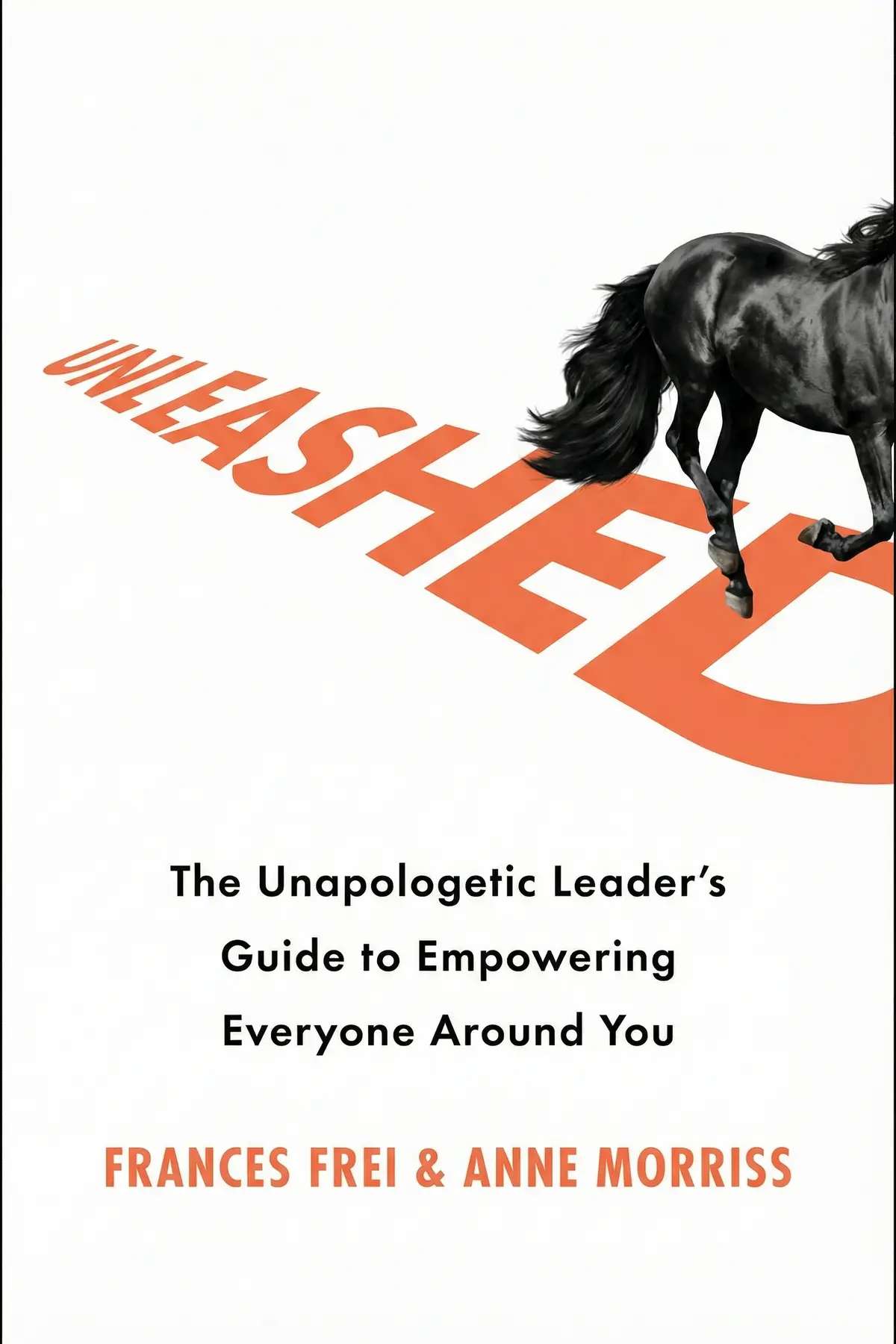
Table of Content
1. Introduction
58 sec
If you were promoted because you were good at your own work, you may still be judging yourself by your own performance. In Unleashed, Harvard Business School professor Frances Frei and leadership consultant Anne Morriss argue that this is the wrong scoreboard. Leadership, they write, means making other people better because you are present, in a way that keeps working after you leave.
The co-authors, who are married to each other, reject the familiar advice to try harder, own your strengths and patch your weaknesses, because it keeps the leader staring at themselves. Their model moves outward in rings. Trust, love and belonging are built while you are in the room. Strategy and culture carry your influence when you are not. Frei tested these ideas inside Uber during its public crisis, and the pair refined them with companies such as Riot Games and WeWork.
Follow the rings and you get a way to diagnose why people hold back around you, along with small moves you can start making tomorrow morning.
2. Measure your leadership by other people's growth
1 min 47 sec
Most leadership advice asks you to study yourself more closely. Frei found, while studying how work flows through companies, that the real problem was hiding somewhere else, and it changes what a good week at work looks like.
3. Find the trust driver that wobbles under pressure
1 min 52 sec
Trust usually breaks in the same place for each of us, and often in a habit we barely notice. Frei claims it can be repaired far faster than most companies assume, and she has a joke about five-year plans.
4. Demand more and care more at the same time
1 min 43 sec
Most managers choose between being tough and being kind, and assume they must. A parenting lesson from Frei’s own home suggests why that choice quietly holds people back, and what to do instead.
5. Build a team that wins because of its differences
1 min 58 sec
Diversity programs often stall, and the authors think many companies start in the wrong place. Frei’s own experience of being told to fit in shows what actually lets people who are unlike their leader do their best work.
6. Lead the decisions you will never witness
1 min 50 sec
Plenty of companies have a strategy, and plenty of employees could not say what it is. The authors argue that a real strategy has to name something uncomfortable, and that most of them never leave a small circle.
7. Change culture by changing what gets rewarded
1 min 37 sec
Speeches about values rarely change how people behave on a Tuesday afternoon. Drawing on companies whose cultures had turned toxic, the authors argue that repair starts with an uncomfortable question for the person at the top.
8. Conclusion
1 min 06 sec
Unleashed turns a familiar picture of leadership inside out. The people around the leader are the heroes of the story. Frei and Morriss judge a leader by one thing: whether others grow because of their presence, and keep growing once they leave. Each ring of their model widens that reach, from one relationship built on trust to a culture that shapes the behavior of strangers.
What makes the book usable is how small the first moves are. Find your trust wobble and fix one habit that exposes it, such as the phone on the table during a conversation. Count your praise against your corrections until you reach five to one. Ask where each person on your team sits between safe and cherished, and remove the first barrier you find. Then check whether your strategy’s trade-offs live anywhere besides your own head.
None of it requires a new personality or a five-year program, which Frei would say wastes almost all of its time anyway. It requires looking through the window instead of into the mirror. The best evidence that you led well is what your people do on the day you are not there.
About this book
What is this book about?
Many leaders are promoted for their own performance and keep measuring themselves that way, as the person with the answers at the center of every meeting. Frances Frei and Anne Morriss argue that this has it backwards. Leadership, in their definition, is making other people better because you are there, in a way that lasts after you leave. Their model is a set of rings. Trust sits at the center, built from authenticity, logic and empathy. Around it come love, meaning high standards joined to deep devotion to one person's success, and belonging, which scales that care to a team of people unlike you. The outer rings, strategy and culture, carry your influence into decisions made when you are not in the room. The authors draw on Frei's work helping Uber through its public leadership crisis and on their consulting with companies such as Riot Games and WeWork. Readers get diagnostic ideas like the trust wobble and the inclusion dial, plus small, specific habits, from a five-to-one praise ratio to a strategy that names what the company will choose to be bad at.
Book Information
Who it's for
Recently promoted managers
New managers who were promoted for their own work and now need to grow other people.
Leads of quiet teams
Team leads whose people hold back, disagree in private or wait for permission.
Senior leaders rebuilding trust
Founders and executives trying to repair trust or culture after a crisis.
About the Author
Frances Frei
Frances Frei is the UPS Foundation Professor of Service Management at Harvard Business School. She was Uber's first Senior Vice President for leadership and strategy, helping the company respond to a public crisis in its leadership and culture, and her TED Talk on building trust has drawn millions of views. Anne Morriss began her career helping local leaders develop in remote communities of rural Latin America, and in 2007 cofounded the Concire Leadership Institute. Her consulting for firms and governments across the Americas has covered strategy, leadership and institutional change.
Ratings & Reviews
Ratings at a glance

What people think
Listeners find the book offers great leadership perspectives and is a straightforward read. They value the educational depth, with one listener pointing out the inclusion of case studies and tools that supplement every framework. The material is successful at enhancing leadership abilities; one review specifically calls out its useful methods for establishing trust.
Top reviews
Niphon
Finally got around to reading this after seeing Frances Frei's TED talk on trust. The core message—that leadership is actually about making others better as a result of your presence—really hits home. Personally, I found the breakdown of the 'trust triangle' to be a game-changer for my own team meetings. While some sections felt a bit like a Harvard Business School textbook with all the matrices, the real-world stories from Uber and WeWork kept it grounded. It's not just another dry business manual. It is more of a blueprint for creating a culture where everyone actually wants to show up. Not gonna lie, some of the frameworks are a bit dense, but the payoff is worth the effort if you're serious about growth.
Show moreSoontorn
This is hands down one of the most refreshing takes on leadership I’ve encountered in a decade. It completely flips the script by suggesting that your success as a leader is measured by what happens when you aren’t in the room. The concept of being 'other-centered' is powerful. In my experience, most business books focus too much on the 'hero' leader, but this one prioritizes the team's growth. The writing is punchy and the inclusion of various case studies keeps the pace moving. It’s a wonderful resource for anyone looking to move beyond traditional, top-down management styles. This book will challenge you to confront your own leadership profile in a very healthy way.
Show moreSue
Ever wonder why some leaders seem to effortlessly inspire their teams while others struggle despite having all the right credentials? This book answers that by focusing on the 'context' a leader creates. The combination of high standards and deep devotion is a framework I plan to implement immediately. While the book can feel a bit like a textbook in parts, the insights into modern companies like HP are incredibly valuable. It’s a thin book, and you can tell it was written with a very specific, ambitious audience in mind. Regardless of your level, the lessons on empowering others and unleashing potential are universal. Highly recommended for any new manager.
Show moreChamlong
As a middle manager in a tech firm, I found the insights into building belonging particularly relevant to our current culture shift. The authors argue that inclusion isn't just a buzzword; it’s a primary driver of innovation. Frankly, the practical tools provided for building trust are far more useful than the abstract concepts found in similar books. I appreciated the case studies on Microsoft, though some of the hero-worship regarding certain CEOs felt a bit much. The book succeeds because it focuses on the people around the leader rather than the leader’s ego. It’s a quick, informative read that gave me several actionable ideas for my next quarterly review.
Show moreSamart
The chapter on strategy was surprisingly useful, even if it felt a bit like it belonged in a different book than the leadership-focused chapters. Frei and Morriss do an excellent job of explaining how to empower a team through clear direction. Gotta say, the personal anecdotes about their own experiences at Harvard and in the field added a much-needed human touch to the data. The book highlights how real leadership is about unleashing potential in others, a theme that resonated with me deeply. It isn't perfect, and the tone can be a bit 'this is the only way,' but the frameworks for building trust are solid. Definitely worth a spot on your shelf.
Show moreOak
After hearing the authors discuss their philosophy on a podcast, I picked this up to better understand the 'trust triangle.' The book is informative and provides a clear set of tools for developing leadership skills within a complex organization. I especially liked the section on how culture change transforms the people it touches. However, some of the abstract concepts felt a bit detached from the reality of the average workforce. Not everyone can easily make an 'astounding difference' as the book suggests. Still, the focus on empathy and intentionality is a breath of fresh air. It’s a solid 4-star read that offers more practical value than your average airport business book.
Show moreMaya
What sets 'Unleashed' apart is the raw honesty about the messy side of management. The authors don't shy away from the 'growing pains' that come with fixing a toxic culture. I loved how they injected their personal experiences into the lessons; it made the advice feel much more authentic. Their work with brands like Riot Games provides fascinating context for their theories on belonging and safety. Personally, I think the book is best when it sticks to these human-centric stories. It’s a bit thin on the 'how-to' for some of the larger organizational changes, but it serves as an excellent starting point for those who need a serious culture wake-up call.
Show moreOksana
Is it possible for a book to be both brilliant and incredibly frustrating at the same time? To be fair, Frei and Morriss offer some of the most insightful commentary on modern leadership I've encountered lately. However, the tone often veers into a sort of HBS swagger that might alienate readers who aren't already in that ecosystem. I found the 'high standards and deep devotion' matrix useful, yet the writing style feels a bit clunky in the middle chapters. It’s a thin volume, but I still think it could have been trimmed further, especially the parts on strategy which felt slightly out of place. It’s a good read, just be prepared for a very academic vibe.
Show moreChiw
Picked this up because a few colleagues kept mentioning the 'Frei and Morriss' approach to culture. In my view, I found it a bit of a mixed bag. The first few chapters are gold—truly insightful and filled with food for thought regarding inclusion and innovation. But as the book progressed, it felt a bit repetitive. The swaggering tone mentioned by other reviewers is definitely there. To be fair, they have the track record to back it up, but a little more humility would have gone a long way. That said, the case studies are engaging and the core message is vital. It’s a decent 3-star read that could have been a spectacular long-form article.
Show moreSupachai
Look, I wanted to love this, but it felt like a polished HBS marketing brochure more than a practical guide. Most of the ideas here feel like repackaged concepts from decades ago—think Jan Carlson or Herb Kelleher—just dressed up in modern jargon. The attempt to be 'disruptive' with the book’s structure actually makes it harder to follow the main arguments. While the vignettes about Uber are interesting, they don't necessarily provide a roadmap for those of us working in smaller, less chaotic environments. Truth is, if you’ve watched their TED talks, you’ve already gotten the best parts. It’s not poorly written, but it lacks the depth I expected for the price.
Show moreQuestions about this book
What is the main idea of Unleashed by Frances Frei and Anne Morriss?
The authors argue that leadership is not about the leader. It is about making other people better through your presence, in a way that keeps working after you leave. They organize this as rings of empowerment: trust, love and belonging, built while the leader is present, and strategy and culture, which carry the leader’s influence when they are absent.
What are the three drivers of trust in Unleashed?
Frei and Morriss name authenticity, logic and empathy. People trust you when they believe they see the real you, have faith in your judgment and competence, and believe you care about them. Almost every loss of trust traces back to one of the three. Each person has a trust wobble that slips under stress and a trust anchor that holds firm.
What does love mean in leadership according to Unleashed?
Love, in the book, means helping one person reach their full potential by combining high standards with deep devotion to their success. The authors say these are wrongly treated as a trade-off. Their practical advice includes catching people doing something right, giving specific and sincere praise, keeping positive to constructive feedback at five to one or more, and saying we more than me.
Why do the authors put inclusion before diversity?
Frei calls inclusion the missing link: when people feel included, diversity tends to follow, but hiring for diversity alone does not create inclusion. The book describes an inclusion dial with four levels, safe, welcome, celebrated and cherished, and notes that people only feel welcome once they feel safe. The goal is a team that excels because of its differences.
How can I apply Unleashed as a manager?
Start by finding your trust wobble and changing one habit that exposes it, such as checking your phone while someone talks. Track your ratio of praise to correction for a week. Place each team member on the inclusion dial and remove one barrier. Then ask your team what your strategy says the company will be bad at, and reward the behavior you want in your culture.
Readers also enjoyed





A Year with Peter Drucker: 52 Weeks of Coaching for Leadership Effectiveness
Joseph A. Maciariello



Acting with Power: Why We Are More Powerful Than We Believe
Deborah Gruenfeld

All In: How Great Leaders Build Unstoppable Teams
Mike Michalowicz

AUDIO SUMMARY AVAILABLE
Listen to Unleashed in 15 minutes
Get the key ideas from Unleashed by Frances Frei, plus 5,000+ more nonfiction titles.
- 5,000+ titles
- Listen as much as you want
- 7-day free trial
- Cancel anytime









