

14 min 28 sec
Available in: English
Unconscious Branding: How Neuroscience Can Empower (and Inspire) Marketing
Shows how to build a brand around the way people really decide: through mental shortcuts, group instinct, surprise, comfort, imagination, emotion and small actions they later describe as their own free choice.
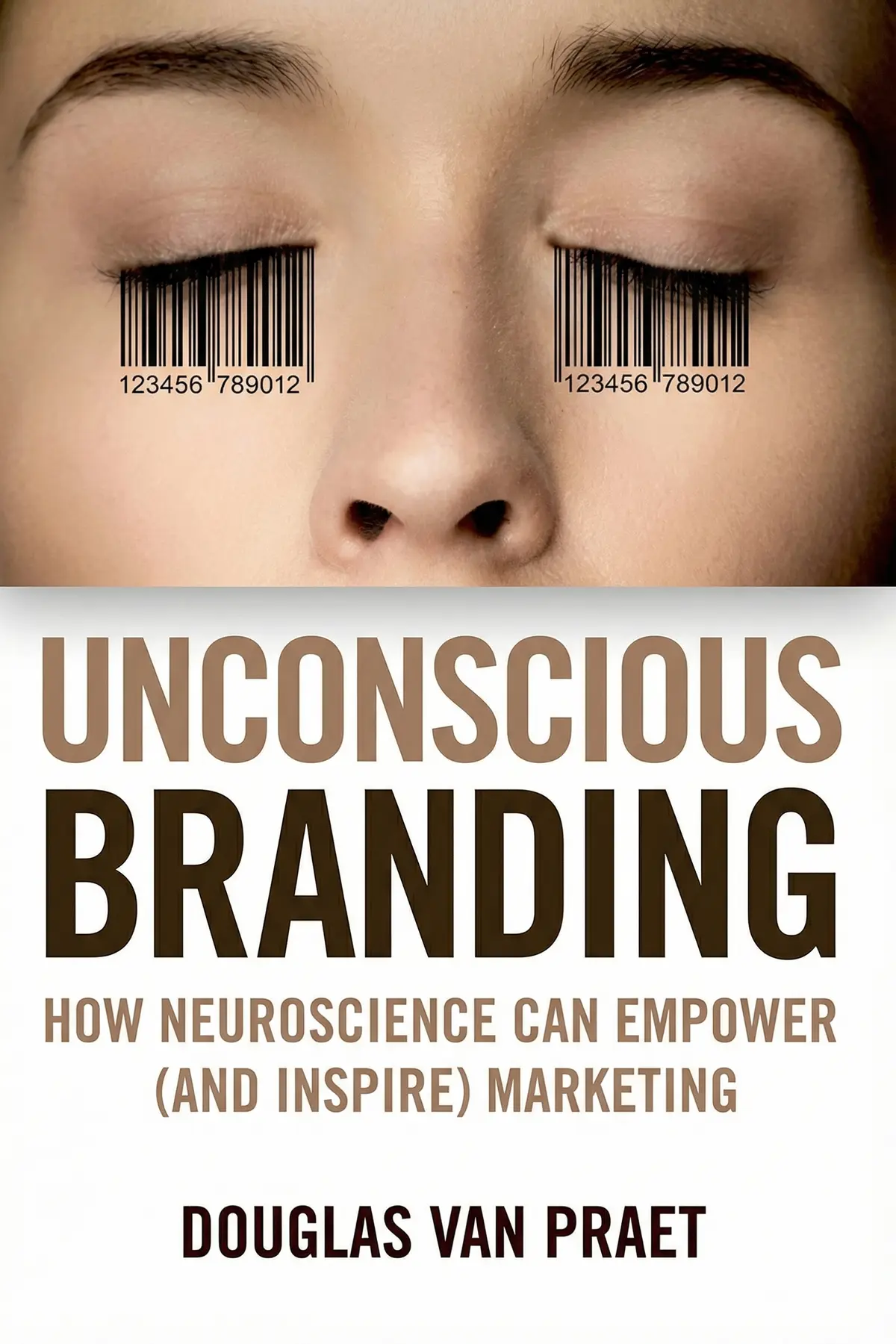
Table of Content
1. Introduction
1 min 06 sec
A product can be excellent and still disappear on a crowded shelf, because most buying decisions are made by parts of the mind the buyer never consults. That is the starting point of Unconscious Branding by Douglas van Praet, the advertising executive behind the Volkswagen commercial of a small child dressed as Darth Vader. Shoppers rarely weigh every option, he argues; they reach for shortcuts, like picking the market leader or assuming the pricier item is better.
His throughline is that a brand wins when it is built around how human brains really work: their instinct for groups, their hunger for surprise and safety, their imagination, their feelings and their doubts. The ideas that follow trace his seven-step method, from catching attention to getting a customer to act. Along the way come a cowboy who sold cigarettes to men, a gum that dentists endorsed and a free cup of green tea that changed a coffee order. The reward is a practical way to design campaigns that reach people where their choices are actually made.
2. Sell to the shortcuts shoppers really use
1 min 27 sec
Faced with a shelf of near-identical products, almost nobody compares them all. Van Praet explains what people do instead, and why a pack of motorcyclists in matching leather reveals something every brand can use.
3. Speak to body, feeling and reason at once
1 min 47 sec
A mustard ad, a can of Coke and a pack of chewing gum each appeal to a different region of the brain. Van Praet argues that the strongest campaigns find a way to reach every one of them.
4. Break the expected pattern to win attention
1 min 30 sec
A villain who should frighten audiences made viewers laugh instead, and a calm back-seat conversation ended in a shock. Both ads tapped the same reflex, one that decides what your customers notice at all.
5. A trusted brand that earns a higher price
1 min 31 sec
A carmaker asking for public money undid its own case with a single flight. A study of relaxed shoppers shows what the opposite feeling is worth at the register.
6. Leave room for customers to write themselves in
1 min 34 sec
One famous slogan said almost nothing, and customers wrote in to say it had changed their lives. Van Praet explains why a vaguer message can outsell a precise one, and what the brain is doing when it does.
7. Customers buy the feeling, so sell it
1 min 24 sec
A warehouse store hides its best items, and shoppers love it. A computer company sells membership in a club. Both point to what customers are really paying for when they reach the checkout.
8. Borrow the traits your buyers want to have
1 min 33 sec
A cigarette first sold to women became the leading brand in the United States after one change of image. A fake designer shirt in Santiago shows the same force from another angle.
9. Invite one small action and let customers own it
1 min 29 sec
You accept a free drink instead of your usual order and soon believe it was your own idea. Van Praet shows how brands design that moment, and why customers rarely notice it happening.
10. Conclusion
1 min 07 sec
Van Praet’s method amounts to a change of audience. A campaign aimed at a calm shopper weighing features is aimed at someone who barely exists. The real customer is a social animal leaning on shortcuts, a pattern detector waiting to be surprised, a creature that pays more when it feels safe, that imagines itself into an open slogan and that later explains its own choices as if it had planned them. Every case in the book, from the child in the Vader costume to the cowboy selling cigarettes, works by meeting that person first.
The book ends on a plea for creativity: doing something new so a message reaches both the conscious and the unconscious mind. That makes a first step easy to find. Look at your current campaign for the expected element you could overturn, the way a fearsome villain became a child trying to move the dishes. Check that it gives the doubter one trusted fact and the dreamer room to fill in the rest. Then find the smallest action a customer could take, like accepting a free cup of tea, and let them conclude it was their idea all along.
About this book
What is this book about?
A great product is only half the work. The market is crowded, new ideas arrive every day, and a brand that fails to stand out simply gets passed over. Douglas van Praet, the advertising executive behind Volkswagen's mini Darth Vader commercial, argues that many campaigns aim at a rational buyer who weighs every option. Real customers, in his account, decide through instinct, shortcuts and feeling. Drawing on how the brain works, he lays out a seven-step method. It starts with the shortcuts and group instincts behind everyday choices and the brain's physical, emotional and rational parts. It then moves through breaking expected patterns to win attention, building comfort and trust, leaving messages open to the imagination, selling emotion, answering the skeptic with credible proof and attaching desirable traits to a brand. The examples are familiar: Nike's Just Do It, Grey Poupon's aristocrats, Trident's dentists, the Marlboro Man and a free cup of green tea at a coffee shop. Readers get a practical checklist for designing campaigns that reach the parts of the mind where buying decisions are really made.
Book Information
Who it's for
Founders and business owners
Founders and small business owners with a good product that the market keeps overlooking.
Marketers and agency creatives
Marketers and agency creatives who want campaigns grounded in how people actually decide.
Entering brand or advertising
Career switchers moving into brand or advertising roles who need a clear mental model quickly.
About the Author
Douglas van Praet
Douglas van Praet founded Unconscious Branding, a consultancy that applies behavioral science to the work of building brands. Before that he was an executive vice president at the agency Deutsch LA, where he oversaw the Volkswagen account. He created Volkswagen's The Force commercial for the Super Bowl, in which a miniature Darth Vader tests his powers around the house, and no Super Bowl ad has been shared more.
Ratings & Reviews
Ratings at a glance
What people think
Listeners find the book offers excellent perspectives on consumer behavior and is an enjoyable, captivating listen. They value its content quality, with one listener pointing out the traditional marketing examples, and find it especially useful for marketing professionals. Listeners praise the writing style and regard it as a source of new ideas.
Top reviews
Naomi
Douglas van Praet provides a fascinating deep dive into why we do what we do as consumers. Most marketing books feel like they are recycling the same tired tropes from the nineties, but this one leans heavily into cognitive science to reveal how we are driven by forces we don’t even notice. I loved how he used his experience with Volkswagen to illustrate his points because it grounded the high-level psychological theories in something tangible. The writing is incredibly smooth and doesn't feel like a slog through a dry academic textbook. It serves as a brilliant idea generator for anyone in the industry. Frankly, it changes how you look at every billboard or television commercial you see. A must-read for professionals who want to understand the actual behavior of their audience rather than just looking at demographic data.
Show moreZanya
This book is essentially a masterclass in modern marketing. Van Praet’s background at Deutsch LA shines through as he bridges the gap between complex neuroscience and practical brand building. I found the chapter on the evolution of the brain to be particularly enlightening. It explains why we are hardwired to respond to certain stimuli in ways that logic can't explain. The truth is, we aren't the rational decision-makers we like to think we are. This book provides a roadmap for tapping into that hidden reality. It’s an essential tool for any creative director or strategist looking to move beyond surface-level engagement. The pacing is quick, the examples are relevant, and the insights are immediately applicable. I’ve already started applying some of these principles to my current projects.
Show moreAnthony
Wow, I wasn't expecting a marketing book to be such a page-turner. Douglas van Praet has a way of making complex psychological concepts feel like common sense. He effectively argues that we are feeling machines that think, not thinking machines that feel. This distinction is vital for anyone trying to build a brand in a crowded market. The book is packed with great insights and serves as a powerful reminder that traditional research methods often miss the mark. If you want to know how to actually connect with people on a primal level, read this. It’s easily one of the most useful books on advertising I’ve picked up in years. The combination of evolutionary psychology and real-world marketing experience is just brilliant.
Show moreKasemsan
Finally got around to reading this after seeing it on several must-read lists for brand strategy. I was pleasantly surprised by how accessible the prose is compared to a standard cognitive psychology curriculum. Van Praet’s stance is somewhat controversial because it basically tells marketers that everything they are doing is wrong if they aren't targeting the unconscious mind. The case studies are the real highlight here. He takes famous campaigns and deconstructs them through a neurological lens which makes the theories much easier to digest. It isn't just theory; it’s an actionable framework. My only minor gripe is that some chapters felt a bit repetitive toward the end. Still, it’s a solid 4-star read that offers a unique perspective on the intersection of biology and branding.
Show moreTakeshi
To be fair, the premise that we are irrational creatures isn't new, but the way Van Praet structures it into a seven-step process is genuinely useful. He moves beyond the 'what' of consumer behavior and dives deep into the 'how' of creating lasting impressions. The book is quite an idea generator. I appreciated how he scrutinized specific campaigns against his theory to prove they weren't just lucky accidents. Some might find the focus on the unconscious a bit cynical, but it’s an honest look at the reality of human cognition. It is much more readable than a traditional textbook, which I appreciated. While I didn't agree with every single conclusion, the core message is incredibly compelling. It’s a valuable addition to any marketer’s library.
Show moreMichael
Picked this up because I wanted to understand the 'why' behind successful campaigns like the ones for Volkswagen. Van Praet makes a strong case that most marketing fails because it addresses the wrong part of the brain. The writing style is engaging and the concepts are presented with a lot of clarity. It’s fascinating stuff. I particularly enjoyed the sections where he deconstructs the emotional triggers used in high-budget ads. Not gonna lie, it’s a bit scary to realize how much of our shopping is done on autopilot. However, as a business owner, this information is gold. It’s helped me rethink my entire approach to customer engagement. A few parts were a bit dense, but overall, it’s a very high-quality read.
Show moreSumalee
Ever wonder why you feel an inexplicable urge to buy things you don’t actually need? This book attempts to answer that, but I left feeling slightly conflicted about the ethics of it all. Van Praet argues that consumers make the vast majority of their decisions unconsciously. While his analysis of human psychology is sharp, it often feels like a manual for manipulation. It plays on emotions without giving people the chance to make a truly rational choice. Furthermore, the book largely ignores the negative externalities of advertising like materialism or overconsumption. To be fair, it’s a well-written piece of work with some great insights into consumer behavior. I just wish there was a more balanced discussion regarding the social responsibility of marketers who use these powerful psychological tools.
Show moreLek
As someone who has studied consumer behavior for years, I found this to be a bit of a mixed bag. The book is definitely a pleasant and fascinating read, but I wouldn't call it a 'Bible' for research. There weren't many earth-shattering revelations for me. If you’ve read any neuroscience or behavioral economics before, a lot of this will feel like familiar territory. It seems like the author was occasionally trying to force specific case studies to fit into his seven-step action plan, even when the connection felt a bit tenuous. It’s a great introductory text for marketing students or people new to the field. However, seasoned pros might find it lacking in truly pathbreaking discoveries. It’s worth a look, but manage your expectations for something revolutionary.
Show moreAir
Truth is, while the writing style is pleasant and the concepts are solid, the book occasionally feels like it’s trying too hard to fit reality into its specific framework. I enjoyed the neuroscience aspects, but I’ve seen better treatments of consumer behavior in other texts. It’s a bit light on hard data and heavy on anecdotal evidence from the author’s own career. Look, it’s a good book, and it definitely provides some food for thought. It just didn't quite live up to the massive hype for me. It’s a decent choice for a plane ride or a casual read, but don't expect it to completely revolutionize your understanding of the human mind. A respectable three stars for the effort and the clear, accessible prose.
Show moreYui
Not what I expected at all, and I actually struggled to finish it. While the author clearly knows his stuff, the tone felt a bit too focused on the 'science of manipulation' for my liking. It feels like the book promotes the idea of bypassing a consumer's agency to trigger a purchase. There is very little talk about the ethics of these methods. Does it work? Probably. But does that make it right? The book lacks a comprehensive examination of how these tactics contribute to waste and unrealistic societal standards. I found the emphasis on the unconscious mind a bit overwhelming and repetitive after the first few chapters. It might be a great resource for some, but it simply didn't resonate with my personal philosophy on mindful consumption.
Show moreQuestions about this book
What is the main idea of Unconscious Branding?
Douglas van Praet argues that marketing works best when it is built around how the human brain actually makes choices. Shoppers lean on shortcuts such as following the crowd, respond to surprise, trust brands that make them feel safe and buy feelings more than features. His seven-step method moves from grabbing attention by breaking patterns to inviting a small action that customers later explain as their own decision.
What are the three parts of the brain in Unconscious Branding?
Van Praet describes a physical part, often called the reptilian brain, that handles needs like eating and mating and responds to survival, safety, security, sustenance, sex and status. An emotional part holds memories and feelings, which is why a Coke logo can trigger liking and thirst. A rational part solves problems and compares prices, so it responds to facts, savings and trusted proof.
How can I use pattern interruption in marketing?
Van Praet says the brain notices whatever breaks its expectations. In his Volkswagen ad, Darth Vader, a symbol of evil, became an adorable kid attempting to wield the Force against a dog. To apply it, list what ads in your category usually show, such as the setting, tone or hero, and reverse one element so your message stands out, then follow the surprise with comfort.
How does a brand build trust according to van Praet?
Trust grows when customers feel comfortable and safe, and it breaks when actions contradict words. General Motors lost public confidence in 2008 when its chief executive flew to a hearing on cost cutting by private jet. Van Praet also points to a Columbia University study showing that relaxed people would spend roughly 15 percent extra on a product, so comfort wins both loyalty and better prices.
Who should read Unconscious Branding?
It suits founders whose products struggle to get noticed, marketers and creatives who want campaigns rooted in behavioral science, and people moving into brand work who need a simple framework. The examples are well known, from Nike’s Just Do It and the Marlboro Man to Trident’s dentists and Red Bull’s student parties, which makes the ideas easy to remember and apply.
Readers also enjoyed

AUDIO SUMMARY AVAILABLE
Listen to Unconscious Branding in 15 minutes
Get the key ideas from Unconscious Branding by Douglas van Praet, plus 5,000+ more nonfiction titles.
- 5,000+ titles
- Listen as much as you want
- 7-day free trial
- Cancel anytime









