

15 min 24 sec
Available in: English
Two Nations Indivisible: Mexico, the United States and the Road Ahead
Shows how Mexico moved from one-party rule and currency crashes to real elections and an export economy, why cartel violence and monopolies persist, and why both nations gain by tackling these problems together.
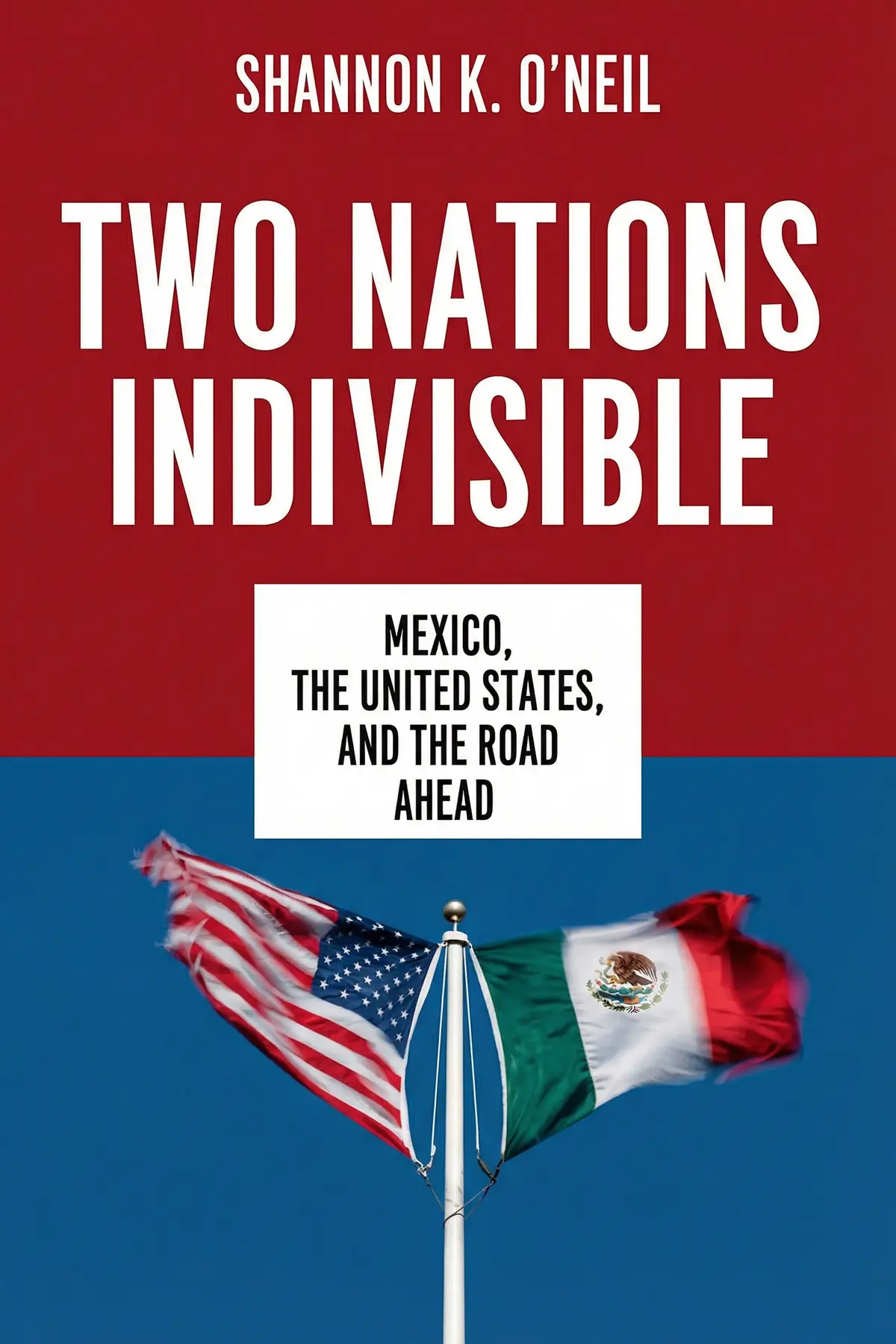
Table of Content
1. Introduction
1 min 02 sec
If your picture of Mexico comes mostly from crime news, you are seeing only part of the country. In 2010 Juárez counted 3,000 drug-related killings, the worst toll of any city on earth, yet multinationals such as Siemens and Bosch kept opening factories there. In Two Nations Indivisible, Shannon K. O’Neil, a Latin America specialist at the Council on Foreign Relations, argues that both facts belong to one story.
Over roughly three decades, Mexico moved from one-party rule and repeated currency crashes to contested elections and an export economy. Its remaining troubles, from cartels to monopolies to migration, are ones it shares with the United States. That is the case the ideas ahead build: the two neighbors rise or stumble together, and each does better when it stops treating the other as a problem to keep out. What follows is a clearer map of the border’s real issues, and of the reforms that could ease them.
2. Read Mexico past the crime headlines
1 min 46 sec
One border city became the most violent place on earth while global manufacturers kept building there. Both facts are true, and only one of them usually makes the news north of the border.
3. Understand how a one-party state became a democracy
1 min 53 sec
Burning credit cards outside a central bank, masked rebels in a southern jungle and a president who refused to crack down. Each played a part in ending seven decades of single-party rule.
4. Understand how cleaner elections set off the cartel wars
1 min 49 sec
Mexico’s drug violence surged just as its politics became more honest. The explanation runs through a sealed-off Florida coastline and a set of private arrangements that democracy tore up.
5. See where free trade helps and where it stops
1 min 56 sec
A trade deal multiplied exports across the border several times over. Yet families in Mexico still overpay for everyday goods, and the reason has nothing to do with tariffs.
6. A migration policy that matches real labor needs
2 min 06 sec
Over 100,000 university graduates who could not legally take a job. Volunteers patrolling the desert. O’Neil argues the real fix is far less dramatic, and it starts with how visas are counted.
7. What a failed ambassadorship teaches about partnership
1 min 52 sec
An American envoy pushed for a broader security plan and worked to build support for it in both capitals. Then leaked cables reached the Mexican president, and two years of careful diplomacy came apart.
8. See how Mexico's next reforms could reward both countries
1 min 48 sec
The party that held Mexico back for decades returned to power and promptly passed sixteen reforms. The bigger tests still lie ahead, and some of them depend on American money.
9. Conclusion
1 min 12 sec
Years after the book appeared, a 2016 presidential campaign made a huge border wall its signature promise, and the fierce reactions for and against showed how tangled the relationship remains. O’Neil’s book reads as a patient reply to that impulse. Her Mexico is neither the crime scene of the headlines nor a finished success. It is a young democracy born from burned credit cards and an independent election body, an export power built on NAFTA, and a country still fighting cartels and its own monopolies. Nearly every one of those stories runs through the United States: American demand feeds the drug trade, American visas shape migration, American investment could rebuild the rails.
So when Mexico comes up at work or over dinner, ask for the investment figures alongside the murder count. Weigh migration proposals by whether they follow real labor needs and keep families together. And watch competition rules, reelection and energy reform, where Mexico’s progress will show first.
A wall can mark a line on a map. On O’Neil’s evidence, the two economies on either side of it already run on each other.
About this book
What is this book about?
Most news about Mexico that reaches the United States is about drugs and murder. Shannon K. O'Neil, a Latin America specialist at the Council on Foreign Relations, argues that this picture hides how much the country changed politically, economically and socially over roughly three decades, and why that change matters to its northern neighbor. She follows Mexico from the long rule of the PRI, through the protests and electoral reforms that produced the first truly democratic presidential handover in 2000, to the NAFTA trade boom that made it Latin America's largest exporter. She is just as clear about what remains broken: cartels that grew violent once corrupt protection ended, a few giant firms that inflate prices, and a migration system that leaves millions without legal status. Readers get a balanced map of the relationship and a set of concrete proposals: visas that follow labor demand, faster family reunification, American investment in Mexican infrastructure, and the domestic reforms on competition, reelection and energy that could make Mexico a stronger democratic partner.
Book Information
Who it's for
Professionals weighing Mexico
Professionals in trade, manufacturing or supply chains weighing Mexico as a market or production base.
Curious about migration economics
Readers who follow migration and border debates and want the economics behind them.
Students of the Americas
Students of Latin America or US foreign policy looking for a clear account of Mexico's democratic turn.
About the Author
Shannon K. O’Neil
Shannon K. O'Neil works at the Council on Foreign Relations, an American think tank focused on foreign policy, where her expertise covers global trade, supply chains and Latin America, including Mexico's ties to the United States, corruption, democracy and immigration. She has testified before Congress on Mexico and Latin America, writes a column for Bloomberg Opinion, and has lived and worked in both Mexico and Argentina. She has taught Latin American politics at Columbia University and holds a PhD in government from Harvard. Two Nations Indivisible was her first book; she later wrote The Globalization Myth.
Ratings & Reviews
Ratings at a glance
What people think
Listeners find the book informative and skillfully written, with one listener noting that it provides statistical reports. Additionally, the work receives positive remarks for its accessibility and clarity in describing the relationship between Mexico and the United States. Listeners also value the tempo, with one listener pointing out the author's masterful job of marshalling facts and arguments. However, listeners disagree on the value for the money.
Top reviews
Fon
Shannon O'Neil does a fantastic job of deconstructing the outdated 'distant neighbors' narrative that has plagued US-Mexico relations for decades. Her prose is clear and the pacing keeps you engaged, even when she’s diving into dense economic data or the fall of the PRI. I was particularly struck by her argument that we are far more integrated than the average American realizes. The way she marshals facts to show Mexico's ascending middle class is eye-opening. However, I do think she glosses over some of the deeper corruption issues that still haunt the business sector. Still, it's a vital read for anyone who wants to move past the headlines of drug violence to see the real, cosmopolitan Mexico that is emerging right next door.
Show moreLeo
Ever wonder why the US and Mexico can't seem to get on the same page? This book offers some of the best answers I've seen in years. O'Neil’s central thesis—that we are 'indivisible'—is backed by a masterful assembly of facts regarding our shared economic destiny. She doesn't just give opinions; she supplies the numbers to prove that Mexico is no longer the country it was in the 1980s. I particularly enjoyed the sections on how Mexican democracy has matured since 2000. It’s a shame this isn’t required reading for every staffer on Capitol Hill. The clarity of her argument is refreshing and the pacing is perfect for a weekend read. This is exactly the kind of nuanced analysis we need more of.
Show morePakpoom
As someone who follows Latin American politics, I found this to be an incredibly informative look at the modern state of our southern neighbor. O'Neil provides a much-needed correction to the sensationalized news coverage that focuses solely on cartel violence and border crossings. The book is well-written and flows naturally from historical context to modern policy prescriptions. To be fair, her perspective is definitely shaped by her time among the Mexico City elites, which sometimes makes the analysis feel a bit detached from the struggles of the rural poor. But her clarity on how NAFTA has fundamentally reshaped both economies is undeniable. It’s a solid piece of research that challenges the 'backward country' stereotype with hard data and compelling arguments.
Show moreSamart
The chapter on the transition from an oil-reliant economy to a diverse manufacturing hub was the highlight for me. O’Neil explains complex trade relationships with a readability that is rare in political science texts. She makes a compelling case for why a prosperous Mexico is in the best interest of the United States. I appreciated the statistical reports she included, as they provide a sturdy backbone for her 'glass-half-full' outlook. My only real gripe is that the policy suggestions toward the end felt a bit repetitive of things I've heard in other think-tank circles. Nevertheless, the book is a masterclass in marshalling arguments to prove that our two nations are truly indivisible. It’s worth the price for the historical context alone.
Show morePrapaiwan
Finally got around to reading this and I'm glad I did. It’s a short but punchy volume that seeks to dispel the false images Americans have of Mexico. Instead of dirt streets and poverty, O'Neil shows us a country of growing democracy and sophisticated industries. The way she explains the cracking of PRI’s soft authoritarianism is brilliant and easy to follow. Look, some might argue it’s too optimistic, but after years of hearing nothing but 'failed state' rhetoric, this perspective is refreshing. The book is well-paced and never gets bogged down in unnecessary jargon. It provides a clear roadmap for how the US can stop treating Mexico as a problem to be solved and start seeing it as a partner.
Show moreDavid
This book masterfully bridges the gap between scholarly research and accessible journalism. O'Neil provides a compelling narrative of Mexico's ascent, focusing on the emergence of a cosmopolitan population that the American media loves to ignore. I appreciated how she placed drug violence in a broader perspective, ensuring it didn't overshadow the real story of economic reform. The prose is clean and the arguments are easy to digest, making it a great pick for anyone interested in foreign policy. While I agree with other reviewers that it can be a bit 'gringo-centric' in its prescriptions, the overall message is vital. We need to stop seeing the border as a wall and start seeing it as a bridge. A very readable and important work.
Show moreManop
While the pacing is excellent and the writing is sharp, I couldn't help but feel the book takes a very gringo-centric approach to the drug problem. O'Neil is quick to point out the violence in Mexico but eludes the uncomfortable reality of US drug consumption driving the whole machine. Truth is, the book is at its best when discussing commercial ties and the growth of the Mexican middle class. She paints a picture of a country on the rise, which is a welcome change from the usual doom-and-gloom. I wish she had spent more time on civil society instead of just focusing on market-oriented think tanks. It’s a good 3-star read that offers a lot of information, even if it feels a bit lopsided at times.
Show moreEmily
I found the statistical reports and the deep dive into migration trends to be the most valuable parts of this book. O'Neil correctly identifies that migration has actually been falling, contrary to popular belief. However, her focus on the 'Hermes silk tie' crowd in Mexico City is a bit distracting. The book feels like it was written for and by the elite, which makes sense given her acknowledgments section. I was also surprised there was no mention of major corporate scandals like the Walmart bribery case. It makes you wonder if her proximity to the Mexican Businessmen's Council colored the narrative too much. It’s definitely informative and well-written, but you have to take the rosy economic outlook with a grain of salt.
Show moreNaomi
Frankly, the argument about Mexican re-election laws was where O'Neil lost me a bit. She suggests that allowing re-election would create more accountability, but that seems to ignore the very different democratic traditions of Mexico compared to the US. Beyond that, the book is quite good. It’s a well-written summary of why the 'distant neighbors' concept is dead. She handles the topic of NAFTA with great skill, showing the mutual benefits that are often ignored by politicians. The book is informative, but the tone can feel a little too sure of itself at times. It’s a solid 3-star effort that provides a lot of clarity on trade, even if the political analysis feels a bit speculative.
Show moreChamp
Not what I expected, given the rave reviews from the policy world. This book is heavily supported by the wealthy Mexican elite, and it shows. O'Neil spends so much time poking fun at the Mexico City upper class while simultaneously relying on them for all her data. Where is the voice of the actual people? She talks about civil society but mostly just cites market-friendly think tanks. Plus, ignoring the Foreign Corrupt Practices Act and major bribery cases felt like a massive oversight for a book claiming to look at the 'road ahead.' The writing is clear enough, but I didn't find the value for money here. It felt more like a polished PR piece for NAFTA than a balanced sociological study.
Show moreQuestions about this book
What is the main idea of Two Nations Indivisible?
Shannon K. O’Neil argues that US news shows Mexico mostly through drug violence and misses its real progress. Over about three decades Mexico became a democracy, with its first truly democratic presidential handover in 2000, and an export power after NAFTA. Its remaining problems, including cartels, monopolies and migration, are tied to the United States, so the two countries benefit most by working on them together as economic partners and democratic neighbors.
Why did drug violence in Mexico increase as the country became more democratic?
O’Neil explains that under the old authoritarian system, traffickers had arrangements with corrupt officials that kept violence relatively contained. When opposition politicians took office, cartels lost that protection and fighting broke out. In Chihuahua, murders rose 60 percent in the two years after a National Action Party governor was elected in 1992, and violence escalated again after President Felipe Calderón declared war on drug trafficking in 2006.
Did NAFTA help Mexico's economy?
According to the book, yes. By 2011 Mexico exported five times as much to the United States as before the agreement, US exports to Mexico had risen fourfold, and foreign investment made Mexico Latin America’s largest exporter. O’Neil warns the edge will shrink as countries such as China gain their own deals, and that Mexico must also tackle monopolies, which the OECD found inflate household prices by about 40 percent.
What immigration reforms does Shannon O'Neil propose?
She argues that citizen border patrols are not sustainable and proposes three changes. First, speed up family reunification by giving family visas to the immediate relatives of naturalized US citizens. Second, replace the fixed visa quota with work and permanent visa numbers that follow the needs of the US labor market. Third, enforce existing labor laws against employers and workers in the black market.
Who should read Two Nations Indivisible?
It suits anyone whose work or interests touch Mexico: people in trade, manufacturing and supply chains, students of Latin American politics, and readers following debates on migration and the border. It offers a balanced picture that covers both the violence in cities like Juárez and the factories, trade growth and reforms that headlines tend to leave out.
Readers also enjoyed

A River in Darkness: One Man’s Escape from North Korea
Masaji Ishikawa

A Splendid Exchange: How Trade Shaped the World
William J. Bernstein

A Theory of Justice
John Rawls






A Warning
Miles Taylor
AUDIO SUMMARY AVAILABLE
Listen to Two Nations Indivisible in 15 minutes
Get the key ideas from Two Nations Indivisible by Shannon K. O’Neil, plus 5,000+ more nonfiction titles.
- 5,000+ titles
- Listen as much as you want
- 7-day free trial
- Cancel anytime









