

14 min 04 sec
Available in: English
Trust Matters More Than Ever: Proven Tools to Lead Better, Grow Faster & Build Trust
Shows why stalled projects, wary clients and slow decisions often trace back to missing trust. It sets out eight learnable pillars, each with a simple tool, for building trust at work and beyond.
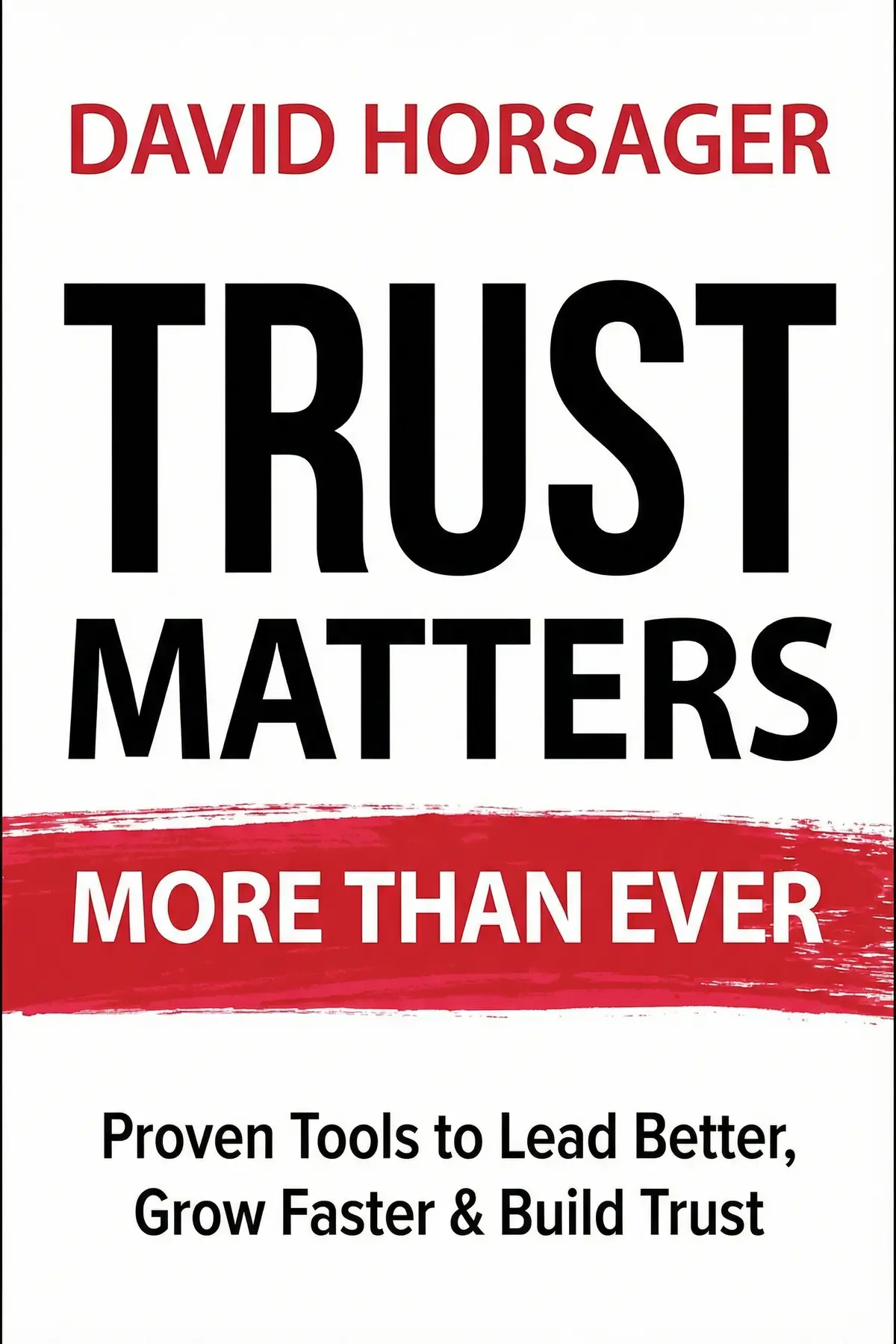
Table of Content
1. Introduction
1 min 11 sec
If your work keeps stalling on what look like strategy, sales or management problems, David Horsager has a blunter diagnosis: they are often trust problems. In Trust Matters More Than Ever, the strategist and CEO of the Trust Edge Leadership Institute notes that trust in government has slid from about 77 percent in the early 1960s to roughly 20 percent now. Schools, media, religion and medicine have lost ground too. As institutions lose credibility, people turn to reviews, platforms and networks, and personal trust in those closest to them is rising again too. That puts the weight on you.
Horsager’s case is that trust can be learned like any other skill. It rests on eight pillars, all starting with C, and each one can be practiced with a small tool. One is a clarifying question, another a ranked list of principles, another a six-point accountability check, another a daily health routine. With them you can see where trust is leaking in a team, a client relationship or your own habits, and what to fix first.
2. Spot the trust gap hiding behind slow work
1 min 56 sec
A project drags, a deal stalls, a team argues in circles, and the usual fixes change nothing. Horsager points to a cause most people never check, and he explains why it is getting harder to ignore.
3. Turn vague goals into plans people believe
1 min 46 sec
Fuzzy instructions feel harmless in the moment, yet Horsager links them to a large share of workplace conflict. A three-letter tool and one repeated question can turn a hopeful wish into a task someone actually owns.
4. Visible care that makes people speak up
1 min 34 sec
A team can understand every instruction and still keep its best ideas to itself. Horsager argues that the missing ingredient is often written off as softness, and he turns it into four habits anyone can practice.
5. Decide your principles before the pressure arrives
2 min 02 sec
Under stress, even well-meaning people make choices they later regret. Horsager offers a way to settle hard calls in advance, and a second plan to keep your skills from quietly losing their value.
6. Keep your word and tell true stories
2 min 07 sec
An apology after a broken promise feels like the right move, yet Horsager says it rarely repairs anything. He explains what does, and why a story about your own mistake can bring people closer than your achievements.
7. Small repeated actions keep trust from wearing away
2 min 12 sec
Trust built over months can thin out without any single failure. Horsager’s last two pillars explain how results and routine keep it alive, down to the ordinary daily habits that make steady behavior possible.
8. Conclusion
1 min 16 sec
What the eight Cs add up to is a shift in where trust comes from. Institutions once carried much of it for us. As that support weakens, trust becomes something each person and each team has to produce, through behavior others can watch and count on. Horsager’s frame is simple: high trust makes decisions faster, costs lower and loyalty deeper, and low trust drags everything down.
He ends where it all starts, with you. If you do not trust yourself, he argues, others will not either, and building self-trust takes honesty, humility and work. That is why so many of his tools are about your own conduct: a ranked list of principles, a 90-day learning plan, a promise kept so that no apology is needed.
A useful start is to find the pillar where your trust is weakest. If people often misread you, close your next meeting with an outcome, a deadline and one clarifying question. If your follow-through slips, keep one small promise every day this week and let it become a repeater.
Trust, in this book, is less a feeling people have about you than a record you keep adding to, one interaction at a time.
About this book
What is this book about?
Many problems that look like strategy, sales or management failures are really trust failures, David Horsager argues. Confidence in government has fallen from about 77 percent in the early 1960s to roughly 20 percent today, and schools, media, religion and medicine have lost ground too. As institutions weaken, people lean on reviews, networks and the people closest to them. Each person now carries more of the weight. Horsager replies that trust is a skill, a habit and a choice, built on eight pillars he calls the eight Cs, which are clarity, compassion, character, competency, commitment, connection, contribution, plus consistency as the last one. High trust makes work faster, cheaper and more loyal. Low trust adds friction and stress to every step. The book pairs each pillar with a practical tool. Readers get the ODC questions for clear plans and the LAWS acronym for visible care. They also get a ranked list of operating principles, a 90-day learning plan, a six-step accountability check, the Six Es of Motivation and the SEEDS habits that keep a person steady. The result is a way to find where trust is leaking and what to fix first.
Book Information
Who it's for
Team leads
Team leads whose meetings end in confusion and whose people hold back ideas.
Leaders suspecting trust problems
Founders and managers who suspect slow sales or high turnover hide a deeper trust problem.
Wanting to earn trust
Early-career professionals who want colleagues and clients to rely on them faster.
About the Author
David Horsager
David Horsager is a strategist and keynote speaker and the CEO of the Trust Edge Leadership Institute. He created the Enterprise Trust Index and directs The Trust Outlook, a national study on trust. A national bestselling author, he also wrote The Trust Edge and The Daily Edge. His work has appeared in Fast Company, Forbes and The Wall Street Journal. He has spoken on six continents, to audiences ranging from FedEx and Toyota to the New York Yankees and the Department of Homeland Security.
Ratings & Reviews
Ratings at a glance

What people think
Listeners find the content delivers compelling observations and actionable tips, while one listener observes that it is firmly grounded in real-world results. Additionally, the book provides ready-to-use resources for immediate application, and one listener specifies that it is built upon 8 key pillars of trust. They also appreciate its ability to cultivate greater trust and forge more sincere bonds in every aspect of life.
Top reviews
Kenji
This book is essentially a masterclass in human connection that goes far beyond the typical corporate leadership manual. David Horsager treats trust like a living organism, something that requires constant nourishment and the right environment to flourish. I found the 8-pillar framework to be incredibly robust, especially the focus on 'contribution' which often gets overlooked in these types of discussions. The 40 specific tools provided are not just abstract concepts; they are actual, sharpenable implements you can use to mend relationships or build new ones from scratch. While some of the diagrams are a bit dense upon first glance, the overall impact of the 90-day plan is undeniable for anyone willing to put in the work. It’s a hopeful, sturdy guide that reminds us that while trust is easily broken, it is also something we can intentionally rebuild with steady hands.
Show moreMaksim
Honestly, the way Horsager breaks down the 'Counter Forces' that erode our credibility makes this a mandatory read for anyone in a leadership position. He doesn't just tell you that trust matters; he shows you exactly how to measure it and what to do when it starts to leak out of your organization. The farmer metaphor throughout the book is beautiful and grounded, making the advice feel timeless rather than trendy. I spent a lot of time with the 'What Trust Tool do I need today?' index, which is perfect for those days when you don't have time to read a whole chapter. It’s rare to find a book that is both deeply philosophical and immediately applicable to a Tuesday morning staff meeting. This isn't just about business—it’s about how to be a person of weight and character in a world that often feels flimsy.
Show moreGai
The chapter on 'Compassion' felt like a breath of fresh air in a genre that usually prioritizes bottom-line metrics over human emotion. Horsager manages to prove that being a 'good' person and being a successful leader are not mutually exclusive goals, but are actually deeply intertwined. I loved the visual aids, especially the 'Counter Forces' graphic, because it gave me a language to describe why my previous team failed. This book is structured like a toolkit, and like any good toolkit, the implements are sturdy, well-designed, and ready for immediate use in the field. Every leader should keep a copy of this nearby to remind themselves that their word is their bond and their character is their greatest asset. It’s a hopeful look at how we can fix our broken institutions one relationship at a time. Truly an essential read for 2024 and beyond.
Show moreHugo
I've been searching for a way to bridge the gap between my team's output and our culture, and this blueprint for authenticity provided the missing link. David Horsager has a way of stating the obvious in a way that makes you realize you haven't been doing it at all. The 40 tools are the highlight here, providing a clear path forward when everything feels like it's falling apart during a crisis. I especially liked the 'What Trust Tool do I need today?' section because it recognizes that leadership is often about triage rather than long-term planning. This book is a steadying force in an uncertain world, offering a reminder that the harvest of trust only comes to those who work the land. It is easily the most actionable book on organizational health I have read in the last five years.
Show moreFrida
After seeing how quickly workplace morale can crumble, I realized that trust isn't just a soft skill but a hard currency. Horsager’s book offers a pragmatic blueprint for authenticity that felt very relevant to my current team dynamics. The division into 8 key pillars makes the daunting task of 'building trust' feel much more manageable and structured. I particularly appreciated the section on 'Consistency' because it highlights how small, repetitive actions outweigh one-time grand gestures. To be fair, some of the 40 tools felt a little repetitive, and a few examples seemed slightly dated for the modern remote-work era. However, the 'What Trust Tool do I need today?' section at the back is a genius addition for quick reference. It’s a solid resource for anyone looking to foster deeper connections in their professional life.
Show morePriya
Picked this up on a whim, and I’m glad I did because the emphasis on 'compassion' as a fundamental pillar was a total lightbulb moment. Most business books ignore the emotional undercurrents of productivity, but Horsager leans right into them with real-world examples that hit home. The writing style is clear and flows like water, making it easy to digest even when the topics get heavy or self-reflective. I’ve started implementing the 90-day trust building cycle with my direct reports, and the fresh shoots of improved communication are already visible. My only gripe is that the book can feel a bit repetitive in the middle chapters as it reinforces the core pillars. Still, the practical value of the tools far outweighs the minor pacing issues. It is a very useful guide for becoming a more intentional human being.
Show morePing
Gotta say, I appreciated the 'Lasting Trust' diagram because it simplified complex psychological concepts into something my kids could even understand. The book does a great job of taking high-level theory and grounding it in the dirt of everyday life and work. I’ve been using one tool per week as suggested, and the intentionality has already changed the way I approach difficult conversations with my clients. To be fair, the tone can be a bit 'cheerleader-ish' at times, which might grate on more cynical readers who prefer a drier, more academic style. However, if you can get past the enthusiasm, the actual strategies for building consistency and contribution are gold. It’s a very practical guide that focuses on real-world results rather than just feeling good about yourself. I’d recommend it to anyone managing a team.
Show moreWin
Is trust really the 'soil' of our interactions, or is it just another corporate buzzword used to mask underlying power dynamics? David Horsager makes a compelling case for the former, though the book sometimes feels like it’s trying to solve every human problem with a single hammer. The 8 pillars are a useful mental model, but I found some of the 40 tools to be a bit simplistic for complex organizational conflicts. Frankly, the 'Lasting Trust' diagrams were helpful, but the text surrounding them felt like it could have been edited down for more impact. It’s a decent read if you’re new to the concept of trust as a business metric, but seasoned leaders might find some of it to be common sense. It’s definitely actionable, though I struggled to stay engaged through the more anecdotal sections of the middle chapters.
Show moreSuphan
Look, the core message here is solid, but I found the sheer volume of 40 different tools to be a bit overwhelming for a single volume. While the 8-pillar framework is a great way to categorize the concepts, I felt like the book sacrificed depth for breadth in several sections. Some of the tools are fantastic and provide immediate clarity, while others feel like filler that could have been summarized in a few bullet points. I appreciated the actionable nature of the 90-day plan, but sticking to it requires a level of discipline that the book assumes everyone already possesses. It’s a helpful resource to keep on your desk for occasional reference, but reading it straight through was a bit of a slog for me. A good book, just not the revolutionary experience I was expecting based on the hype.
Show moreOrawan
Not what I expected in terms of pacing, as the book asks for a significant time commitment to really work through the 90-day plan effectively. While I respect the research behind the 8 pillars, I found the writing to be somewhat repetitive, constantly circling back to the same themes without adding new layers. The 40 tools are hit-or-miss; some are absolute game-changers for communication, while others felt like common-sense advice repackaged in fancy terminology. In my experience, trust is more organic and less mechanical than the 'implement' metaphor suggests, making some of the steps feel a bit forced. It’s a decent manual for someone who needs a very rigid structure to follow, but it lacked the nuance I was hoping for. It's okay, but maybe a bit over-engineered for such a fundamental human experience.
Show moreQuestions about this book
What is the main idea of Trust Matters More Than Ever?
David Horsager argues that trust, the steady belief that someone will keep doing what is good and right, decides how fast and how cheaply people work together. As trust in institutions falls, it rests more on individuals. He treats trust as a skill anyone can learn, resting on eight pillars known as the eight Cs: clarity, compassion, character, competency, commitment, connection, contribution, plus consistency.
What are the eight pillars of trust according to David Horsager?
Clarity makes your meaning explicit. Compassion shows you act for others. Character means choosing the ethical path even when it costs more. Competency keeps your skills current. Commitment is following through on promises. Connection creates a sense of belonging by way of a common purpose and truthful stories. Contribution means producing results that count. Consistency repeats dependable behavior so people know what to expect from you.
What is the ODC tool for clarity?
ODC stands for outcome, deadline and clarifiers. You name the result you want, fix a precise deadline, then pose questions like what could block you or how success would appear a week from now. Horsager pairs it with asking how repeatedly until a concrete task appears, with a named person, time and place attached at the end.
How do you rebuild trust after it has been broken?
Horsager says an apology alone is not enough. What restores trust is delivering on what you promised, backed by small daily signs of follow-through such as returning calls, being on time and keeping your word. When leaders visibly commit to their people, he argues, those people tend to commit in return.
Who should read Trust Matters More Than Ever?
It suits managers, team leads and founders facing slow decisions, guarded communication or turnover, and anyone who wants to be relied on at work. Its tools are short and practical, from the LAWS acronym for visible care to the six-step accountability framework and the SEEDS daily habits that help a person stay steady.
Featured in
Readers also enjoyed


A Year with Peter Drucker: 52 Weeks of Coaching for Leadership Effectiveness
Joseph A. Maciariello



Acting with Power: Why We Are More Powerful Than We Believe
Deborah Gruenfeld

All In: How Great Leaders Build Unstoppable Teams
Mike Michalowicz



7 Powers: The Foundations of Business Strategy
Hamilton Helmer
AUDIO SUMMARY AVAILABLE
Listen to Trust Matters More Than Ever in 15 minutes
Get the key ideas from Trust Matters More Than Ever by David Horsager, plus 5,000+ more nonfiction titles.
- 5,000+ titles
- Listen as much as you want
- 7-day free trial
- Cancel anytime









