Super Thinking: The Big Book of Mental Models
Gabriel Weinberg
 English
Shows founders why a good product will not find buyers on its own, and how to test marketing channels cheaply, pick the one that works and focus the company on growth.
1 min 02 sec
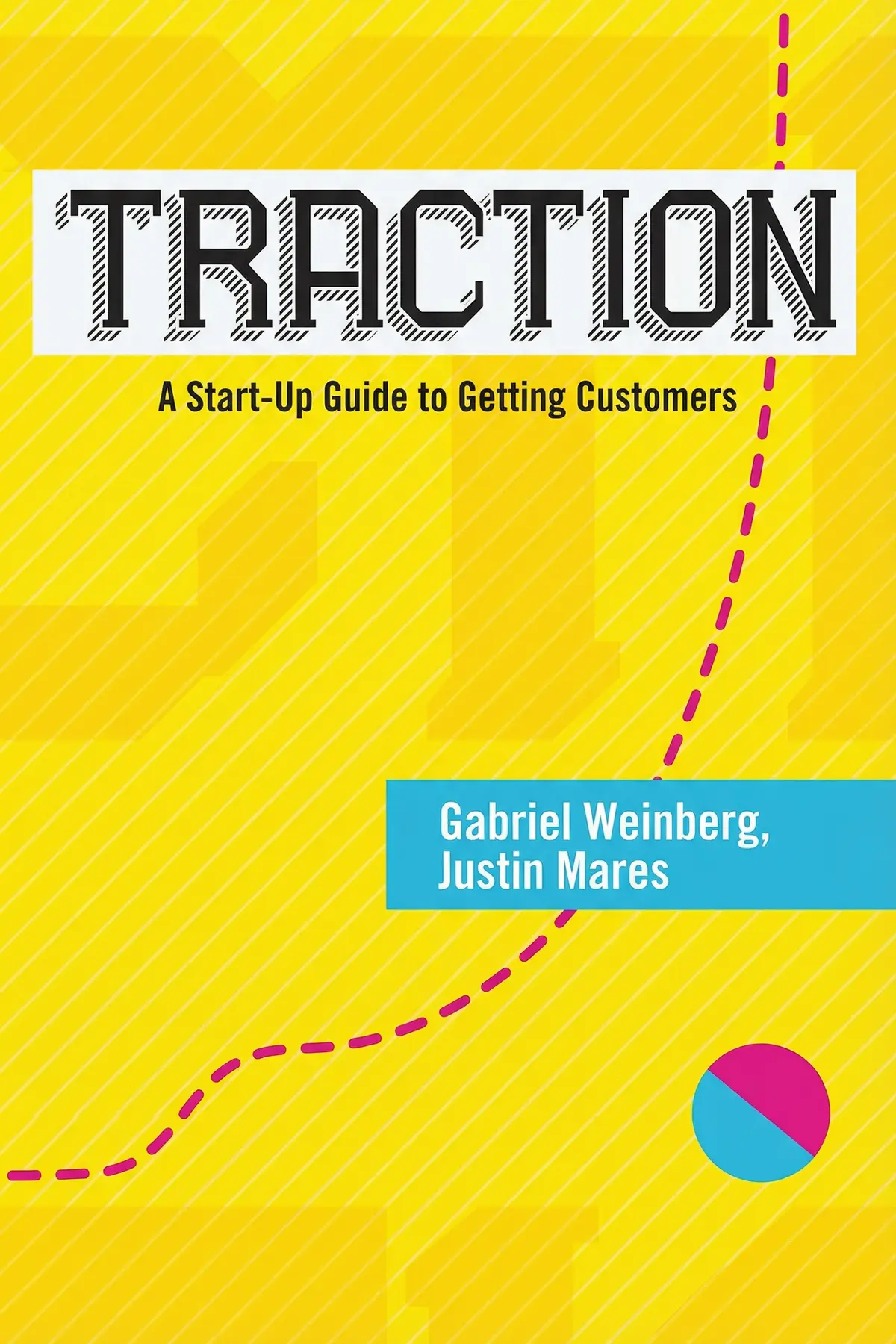
A start-up with a good product and no steady flow of customers is a car spinning its wheels in mud, and most founders respond by revving the engine with more features and more polish. In Traction, DuckDuckGo founder Gabriel Weinberg and growth specialist Justin Mares argue that the engine is rarely the problem. What a new company lacks is grip, which they call traction: rising customer demand for what it sells.
Because a start-up is judged above all by how fast it grows, and only that demand can drive growth, they treat finding customers as a discipline equal to building the product, starting on day one. Their case runs through Dropbox, Google, Twitter and Weinberg’s own search engine, and through a long menu of ways to reach people, from small blogs to cold calls. What they offer in the end is a way to choose: test a few channels cheaply, commit to the one that works, and organize the company around one clear growth target.
1 min 26 sec
Dropbox once paid twice as much to win a customer as that customer paid back. Learning this early meant they still had time to try cheaper viral approaches, which shows the value of thinking about customers well before launch.
1 min 38 sec
Founders tend to market their product the way they already know, and ignore everything else. A five-step method forces a wider look, then narrows the field before any serious money is spent.
1 min 41 sec
A charity website went from a few local news stories to a spot on Oprah Winfrey’s famous list. The route it took is open to almost any small company willing to aim low first.
1 min 38 sec
Paying for every new customer adds up fast. Dropbox found a way to make its users want to bring in their friends, but the trick only works if one easily overlooked detail is right.
1 min 38 sec
A backpack maker stuck on page three of search results is almost invisible. Small changes in wording can move it up, and a playful eyewear brand shows how to advertise on social networks without paying.
1 min 34 sec
A bicycle brake maker without a finished product walked into a trade show and walked out on the path to a major deal. Partnerships can open doors that no advertising budget reaches.
1 min 22 sec
Email and cold calls sound old-fashioned next to social media. Yet for people already curious about your product, or for anything expensive, a personal approach can earn trust that ads cannot.
1 min 20 sec
Every start-up has more tasks than time, from logos to hiring. DuckDuckGo chose a single number to chase, and that choice made it easy to see which work could wait.
1 min 07 sec
Weinberg and Mares close by restating their key message that even great products do not sell themselves. A strong engine does not help without grip on the ground where customers actually are, and their book turns that grip into something a founder can plan. Demand does not appear because a product is good. It appears because someone chose a channel, tested it, measured what one customer cost and kept going only when the numbers held.
That changes how a start-up spends its days. Half the effort goes to finding customers from the first week, early enough that a mistake like Dropbox’s costly search ads becomes a cheap lesson. Before committing real money, put three channels on an A-list and test them small. Choose one number, the way DuckDuckGo chose 100 million monthly searches, and let it push lesser tasks aside. And if you are unsure where to begin, the authors point to a trade show in your field, where press, partners and early fans gather in one hall.
The tank does not win because of its engine. It wins because it was built to grip.
Many founders pour their energy into the product and assume customers will follow. Gabriel Weinberg, founder of DuckDuckGo, and growth specialist Justin Mares argue that this almost never happens. A start-up is judged by how fast it grows, and growth comes only from rising customer demand, which they call traction. The authors walk through the many routes to customers: press coverage that climbs from small blogs to national outlets, referral programs, search and social ads, partnerships, trade shows, email and direct sales. Their examples include Dropbox, Google, Twitter, Warby Parker and DuckDuckGo itself. The heart of the book is a method for choosing. The Bullseye Framework asks founders to brainstorm every channel, test the three most promising ones cheaply and focus on the winner. Readers also learn to set a specific traction goal and follow a critical path of actions toward it, setting everything else aside.
Founders with a working product and too few customers.
Early employees and marketers deciding where to spend a small budget.
Side-project builders who want a simple way to test which marketing actually brings users.
Gabriel Weinberg founded DuckDuckGo, an independent online protection company, and is its CEO. He studied physics at MIT and later completed a master's degree in its Technology and Policy Program, and he also co-wrote Super Thinking. Justin Mares led growth at Exceptional Cloud Services, a developer tools company bought by Rackspace in 2013, after co-founding a 3D printing business that was acquired in 2011. He has advised startups and well-known websites and mentors at the seed-stage accelerator 500 Startups.
Gabriel Weinberg
Listeners find this book to be essential for startups, offering actionable guidance through concrete examples and clear perspectives. Additionally, the material is thorough, with one listener noting it lists 19 different categories of marketing efforts, and listeners value the uncomplicated, straightforward delivery and quality writing style.
As a developer transitioning into the business side of things, I found Weinberg's approach to growth incredibly refreshing. Most marketing books feel like they are written for people selling soap, but this is clearly for the tech crowd. The 'Bullseye Framework' gives you a structured way to actually test these 19 channels without losing your mind or your budget. Truth is, I used to think the product was everything, but the '50% rule'—spending half your time on distribution—changed my entire philosophy. It's not a magic bullet, and you still have to do the hard work of testing, but it provides a clear map. Some of the case studies feel a bit dated now, yet the core principles remain solid.
Show moreWow. This is the first business book I've read that didn't make me want to roll my eyes at 'thought leadership' nonsense. Gabriel Weinberg, the founder of DuckDuckGo, and Justin Mares have put together a manual that is actually usable on Monday morning. I spent the last three hours mapping out our Bullseye framework and realized we were completely ignoring four channels that our competitors aren't even touching yet. It's easy to fall into the 'product trap' where you just keep polishing features while nobody is using the app. This book is the slap in the face most technical founders need. It isn't perfect—some of the offline advice feels a bit niche—but the mindset shift is worth ten times the cover price.
Show moreTraction is arguably the most practical guide for startups since The Lean Startup. Most people focus entirely on building a great product, but as the authors point out, that's a trap if you don't have a way to reach customers. The book offers a comprehensive list of 19 different channels, and the beauty is in its simplicity. You don't need a marketing degree to understand their testing methodology. In my experience, most founders fail because they give up on a channel too early or stick with a dead one too long. This book provides the discipline to avoid those mistakes. It's a must-read if you're serious about growth.
Show morePicked this up on a whim and ended up finishing it in two sittings because the advice is so actionable. Weinberg and Mares don't waste your time with flowery language or vague metaphors about 'brand identity.' Instead, they give you a toolkit of real-world examples and a clear methodology for finding your next growth lever. It’s the kind of book you keep highlighting until the whole page is yellow. Even if you only find one new channel that works, it pays for itself a hundred times over. To be fair, you'll need to supplement this with more technical guides for the specific channels you choose. But as a high-level roadmap for acquisition, nothing else really comes close.
Show moreFinally got around to reading this after hearing so many founders rave about it in Slack groups. It’s essentially an encyclopedia of customer acquisition strategies, ranging from SEO to viral loops and even offline ads. The writing style is simple and direct, which I appreciate because I don’t have time for fluff. While some chapters are definitely more developed than others, the breadth of the content is impressive. To be fair, if you are already an expert in one specific area like SEM, you won't find much new info in that particular section. However, the value lies in seeing the full menu of options and using their methodology to narrow down what works for your specific niche.
Show moreThis book should be mandatory reading for every startup team, even if just to get everyone on the same page regarding terminology. It covers a lot of ground quickly, listing 19 distinct categories of marketing efforts that you can systematically experiment with. Look, you aren't going to become an SEO wizard just by reading the ten pages they give you here. That's not the point of the book though. The point is to stop guessing and start measuring your acquisition costs across different platforms. It’s a fast read, very direct, and cuts through the typical marketing jargon. I do wish there were more updated examples for the B2B space, but the logic holds up regardless of your industry.
Show moreAfter hearing Weinberg on a few podcasts, I decided to pick this up to help scale my consultancy. The concept of 'Traction' is often treated as some mysterious dark art, but this book demystifies it into something manageable and scientific. I especially liked the emphasis on engineering as marketing—building tools to attract users—which is something we’ve started implementing with great success. Gotta say, the layout is very clean and the prose is punchy, making it easy to skim the parts that don't apply to your business. My only real complaint is that some of the 'interviews' feel a bit like filler to hit a page count. Still, it’s a great resource to keep on your desk for brainstorming sessions.
Show moreThe chapter on 'Targeting Blogs' alone was worth the price of admission for my small e-commerce brand. I've always been overwhelmed by the sheer number of marketing options out there, so having them categorized into 19 specific buckets was a huge relief. It’s a very tactical book, which might annoy some who want high-level theory, but for a bootstrapper, it’s exactly what’s needed. Not gonna lie, some of the sections on trade shows and offline events felt a little irrelevant for a digital-first company. However, the overarching Bullseye framework is a brilliant way to prioritize your time and energy. It keeps you focused on the one thing that actually moves the needle.
Show moreNot what I expected given the hype, though I can see why people like the checklist nature of the book. My main gripe is that it prioritizes tactics over strategy, which can lead inexperienced founders down a rabbit hole of meaningless testing. The authors give you 19 different buckets but don't always explain the nuance of why one might fail while another succeeds beyond just saying 'test it.' Personally, I found the interviews with other founders to be the most engaging part of the text. It’s a decent primer for someone who has never touched marketing before, but it lacks the depth needed for a scale-up. I'd call it a solid 'getting started' guide that you will likely outgrow quickly.
Show moreLook, I wanted to love this, but it felt like a series of blog posts stitched together into a physical book. Most of the advice is incredibly high-level and relies heavily on the 'just test it' mantra which isn't helpful when you have limited capital. It feels monotonous after the fifth channel description because the structure of every chapter is identical. Frankly, I think you could get 90% of the value by just looking up the list of 19 channels online and reading a summary of the Bullseye framework. It lacks the strategic depth I was looking for. If you're looking for a deep dive into growth hacking, this isn't it. It's more of a shallow overview for absolute beginners.
Show moreThe authors argue that even great products do not sell themselves. A start-up lives or dies by how fast its customer base grows, so founders should work on traction, meaning rising customer demand, from the start. They recommend splitting time evenly between product and traction, testing several marketing channels, and building company goals around growth.
It is a five-step method for choosing a marketing channel. Brainstorm every channel in your industry, sort them into promising, possible and long shots, and pick the top three. Test those three cheaply, checking what one customer costs, how many customers each can bring and whether they are the right ones. Then focus on the winner, or repeat the process.
It suits founders and early team members who have built something but struggle to find customers. It also helps marketers at small companies choosing between press, ads, partnerships, email or sales, since the book compares many channels and offers a way to test them before spending heavily.
Check whether traction gets about half your working time. List every channel you could use, choose three and design small, cheap tests for each. Set one specific growth number, as DuckDuckGo did with 100 million monthly searches, and drop tasks that do not move it. The authors also suggest attending a popular trade show in your field.



Hamilton Helmer





Duncan Clark


AUDIO SUMMARY AVAILABLE
Get the key ideas from Traction by Gabriel Weinberg, plus 5,000+ more nonfiction titles.