

59 Seconds: Change Your Life in Under a Minute
Richard Wiseman
 English
Shows how to replace rigid goals with small, time-bound experiments, then use energy, focus, deliberate imperfection and weekly reflection to learn your way forward when the path ahead is unclear.
56 sec
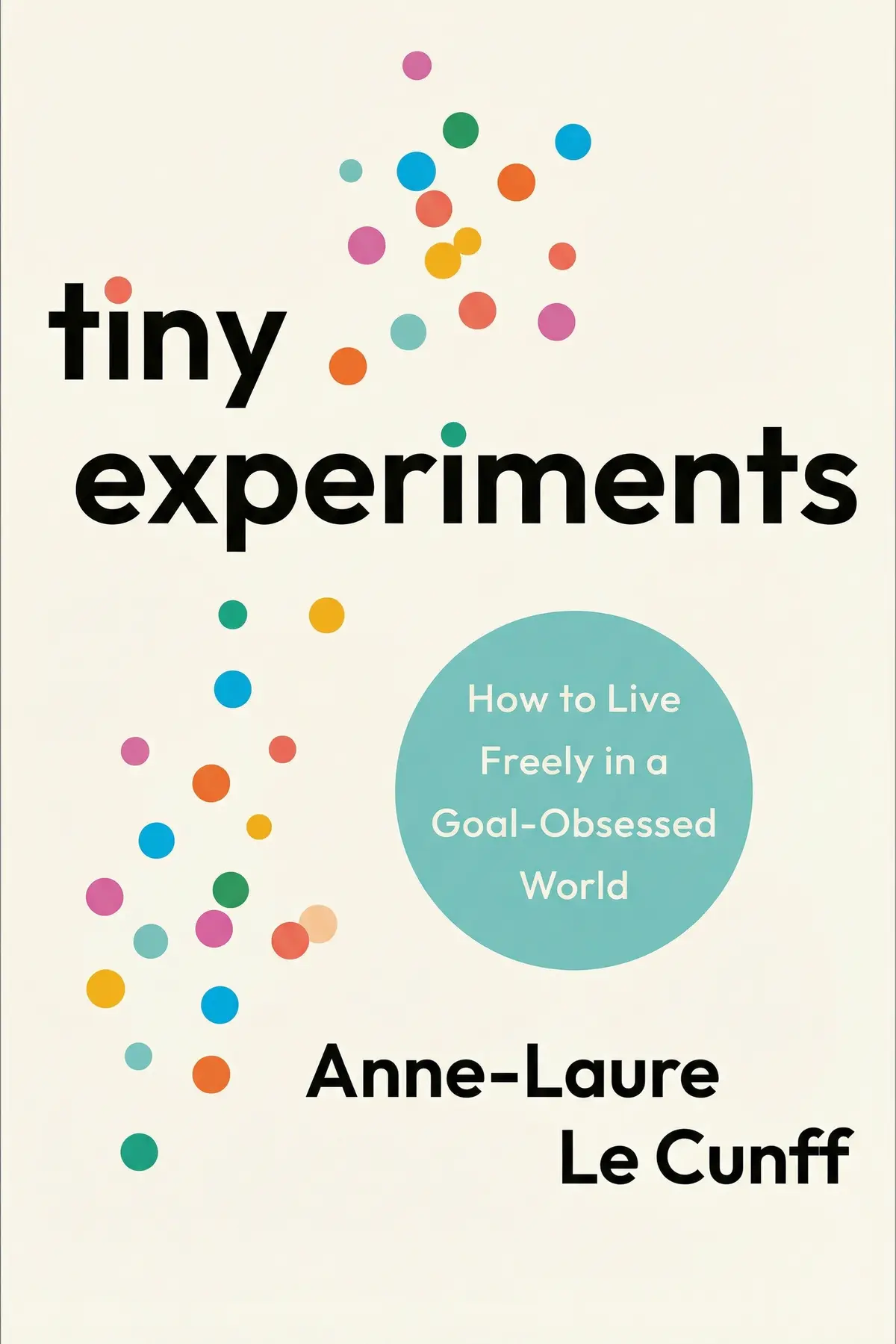
If you are working hard toward goals you no longer fully believe in, the usual advice is to set a sharper goal. In Tiny Experiments, neuroscientist and former Google executive Anne-Laure Le Cunff argues for the opposite move. When the path is unclear, replace the distant destination with a small commitment that has an end date, and treat whatever happens as information.
Her case is that a curious life grows through loops of committed action and honest reflection, and that this works better than a straight climb toward fixed targets. Her examples include a marketer who learned to code one hour a day, a marathon runner’s training diary and a cartoonist who refused to cash in.
From them come a one-line formula for a pact, three questions for finding your best hours, a five-minute weekly review and a clear way to decide what to do when an experiment ends.
1 min 57 sec
A marketer who could not stick with learning to code made one modest public promise, and it spread far beyond him. The shape of that promise is simple enough to write on a sticky note tonight.
2 min 05 sec
Seeing your whole life as a page of tiny squares can push you to squeeze every minute, and that often ends in burnout. The ancient Greeks had a second word for time that points somewhere better.
2 min 05 sec
One of television’s most successful producers was asked how she does it all, and her answer surprised people. A bond manager and an entire country offer the same uncomfortable lesson about trying to excel everywhere.
2 min 08 sec
A champion marathon runner records details most athletes would ignore, down to how his shoes feel. His habit points to the half of progress that busy people skip, and a three-column sheet that brings it back.
2 min 16 sec
A famous cartoonist turned down the merchandise and media deals almost anyone would accept. His refusal shows that finishing an experiment opens more doors than the one everyone pushes you toward.
2 min 07 sec
A future pope, a fashion designer and a film star all took detours that no career planner would draw. Their paths point to a different measure of a meaningful life, one you can start using this month.
1 min 07 sec
Tiny Experiments asks you to stop treating the unclear stretches of life as a waiting room before the real plan begins. For Le Cunff, those stretches are where you find out who you are. The tools she offers are small: a sentence that commits you for a set time, a ritual that opens your best hours, a short list of things you will do only well enough, a sheet with three columns. None of them requires knowing where you will end up.
What changes is the measure. A goal asks whether you arrived. An experiment asks whether you showed up, what you noticed and what you will try next, and every honest answer counts as progress.
So pick one thing you have been circling for months and write it as a pact with an end date, ten days if it is new to you. Protect a window for it. At the end of each week, spend five minutes on plus, minus and next. When the pact ends, decide on purpose whether to persist, pause or pivot, and pass what you learned to someone who can use it.
Kallaway never set out to start a movement. He promised himself one hour a day.
Many careers and lives are built around a straight line. You pick a goal, climb toward it and treat any detour as failure. Then a health scare, a failed startup or a creeping sense of emptiness breaks the line, and the usual planning tools stop helping. Anne-Laure Le Cunff, a neuroscientist and founder, argues that these uncertain stretches are the best places to grow, as long as you approach them like a scientist. Her method starts with the pact: a promise to do one small action for a set period, judged only on whether you show up. Around it she builds a way of working. You manage physical, cognitive and emotional energy instead of minutes. You choose where to accept imperfection. You reflect each week with a simple three-column review. And at the end of each experiment you decide whether to persist, pause or pivot. Her examples include Alexander Kallaway's 100 days of coding, Eliud Kipchoge's training diary, Shonda Rhimes on not doing it all and Ben Tossell's curiosity-led career. The book ends by swapping the chase for legacy for generativity, which means helping other people now with what you learn.
Professionals stuck chasing goals they no longer believe in and unsure what to try next.
Career switchers and side-project builders who want a low-risk way to test a new direction.
Recovering productivity enthusiasts and perfectionists heading toward burnout who want to work with their energy.
Anne-Laure Le Cunff has worked as a neuroscientist, a founder and a writer. She was an executive at Google before returning to university, and she earned a Ph.D. in Psychology and Neuroscience at King's College London. She founded Ness Labs, a platform for neuroscience-based learning and creativity, and writes its newsletter. Her subjects include evidence-based ways to make better use of your mind, handle uncertainty and keep learning for life.
Listeners find this work to be both motivating and perceptive, featuring evidence-based material that provides tangible steps for self-improvement. They value the focus on trial and error, as one listener points out how it helps transform uncertainties into experiments. The text is accessible, pleasing, and efficient; one review emphasizes that it delivers the necessary equipment to master flow. Listeners prize the practical nature of the advice, with one noting that every chapter offers actionable takeaways that stick.
This book arrived at exactly the right time when I was feeling paralyzed by the pressure of massive life goals. Anne-Laure Le Cunff takes her neuroscience background and turns it into a very practical manual for anyone scared of failing. Instead of the usual corporate fluff, she treats life like a laboratory where every setback is just data. To be fair, some sections felt a bit like a textbook, but the PACT framework is genuinely useful for breaking out of a creative slump. I loved the idea of turning my paralyzing doubts into small, manageable experiments. It’s less about perfection and more about flow. I’ve already implemented three of her suggestions and feel more productive than I have in months.
Show moreAs someone who has struggled with burnout for years, Le Cunff’s perspective on iterative progress felt like a breath of fresh air. She doesn't promise massive overnight changes. The truth is, most of us just need a way to make small improvements without feeling overwhelmed by the 'productivity' cult. The writing is clear and the tone is incredibly empowering. I've already started my first 'tiny experiment' with my morning routine, and the results are promising. It’s rare to find a self-improvement book that feels both rigorous and compassionate. If you’re feeling stuck on the career ladder and want to reclaim your curiosity, buy this book.
Show moreThe chapter on reframing failure as data changed my entire approach to my side project. For years I’ve been terrified of starting because I didn't want to mess up, but this book gave me the tools to view every setback as a learning opportunity. It’s a very practical guide that focuses on empowering the reader through experimentation. While it’s in a crowded field alongside James Clear, I think the 'experiment' mindset is more forgiving than the 'habit' mindset. Not gonna lie, the French-accented narration in the audiobook was a bit slow for me, so I switched to the physical copy. It's a much better experience in print where you can highlight the actionable steps. Truly transformative for my daily productivity.
Show morePicked this up on a whim and was pleasantly surprised by the depth of the research. Anne-Laure Le Cunff avoids the usual clichés of the genre by rooting her advice in neuroscience. This isn't just a pep talk; it’s a manual for personal growth that respects the complexity of the human brain. I particularly enjoyed the sections on overcoming the fear of disruption and building social connections. It provides a structured way to handle uncertainty, which is something we all need in 2025. Every chapter offers actionable takeaways that stick with you long after you close the cover. It’s a 5-star read for anyone looking to reclaim their agency in a chaotic world.
Show moreFinally got around to reading 'Tiny Experiments' and I appreciate the shift from rigid habits to curious testing. The author doesn't just tell you to 'follow your dreams' blindly. Instead, she provides a research-backed method to test those dreams before you blow up your life. In my experience, the iterative approach is much more sustainable than trying to change everything overnight. Every chapter has actionable takeaways that stick with you. It's an easy, enjoyable read that actually yields results if you’re willing to do the work. The only downside was that the pacing felt a bit uneven in the middle chapters, but the conclusion ties everything together beautifully.
Show moreNot what I expected, but in a good way. I thought this was going to be another book on how to be a more efficient worker bee. Instead, it’s a deep dive into how to build a meaningful life through trial and error. Some might find it a bit basic if they’ve read a lot of self-help, but for me, the simplicity was the point. It strips away the jargon and gives you a framework to actually do things. It's insightful, empowering, and highly recommended for anyone feeling demotivated. The author manages to turn complex neuroscience into something you can actually use while drinking your morning coffee.
Show moreTo be fair, the self-help market is incredibly crowded, so finding a new angle is tough. This book manages it by focusing on the 'experiment' as the unit of change rather than the 'habit.' It’s a subtle but powerful difference that makes the advice feel much more attainable. While I agree with some other reviewers that the organization can feel repetitive in spots, the practical guidance is top-notch. It helped me step off the corporate hamster wheel and start thinking about my career in a much more creative way. It’s an easy, enjoyable, and ultimately productive read. Not exactly a reinvention of the wheel, but a very polished and scientific version of it.
Show moreAfter hearing all the buzz about Ness Labs, I had high hopes for this one, but it ended up being a bit of a mixed bag for me. While the core philosophy is sound, the book feels a bit cluttered with excessive examples that don't always land. Frankly, I missed some of the more practical tools she usually mentions online, like the Eisenhower Matrix or interstitial journaling. It’s a decent read if you’re trapped in the corporate hamster wheel and need permission to try something new, but it didn't feel revolutionary. Look, it’s better than most generic productivity books, but it lacks the punch of something like Atomic Habits. It’s a good introductory text, but seasoned self-help readers might find it a bit repetitive.
Show moreEver wonder why some productivity books feel like they’re written for people with no actual responsibilities? This one almost falls into that trap by occasionally ignoring the role of luck and privilege in success, but it redeems itself through its scientific grounding. Anne-Laure’s PhD in neuroscience adds a layer of credibility that many 'gurus' lack. I found the PACT framework helpful, though the middle of the book gets a bit repetitive with its anecdotes. Personally, I think it’s a great companion to Four Thousand Weeks, but it isn't quite the life-changing manifesto it claims to be. It’s not a magic spell for success, but it is a solid toolkit for better decision-making.
Show moreFrankly, I found the structure a bit cluttered with too many underdeveloped examples that felt like they were there just to fill space. The core idea—that we should test our lives in small increments—is excellent, but it could have been a long essay rather than a full book. I was hoping for more on the Wayfinder mindset, which was barely touched upon compared to her workshops. However, the author’s enthusiasm is contagious and her academic background shines through. To be fair, if you are new to the world of productivity and want something less 'hustle culture' and more 'curiosity culture,' this is a solid entry point. Just don't expect a revolution.
Show moreAnne-Laure Le Cunff argues that when life feels uncertain, you should run small experiments instead of chasing fixed goals. Each experiment is a pact: one action, repeated for a set period, judged only on whether you show up. Paired with regular reflection, these loops of action and review help you learn what fits you. She contrasts this experimental mindset with a linear one that treats uncertainty as a threat and success as a single destination.
A pact is a simple promise to do a specific action for a set length of time. Alexander Kallaway’s public pledge to code one hour a day for 100 days is the model. Le Cunff suggests about 10 days for something new, a month for something you have tried before and three months to strengthen an existing habit. Choose an action small enough to complete even on a bad day.
Plus Minus Next is Le Cunff’s weekly reflection tool. On one sheet of paper, draw three columns: what went well, what did not go as planned, and what you will try next. It takes around five minutes, works for any area of life and keeps attention on improvement instead of regret. It supplies the reflection half of each growth loop, alongside the action half provided by your pacts.
Le Cunff describes three equally valid choices. You can persist and keep going unchanged, as Maria Popova has with her weekly essays for nearly two decades. You can pause when your energy belongs elsewhere. Or you can pivot, keeping the purpose but changing the format, such as cutting five articles a week to one. Decide by weighing external signals, like circumstances, and internal ones, like your motivation.
It suits people at a crossroads: professionals questioning a career ladder, founders after a setback, career switchers testing a new field and anyone burned out by productivity systems. The book offers small, practical tools, from pacts and magic windows to deliberate imperfection, plus a view of meaning built on helping others now instead of chasing a legacy.
Richard Wiseman





William B. Irvine


Andrew D. Thompson


Deepak Chopra
AUDIO SUMMARY AVAILABLE
Get the key ideas from Tiny Experiments by Anne-Laure Le Cunff, plus 5,000+ more nonfiction titles.









