

16 min 13 sec
Available in: English
Time of the Magicians: Wittgenstein, Benjamin, Cassirer, Heidegger, and the Decade That Reinvented Philosophy
Follows four philosophers through Germany's chaotic 1920s and shows how their rival answers about death, culture, language and close observation still shape how we face meaning, fear and the limits of what we can know.
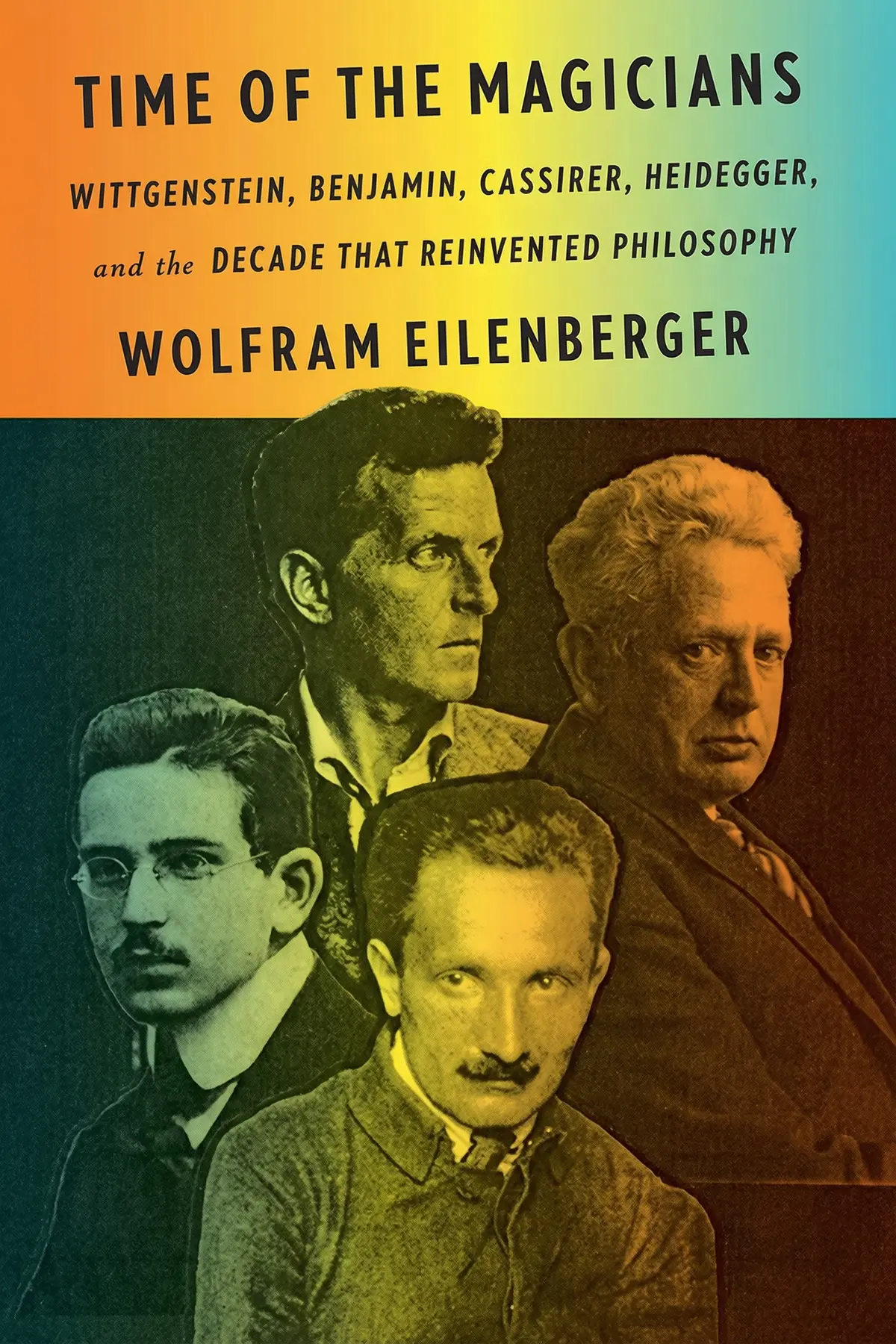
Table of Content
1. Introduction
1 min 02 sec
When the big questions arrive, about death, meaning or what you can really know, most of us have no map for them. In Time of the Magicians, German philosopher Wolfram Eilenberger shows that four thinkers drew four very different maps in a single decade, in a Germany wrecked by war. Martin Heidegger said we must look straight at our own death. Ernst Cassirer answered that culture lifts us above it. Ludwig Wittgenstein concluded that thinking runs into a wall, and Walter Benjamin looked for truth in patient attention to ordinary things.
Eilenberger’s argument is that these rival answers, formed amid poverty, street fighting and political collapse, reset the direction of philosophy after the Enlightenment and still guide how we think. Follow the four lives and the history turns into something more useful: a set of positions to test against your own fears, your work and the news.
2. Two rival answers to what a human is
2 min 08 sec
A young philosopher wore his ski gear to dinner at a Swiss hotel and then challenged an older, cosmopolitan professor who had made his name in Hamburg. Their quarrel was about whether culture can save us, and it split a whole generation.
3. Face your own mortality to live fully
1 min 59 sec
Students packed his lectures to hear that they should be afraid. Heidegger promised a fuller life on the far side of that fear, though his own life followed a much easier path than the one he preached.
4. Stay calm by valuing every way of knowing
2 min 01 sec
A bullet cut the power in the middle of his lecture, and he simply kept talking. Cassirer’s steadiness came from an unusual belief about people, and from a library arranged unlike any other.
5. Learn where thinking ends and living begins
1 min 54 sec
One of the richest heirs in Europe came home from the war and gave everything away. He then wrote a book almost no one understood, claiming it had finished philosophy for good.
6. See a whole era in ordinary things
1 min 59 sec
He was always broke, always spending, and never accepted by the universities. Yet Benjamin found a way to read an entire age in a shopping arcade, and his method needs nothing but attention.
7. See how language shapes what you can understand
1 min 54 sec
All four agreed that language does far more than carry messages, then split sharply over what it can reach. A bare house in Vienna became the strangest answer of all.
8. What great minds can and cannot do in a crisis
2 min 06 sec
As democracy wobbled, one philosopher defended it in public at real personal risk, and another praised a lonely mountain hut. Their political choices show what a philosophy of life becomes under pressure.
9. Conclusion
1 min 10 sec
Eilenberger’s decade ends in exile, death and disgrace, yet the four men feel close to us. Each faced the same pressure: a world whose old certainties had collapsed, where reason alone no longer looked like a cure. Cassirer trusted culture and human decency. Heidegger wanted people frightened into living fully. Wittgenstein dissolved the great questions of philosophy into a problem of language. Benjamin waited for the world to reveal itself to a patient eye.
The book supports a few habits of mind. In a crisis, notice which of the four you are acting out, the one who seeks comfort in shared culture or the one who demands the hard truth. When an argument goes in circles, ask whether the words themselves have reached their limit. Give one ordinary object your full attention, the way Benjamin read a Paris arcade. And judge a thinker partly by what they did when their country fell apart.
The lights went out in Berlin in 1919, and Cassirer kept talking. Each of them had to decide what to do in the dark.
About this book
What is this book about?
In 1919 Germany lay in ruins. The monarchy had fallen, the war had wrecked the country, and the old faith that reason could cure every ill no longer held. Over the following decade, four very different thinkers tried to rebuild philosophy from the ground up: Martin Heidegger, Ernst Cassirer, Ludwig Wittgenstein and Walter Benjamin. Wolfram Eilenberger tells their story as a group portrait. Heidegger wanted to shock people awake by making them face death. Cassirer trusted culture, symbols and human decency. Wittgenstein gave away a fortune and decided thought could not solve the riddle of existence. Benjamin, always broke, looked for truth by studying ordinary things closely. Their ideas run alongside their lives: a famous debate in Davos, love affairs, a village school, a cube-shaped house in Vienna. Then come the Nazi years, which pushed them toward exile, complicity or death. Readers get a clear map of four ways to answer the biggest questions, along with the human cost of holding each one when a society falls apart.
Book Information
Who it's for
Curious about philosophers' lives
Curious readers who want philosophy told through real lives, love affairs and political danger.
Students meeting these thinkers
Students meeting Heidegger, Wittgenstein, Cassirer or Benjamin for the first time and wanting a clear map.
Facing loss or uncertainty
Anyone facing loss or uncertainty who wants several serious ways to think about death and meaning.
About the Author
Wolfram Eilenberger
Wolfram Eilenberger is a bestselling German writer and philosopher who writes on everything from everyday culture and politics to sports. Time of the Magicians has been translated into thirty languages and won the Bavarian Book Prize in 2018 and France's Prix du Meilleur Livre Étranger in 2019. He has taught at the University of Toronto, Indiana University Bloomington, ETH Zürich and Berlin University of the Arts. He also helps run the philosophy festival phil.cologne and hosts the Swiss television program Sternstunde Philosophie.
Ratings & Reviews
Ratings at a glance
What people think
Listeners value the philosophical depth found in the text, and one individual pointed out the superb breakdown of every philosopher's contributions. Furthermore, the biographical elements are well-received; one listener mentioned it offers a standout perspective on Cassirer. The quality of the prose is also lauded, with one listener calling it well-written for any curious reader. Views on the book’s delivery are varied, as some consider it heavy while others remark on its scholarly approach.
Top reviews
Elena
This book manages to breathe life into four titans of thought who usually feel like cold, marble statues in a university hallway. Eilenberger captures the electricity of 1920s Berlin and the sheer desperation of a generation trying to find meaning after the Great War. I was particularly struck by the descriptions of Walter Benjamin’s constant state of flux and his struggle for professional recognition. The author avoids the dry, academic tone you’d expect from a philosophy book, opting instead for a narrative that feels almost like a high-stakes drama. Some might find the focus on their personal lives a bit much, but it helped me understand that their ideas didn't emerge from a vacuum. It is a brilliant group biography that makes the 'magical' decade feel immediate and vital for today’s readers.
Show moreJom
Wow, what a ride through the 1920s! I loved the focus on the everyday lives of these men—Heidegger in his mountain hut, Wittgenstein giving away his fortune, and Benjamin constantly on the run. Eilenberger makes the argument that philosophy isn't just about abstract logic, but about how we live our lives in times of crisis. The prose is elegant and fast-paced, which is rare for this genre. I finally feel like I understand why the Davos encounter was such a turning point for European thought. Even if you aren't a philosophy student, the historical context of hyperinflation and social collapse makes for a fascinating backdrop. It is easily one of the most engaging non-fiction books I have read this year.
Show moreThitiwan
Frankly, this is the best group biography I have encountered in years. Eilenberger manages to connect the dots between four very different thinkers in a way that feels organic rather than forced. I was mesmerized by the portrait of Wittgenstein; the image of a war hero returning to teach primary school in rural Austria is just so vivid. The book captures that specific post-war anxiety where old systems of value had crumbled and everything was up for grabs. It’s intellectual history told with the heart of a novelist. I found myself highlighting passages on almost every page, particularly the ones regarding Benjamin’s 'Arcades Project' and the nature of symbols. A truly exceptional work that deserves all the praise it has received.
Show moreTariq
Picked this up after a recommendation from a philosophy podcast and I wasn't disappointed. The way Eilenberger weaves the personal crises of these four men together with the political instability of the Weimar Republic is genuinely gripping. I’ve always been intimidated by Cassirer, but this book provides an exceptional overview of his symbolic forms that actually makes sense to a non-expert. The chapters are short and punchy, which helps when you're dealing with such dense intellectual material. My only complaint is that the author leans a bit too heavily into the 'unreliable' accounts of their sexual gossip. Still, it’s a compelling intellectual history that should lead any curious reader to go back and check out the original works of the 'magicians' themselves.
Show moreRiley
After hearing so much about Heidegger’s 'Being and Time,' I finally feel like I have a grasp of the man behind the jargon. Eilenberger doesn't shy away from the darker aspects of Heidegger’s character, and he does a great job showing how his philosophy of 'authenticity' was already leaning toward a dangerous cultural nationalism. The comparison between the four thinkers is brilliant, acting as a prism to show how different minds reacted to the same era of groundlessness. I found the sections on Walter Benjamin particularly moving, especially his obsession with toys and his inability to finish his habilitation thesis. My only minor gripe is that the ending felt a little rushed. It is a very well-written book for anyone who wants to see the human side of abstract ideas.
Show moreViroj
Finally got around to reading about the Davos dispute without having to trudge through five hundred pages of primary texts. Eilenberger’s analysis of the clash between Cassirer’s neo-Kantianism and Heidegger’s existentialism is the highlight of the book. He presents it not as a dry academic debate, but as a battle for the soul of the 20th century. I also appreciated the attention given to the 'lesser-known' figures like Cassirer, who often gets overshadowed by the more eccentric Wittgenstein. The writing is smooth and avoids the clunky terminology that usually kills my interest in philosophy books. While it’s true that some historical details are a bit loose, the overall narrative flow is excellent. It’s a solid 4-star read for any history buff.
Show moreMonthon
As someone who isn't a trained philosopher, I found Eilenberger's style surprisingly approachable and even a bit exciting. He treats these four men like the rockstars of their era, following them from the lecture halls of Germany to the streets of Paris and the mountains of Switzerland. The book is weighty but never feels like a slog, thanks to the author's ability to switch perspectives just as things are getting too dense. To be fair, he does take some liberties with diary entries, and his claim that 1929 was 'magical' is a bit of a stretch given the impending disaster. However, the way he ties Heidegger's later Nazi involvement to his early work was handled with necessary gravity. It’s a fascinating, if occasionally slightly speculative, look at a decade that reinvented how we think.
Show moreErn
Ever wonder if an author actually bothered with a fact-checker before hitting the print button? Eilenberger writes with undeniable flair, but his sloppy errors regarding the Austrian Schilling and calling Wittgenstein’s family 'billionaires' in 1919 are distracting for anyone who knows the history. It is a bit of a 'feuilleton' read—lightweight philosophy for people who want to name-drop at dinner parties without actually reading Being and Time. To be fair, the section on the Davos dispute between Heidegger and Cassirer is well-staged and offers a decent summary of their clashing worldviews. However, the liberal use of 'magical' as an adjective and the constant psychological speculation made me trust the narrator less and less. It is a fun read if you treat it as historical fiction, but take the scholarship with a massive grain of salt.
Show moreSumalee
Look, the prose is a bit too 'journalistic' for my taste, bordering on tabloid territory at times. Do we really need the intimate details of Heidegger’s affair with a young Hannah Arendt to understand his ontology? Eilenberger is clearly a talented writer, but he has a habit of projecting modern sensibilities onto the 1920s. He also confuses 'unsinnig' and 'sinnlos' when discussing Wittgenstein, which is a massive red flag for anyone who has studied the Tractatus seriously. On the plus side, the book is quite accessible and does a great job of placing these four men in the same room, metaphorically speaking. It’s a decent introduction for a beginner, but scholars will likely find the lack of a rigorous fact-check frustrating. It’s middle-of-the-road for me.
Show moreUraiwan
Not what I expected from a serious work of history. The truth is, the 'magical' framing of 1929 feels like a marketing gimmick designed to sell books to people who read the Sunday arts section. Eilenberger uses a grating, journalistic style that prioritizes flashy anecdotes over any rigorous philosophical interpretation. For instance, his treatment of Wittgenstein’s language games is incredibly superficial. He spends more time talking about Wittgenstein hitting a student than he does explaining the fundamental shift in the Tractatus. It’s a book for the bored intellectual who wants the 'vibe' of the 20s without doing the work. If you want a real biography, go read Ray Monk or Safranski instead of this watered-down version. Very disappointing execution for such a great premise.
Show moreQuestions about this book
What is Time of the Magicians about?
Wolfram Eilenberger follows four philosophers, Martin Heidegger, Ernst Cassirer, Ludwig Wittgenstein and Walter Benjamin, through Germany’s turbulent 1920s. After the First World War destroyed old certainties, each tried to rebuild philosophy. Eilenberger argues that their rival answers about death, culture, language and observation reset the direction of philosophy after the Enlightenment and still shape how we think today.
What was the Davos debate between Heidegger and Cassirer?
On March 26, 1929, the two met at the Belvédère Hotel in Davos, Switzerland, to argue about human nature and the purpose of philosophy. Cassirer said humans create culture and symbols that lift them above mortality, and that philosophy should free us from fear. Heidegger said fear and death underlie human experience, and that philosophy must confront people with that truth so they can become free.
What did Wittgenstein mean when he said we must stay silent about whatever we cannot speak of?
In the Tractatus, Wittgenstein argued that thinking cannot solve the mystery of existence. Language can describe facts, which belong to the natural sciences, but the meaning of life lies beyond what words can say and shows itself only in moments of mortal danger. So, in his view, it is pointless to theorize about it. After writing the book, he left to become a village schoolteacher in Austria.
What happened to the four philosophers under the Nazis?
Cassirer, who was Jewish and had publicly defended the Weimar democracy, was forced to emigrate after the Nazi takeover. Heidegger joined the Nazi Party and became director of Freiburg University under Hitler. Benjamin, also Jewish, went into exile in France, fled again when Germany invaded, and took his own life in 1940. Wittgenstein returned to teach at Cambridge after Hitler annexed Austria.
How can the ideas in Time of the Magicians help today?
The four thinkers offer distinct ways to meet hard questions. Heidegger suggests facing your own mortality to live more fully. Cassirer suggests valuing every form of knowledge and staying calm through culture. Wittgenstein reminds you that some questions sit beyond what words can settle. Benjamin suggests close attention to everyday objects to understand your era, the way he read the shopping arcades of Paris.
Readers also enjoyed

A History of Iran: Empire of the Mind
Michael Axworthy

A History of the World in 6 Glasses
Tom Standage

A Long Way Gone: Memoirs of a Boy Soldier
Ishmael Beah




A Splendid Exchange: How Trade Shaped the World
William J. Bernstein

A Spy Among Friends: Philby and the Great Betrayal
Ben Macintyre

AUDIO SUMMARY AVAILABLE
Listen to Time of the Magicians in 15 minutes
Get the key ideas from Time of the Magicians by Wolfram Eilenberger, plus 5,000+ more nonfiction titles.
- 5,000+ titles
- Listen as much as you want
- 7-day free trial
- Cancel anytime









