
Beyond Good and Evil
Friedrich Nietzsche
 English
 ไทย
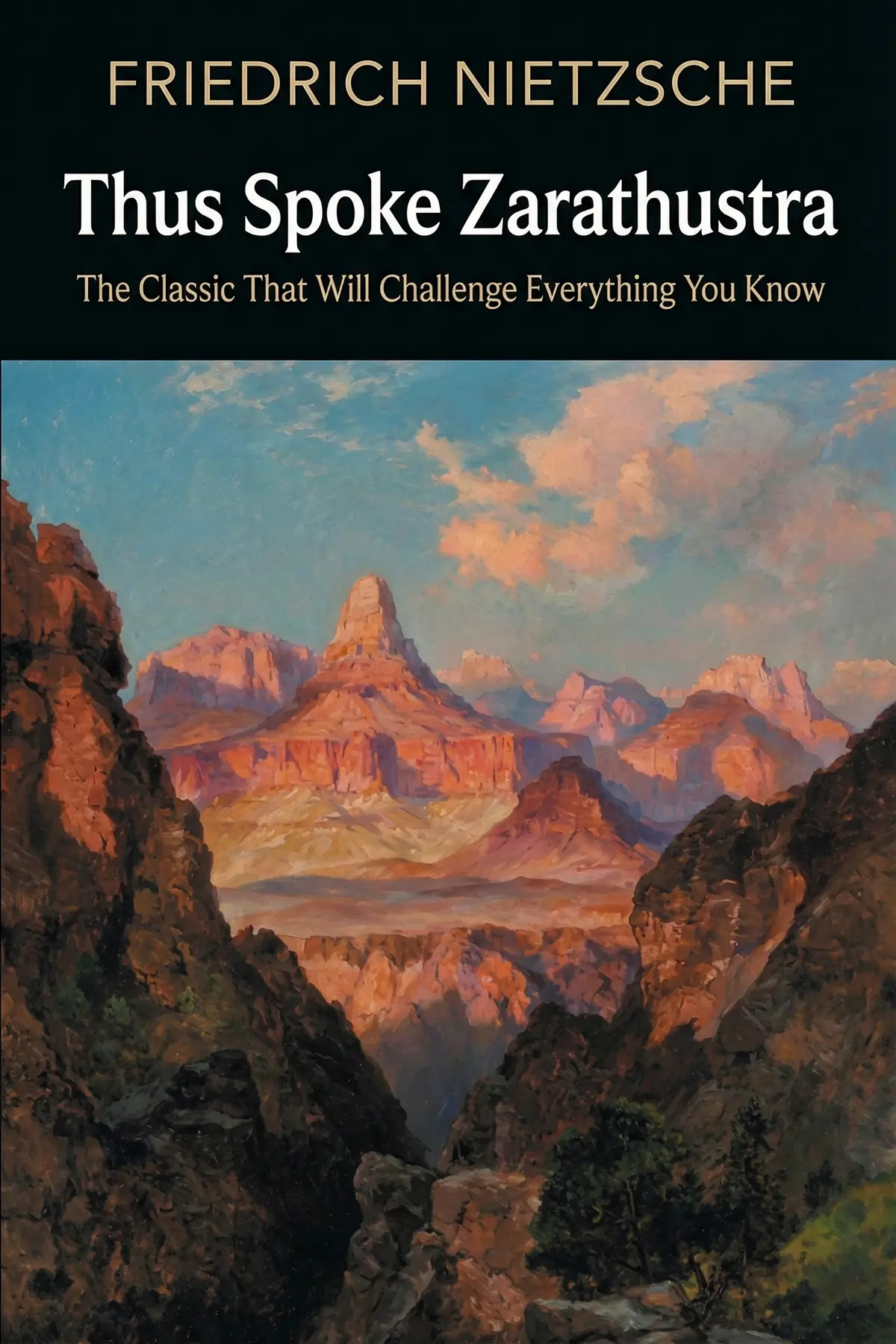
Nietzsche's poetic novel follows a prophet who argues that once old certainties like God collapse, people must overcome themselves, create their own values and meet life's mix of joy and suffering with laughter.
1 min 09 sec
If the rules you grew up with no longer feel solid, you can cling to them or start building values of your own. In Thus Spoke Zarathustra, Friedrich Nietzsche chooses the second path, and his opening move is blunt: God, he suggests, can no longer give morality and truth a reliable footing. The book is a poetic work of fiction that Nietzsche composed in four installments from 1883 to 1885, telling of a prophet who descends from a decade of solitude in the mountains to share his hard-won insight. Mostly, people laugh at him.
One line runs through his teaching. When the old foundations give way, a person has to overcome themselves and create their own values, saying yes to life with all its pain, and carrying that weight with laughter. Follow Zarathustra from a mocking town square to a strange feast in his mountain cave, and Nietzsche’s best-known ideas arrive as a story: the overman, the will to power, eternal recurrence. Along the way come a few hard questions worth putting to your own habits of thought.
1 min 45 sec
An old saint in a forest hears news that makes his whole way of life look outdated. Nietzsche treats that loss as the start of something larger, and it begins with a picture of humans dangling over empty space.
1 min 49 sec
Before anyone can create their own values, Zarathustra says, they must pass through two other shapes. Knowing which one you are in right now changes how a hard stretch of life feels.
2 min 03 sec
A crowd hears a warning about wasted lives and asks for exactly that fate. Then a performer falls from a rope above the square, and Zarathustra rethinks whom he is really talking to.
2 min 05 sec
A dream about a mirror sends Zarathustra back down the mountain to attack virtue, pity and equality. His alternative to them begins somewhere surprisingly close to home.
1 min 58 sec
A prophecy of emptiness and a castle full of coffins push Zarathustra to the edge. Then he meets a thought so heavy that he faints, and he needs an unlikely defense against it.
2 min 13 sec
Two kings, a magician, a pope and a lost shadow gather in a mountain cave. What they share, and what they end up worshipping, reveals Nietzsche’s final word on joy and pain.
1 min 07 sec
Zarathustra never meets the overman. The book closes on a lion at the door and a man walking into the morning, and that unfinished ending may be its most honest image. Nietzsche gives no finished model to copy, since copying would undo the point. He gives a direction: overcome yourself, make values you can stand behind, and accept a life where joy and sorrow come as a pair.
There is plenty here to argue with. Zarathustra scorns pity and equality and dismisses women, and those positions deserve hard questions. The central challenge still holds. Take one belief you live by and decide whether you would pick it again if nobody had handed it to you. Notice where comfort is shrinking you, the way the people of Motley Cow asked to become last men. And when a problem starts to feel like the weight of the world, remember the coffin that burst open with laughter.
Nobody at the feast became an overman. Each of them became a bridge, and Zarathustra thought that was reason enough to dance.
Many people reach a point where the values they inherited stop holding. Friedrich Nietzsche wrote Thus Spoke Zarathustra, a poetic novel in four parts written between 1883 and 1885, about what comes next. Its hero is a prophet who leaves ten years of solitude in the mountains to announce that God is dead and that humanity must reach for something higher: the overman, a person who finds meaning within instead of borrowing it. Along the way Zarathustra is mocked by a town that would rather stay comfortable. He attacks pity, equality and what Nietzsche calls the morality of the weak. He wrestles with the crushing idea that everything recurs forever, and he finally gathers a strange band of seekers for a feast in his cave. His answer to the heaviness of life is laughter and dance. Readers get Nietzsche's central ideas told as a story: the overman, the will to power, the three stages of the spirit and eternal recurrence. They also get a demanding question to carry with them, about which of their values they would choose again on their own.
Readers who have outgrown the beliefs they were raised with and want a way to build their own.
Professionals who feel comfort turning into stagnation and want a sharper standard for growth.
Curious listeners who want the overman, the will to power and eternal recurrence told as one story.
Friedrich Nietzsche was born in 1844 in Röcken, in the Prussian Province of Saxony. Trained as a classical philologist, he became a professor at the University of Basel in 1869, at only 24. Ill health ended that post in 1879, and he spent the following decade as an independent writer, moving between Switzerland, Italy and southern France, where much of his central work took shape. His writing, often aphoristic and ironic, is linked to perspectivism, the Übermensch and eternal return. After his collapse in 1889 and his death in 1900, his sister edited his manuscripts to fit her nationalist views, a distortion later scholars corrected.
Friedrich Nietzsche
Friedrich Nietzsche
Friedrich Nietzsche
Friedrich Nietzsche
Friedrich Nietzsche
Listeners find that while perspectives differ on the text's frequently dense and cryptic language, many listeners value the book as an imaginative, sagacious, and deeply intellectual exploration of philosophy. Furthermore, they cherish the instances of genius and elegant phrasing found throughout the work, with one listener noting that the volume provides "deep insights" that make the endeavor worthwhile. Additionally, they highlight the narrative's distinct poetic organization. They also mention the demanding quality of the material, with one listener even comparing the encounter to reading James Joyce's *Ulysses*.
This book is a fever dream of philosophy that manages to be simultaneously hilarious and terrifyingly profound. Nietzsche isn't just writing a dry treatise; he’s building a whole world of symbols, from the tightrope walker to the laughing lion. While the prose can be abstruse, the core message of self-overcoming hits like a lightning bolt. It’s certainly not for everyone, as it demands your total attention and a willingness to be confused. Frankly, the sheer creativity on display here puts most modern thinkers to shame. I found myself highlighting entire pages of beautiful, rhythmic phrasing that felt more like music than text. It’s a wild, intelligent journey for anyone brave enough to climb the mountain with Zarathustra. Be prepared to feel small before you feel great.
Show moreRarely do you encounter prose that feels like it’s vibrating with its own internal energy and chaotic spirit. Nietzsche’s Zarathustra is a character for the ages, a lonely prophet shouting truths that the world isn't ready to hear. The declaration that 'God is dead' is only the beginning of a much deeper exploration into human value. I loved the way the language mimicked religious scripture while simultaneously tearing down traditional morality. It’s a wise, perceptive, and deeply creative work that defies easy categorization or summary. You might find yourself frustrated by the obscure wordplay, but the brilliance of the 'Overman' concept makes it worth the effort. This is easily one of the most intelligent and provocative books in my collection.
Show moreAfter hearing about the 'Overman' for years, reading the source material was an absolute revelation for my own philosophy. The structure is so unique—it’s part epic poem, part philosophical manifesto, and part satirical play. Nietzsche’s wordplay is incredibly clever, even in translation, and his ability to subvert biblical language is masterful. I found the animal metaphors, like the camel and the child, to be profoundly moving and easy to visualize. This isn't just a book of ideas; it’s an invitation to reinvent yourself from the ground up. Look, it’s a difficult trek, but the view from the top of Nietzsche's mountain is incomparable. I feel like a more perceptive person after finishing this journey.
Show moreThe chapter on the three metamorphoses changed how I view my own creative struggle and the nature of freedom. Nietzsche’s prose is incredibly rhythmic and beautiful, reminding me more of a symphony than a standard philosophy text. While some parts are admittedly impenetrable, the general arc of Zarathustra’s journey is surprisingly compelling. He is a teacher who doesn't want followers, which is a refreshing take on the prophet archetype. I was struck by the deep insights regarding the 'eternal recurrence' and what it means for our daily choices. It’s a book that demands to be read aloud so you can feel the weight of the words. Truly, this is one of the most intelligent and transformative things I have ever read.
Show moreFinally got around to finishing this monster and I’m still processing the sheer weight of it. Much like James Joyce’s Ulysses, this isn't a book you simply 'read'—it’s something you survive and inhabit over time. There were long chapters where I felt totally lost in a sea of obscure allusions and impenetrable metaphors. Then, suddenly, a sentence would appear that made everything click into place with startling clarity. The concept of the Übermensch is fascinating, even if the surrounding text is often a messy heap of contradictions. Truth is, Nietzsche’s tone can be quite off-putting with its constant shouting and relentless exclamation marks. Despite the difficulty, the intellectual reward of wrestling with his ideas is undeniable. It’s a beautiful, frustrating experience.
Show moreIs it possible to feel both incredibly small and vastly powerful at the same time? Reading this felt like a physical ascent, mimicking Zarathustra’s own trek up the mountain to find his solitude. The wisdom tucked between the lines of poetic prose is staggering, yet I can’t ignore how dense the second half becomes. Sometimes it feels like the author is just talking to himself in a language no one else speaks. I struggled with the blatant misogyny and the elitist dismissal of the 'rabble' throughout the text. Still, the beautiful imagery of the eagle and the serpent kept me anchored to the narrative. It’s a challenging masterpiece that requires multiple sittings to truly digest. Not for the faint of heart.
Show moreAs someone who enjoys a mental workout, Zarathustra provided the equivalent of a philosophical marathon through the high Alps. The book is wise and perceptive, but it also carries a heavy burden of spiteful blather that is hard to ignore. I appreciated the way Nietzsche challenges the reader to soar above the common herd and seek their own truth. Yet, the writing style is so arcane that it often feels like he’s trying to hide his meaning. It’s a creative and playful text, but one that demands a lot of patience and a dictionary. I suspect I will need to return to this in a few years to truly understand the allusions. It’s a flawed but undeniably brilliant piece of literature.
Show moreGotta say, the biblical parody elements really made this an entertaining, if dense, read for me. Using terms like 'Selah' and 'verily' to dismantle traditional values is a stroke of satirical genius. The book is a strange mix of profound wisdom and what can only be described as high-level intellectual trolling. I enjoyed the sections where Zarathustra wanders through the marketplace, even if the crowd's reaction is predictably depressing. It’s a long short book, as the dense phrasing makes every page feel like a mile of progress. While I didn't agree with every 'insight,' the creative energy kept me turning the pages. It’s a wild ride that I would recommend to any serious reader.
Show moreTo be fair, I think I need a degree in 19th-century German thought to fully grasp every nuance here. There are moments of absolute brilliance where Nietzsche’s insights into human nature are sharper than a razor. However, those moments are buried under what feels like a mountain of nonsensical shouting and self-serious allegories. I found myself becoming quite bewildered by the later sections involving the 'higher men' in the cave. It often felt like the plot was just a thin skeleton designed to support endless, repetitive screeds. While the writing is undeniably poetic, it can also be incredibly ungracious toward anyone Nietzsche deems 'lesser.' It’s a fascinating historical artifact, but I’m not sure I’m well-read enough to love it yet. It was simply okay.
Show moreNot what I expected from a book that is supposedly the foundation of modern individualism and thought. I found the experience largely impenetrable and, quite honestly, a bit of a slog to get through. The protagonist is constantly exclaiming at the top of his lungs, yet he rarely seems to say anything concrete. It feels like a messy heap of personal grievances wrapped in bad poetry and obscure references that mean very little today. I was particularly disappointed by the way women are treated as nothing more than cows or riddles to be solved. Perhaps it was revolutionary in 1883, but now it feels like the rambling of a very sick man. I might try his other works, but this one was a miss.
Show moreNietzsche’s novel argues that once God can no longer ground morality and truth, people must find meaning within themselves. Zarathustra names the goal the overman, someone who masters their own weaknesses and makes up their own values. Reaching for it involves struggle and suffering, and the book insists on embracing this world, pain included, instead of waiting for an afterlife. It pairs that demand with laughter and dance as the answer to life’s heaviness.
In Nietzsche’s philosophy, the overman, or Übermensch, is the highest stage of human development. He finds meaning and truth in himself instead of relying on God, science or absolute truth. Zarathustra pictures humans as a rope stretched between beast and overman over an abyss. In the final part, he tells a group of seekers gathered in his cave that each of them is a bridge toward the overman, though none has become one yet.
They are Zarathustra’s three stages on the way to the overman. The camel represents self-discipline and giving up comfort. The lion represents independence and breaking free from outside influences. The child represents self-creation and rebirth. Zarathustra says the progression always involves struggle and suffering. Near the novel’s close he discovers a lion outside his cave and reads that as a signal that the overman is on the way.
Eternal recurrence is the idea that everything that happens has happened before and will happen again, endlessly. Nietzsche does not use it to deny change; it can be read as all things forever becoming, never reaching a final state. Zarathustra finds it terrifying because the mediocrity he fears would return over and over, and he faints under the thought. His later answer, in The Drunken Song, is to say yes to joy and sorrow together.
Start by testing one value you hold and asking whether you would choose it again if no one had given it to you. Notice where comfort is making you settle, as the townspeople did when they asked to become last men. Look at where you excel in one area and stay weak in others. And when a problem feels overwhelming, treat lightness as strength, as Zarathustra does after his dream of a coffin bursting with laughter.


William B. Irvine

Nigel Warburton

John Rawls
Colin Ward
AUDIO SUMMARY AVAILABLE
Get the key ideas from Thus Spoke Zarathustra by Friedrich Nietzsche, plus 5,000+ more nonfiction titles.









