Beyond Good and Evil
Friedrich Nietzsche
 English
 ไทย
Shows how Nietzsche's own illness, diet, climate and solitude shaped his thinking. It also gives you hard questions for testing your routines, your values and the borrowed opinions that keep you from thinking for yourself.
1 min 08 sec
If your best thinking keeps getting crowded out by fatigue, other people’s opinions and rules you never chose, Nietzsche offers a blunt diagnosis: the trouble may start with your stomach and your weather. In Ecce Homo, the autobiography Friedrich Nietzsche wrote in the months before his breakdown in 1889, he claims that where you live and what you eat decide whether a gifted mind can work at all.
That is only his first surprise. He treats his long illness as a teacher, argues that much of traditional morality was shaped by the weak, and insists that no one finds their own voice while buried in other people’s books. His answer to the subtitle, how one becomes what one is, runs through every idea here: becoming yourself is a practice of body and nerve. Read your conditions honestly, turn suffering into insight, and stand apart from inherited values long enough to hear your own. What follows is a set of hard questions to put to your routine, your diet and your morals.
2 min 05 sec
Nietzsche decided that most of his early life had been spent in the wrong places, eating the wrong meals. His case for why that mattered is funny, harsh and more practical than it first sounds.
2 min 02 sec
He spent months in bed, unable to read, with headaches lasting days. Yet he describes that stretch as one of the most fertile of his life, and he explains what illness revealed about his character.
2 min 10 sec
Nietzsche called himself both a decadent and its opposite. That odd double identity, he believed, let him see where our most cherished values really come from, and which state of mind produced them.
2 min 05 sec
Many people feel faintly guilty for wanting things for themselves. Nietzsche claims that guilt has a history and an author, and he names the people he believes put it there.
2 min 03 sec
Nietzsche watched gifted young minds burn out by thirty, and he blamed a habit most professionals consider a virtue. His remedy asks for courage as much as for a new schedule.
2 min 10 sec
His work Zarathustra grew out of a period when he deliberately cut himself off from familiar conditions and lived in deep solitude. He explains why that distance was necessary, and why he never meant it to last forever.
1 min 16 sec
Ecce Homo answers its own subtitle with a picture of the self as something grown, the way a plant is grown, by getting the conditions right. In Nietzsche’s account, you become what you are by treating your life as material: the dry air that sharpens thought, the meal that clouds it, the three-day headache that somehow brought clarity, the moral rule that may be weakness dressed as virtue. Nothing on that list is too small or too sacred to examine. His claims are often extreme, but the method can be used by anyone.
Start with your own conditions. Notice which foods, places and hours leave you sharp, and arrange more of your life around them. When illness or exhaustion slows you, ask what the slower stretch lets you see, and whether your remedies help or only soothe. Guard your freshest hours for your own thoughts before anyone else’s reach you. And when a value makes you ashamed of an ordinary wish to grow, ask whether it was shaped by someone rising or someone failing.
Nietzsche’s worn-out scholars were matches that needed striking before they gave a spark. He wanted a mind that could catch fire on its own.
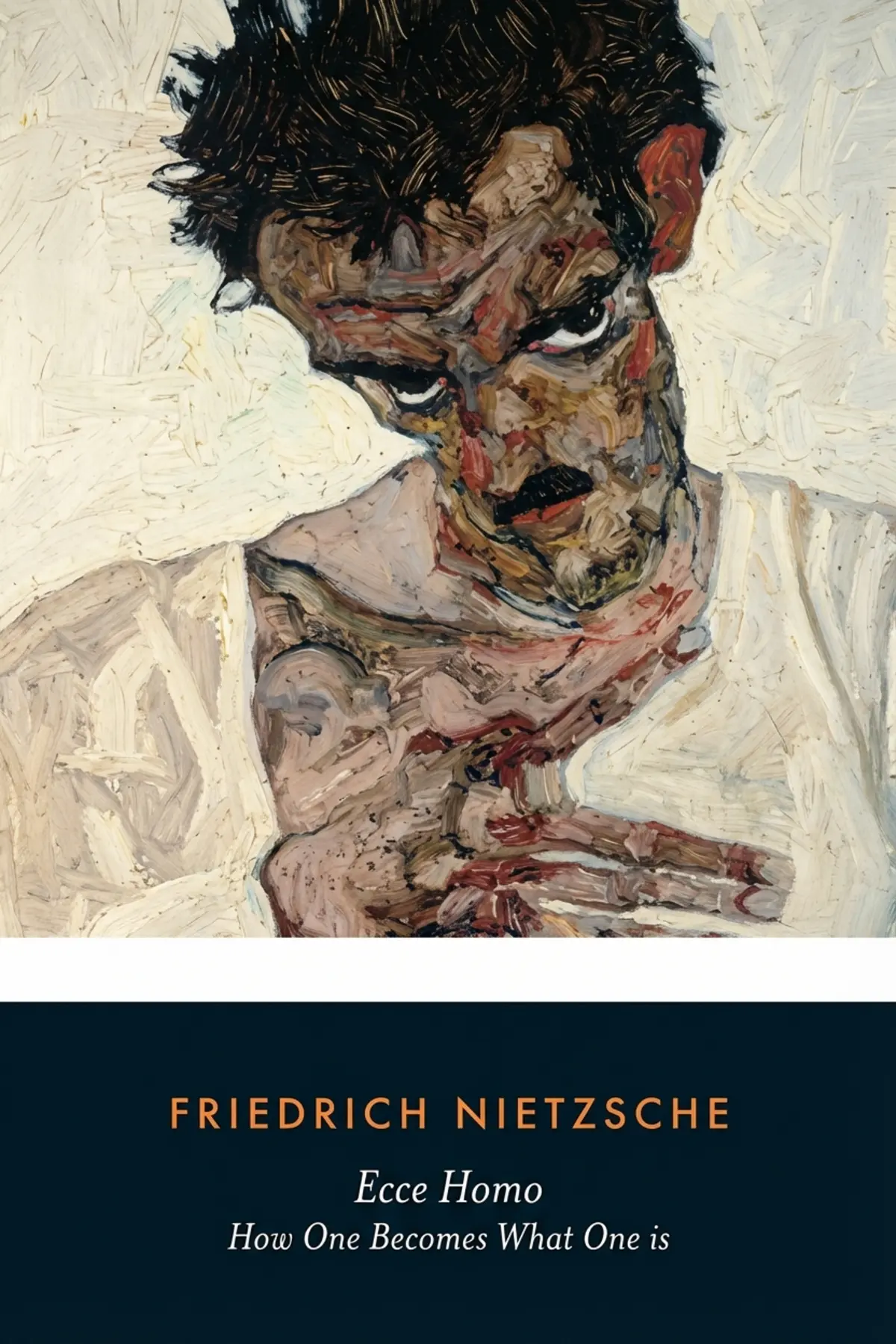
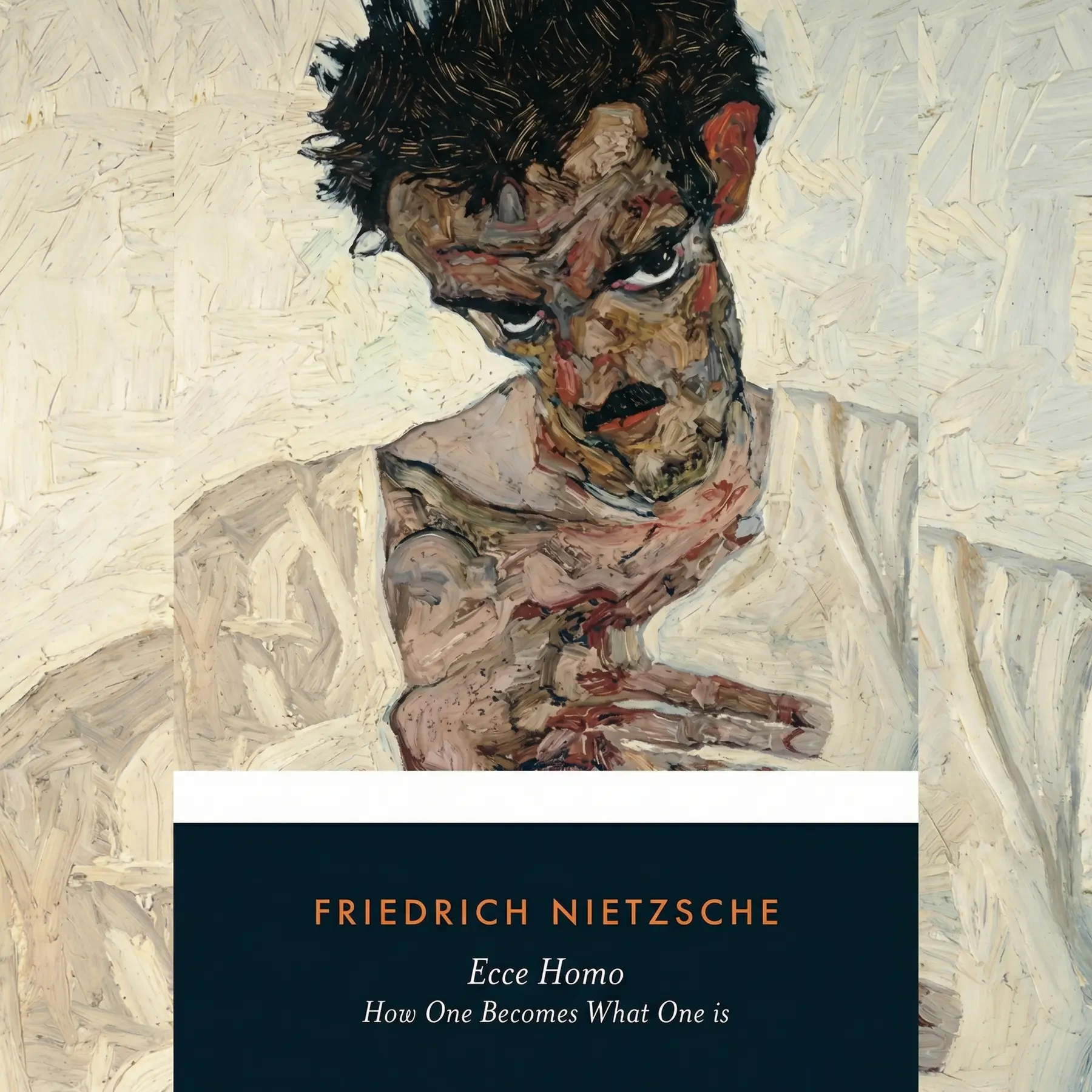
Ecce Homo is the autobiography Friedrich Nietzsche wrote in the months before his breakdown in 1889. It does not tell a life story in order. Its subtitle, How One Becomes What One Is, names its real subject: what it takes to become yourself when climate, habit, morality and the crowd keep pulling you elsewhere. Nietzsche's angle is physical and personal. He argues that where you live and what you eat decide whether a gifted mind can work at all. He treats his months of illness as a source of clarity, and he claims that seeing life from both weakness and strength exposes the psychology behind moral systems, many of which he believes were built by declining life to shame healthy instincts. Readers get his case for guarding the mind from constant reading and reaction, for daring to question what is forbidden, and for using solitude and strict self-discipline as tools for self-discovery. The result is a set of tests anyone can apply to their own days and values.
Knowledge workers who spend their days reacting to other people's ideas and want room for their own.
People recovering from illness or burnout who want to find meaning in a slow, hard stretch.
Curious readers who want Nietzsche's ideas on morality and solitude in his own personal voice.
Friedrich Nietzsche was born in 1844 in Röcken, in Prussian Saxony, and trained as a classical philologist. At 24 he became a professor at the University of Basel, then resigned in 1879 because of ill health and lived as an independent writer in Switzerland, Italy and southern France, producing much of his central work in the 1880s. His writing spans poetry, cultural criticism and philosophy, and he is linked to perspectivism, a genealogical critique of Christian morality and eternal return. He collapsed in 1889 and died in 1900.
Friedrich Nietzsche
Friedrich Nietzsche
Friedrich Nietzsche
Friedrich Nietzsche
Friedrich Nietzsche
Listeners view this autobiography as a masterful and profoundly intimate self-portrait that illustrates Nietzsche’s distinct philosophical complexity and literary energy. Even though perspectives differ on the author’s arrogant delivery and noted ego, listeners value the unshielded sincerity of his musings and his devotion to living with mental fervor. Additionally, they highlight the text's importance as a deep psychological study, with one listener describing it as "sometimes brilliant, sometimes confounding" in its quirkiness. Furthermore, they find the author’s particular details about his compositional methods and daily routines to be especially intriguing.
Wow, I wasn't prepared for the sheer poetic force of Nietzsche’s self-reflection in his final sane months. There is an intensity here that you just don't find in modern philosophy. He writes with a commitment to living that is almost frightening. His rejection of 'free will' as a tool for psychological torture is a masterstroke of insight. The book functions as a map of his intellectual journey, but it’s also a deeply personal account of his struggle with health and isolation. When he speaks about being a 'destiny' and his fear of one day being considered a 'saint' instead of a 'buffoon,' you can sense his desperation to be understood on his own terms. It’s a stunning, confounding, and ultimately tragic self-portrait that every serious reader should experience at least once. Truly a soaring piece of literature.
Show moreThe chapter on 'Why I Am So Clever' might seem insufferable to the average reader, but to those who have lived in the 'ice and high mountains' of thought, it is pure liberation. Nietzsche is stripping away the masks of humility that society forces us to wear. This is a work of total honesty. He knows he is a 'destiny,' and history has proven him right. His writing style here is more refined and explosive than ever—every sentence feels like a lightning bolt. I love how he connects his physical well-being to his intellectual output; the idea that a bad diet can lead to bad philosophy is a hilarious but profound observation. This is a book for the bold venturers, the ones who aren't afraid of the abyss. It is arguably the most 'alive' book I have ever read.
Show moreThis book is less of a traditional autobiography and more of a fever dream composed by a man who knows his mind is slipping away. Nietzsche’s reflections in Turin are hauntingly beautiful, though his ego is undeniably massive. He asks himself questions like 'Why I am so wise' and 'Why I am so clever' with a total lack of bourgeois modesty that is both refreshing and slightly alarming. The way he discusses his physical ailments, like those agonizing migraines and his strict dietary rules against coffee and alcohol, adds a layer of human fragility to his 'Superman' persona. You can feel the poetic force in every sentence, even when the logic starts to fray at the edges. It is a heartbreaking psychological document of a genius standing on the precipice of a total breakdown. Highly recommended for those who want to see the man behind the hammer.
Show moreAfter hearing so much about Nietzsche’s 'madness,' reading his own account of his health and habits was surprisingly grounding. He details his migraines and vomiting with such clinical detachment that it makes his philosophical 'overcoming' seem much more impressive. The book is bizarrely structured, yet the 'Why I Am So Wise' section contains some of his most piercing observations on morality and the self. He treats his life as a work of art, which explains the high-intensity tone. My only gripe is that his dismissiveness of other thinkers can feel a bit petulant at times. However, his commitment to intellectual passion is infectious. It’s an outrageous, braggadocious, and sometimes brilliant look into the mind of a man who changed the course of modern thought before falling into silence.
Show moreGotta say, the way he discusses his literary output as a series of monumental victories is both hilarious and deeply moving. He is so terrified of being misunderstood or turned into a 'holy' figure that he goes out of his way to be as provocative as possible. He would rather be a saltimbank—a clown—than a saint. This work provides a crucial context for all his other books. You see the man who suffered through blindness and isolation yet still managed to write with a poetic force that rivals Heine. It’s not a perfect book; some of the tangents about German culture feel a bit dated and repetitive. But the central project—the judgment of one's own life without hypocrisy—is handled with incredible courage. It’s a haunting final testament.
Show moreAs someone who appreciates a good intellectual middle finger to the establishment, this book hit all the right notes. Nietzsche’s contempt for 'pudoare burgheză' or middle-class modesty is on full display here. He doesn't just think he's right; he thinks he's the most important event in the history of mankind. While that might sound like a lot to handle, his prose is so vibrant that you almost find yourself agreeing with him. The insights into his writing process are particularly fascinating for anyone who has struggled to produce creative work. He describes a state of exaltation that is both enviable and terrifying. It’s a short, punchy book that serves as a perfect, if eccentric, introduction to the man’s internal world. Not a dull page in the whole thing.
Show moreLook, you have to approach this work with the understanding that Nietzsche was writing on the very edge of an abyss. If you expect a standard life story, you'll be disappointed. This is a soul baring itself. The way he frames his existence around 'Why I Am So Wise' and 'Why I Am So Clever' is a deliberate subversion of the way people usually write about themselves. Personally, I found his obsession with his own health—the vomiting, the weather in Turin, the specific types of tea—to be the most humanizing part of the text. It grounds his high-flying philosophy in a very tangible, physical reality. It’s a brilliant and intensely personal self-portrait that showcases his unique philosophical depth. Even the confounding parts feel necessary to the overall picture of a mind in overdrive.
Show moreEver wonder what a literal 'ego trip' looks like when translated into nineteenth-century German prose? This is it. While Nietzsche is undeniably brilliant, the sheer braggadocio in Ecce Homo can be exhausting to wade through. He spends a significant portion of the text praising his own books—especially Zarathustra—as if they were divine revelations rather than philosophical texts. To be fair, his insights into nutrition and the 'climatology' of the spirit are fascinating, if a bit eccentric. He warns against the dulling effects of coffee and advocates for water, which is a funny takeaway from a supposed nihilist. I found the 'Why I Am a Destiny' chapter to be particularly grandiose, bordering on the delusional. It's an important historical artifact for understanding his final sane moments, but the arrogance makes it a difficult 'casual' read.
Show morePicked this up expecting a clear guide to his philosophy, but what I got was a bizarre, brilliant, and often confounding psychological document. It is hard to tell where the genius ends and the pathology begins. He writes about his book Zarathustra with such emotional intensity that he claims he can't even look at it without sobbing for half an hour. That level of hyper-sensitivity is all over these pages. The advice on tea and coffee is actually quite funny, but the way he attacks the concept of 'sin' is deadly serious. It is a strange autobiography because it tells you very little about what he did, and everything about how he felt and what he ate. It's a short read, but I had to take frequent breaks because the ego on display is just so dense.
Show moreTo be fair, I struggle with philosophers who spend more time praising their own genius than actually explaining their ideas to the reader. This entire work feels like one long, unedited boast. The chapter titles alone—'Why I Write Such Good Books'—are enough to make anyone roll their eyes. Nietzsche’s raw frankness is often cited as a strength, but here it just feels like megalomania. I was looking for a deep dive into his philosophical evolution, but instead, I got a list of his favorite foods and a bunch of insults directed at the German people. There are occasional sparks of brilliance, but they are buried under a mountain of self-aggrandizement. Frankly, it’s a bit of a mess. It’s probably a great 'psychological document' for scholars, but as a book, it’s incredibly frustrating and often incoherent.
Show moreEcce Homo is Nietzsche’s account of how a person becomes who they really are. He argues that this depends on physical conditions such as climate and diet, on turning illness into insight, on questioning a morality he believed was shaped by declining life, and on the courage to think alone. Solitude and strict self-discipline, in his view, are the tools that make this self-discovery possible.
During months in bed, unable to read, and through headaches lasting three days, Nietzsche reports a cold, precise clarity of thought he lacked when well. He links his weakest period to breakthroughs such as The Dawn of Day. He also sees illness as a test: a healthy nature chooses remedies that help it recover, while a decadent one chooses what harms it further.
He claims they decide whether a gifted mind can work at all. He felt he lived in the wrong climates until thirty-four and linked dry air to the great thinking cities, such as Paris, Florence, Athens and Jerusalem. He blamed heavy German cooking and drinking for dulling the intellect, praised the cooking of Piedmont and gave up alcohol for his sensitive system.
Track which foods, places and hours leave you clear or foggy, and move your life toward the clear ones. Keep your first hour for your own thinking instead of reading. Ask whether a value you hold was formed in weakness or in strength, and whether it gives you more life energy or less. Set aside regular time alone to notice what you actually think.

Barack Obama


Masaji Ishikawa


Ben Macintyre

William B. Irvine



James Shapiro
Nigel Warburton
AUDIO SUMMARY AVAILABLE
Get the key ideas from Ecce Homo by Friedrich Nietzsche, plus 5,000+ more nonfiction titles.